---
title: Ten Ancient Egypt Facts You Need to Know: Fun Trivia About Ancient Egypt
author: Joshua J. Mark
source: https://www.worldhistory.org/article/1508/ten-ancient-egypt-facts-you-need-to-know/
format: machine-readable-alternate
license: Creative Commons Attribution-NonCommercial-ShareAlike (https://creativecommons.org/licenses/by-nc-sa/4.0/)
updated: 2026-01-19
---
# Ten Ancient Egypt Facts You Need to Know: Fun Trivia About Ancient Egypt
_Authored by [Joshua J. Mark](https://www.worldhistory.org/user/JPryst/)_
Ancient [Egypt](https://www.worldhistory.org/egypt/) is defined as the [civilization](https://www.worldhistory.org/civilization/) that flourished in North [Africa](https://www.worldhistory.org/disambiguation/africa/) between circa 6000 and 30 BCE – from the [Predynastic Period in Egypt](https://www.worldhistory.org/Predynastic_Period_in_Egypt/) (circa 6000 to circa 3150 BCE) through the [Ptolemaic Dynasty](https://www.worldhistory.org/Ptolemaic_Dynasty/) (323-30 BCE) before Egypt became a province of [Rome](https://www.worldhistory.org/Rome/). [Roman Egypt](https://www.worldhistory.org/Roman_Egypt/) (30 BCE to 646 CE) afterwards fell to the invasions of the Muslim Arabs.
For thousands of years, the civilization of Egypt was among the most significant in the ancient world, and its kings were considered the living representatives of the divine on earth. The central value of [Egyptian culture](https://www.worldhistory.org/Egyptian_Culture/) was balance – personified by the goddess [Ma'at](https://www.worldhistory.org/Ma'at/) – and this encouraged a stable social platform from which people could explore the world and advance their understanding of how to live in it and, further, what waited in the afterlife beyond [death](https://www.worldhistory.org/disambiguation/Death/).
[  The Great Sphinx and Pyramids of Giza Betsy Mark (CC BY-NC-SA) ](https://www.worldhistory.org/image/10010/the-great-sphinx-and-pyramids-of-giza/ "The Great Sphinx and Pyramids of Giza")The [ancient Egyptians](https://www.worldhistory.org/collection/162/the-ancient-egyptians/) developed a highly sophisticated [culture](https://www.worldhistory.org/disambiguation/culture/), which made significant advances in medical practices and procedures, architectural and construction innovations, the development of literary motifs in poetry and prose, religious belief and tradition, and a vision of the afterlife, which was grander and more comforting than any other of its time.
The following are ten facts about Egypt in answer to the most commonly asked questions:
### What Is the Difference Between Kingdom Periods & Intermediate Periods?
The ancient Egyptians had no demarcations between eras of their civilization. Events were dated from the rule of kings or memorable events, whether natural – such as floods, bad harvests, especially good harvests, or 'signs' attributed to the gods – or historical, such as great military victories or building projects. Designations such as 'kingdoms' and 'intermediate periods' come from scholars in the modern day in an effort to make it easier to study the immense breadth of [Egyptian](https://www.worldhistory.org/disambiguation/Egyptian/) civilization.
The history of ancient Egypt is therefore broken into different eras. The dates differ sometimes owing to the system scholars choose to use, but the generally accepted dates are:
- Predynastic Period: circa 6000 to circa 3150 BCE
- [Early Dynastic](https://www.worldhistory.org/disambiguation/Early_Dynastic/) Period: circa 3150 to circa 2613 BCE
- [Old Kingdom](https://www.worldhistory.org/disambiguation/Old_Kingdom/): circa 2613-2181 BCE
- [First Intermediate Period](https://www.worldhistory.org/disambiguation/First_Intermediate_Period/): 2181-2040 BCE
- [Middle Kingdom](https://www.worldhistory.org/disambiguation/Middle_Kingdom/): 2040-1782 BCE
- [Second Intermediate Period](https://www.worldhistory.org/disambiguation/Second_Intermediate_Period/): circa 1782 to circa 1570 BCE
- [New Kingdom](https://www.worldhistory.org/disambiguation/New_Kingdom/): circa 1570 to circa 1069 BCE
- [Third Intermediate Period](https://www.worldhistory.org/Third_Intermediate_Period_of_Egypt/): circa 1069-525 BCE
- [Late Period of Ancient Egypt](https://www.worldhistory.org/Late_Period_of_Ancient_Egypt/): 525-323 BCE
- [Ptolemaic Egypt](https://www.worldhistory.org/Ptolemaic_Egypt/): 323-30 BCE
The difference between 'kingdoms' and 'intermediate periods' has to do with the centralization of rule. During the kingdoms, there was a monarch governing from a central location, the [economy](https://www.worldhistory.org/disambiguation/economy/) and society were stable, and there was discernible cultural progress.
During the intermediate periods, the [Egyptian government](https://www.worldhistory.org/Egyptian_Government/) was divided between different locations, there was less stability, and physical evidence shows fewer cultural advances. Even so, the intermediate periods were nowhere near as chaotic as the scholars of the 19th and 20th centuries interpreted them.
### Who Was the [Pharaoh](https://www.worldhistory.org/pharaoh/) of the Book of Exodus?
The most commonly cited Egyptian king for the unnamed pharaoh of Exodus is [Ramesses II](https://www.worldhistory.org/Ramesses_II/) (the Great, reign 1279-1213 BCE), and the second most cited is [Akhenaten](https://www.worldhistory.org/Akhenaten/) (reign 1353-1336 BCE), although various writers through the years have claimed many others. There is actually no historical, textual, or physical evidence that the Hebrews were enslaved in Egypt at any time in any great numbers.
There is ample evidence that the people who built the [pyramids](https://www.worldhistory.org/pyramid/) and other great monuments of Egypt were Egyptians, either skilled workers or unskilled laborers who were expected to devote time to community service – such as public building projects – at the times when the [Nile](https://www.worldhistory.org/nile/) River flooded and farming was impossible.
In spite of the claims of many through the years, the Exodus story is a cultural myth, and there was no actual pharaoh who enslaved the Israelites because they were never enslaved en masse in Egypt. Slaves were taken from various lands after military victories or bought from traders and were primarily used in the mines and by royalty. There may have been Hebrew slaves among these, but not in the numbers given in the biblical narrative.
[  Book of Exodus Walters Art Museum Illuminated Manuscripts (Public Domain) ](https://www.worldhistory.org/image/6065/book-of-exodus/ "Book of Exodus")### What Was the Egyptian Army Like & How Was It Organized?
In the period of the [Old Kingdom of Egypt](https://www.worldhistory.org/Old_Kingdom_of_Egypt/), the army was made up of conscripts from various districts (*nomes*) under the leadership of a regional governor (*nomarch*). The *nomarch* organized his men and sent the company to the king. During the [First Intermediate Period of Egypt](https://www.worldhistory.org/First_Intermediate_Period_of_Egypt/), this system broke down as each individual *nomarch* gained greater power with the fall of the central government and used their militia to pursue their own agenda. In the [Middle Kingdom of Egypt](https://www.worldhistory.org/Middle_Kingdom_of_Egypt/), Amenemhat I (reign circa 1991-1962 BCE) created the first standing army.
The military was improved upon during the [Second Intermediate Period of Egypt](https://www.worldhistory.org/Second_Intermediate_Period_of_Egypt/) through contributions from the [Hyksos](https://www.worldhistory.org/Hyksos/), such as the horse-drawn [chariot](https://www.worldhistory.org/chariot/), the composite bow, the scimitar sword, and [bronze](https://www.worldhistory.org/disambiguation/bronze/) dagger. By the time of the [New Kingdom of Egypt](https://www.worldhistory.org/New_Kingdom_of_Egypt/), the Egyptian army was a highly trained, professional fighting force that helped to create and maintain the [Egyptian Empire](https://www.worldhistory.org/Egyptian_Empire/).
The army was organized into divisions, which were each named for a principal deity and comprised approximately 5,000 men. Each division had an officer who oversaw 50 soldiers and reported to a superior in charge of 250, who, in turn, reported to a captain, who was under a troop commander. The troop commander was responsible to the troop overseer, who reported to the fortification overseer (in command of where the troops were stationed), who was under a lieutenant commander, who reported to a general. The general was directly under the supervision of the [Egyptian vizier](https://www.worldhistory.org/Egyptian_Vizier/), who reported to the pharaoh.
[ 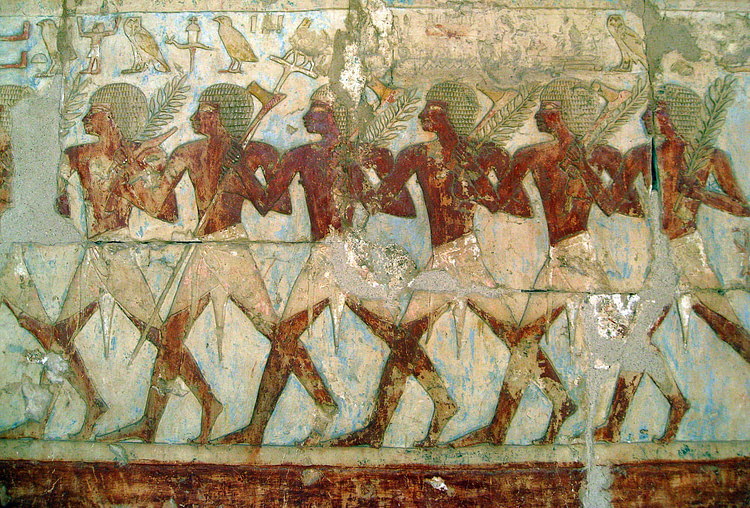 Egyptian Soldiers Σταύρος (CC BY) ](https://www.worldhistory.org/image/5827/egyptian-soldiers/ "Egyptian Soldiers")[Egyptian warfare](https://www.worldhistory.org/Egyptian_Warfare/) was never aimed at [conquest](https://www.worldhistory.org/warfare/) but, rather, defense and stability. Even during the rise of the Egyptian [Empire](https://www.worldhistory.org/empire/), the armies were used to create – and then maintain – a buffer zone around Egypt to prevent invasion, but they never went further than they needed to in order to maintain order. Part of the reason for this was the [Egyptian religion](https://www.worldhistory.org/Egyptian_Religion/) and the belief that, if one died outside of Egypt's borders, one's soul would have a harder time reaching the paradise of the [Field of Reeds](https://www.worldhistory.org/Field_of_Reeds/).
### What Was Egyptian [Religion](https://www.worldhistory.org/religion/) Like & How Did It Influence People?
Egyptian religion infused every aspect of the individual's daily life. The gods were ever-present and were thought to have given humanity the most perfect place in which to live, with all the necessities and luxuries one could ask for. All the gods asked for in return was that people honor them through worship and maintain the celestial order known as *ma'at* – harmony – which bound all things together.
To the ancient Egyptians, life on earth was only one part of a much grander journey toward eternal happiness in an afterlife that was a mirror image of one's life on earth. After death, the soul was guided to the Hall of Truth, where its heart was weighed in the balance against the white feather of truth of the goddess Ma'at by the great [god](https://www.worldhistory.org/God/) [Osiris](https://www.worldhistory.org/osiris/). If one's heart was found lighter than the feather, one moved on toward the Field of Reeds; if heavier, the heart was dropped to the floor, where it was eaten by a monster, and the soul ceased to exist. *The [Egyptian Book of the Dead](https://www.worldhistory.org/Egyptian_Book_of_the_Dead/)* was written as a guide for the soul to help it avoid any pitfalls in the afterlife and find its way to paradise safely.
This belief influenced the daily lives of the Egyptians in that it was understood that one's existence was not confined by the time between one's birth and death, but one was an immortal soul, journeying on earth for a certain time, and essentially an eternal being who would one day live among the gods in a paradise, where all they had lost was returned to them.
### Why Did the Egyptians Mummify Their Dead?
The Egyptians believed the soul was constituted of nine separate parts:
- *Khat* was the physical body
- *Ka* was one's double form
- *Ba* was a human-headed bird aspect, which could speed between earth and the heavens
- *Shuyet* was the shadow self
- *Akh* was the immortal, transformed self
- *Sahu* and *Sechem* were aspects of the Akh
- *Ab* was the heart, the source of good and evil
- *Ren* was one's secret name
The physical body (*khat*) needed to be preserved so the *ka* and *ba* could recognize themselves and the *akh* could continue on to the Field of Reeds. In [Egyptian burial](https://www.worldhistory.org/Egyptian_Burial/) rites, [grave](https://www.worldhistory.org/burial/) goods were included in the [tomb](https://www.worldhistory.org/tomb/) of the deceased so they could be used in the afterlife, and these would only be of value if the body remained intact.
[  Egyptian Mummy in Wrappings John Tuttle (CC BY-NC-SA) ](https://www.worldhistory.org/image/6681/egyptian-mummy-in-wrappings/ "Egyptian Mummy in Wrappings")Contrary to popular belief, the Egyptians were not obsessed with death; they enjoyed life so much they never wanted it to end, and this encouraged the belief in an eternal realm where one would live forever, enjoying all one did in life, in the presence of the gods.
### Is There Any Truth to the Curse of [Tutankhamun](https://www.worldhistory.org/Tutankhamun/)/the Curse of the Pharaohs?
There is no truth to the famous Curse of the Pharaohs, which gained notoriety after the archaeologist Howard Carter opened the tomb of Tutankhamun in November 1922. Of the 58 people present when the tomb and sarcophagus were opened, only eight died within the next twelve years, and all of quite reasonable and rational causes, having nothing to do with the tomb.
The myth of the Curse of Tutankhamun began in 1923 when the bestselling writer Marie Corelli (1855-1924) sent a letter to the magazine *New York World,* quoting from an ancient text she claimed to own, which warned of terrible consequences for anyone who disturbed the tombs of the kings of Egypt. Corelli was a popular novelist at the time, and her letter received a great deal of attention.
[ 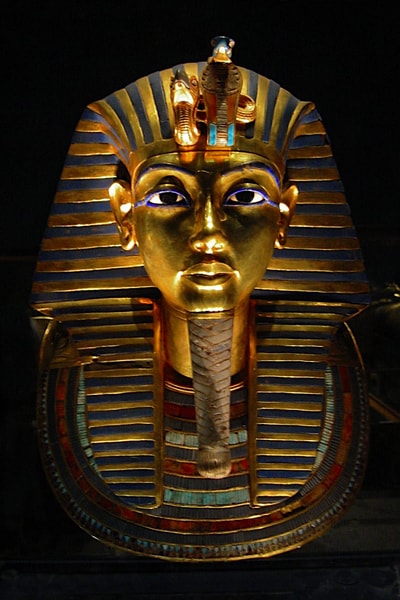 Death Mask of Tutankhamun Richard IJzermans (CC BY-NC-SA) ](https://www.worldhistory.org/image/1048/death-mask-of-tutankhamun/ "Death Mask of Tutankhamun")Howard Carter, at this same time, was increasingly frustrated by the many visitors interfering with his work at Tutankhamun's tomb, and Corelli's letter – which was popularized by the press – had exactly the effect he would have wished for in scaring people away. Carter could proceed with the excavation and examination of the tomb without further distraction and so never contradicted Corelli's claim – even though there was never any evidence she owned any ancient text and no evidence of any curse. Hollywood movies would further popularize the “Mummy's Curse” and embed it in the collective consciousness of the modern day.
### What Food Did the Egyptians Eat?
The Egyptian diet was mainly vegetarian. Meat could not be stored as the Egyptians had no refrigeration, and so it was eaten shortly after slaughter at festivals, banquets, and by the upper class who had the leisure to hunt large game. Poultry and fish were eaten by every social class.
The staples of the Egyptian diet were bread and [beer](https://www.worldhistory.org/Beer/). Although wine was made (from grapes as well as other fruit), it was mainly the drink of the upper class. Beer was the most popular drink – consumed at every meal of the day – as it was considered healthier than drinking from the Nile or streams, which could be polluted, and it was believed to promote a lighter spirit and contented heart. Workers' wages, in fact, included a ration of beer and bread.
[  Ancient Egyptian Brewery and Bakery Keith Schengili-Roberts (CC BY-SA) ](https://www.worldhistory.org/image/573/ancient-egyptian-brewery-and-bakery/ "Ancient Egyptian Brewery and Bakery")Vegetables and fruits made up most of the rest of the Egyptian diet, including onions, lentils, leeks, garlic, olives, pomegranate, grapes, dates, and figs. Wealthy Egyptians enjoyed coconuts, which were among the most popular imported luxury goods. Cows, goats, and sheep were raised for milk, which also provided cream, curds, and whey, while bulls (aside from the sacred [Apis](https://www.worldhistory.org/Apis/) Bull) were raised for manual labor on farms.
The Egyptians also enjoyed a wide array of spices and oils with their meals, including sesame, flaxseed, cinnamon, cumin, and – the most popular – horseradish. Different foods were often prescribed by physicians as remedies, and, in [Egyptian medicine](https://www.worldhistory.org/Egyptian_Medicine/), diet was recognized as a major factor in one's health.
### What Was Daily Life Like in Ancient Egypt?
Egyptian society was based on a hierarchy, which descended down from highest to lowest:
- King (known as *pharaoh* only after the New Kingdom period) and royal family
- Vizier
- Members of the court
- Priests and scribes (including physicians)
- Regional governors
- Military leaders
- Artisans and craftspeople (including skilled workers)
- Workplace supervisors
- Unskilled workers and farmers
- Slaves
Social mobility was not encouraged because it was thought that the social order had been decreed by the gods in keeping with *ma'at,* and so maintaining it was vital in keeping harmony and balance in the land. It was the king's responsibility to ensure *ma'at* was upheld at every level, but, with very rare exceptions, everyone understood their place and behaved accordingly.
The economy was based on [agriculture](https://www.worldhistory.org/disambiguation/Agriculture/), and most of the lower class were farmers. A farmer's day began at sunrise when he (and sometimes his wife and children) went to the fields and ended at dusk when they returned home for the evening meal. [Trade](https://www.worldhistory.org/disambiguation/trade/) was conducted through the barter system until circa 525 BCE, when [coinage](https://www.worldhistory.org/coinage/) was introduced by the Persians. The monetary unit in place before that was the *deben,* which was a set value on a product.
[ 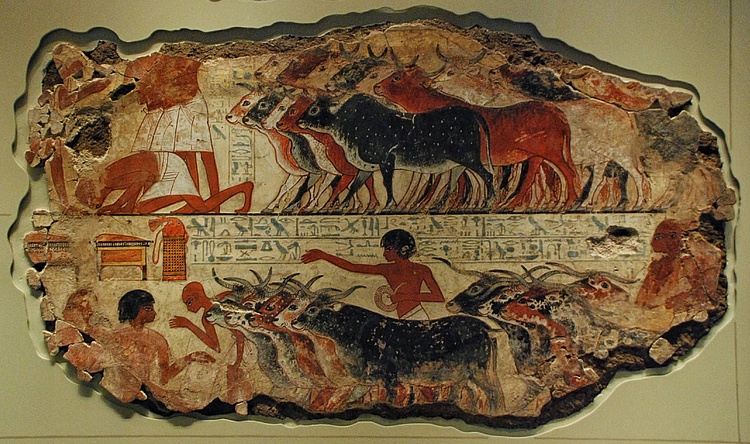 Egyptian Cattle Herd Jan van der Crabben (CC BY-NC-SA) ](https://www.worldhistory.org/image/3027/egyptian-cattle-herd/ "Egyptian Cattle Herd")In their leisure time, the upper class hunted, played sports, fished, played board games, and watched sporting events, and, except for hunting big game, the lower class enjoyed these same pastimes, as well as swimming and boating. The Egyptians enjoyed parties and festivals, and the various gods' birthdays and other events were celebrated by national holidays when work was suspended, and everyone gathered to drink, eat, and dance.
### Were There Any Great Female Rulers Besides [Cleopatra](https://www.worldhistory.org/disambiguation/cleopatra/)?
[Cleopatra VII](https://www.worldhistory.org/Cleopatra_VII/) (69-30 BCE) is arguably the most famous Egyptian queen. She was ethnically [Greek](https://www.worldhistory.org/disambiguation/greek/), the last monarch of the Macedonian Ptolemaic Dynasty, but she was culturally Egyptian. There were many other great Egyptian queens throughout the nation's history, however.
In the [Early Dynastic Period in Egypt](https://www.worldhistory.org/Early_Dynastic_Period_In_Egypt/), there was Neithhotep of the [First Dynasty of Egypt](https://www.worldhistory.org/First_Dynasty_of_Egypt/) (circa 3150 to circa 2890 BCE) and Merneith (circa 2990 BCE). In the Old Kingdom, Queen Hetepheres I (wife of King Sneferu, reign circa 2613-2589 BCE) was the mother of King Khufu (reign 2589-2566 BCE) and exercised considerable influence over him. One of the most controversial queens of this same period was [Nitocris](https://www.worldhistory.org/Nitocris/) (circa 2184-2181 BCE), who is said to have avenged her brother's murder by inviting his killers to a banquet in an underground chamber and then drowning them. It should be noted, however, that scholars continue to debate the truth of this story and whether this queen even existed.
In the Middle Kingdom, Queen Sobeknefru reigned (circa 1807-1802 BCE), and this period also saw the development of the honorary title of [God's Wife of Amun](https://www.worldhistory.org/God's_Wife_of_Amun/), which would elevate the [women](https://www.worldhistory.org/disambiguation/women/) who later held it to influential positions. Queen Ahhotep I (circa 1570-1530 BCE) is the first known powerful woman to have held the title at the beginning of the New Kingdom, and she passed it to her daughter-in-[law](https://www.worldhistory.org/disambiguation/law/) Ahmose-Nefertari (circa 1570-1544 BCE), who would pass it on to others.
Some of the greatest and best-known queens come from the New Kingdom period, such as [Hatshepsut](https://www.worldhistory.org/hatshepsut/) (reign 1479-1458 BCE), [Tiye](https://www.worldhistory.org/tiye/) (wife of [Amenhotep III](https://www.worldhistory.org/Amenhotep_III/), reign circa 1386-1353 BCE), [Nefertiti](https://www.worldhistory.org/Nefertiti/) (circa 1370-1336 BCE), wife of Akhenaten, who took over his responsibilities when he neglected them for religious pursuits. There was also Nefertari (circa 1255 BCE), wife of and inspiration to [Ramesses](https://www.worldhistory.org/disambiguation/ramesses/) the Great, who is famously depicted at [Abu Simbel](https://www.worldhistory.org/Abu_Simbel/).
In the Third Intermediate Period, some of the most powerful women held the title of God's Wife of [Amun](https://www.worldhistory.org/amun/), such as Amenirdis I (circa 714-700 BCE), who ruled Upper Egypt. A later God's Wife of Amun, Nitokris I (also known as Neitiqert, circa 655-585 BCE), ruled almost all of Egypt and was the wealthiest of all the God's Wives in the history of the title. By the time Cleopatra VII took the throne, Egypt already had a long history of powerful women in positions of authority.
### What Are Some Cultural Legacies of Ancient Egypt?
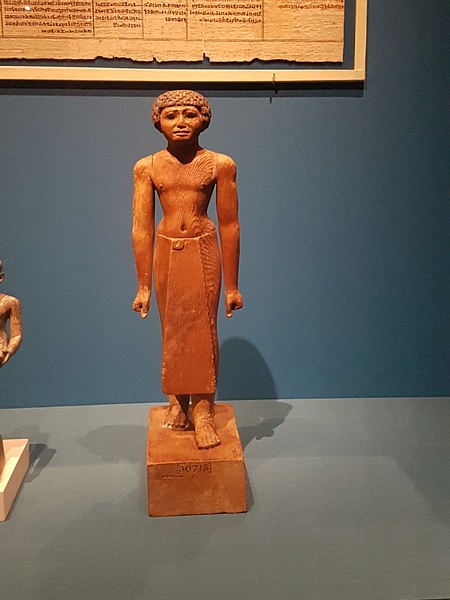
Ancient Egypt contributed a number of inventions and innovations regularly used in the present day. The Egyptians placed a high value on personal hygiene, and so daily bathing, combs and brushes, make-up (used by both women and men), and perfumes were all either invented or improved upon by them.
They also invented the toothbrush and toothpaste, the breath mint, and deodorant in the form of incense. Dentistry was also developed by the Egyptians, as was the physician's practice of taking a patient's history in diagnosing illness. Women, as well as men, were doctors, and some of the first clinics and medical schools in the world were established in Egypt.
[  Egyptian Doctor Liana Miate (CC BY-NC-SA) ](https://www.worldhistory.org/image/6617/egyptian-doctor/ "Egyptian Doctor")[Egyptian architecture](https://www.worldhistory.org/Egyptian_Architecture/) developed the true [pyramid](https://www.worldhistory.org/pyramid/) and the obelisk, as well as the techniques by which these were made and raised. Although engineers in the present day still do not understand how the Egyptians built, moved, and erected most of their great monuments, the structures inspired later cultures to emulate the forms.
In agriculture, the Egyptians learned irrigation methods from the Hyksos and improved upon the light and heavy gauge ox-drawn plow. They also developed Babylonian concepts of astronomy and astrology, the calendar, and mathematics.
[Egyptian literature](https://www.worldhistory.org/Egyptian_Literature/), especially of the Middle Kingdom, established the form of the romantic ballad and literary/philosophical dialogue (later made famous by [Plato](https://www.worldhistory.org/plato/)'s works). The religion and [philosophy](https://www.worldhistory.org/philosophy/) of the Egyptians have long been recognized as influencing [Greek philosophy](https://www.worldhistory.org/Greek_Philosophy/) as well as later religions such as [Christianity](https://www.worldhistory.org/christianity/) and [Islam](https://www.worldhistory.org/islam/), especially through the concepts of eternal life, judgment after death, and rewards/punishments in the afterlife.
#### Editorial Review
This human-authored article has been reviewed by our editorial team before publication to ensure accuracy, reliability and adherence to academic standards in accordance with our [editorial policy](https://www.worldhistory.org/static/editorial-policy/).
## Bibliography
- [Bunson, M. *The Encyclopedia of Ancient Egypt.* Gramercy Books, 2009.](https://www.worldhistory.org/books/B01K3KKFEW/)
- [David, R. *Handbook to Life in Ancient Egypt Revised.* Oxford University Press, 2007.](https://www.worldhistory.org/books/0195366719/)
- [David, R. *Religion and Magic in Ancient Egypt.* Penguin Books, 2003.](https://www.worldhistory.org/books/0140262520/)
- [Pinch, G. *Egyptian Mythology.* Oxford University Press, 2004.](https://www.worldhistory.org/books/0195170245/)
- [Robins, G. *Women in Ancient Egypt.* Harvard University Press, 1993.](https://www.worldhistory.org/books/0674954696/)
- [Shaw, I. *The Oxford History of Ancient Egypt.* Oxford University Press, U.S.A., 2004.](https://www.worldhistory.org/books/0192804588/)
- [Silverman, D. P. *Ancient Egypt.* Oxford University Press, USA, 2010.](https://www.worldhistory.org/books/B00BUWAE2Q/)
- [Van De Mieroop, M. *A History of Ancient Egypt.* Wiley-Blackwell, 2012.](https://www.worldhistory.org/books/B00BSZV7Q2/)
- [Wilkinson, R. H. *The Complete Gods and Goddesses of Ancient Egypt.* Thames & Hudson, 2017.](https://www.worldhistory.org/books/0500284245/)
- [Wilkinson, T. *The Rise and Fall of Ancient Egypt.* Random House, 2013.](https://www.worldhistory.org/books/0553384902/)
## About the Author
Joshua J. Mark is World History Encyclopedia's co-founder and Content Director. He was previously a professor at Marist College (NY) where he taught history, philosophy, literature, and writing. He has traveled extensively and lived in Greece and Germany.
- [Linkedin Profile](https://www.linkedin.com/pub/joshua-j-mark/38/614/339)
## Questions & Answers
### What is the difference between a kingdom and an intermediate period in ancient Egypt?
A kingdom period in ancient Egypt is defined by a monarch ruling from a central location; an intermediate period is marked by a decentralized government.
### Did Hebrew slaves build the great monuments of ancient Egypt?
There is no evidence that Hebrew slaves built the great monuments of Egypt, nor any that there was a large number of Hebrew slaves in Egypt at any time. The great monuments of Egypt were built by skilled and unskilled Egyptian laborers.
### Is there any truth to the Curse of Tutankhamun?
No. The Curse of Tutankhamun was suggested by a writer, Marie Corelli, and was popularized by the press. Howard Carter welcomed the "curse mania" because it frightened people away from Tut's tomb, and so Carter could work in peace, and he never said or did anything to correct this myth.
### Was Cleopatra actually Greek?
Cleopatra VII was ethnically Greek, but, because she was born in Egypt, knew the language, engaged in the religious rituals, and fully embraced the customs, she was culturally Egyptian.
## External Links
- [The British Museum/Ancient Egypt for Kids 7-11 Student Guides & Teacher Resources](https://www.britishmuseum.org/learn/schools/ages-7-11/ancient-egypt)
- [Ancient Egyptian Timeline - The Australian Museum](https://australian.museum/learn/cultures/international-collection/ancient-egyptian/ancient-egyptian-timeline/)
- [Egyptian Art - The Metropolitan Museum of Art](https://www.metmuseum.org/departments/egyptian-art)
- [The Penn Museum: Ancient Egypt & Nubia](https://www.penn.museum/on-view/galleries-exhibitions/egypt-galleries)
## Cite This Work
### APA
Mark, J. J. (2026, January 19). Ten Ancient Egypt Facts You Need to Know: Fun Trivia About Ancient Egypt. *World History Encyclopedia*.
### Chicago
Mark, Joshua J.. "Ten Ancient Egypt Facts You Need to Know: Fun Trivia About Ancient Egypt." *World History Encyclopedia*, January 19, 2026. .
### MLA
Mark, Joshua J.. "Ten Ancient Egypt Facts You Need to Know: Fun Trivia About Ancient Egypt." *World History Encyclopedia*, 19 Jan 2026, .
## License & Copyright
Submitted by [Joshua J. Mark](https://www.worldhistory.org/user/JPryst/ "User Page: Joshua J. Mark"), published on 19 January 2026. The copyright holder has published this content under the following license: [Creative Commons Attribution-NonCommercial-ShareAlike](https://creativecommons.org/licenses/by-nc-sa/4.0/deed.en). This license lets others remix, tweak, and build upon this content non-commercially, as long as they credit the author and license their new creations under the identical terms. When republishing on the web a hyperlink back to the original content source URL must be included. Please note that content linked from this page may have different licensing terms.