---
title: Ten Ancient Rome Facts You Need to Know
author: Joshua J. Mark
source: https://www.worldhistory.org/article/1507/ten-ancient-rome-facts-you-need-to-know/
format: machine-readable-alternate
license: Creative Commons Attribution-NonCommercial-ShareAlike (https://creativecommons.org/licenses/by-nc-sa/4.0/)
updated: 2024-06-11
---
# Ten Ancient Rome Facts You Need to Know
_Authored by [Joshua J. Mark](https://www.worldhistory.org/user/JPryst/)_
Ancient [Roman](https://www.worldhistory.org/disambiguation/Roman/) [culture](https://www.worldhistory.org/disambiguation/culture/) affected vast numbers of people across the known world of its time, beginning with the rise of the [Roman Republic](https://www.worldhistory.org/Roman_Republic/) (509-27 BCE) and throughout the duration of the [Roman Empire](https://www.worldhistory.org/Roman_Empire/) (27 BCE - c. 476 CE in the West and 1453 CE in the East). The Roman [Empire](https://www.worldhistory.org/empire/) at its height (c. 122 CE) extended from [Italy](https://www.worldhistory.org/italy/) to [Britain](https://www.worldhistory.org/disambiguation/Britain/) down to [Greece](https://www.worldhistory.org/greece/) and North [Africa](https://www.worldhistory.org/disambiguation/africa/) to [Egypt](https://www.worldhistory.org/egypt/), the [Levant](https://www.worldhistory.org/levant/), [Asia Minor](https://www.worldhistory.org/Asia_Minor/), and [Mesopotamia](https://www.worldhistory.org/Mesopotamia/) into Central Asia. Roman [civilization](https://www.worldhistory.org/civilization/), language, and customs influenced the lives of the people in all these regions and continues to resonate in the present day through its various legacies.
[ 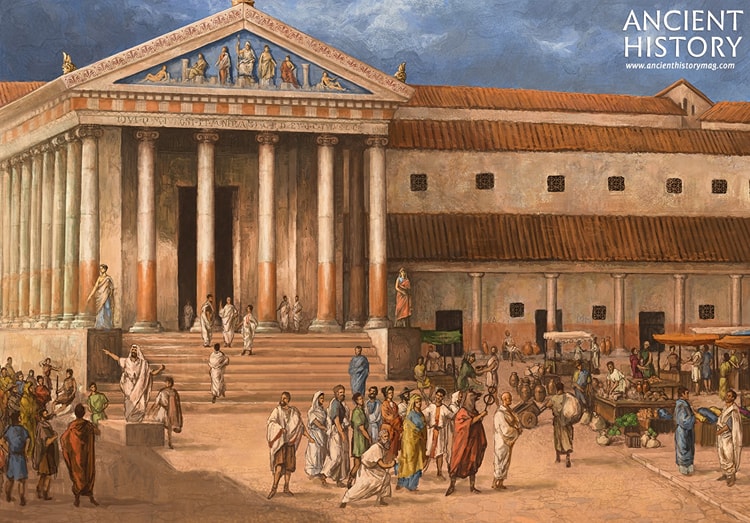 Ancient Roman Marketplace Mateusz Przeklasa / Ancient History Magazine (CC BY-NC-SA) ](https://www.worldhistory.org/image/12040/ancient-roman-marketplace/ "Ancient Roman Marketplace")The impact of Roman culture is still felt in language, the arts, [architecture](https://www.worldhistory.org/disambiguation/architecture/), entertainment, and many other areas of modern life. Knowing who the Romans were and what they did, therefore, provides a better understanding of the present day, who we are, and what we are doing. The following are ten facts about ancient [Rome](https://www.worldhistory.org/Rome/) in answer to questions most frequently asked.
### How & When Was Rome Founded?
According to legend, two demigods – [Romulus and Remus](https://www.worldhistory.org/Romulus_and_Remus/) – were suckled and cared for by a [giant](https://www.worldhistory.org/Giants/) she-wolf at the site until they were grown. [Romulus](https://www.worldhistory.org/Romulus_and_Remus/) killed Remus and is said to have then founded Rome in 753 BCE. Rome is thought to have grown from a small [city-state](https://www.worldhistory.org/Polis/) on the Tiber River known as Latium. According to another legend, it was founded as Rome by a woman named [Roma](https://www.worldhistory.org/disambiguation/Roma/), one of the survivors of the [Trojan War](https://www.worldhistory.org/Trojan_War/), who arrived there with the party led by the Trojan prince [Aeneas](https://www.worldhistory.org/Aeneas/). Another foundation story claims it was once an [Etruscan](https://www.worldhistory.org/Etruscan_Civilization/) port-[city](https://www.worldhistory.org/city/) called Rumon. The [Etruscan civilization](https://www.worldhistory.org/Etruscan_Civilization/) was the most powerful in the region prior to the rise of Rome and so the claim that Rome developed from the Etruscan Rumon is most likely true.
[  Romulus & Remus Mark Cartwright (CC BY-NC-SA) ](https://www.worldhistory.org/image/1456/romulus--remus/ "Romulus & Remus")### What Was the Roman Republic?
Between c. 753-509 BCE, Rome was ruled by Etruscan kings who had absolute power but consulted with a senate of upper-class citizens, though he always had the last word. The wealthy upper class was tired of this arrangement but could not find any legal way to remove the king. This situation changed in 509 BCE when the son of King Tarquin the Proud raped a governor's daughter, would not accept responsibility for the crime, and was deposed and exiled. The Roman Republic was then founded on the concept of representational government. The senate was kept but the position of the king was eliminated and replaced by a magistrate ([praetor](https://www.worldhistory.org/praetor/)) who answered to the people.
The praetor was eventually replaced by two consuls who acted on the laws written by the [Roman Senate](https://www.worldhistory.org/Roman_Senate/) which were interpreted by eight judges; the Republic was therefore based on separate branches of government – executive, legislative, and judicial – which provided greater stability and fair governance than the old monarchy had. Laws were enacted in the interests of all the people, not just the elite. The most famous [law](https://www.worldhistory.org/disambiguation/law/) code was the [Twelve Tables](https://www.worldhistory.org/Twelve_Tables/), written in 449 BCE, which guaranteed equality of everyone before the law regardless of social class. [Roman law](https://www.worldhistory.org/Roman_Law/) and administration created a stable society, which became strong enough to expand through [conquest](https://www.worldhistory.org/warfare/). After the [Punic Wars](https://www.worldhistory.org/Punic_Wars/) with [Carthage](https://www.worldhistory.org/carthage/) (264-146 BCE), Rome became the superpower of the [Mediterranean](https://www.worldhistory.org/disambiguation/mediterranean/) and expanded further. It became an empire under [Augustus](https://www.worldhistory.org/augustus/) [Caesar](https://www.worldhistory.org/disambiguation/caesar/) (r. 27 BCE - 14 CE), the first [Roman emperor](https://www.worldhistory.org/Roman_Emperor/).
### What Was the Roman Empire?
Augustus founded the Roman Empire after defeating [Mark Antony](https://www.worldhistory.org/Mark_Antony/) (l. 83-30 BCE) and [Cleopatra](https://www.worldhistory.org/disambiguation/cleopatra/) (l. c. 69-30 BCE) at the [Battle of Actium](https://www.worldhistory.org/Battle_of_Actium/) in 31 BCE. [Antony](https://www.worldhistory.org/Mark_Antony/) and Cleopatra, among the other threats they posed to Augustus, were the last link to [Julius Caesar](https://www.worldhistory.org/Julius_Caesar/) and the old concept of the Republic. Augustus expanded the territories already held by Rome and initiated campaigns to [conquer](https://www.worldhistory.org/warfare/) others. The Senate was retained but the emperor now had the last word in decision-making. Augustus' reign was so effective that it established the *[Pax Romana](https://www.worldhistory.org/Pax_Romana/)* (“Roman Peace”), lasting over 200 years, from his time to the [death](https://www.worldhistory.org/disambiguation/Death/) of the last of the Five Good Emperors, [Marcus Aurelius](https://www.worldhistory.org/Marcus_Aurelius/) (r. 161-180 CE) in 180 CE. The emperors who succeeded Aurelius were often far less successful but maintained and expanded the empire until it became too large to be governed from one central location. It was divided in two by [Diocletian](https://www.worldhistory.org/Diocletian/) in 284 CE, becoming the [Western Roman Empire](https://www.worldhistory.org/Western_Roman_Empire/) and the Eastern [Byzantine Empire](https://www.worldhistory.org/Byzantine_Empire/). The Western Empire fell c. 476 CE owing to a number of factors (including government corruption, invasions, overreliance on slave labor) while the [Eastern Roman Empire](https://www.worldhistory.org/Byzantine_Empire/) continued until it fell to the Ottoman Turks in 1453 CE.
[  Augustus of Prima Porta Andreas Wahra (original), new version by Till Niermann (CC BY-SA) ](https://www.worldhistory.org/image/97/augustus-of-prima-porta/ "Augustus of Prima Porta")### How Did Rome Maintain Its Empire?
Rome established a policy of conquest and inclusion: instead of conquering a people, destroying their [cities](https://www.worldhistory.org/city/), and enslaving them, they made the region a province of Rome and granted the people citizenship on the condition that they obeyed Roman law, paid taxes, and provided soldiers for the [Roman army](https://www.worldhistory.org/Roman_Army/). Romans engineering provided these provinces with roads, [aqueducts](https://www.worldhistory.org/aqueduct/) to supply water, and building techniques utilizing their unique cement mixture (still not replicated in the present day) which was stronger than the building materials used previously and resulted in more sturdy structures and bridges. Their road network allowed for the quick deployment and movement of troops in a region as well as efficient communication between provincial governors and the capital and also enabled more efficient [trade](https://www.worldhistory.org/disambiguation/trade/) between regions. Further, the Romans encouraged intermarriage between Roman and provincial elites, which meant closer ties between the provinces and Rome and, through the introduction of Latin to the various peoples, consolidated their power through unity of language and culture.
### What Was the [Roman Religion](https://www.worldhistory.org/Roman_Religion/) & How Did It Influence People?
The Roman [religion](https://www.worldhistory.org/religion/) was polytheistic and developed from early animism (the belief that everything, including inanimate objects, has a spirit), [Etruscan religion](https://www.worldhistory.org/Etruscan_Religion/), and, most significantly, the religion of the Greeks. Roman gods would eventually come to be largely modeled on their counterparts in [Greek religion](https://www.worldhistory.org/Greek_Religion/) ([Jupiter](https://www.worldhistory.org/jupiter/) = [Zeus](https://www.worldhistory.org/zeus/), [Juno](https://www.worldhistory.org/Juno/) = [Hera](https://www.worldhistory.org/Hera/), etc). The early religion focused on ancestor worship and this aspect of the belief would continue throughout Rome's history. The religion was state-sponsored as it was thought that, by honoring the gods, the gods would honor the state. The king of the gods was Jupiter who ruled with his wife Juno. Other important gods included [Minerva](https://www.worldhistory.org/Minerva/), [Mars](https://www.worldhistory.org/Mars/), [Vesta](https://www.worldhistory.org/Vesta/), and [Saturn](https://www.worldhistory.org/Saturn/), and, among these, Saturn and Vesta were central as Saturn (as [god](https://www.worldhistory.org/God/) of [agriculture](https://www.worldhistory.org/disambiguation/Agriculture/), good harvests, and plenty - among other attributes) looked after the good of the state in general while Vesta (goddess of hearth, family, and home) focused on the domestic aspects of life. The most important temples were located on the Capitoline Hill where festivals – such as the popular [Saturnalia](https://www.worldhistory.org/Saturnalia/) honoring the god – and other important events were held or, at least, initiated. The [Vestal Virgins](https://www.worldhistory.org/Vestal_Virgin/) were among the most important religious figures of Rome as they tended the goddess' [temple](https://www.worldhistory.org/temple/), keeping her sacred fire alight and, thereby, ensured the health and prosperity of Roman homes and, by extension, the state.
[  Temple of Juno, Agrigento Mark Cartwright (CC BY-NC-SA) ](https://www.worldhistory.org/image/2625/temple-of-juno-agrigento/ "Temple of Juno, Agrigento")There was no priestly class, priests were appointed by the state, and each city had its own temple and priests who honored the patron god or goddess of that community. The religion was fully integrated into the lives of the people whether through the gods recognized and worshipped by the state – to whom sacrifices were regularly made – or household spirits and the spirits of one's ancestors who protected the home. Formal recognition of the gods took place at ceremonies and festivals but, on a daily basis, Romans paid respect to their individual household gods and spirits who watched over them.
### What Was Daily Life Like in Rome?
The basis of Roman society was the family, which was maintained and controlled by the father, the head of the household, known as the *paterfamilias*. The father had complete control over the lives of the people under his roof and could even reject a newborn – ordering it to be abandoned in the streets – if he felt he could not afford another child or simply did not like the look of it. The concept of the *paterfamilias* was adopted by the emperor who – in many, though not all, cases – represented himself as the great father of the collective Roman people who had only their best interests at heart. The emperor provided the people with amphitheaters for entertainment, religious and cultural festivals (such as Saturnalia and Lupercalia, among many others), and public parks and [Roman baths](https://www.worldhistory.org/Roman_Baths/).
[  The Central Baths at Herculaneum Carole Raddato (CC BY-NC-SA) ](https://www.worldhistory.org/image/11796/the-central-baths-at-herculaneum/ "The Central Baths at Herculaneum")Romans worked at their various jobs, enjoyed leisure time at sporting events and theatrical productions, played sports, and enjoyed swimming, boating, and the public baths which encouraged socialization. Breakfast was a light snack consisting of breads and pastries while the central meal of the day was held in late afternoon and varied depending on one's class. The wealthy could afford spiced meats and other delicacies while the poor often had only bread with thin soup or a bread porridge. Upper-class Romans had houses or villas while the poor lived in apartment buildings (*insulae*) which were built in rows much like apartment complexes in modern-day cities.
### Was Food Important to the Romans?
Food was as important to the Romans as any other civilization, but the concept of the luxurious banquet where people reclined on pillows, drank wine, and were served by slaves only applies to the upper class of Rome and its provinces. Most people had a light breakfast and then the larger meal in mid- to late afternoon which consisted of whatever they could afford. Most meals involved olive oil which was used in preparing a dish and also as a dipping sauce for bread. The Romans were especially fond of sauces, and the most popular was *garum*, made of a fermented fish paste, which was eaten with just about everything. They seasoned their food with spices such as celery seeds, coriander, dates, honey, and vinegar. Vegetables were often stored in brine and eaten as appetizers or side dishes at the afternoon meal.
[ 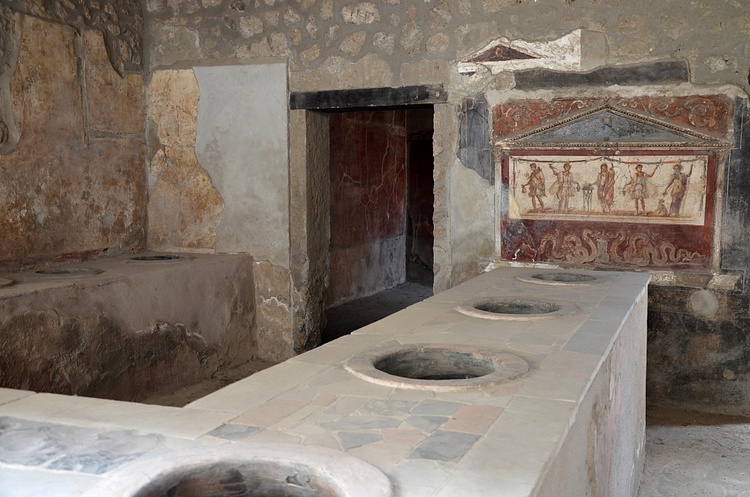 The Thermopolium of Vetutius Placidus in Pompeii Carole Raddato (CC BY-NC-SA) ](https://www.worldhistory.org/image/11256/the-thermopolium-of-vetutius-placidus-in-pompeii/ "The Thermopolium of Vetutius Placidus in Pompeii")Although grape-based wine is most often associated with Rome, an equally popular drink – and far more affordable for most – was *posca*, made from vinegar, water, and spices or from watered-down cheap wine to which other spices were then added. *Posca* was the drink of the lower classes and the military. Fruits such as grapes and dates were often dried and eaten as snacks and carob was used in flavoring meals and preparing desserts. The Romans pioneered the concept of “fast food” through establishments known as *thermopolia* (“places where something hot is found”). A typical *thermopolium* had a counter with jars fixed into it containing prepared food. Customers would order at the counter, pay, and could take their food to go. There were elaborate *thermopolia* which also offered seating and rooms for the night, but most were simple shops providing a quick meal for a low price. *Thermopolia* were looked down upon by the upper class who regarded the food as subpar and because the main clientele was lower class.
### What Was the Roman Army Like & How Did It Work?
The Roman army was divided between legionaries (Roman citizens) and auxiliaries (non-Romans). The legionaries were organized into legions (units of between 4,000-6,000 men), and each legion was then divided into centuries (groups of 80 men), commanded by a [centurion](https://www.worldhistory.org/Centurion/). Within each century, soldiers had different responsibilities such as artillery, infantry, slingers, archers, and engineers among others. Legionaries enlisted for a period of 25 years at an average pay of 2.5 sesterces a day (roughly $4.50- $8.50), after which they could retire and were provided with a discharge bonus and land. Auxiliaries were paid less and almost always placed in the front lines during battles as they were not considered as valuable in [Roman warfare](https://www.worldhistory.org/Roman_Warfare/) as legionaries.
[  Centurion Luc Viatour / www.Lucnix.be (CC BY-NC-SA) ](https://www.worldhistory.org/image/2736/centurion/ "Centurion")Auxiliaries had to serve for 25 years before they could become a Roman citizen, and many did not live anywhere near that long. The average Roman infantryman was equipped with a helmet, body armor over a woolen tunic which fell to the knee, sandals, a sword, shield, dagger, and javelin. The network of roads throughout the empire meant that the army could be quickly deployed in engagements. Roman soldiers were trained to endure marches of up to 20 miles a day, in full [battle](https://www.worldhistory.org/disambiguation/battle/) dress, and be ready for battle at a moment's notice. Soldiers were also trained to form and fight in tight formations which both protected them and provided for greater force in breaking enemy lines.
### What Are Some of Rome's Most Important Cultural Legacies?
Roman cultural legacies continue to influence the modern world in many different areas. The United States government is modeled on that of ancient Rome with its executive, legislative, and judicial branches. The concept of the Electoral College also comes from Rome as the upper-class Romans did not think the common people could be trusted to elect the best person for a position of authority. Although [Athens](https://www.worldhistory.org/Athens/), Greece is credited as the birthplace of democracy, this concept was actually developed more fully by the Romans. In business transactions, the Romans were the first to initiate return of merchandise to a shop for store credit, a refund, or replacement. In architecture, they developed the vault, the arch, and the dome as well as roads which were built so well they can still be traveled in the present day. [Roman architecture](https://www.worldhistory.org/Roman_Architecture/) has influenced buildings all around the world, notably the United States Capitol and many others in Washington, D.C.
[ 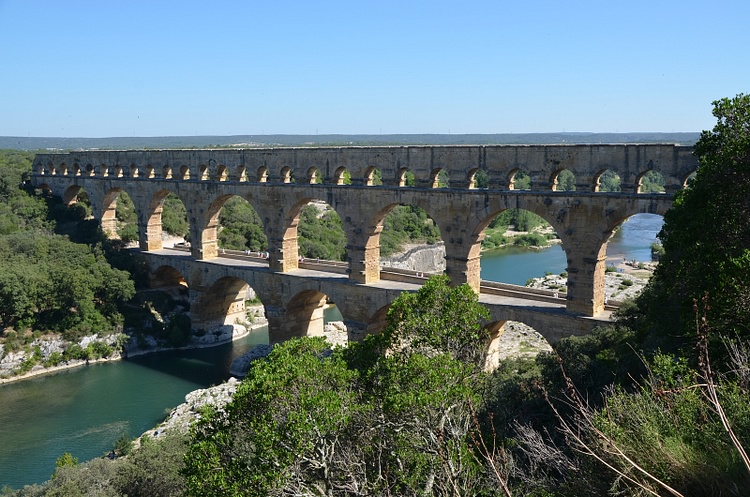 Pont du Gard Carole Raddato (CC BY-NC-SA) ](https://www.worldhistory.org/image/9812/pont-du-gard/ "Pont du Gard")The Romans also established the first fire companies, a police department, and a sanitation department. In entertainment, they refined [Greek drama](https://www.worldhistory.org/Greek_Theatre/) and created the design of the amphitheater which is still used for stadiums and theaters today. Latin, which they carried to their provinces, forms the basis for the Romance languages of French, Italian, and Spanish, and many Latin words form the basis of English words, phrases, and legal concepts. In religion, the adoption of [Christianity](https://www.worldhistory.org/christianity/) by the Romans in the 4th-5th centuries CE elevated the faith from an obscure mystery cult to a world religion, and many aspects of modern-day Christianity, especially in Catholicism, come directly from Roman practices.
### How Did the Roman Empire Fall?
When people speak of the fall of Rome, they are referring to the [fall of the Western Roman Empire](https://www.worldhistory.org/article/835/fall-of-the-western-roman-empire/) c. 476 CE; the Eastern Empire continued until 1453 CE. The Western Empire fell for a number of reasons, after a slow decline of over 300 years, such as:
- Invasions of barbarian tribes
- Government corruption
- The division of the empire in 284 CE
- Mercenary armies
- Political instability
- Overreliance on slave labor
- Unemployment and inflation
- The rise of Christianity
Although the invasions of the [Goths](https://www.worldhistory.org/Goths/) are frequently cited as a major factor in the fall of Rome, these played only one part and would not have had such an impact if Rome had not already been in decline. Rome went through a period of turmoil known as the [Crisis of the Third Century](https://www.worldhistory.org/Crisis_of_the_Third_Century/) (235-284 CE), which saw an increase in widespread government corruption which had existed previously and would continue afterwards. Although Rome survived the crisis, it weakened the empire because, after it was divided, the two halves did not work together well, seeing each other more as rivals than colleagues. Further, the armies came to be comprised of more auxiliary mercenaries than legionaries because, as Rome became more affluent, fewer citizens wanted to serve in the military. These auxiliaries had no intrinsic loyalty to Rome – they were only fighting for pay – and so the army became less effective.
The Roman reliance on slave labor was a major contributing factor because one-third of the people of Rome were slaves who performed many different jobs and thereby deprived lower-class Romans of work. This led to widespread unemployment, which the [Roman government](https://www.worldhistory.org/Roman_Government/) addressed by a welfare system providing free bread, olive oil, and other necessities to the people, and this depleted the treasury. The rise of Christianity has also been cited as a contributing factor because the Christian God had no special affiliation with Rome – He was the God of all people – and so, as Christianity gained adherents, people stopped bringing sacrifice and offering to the temples of the Roman gods, the Roman religion lost its power, and the social structure that religion had maintained became obsolete.
#### Editorial Review
This human-authored article has been reviewed by our editorial team before publication to ensure accuracy, reliability and adherence to academic standards in accordance with our [editorial policy](https://www.worldhistory.org/static/editorial-policy/).
## Bibliography
- [Adkins, L. & Adkins, R. A. *Handbook to Life in Ancient Rome.* Oxford University Press, 1998.](https://www.worldhistory.org/books/0195123328/)
- [Cornelius Tacitus. *Annals and Histories of Tacitus.* Everyman's Library, 2009.](https://www.worldhistory.org/books/1841593117/)
- [Grant, M. *The Climax of Rome.* Weidenfeld, 1993.](https://www.worldhistory.org/books/0297813919/)
- [Harvey, B. K. *Daily Life in Ancient Rome.* Focus, 2016.](https://www.worldhistory.org/books/1585107956/)
- [Lewis, J. E. *The Mammoth Book of Eyewitness Ancient Rome.* Running Press, 2003.](https://www.worldhistory.org/books/078671168X/)
- [Mellor, R. *The Historians of Ancient Rome.* Routledge, 2012.](https://www.worldhistory.org/books/0415527163/)
- [Miles, R. *Carthage Must Be Destroyed.* Penguin Books, 2012.](https://www.worldhistory.org/books/0143121294/)
- [Nardo, D. *Living in Ancient Rome.* Greenhaven Press, 2010.](https://www.worldhistory.org/books/B01F9GUQ7Q/)
- [Parker, H. M. D. *The Roman Legions.* Dorset Press, 1992.](https://www.worldhistory.org/books/B01NH00AB1/)
- [Rodgers, N. *Roman Empire.* Metro Books, 2008.](https://www.worldhistory.org/books/B01N4IKIDY/)
- [Titus Livy. *Livy's Histories.* Penguin Classics, 2002.](https://www.worldhistory.org/books/0140448098/)
- [Wise Bauer, S. *The Story of the World.* W. W. Norton & Company, 2006.](https://www.worldhistory.org/books/1933339004/)
## About the Author
Joshua J. Mark is World History Encyclopedia's co-founder and Content Director. He was previously a professor at Marist College (NY) where he taught history, philosophy, literature, and writing. He has traveled extensively and lived in Greece and Germany.
- [Linkedin Profile](https://www.linkedin.com/pub/joshua-j-mark/38/614/339)
## Cite This Work
### APA
Mark, J. J. (2020, February 21). Ten Ancient Rome Facts You Need to Know. *World History Encyclopedia*.
### Chicago
Mark, Joshua J.. "Ten Ancient Rome Facts You Need to Know." *World History Encyclopedia*, February 21, 2020. .
### MLA
Mark, Joshua J.. "Ten Ancient Rome Facts You Need to Know." *World History Encyclopedia*, 21 Feb 2020, .
## License & Copyright
Submitted by [Joshua J. Mark](https://www.worldhistory.org/user/JPryst/ "User Page: Joshua J. Mark"), published on 21 February 2020. The copyright holder has published this content under the following license: [Creative Commons Attribution-NonCommercial-ShareAlike](https://creativecommons.org/licenses/by-nc-sa/4.0/deed.en). This license lets others remix, tweak, and build upon this content non-commercially, as long as they credit the author and license their new creations under the identical terms. When republishing on the web a hyperlink back to the original content source URL must be included. Please note that content linked from this page may have different licensing terms.