---
title: Wine Culture in the Hellenistic Mediterranean
author: Branko van Oppen
source: https://www.worldhistory.org/article/1502/wine-culture-in-the-hellenistic-mediterranean/
format: machine-readable-alternate
license: Creative Commons Attribution-NonCommercial-ShareAlike (https://creativecommons.org/licenses/by-nc-sa/4.0/)
updated: 1970-01-01
---
# Wine Culture in the Hellenistic Mediterranean
_Authored by [Branko van Oppen](https://www.worldhistory.org/user/bvoppen/)_
The [culture](https://www.worldhistory.org/disambiguation/culture/) of drinking wine was enjoyed throughout the [Mediterranean](https://www.worldhistory.org/disambiguation/mediterranean/) world, and what is true now was true in antiquity, too: wine is always good business. The [Hellenistic Period](https://www.worldhistory.org/Hellenistic_Period/) (c. 335-30 BCE), between [Alexander the Great](https://www.worldhistory.org/Alexander_the_Great/) and [Cleopatra VII](https://www.worldhistory.org/Cleopatra_VII/), witnessed the expansion of [trade](https://www.worldhistory.org/disambiguation/trade/) relations over an ever-growing area, bringing distant regions into direct or indirect contact with each other. Through routes of long-distance trade, goods from Northwest [Europe](https://www.worldhistory.org/europe/), the Middle East, [Arabia](https://www.worldhistory.org/Arabia/), [India](https://www.worldhistory.org/india/), and Central Asia reached the Mediterranean. For the first time in history even produce from [China](https://www.worldhistory.org/china/) reached the Mediterranean, which lay the foundation of the [Silk Road](https://www.worldhistory.org/Silk_Road/). From luxury goods to food, products were exchanged in a swiftly developing consumer society. Think of precious gems, [gold](https://www.worldhistory.org/gold/) and [silver](https://www.worldhistory.org/Silver/), herbs and spices, perfumes and oils, [silk](https://www.worldhistory.org/Silk/) and linen, elephants and slaves, grains such as wheat, emmer and rice, olive oil and fish sauce, parchment and papyrus, [beer](https://www.worldhistory.org/Beer/) and wine.
[  Wall Painting of a Man at a Banquet Osama Shukir Muhammed Amin (Copyright) ](https://www.worldhistory.org/image/9425/wall-painting-of-a-man-at-a-banquet/ "Wall Painting of a Man at a Banquet")Wine was consumed from simple earthenware cups to brilliant glasses. Naturally, the trade of fine gold and silver wine vessels flourished. Different regions had their own specialty, too, from cheap wine from [Egypt](https://www.worldhistory.org/egypt/) to delicious Falernian wine from [Italy](https://www.worldhistory.org/italy/), and the exceptional Carmanian wine from the Highlands of Iran.
### A Brief History of Wine
Viticulture, that is, the cultivation of grapes and the preparation of wine, can be traced back long before the [Hellenistic](https://www.worldhistory.org/Hellenic_World/) Age, to some 8000 years ago in the mountainous areas of the Caucasus and Zagros (respectively in present-day Georgia and Iran). It was also practiced already in the Balkans and the [Levant](https://www.worldhistory.org/levant/) in the [Neolithic period](https://www.worldhistory.org/Neolithic/) (c. mid-5th millennium BCE). Classical [Greece](https://www.worldhistory.org/greece/), of course, is famous for the elaborate culture around wine consumption. This is not the place to discuss the importance of wine in ancient [Greek religion](https://www.worldhistory.org/Greek_Religion/), [Greek medicine](https://www.worldhistory.org/Greek_Medicine/), culture, and society – not to mention the [symposium](https://www.worldhistory.org/Symposium/). Here it should be remembered that [Greek colonization](https://www.worldhistory.org/Greek_Colonization/) spread wine culture across the northern Mediterranean and Black Sea coast, thus sharing it with the [Etruscan civilization](https://www.worldhistory.org/Etruscan_Civilization/), the Romans, [Celts](https://www.worldhistory.org/celt/), and [Scythians](https://www.worldhistory.org/Scythians/).
The Greeks always drank their wine diluted with water as theirs came from the pressing as a thick syrup. [Greek culture](https://www.worldhistory.org/disambiguation/Greek_Culture/) even considered it a barbarian (uncivilized) practice to consume undiluted wine. A wide variety of wines, mainly sweet and aromatic, but also drier varieties were produced on the [Greek](https://www.worldhistory.org/disambiguation/greek/) mainland. A popular Greek wine, which was exported in large quantities to the Black Sea region, was the variety from Mende on the Chalcidice. This Mendaean white wine existed in different types (mild, dry, and with honey), and was considered to have both a therapeutic and a laxative function. On the islands, different varieties of wine were produced still. On [Kos](https://www.worldhistory.org/Kos/), for example, a widely exported variant was mixed with salty sea water; it was traded via sea routes as far as Arabia and India. High-quality red wine from Chios enjoyed an excellent reputation and was exported for high prices to Greece, Italy, and Egypt from the Classical until well into the [Roman](https://www.worldhistory.org/disambiguation/Roman/) Imperial Period (c. 5th century BCE - 2nd century CE).
During the Greek [colonization](https://www.worldhistory.org/disambiguation/colonization/) of the northern Mediterranean and Black Sea, [Phoenicians](https://www.worldhistory.org/phoenicia/) settled across the southern and western Mediterranean, and thus eventually sharing their wine culture with Libyans, Iberians, Italians, to name a few. From the Phoenician heartland (Lebanon), a fine and fragrant white wine was traded from [Byblos](https://www.worldhistory.org/Byblos/) (present-day Jibayl) to the islands of [Cyprus](https://www.worldhistory.org/cyprus/), [Crete](https://www.worldhistory.org/crete/), [Sicily](https://www.worldhistory.org/sicily/), and Sardinia, as well as the north African coast and the Iberian Peninsula. This type of wine was impregnated with pine or pistachio resin (terebinth), as these ingredients would better bring out the soft taste of the beverage. In the Hellenistic Period, this variety was valued as qualitatively equal to the best sweet Muscat-type wine from [Lesbos](https://www.worldhistory.org/lesbos/). Phoenician wine grapes were also cultivated in Sicily and Thrace. From the Bagradas valley (in Tunisia), the Carthaginians exported Passum to [Punic](https://www.worldhistory.org/carthage/) colonies in Sicily, Sardinia, the Balearic Islands, and Spain. That Carthaginian wine, made from raisins, although made by the military rivals of [Rome](https://www.worldhistory.org/Rome/), nevertheless became popular in Italy, too.
[ 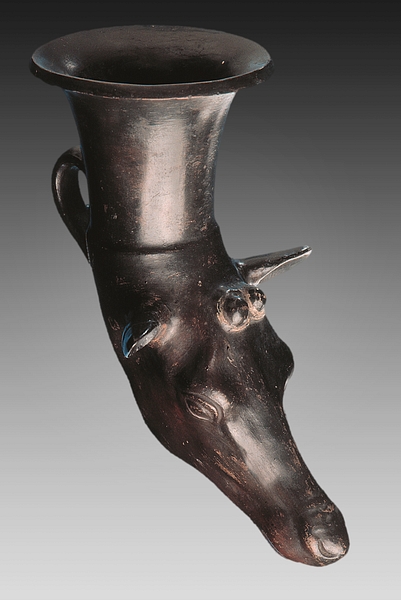 Deer Rhyton Allard Pierson Museum (CC BY-NC-SA) ](https://www.worldhistory.org/image/11911/deer-rhyton/ "Deer Rhyton")In the [Nile](https://www.worldhistory.org/nile/) Delta and [Egyptian](https://www.worldhistory.org/disambiguation/Egyptian/) oases, wine cultivation and consumption dates back at least to the [Old Kingdom of Egypt](https://www.worldhistory.org/Old_Kingdom_of_Egypt/) (late 3rd millennium BCE). On the royal vineyards mainly red wine was produced. In the famous [tomb](https://www.worldhistory.org/tomb/) of [Tutankhamun](https://www.worldhistory.org/Tutankhamun/), however, white wine remains have also been found in pitchers perhaps from imported wine. Egyptian wine could be flavored with pistachio resin (terebinth), fresh grapes and figs, sage, mint, and coriander. The Greeks introduced new grape varieties in Egypt; wine was also imported directly from the [Aegean](https://www.worldhistory.org/aegean/) Sea region. Hellenistic Egyptian wines – made either from grapes or pomegranate or from date or palm – came in different varieties and flavors, from cheap to expensive, from sour to sweet. Even wine vinegar was drunk as a cheap surrogate among the poorer population. Among the rural population, however, beer remained the more popular drink for daily consumption until late antiquity – as it had been since time immemorial.
In [Israel](https://www.worldhistory.org/disambiguation/Israel/), kosher wine had been cherished at least since the time of the [Old Testament](https://www.worldhistory.org/Old_Testament/). The Talmud mentions 70 different varieties of wine form [Palestine](https://www.worldhistory.org/palestine/), such as Sharon and Carmel. Most are red, though some are white varieties. They were produced in different ways, for instance by mixing the wine with clear water and balm (*aluntit*), or with honey and black [pepper](https://www.worldhistory.org/Pepper/) (*anomilin*), but also by smoking the grapes before pressing the wine (*meusham*). The region of Kefar-Signa (in southern Galilee) furnished the wine for the sacrifices in the [Temple](https://www.worldhistory.org/temple/) at [Jerusalem](https://www.worldhistory.org/jerusalem/). In the Hellenistic Period, kosher wines were reckoned among the best. They were not only traded in amphoras (like most other wines), but also in goatskins, and exported from the ports of Ashkelon, Joppa, and Dor to North [Africa](https://www.worldhistory.org/disambiguation/africa/), Europe, and the Black Sea. At the beginning of the common era, with the spread of [Christianity](https://www.worldhistory.org/christianity/), red wine became an essential sacrament of the Eucharistic celebration to commemorate the Last Supper of [Jesus](https://www.worldhistory.org/Jesus_Christ/).
### From Luxury Goods to Commodity Items
Wine was not only drunk from graceful vessels of precious metals, as said, but also from glass or earthenware, and even wooden cups. Difficult as it may be to imagine – due to the prevalence of glass in our modern age – before the [Roman Empire](https://www.worldhistory.org/Roman_Empire/), glass artefacts (whether fashioned of quartz or obsidian) belonged to the highest possible luxury items. The origin of glass manufacture itself can be dated back to the 2nd millennium BCE in [Mesopotamia](https://www.worldhistory.org/Mesopotamia/), [Syria](https://www.worldhistory.org/syria/), and Egypt. It seems to have come to a halt at the end of the [Bronze Age](https://www.worldhistory.org/disambiguation/Bronze_Age/), but was resumed in Syria and Cyprus in the early 1st millennium BCE. Meanwhile, in Hellenistic Syria high-quality wine was exported from the port of Laodicea (present-day Latakia) via the Red Sea as far as Arabia and India. It was during the [Ptolemaic Dynasty](https://www.worldhistory.org/Ptolemaic_Dynasty/), in [Alexandria](https://www.worldhistory.org/alexandria/) that experiments led to new production techniques, so that glass could be manufactured on a significantly larger scale. For it was in the Hellenistic Period that it first became possible to form glass from moulds. Subsequently, in the late Hellenistic Period (c. 1st century BCE), glassblowing was discovered in the [Near East](https://www.worldhistory.org/Near_East/) – an invention that caused a sheer revolution in glass production as it made glass vessels cheaper than earthenware.
[ 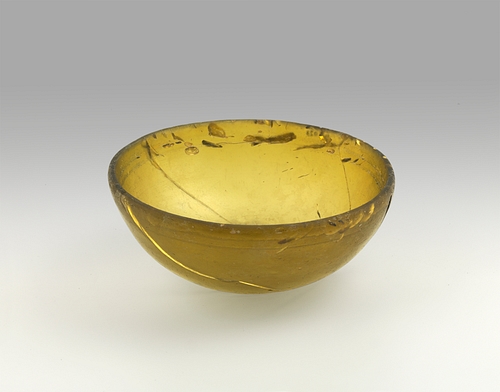 Levantine Amber Glass Wine Cup Allard Pierson Museum (CC BY-NC-SA) ](https://www.worldhistory.org/image/11907/levantine-amber-glass-wine-cup/ "Levantine Amber Glass Wine Cup")Although the Classical Greek and Roman wine culture may be more familiar to the reader, a rich culture around wine consumption also existed in the [Achaemenid](https://www.worldhistory.org/disambiguation/Achaemenid/) [Persian Empire](https://www.worldhistory.org/disambiguation/Persian_Empire/) (550-330 BCE). The *rhyton* – a horn usually decorated with an animal head or forepart, and used to drink, pour, or aerate (pass air through liquid) wine – is a striking expression of this. Carmania in the Highlands of Iran (approximately the modern province of Kerman) was famous for the quality of its wine. Strabo (15.2.14) informs us that the Carmanian grape variety, which flourished due to the fertile soil, was known both for the size of the grapes and for the size of its bunches. After the disastrous journey through the Gedrosia desert, in which perhaps one-third of his troops lost their lives, [Alexander](https://www.worldhistory.org/disambiguation/Alexander/) the Great made a Bacchic triumphal procession through the region and celebrated a drinking party in honor of [Dionysus](https://www.worldhistory.org/Dionysos/) for seven days and seven nights. (There is no reason to believe reports that the modern French wine variously called Syrah, Scyras, and Shiraz, among others, is in any way connected with the Persian wine from the [city](https://www.worldhistory.org/city/) of Shiraz.)
In the region of [Gandhara](https://www.worldhistory.org/Gandhara_Civilization/), northwest of ancient India, the area of the Kabul valley before that river (known as the Cophes in antiquity) empties into the Indus, the Macedonian army had earlier believed to even have discovered the birthplace of Dionysus, the [god](https://www.worldhistory.org/God/) of wine, because the mountainous area was rich in vine and grapes. In the region, wine was indeed consumed during popular religious festivals before the arrival of [Buddhism](https://www.worldhistory.org/buddhism/) from India. Gandharan wine was probably enhanced with spices during the fermentation and was drunk undiluted within days after the pressing (the yeast was therefore still active); it was thus a sweet young wine with a milky color. While [Buddhist](https://www.worldhistory.org/buddhism/) monks were prohibited to drink alcoholic beverages, the tradition of wine festival continued. Vine leaves also became a popular motif in later Gandhara art.
[ 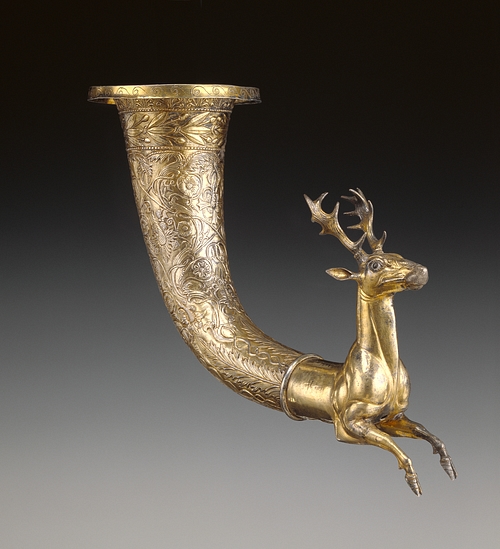 Stag Rhyton J. Paul Getty Museum (CC BY-NC-SA) ](https://www.worldhistory.org/image/11910/stag-rhyton/ "Stag Rhyton")Archaeologists can at least partially reconstruct the network of overseas trade from ceramic vessels discovered in underwater excavations. For example, the amphoras from [Rhodes](https://www.worldhistory.org/Rhodes/) are of a specific type, so that their large-scale dispersal across the [Hellenistic world](https://www.worldhistory.org/Hellenistic_Period/) attests to the wide reach of trade from the island. The local wine produced in Rhodes that was transported in these ceramic containers was very popular. Like the variant from Kos, Rhodian wine was mixed with seawater or salt, although to a lesser extent. While this salty wine was not of particularly high quality, it was precisely its low price that contributed to its enormous popularity as an export commodity.
### A Nereid & a Sea [Centaur](https://www.worldhistory.org/centaur/)
On a scene of a silver wine vase we see, in a turbulent sea, an almost fully bared woman riding sideways with both legs to the right, on the back of a sea centaur. She is a Nereid, a sea [nymph](https://www.worldhistory.org/nymph/), one of the 50 beautiful daughters of the sea god Nereus and his wife Doris (herself the daughter of [Oceanus](https://www.worldhistory.org/Oceanus/) and Tethys). Her body is covered only with drapery over her lap and a band across her breasts. In both raised hands she holds a wavy cloth that bulges like a sail and that gives the impression of blowing wind. This so-called *velificatio* is known from [Roman art](https://www.worldhistory.org/Roman_Art/), for example on the reliefs of the Ara Pacis built by emperor [Augustus](https://www.worldhistory.org/augustus/) (r. 27 BCE - 14 CE).
[ 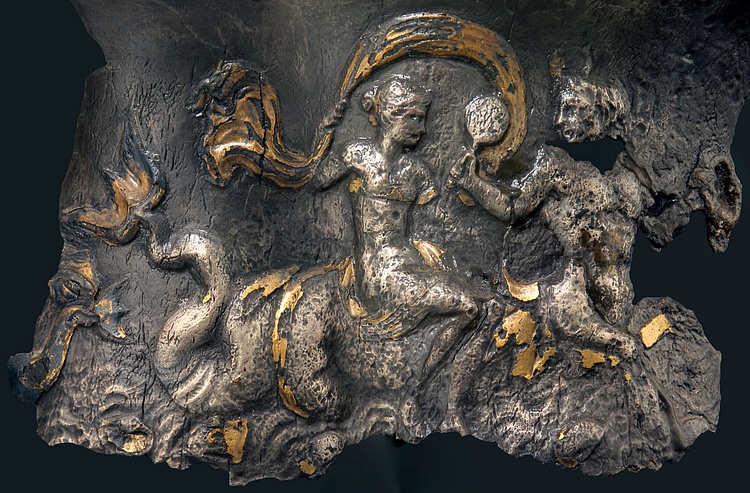 A Nereid & a Sea Centaur Branko van Oppen (CC BY-NC-SA) ](https://www.worldhistory.org/image/11908/a-nereid--a-sea-centaur/ "A Nereid & a Sea Centaur")The sea centaur is a creature from Greek and [Roman mythology](https://www.worldhistory.org/Roman_Mythology/), with the upper body of a horned human, the forelegs of a horse, and the coiled tail of an enormous fish. He looks back at the Nereid on his tail; in his right hand he holds a mirror before her face; in his left hand he carries a wreath. A shell is depicted below his legs, and a dolphin and a fish below his tail. The tail of another sea creature can be seen on the far left of the fragment, probably a mirrored, second marine companion, whose hand can be seen near the wreath. Perhaps we can interpret the scene a little further? Maybe Acis and Galatea, known from [Ovid](https://www.worldhistory.org/ovid/)'s *Metamorphosis* (13.733-897), are depicted here.
The mythological scene is reproduced in repoussage relief on a fragment of the neck of a silver wine vase decorated with gold leaf. With this metalworking technique a deep relief is hammered on the reverse (from the inside out). Afterwards, like in this case, details can be embossed from the front. Maritime themes are relatively common on Roman silver tableware – the reason for bringing up this particular relief scene. During rich banquets, a variety of fish was served while the wine flowed lavishly. This wine jug probably comes from the Roman province of Baetica in southern Spain, a region where wine, olive oil, and fish sauce were traded overseas. Indeed, Ceretanum, a fortified white wine from Ceret in Beatica (present-day Jerez de la Frontera), exported to southern France, Italy and Germany, is thought to be the forerunner of modern sherry.
[ 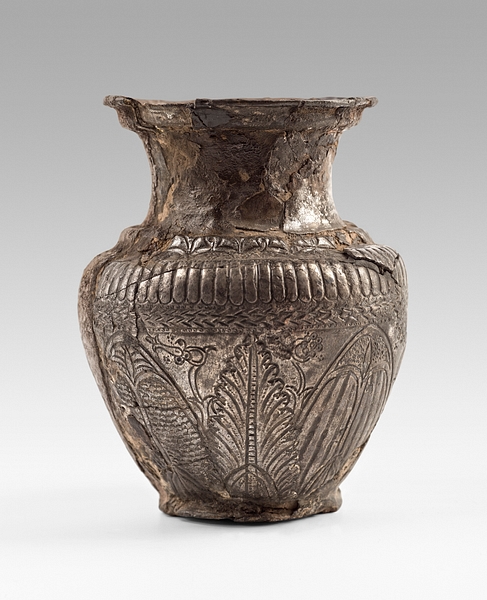 Ptolemaic Silver Wine Vase Allard Pierson Museum (CC BY-NC-SA) ](https://www.worldhistory.org/image/11909/ptolemaic-silver-wine-vase/ "Ptolemaic Silver Wine Vase")The most praised and most expensive Roman wine was certainly the white Falernian wine, which had an alcohol percentage of up to 15%. This “*premier cru*,” as it were the Sauterne of antiquity, grew on the slopes of Falernus, a mountain on the border of Latium and Campania. The son of the dictator [Sulla](https://www.worldhistory.org/sulla/) (138-78 BCE), Faustus Cornelius Sulla (86-46 BCE), owned vineyards halfway up the mountain. The grape was only harvested after the first frost. Due to the maturation process in earthenware amphoras from 15 to 20 years, the wine was [amber](https://www.worldhistory.org/Amber/) to dark brown in color. The harvest from the year of [consul](https://www.worldhistory.org/Consul/) Lucius Opimius (121 BCE) was so famous that [Julius Caesar](https://www.worldhistory.org/Julius_Caesar/) had it poured at a banquet in honor of his Spanish [triumph](https://www.worldhistory.org/Roman_Triumph/) (60 BCE). Like the Greeks, Romans always drank their wine diluted.
Much more could be said about Hellenistic wine consumption, trade, and the vessels from which the drink was consumed. For instance, that the Thasians made a highly and widely valued wine with rose leaves, or that the Ephesians mixed unfermented, cooked grape juice in their Mesogite wine, or that Cyrenean salty wine, though of poor quality, was considered good for the digestion. Suffice to say that wines were enjoyed in a surprisingly wide variety, that they were widely traded, and illustrate the widespread of its culture. In the Hellenistic Age, as much as in earlier and later periods, wine was not just a commodity to be traded far and wide, wine vessels were not merely luxury items for the affluent – wine was a way of life.
An earlier version of this article was originally published at [AncientWorldMagazine.com](https://www.ancientworldmagazine.com/articles/wine-culture-hellenistic-mediterranean/)
The objects illustrated in this article from the Allard Pierson Museum have been on display in the Hellenistic gallery, “From Alexander to [Cleopatra](https://www.worldhistory.org/disambiguation/cleopatra/),” since early 2017. Both authors of this article were involved in the gallery presentation.
#### Editorial Review
This human-authored article has been reviewed by our editorial team before publication to ensure accuracy, reliability and adherence to academic standards in accordance with our [editorial policy](https://www.worldhistory.org/static/editorial-policy/).
## Bibliography
- [Butler, J. *Divine Vintage.* St. Martin's Press, 2012.](https://www.worldhistory.org/books/0230112439/)
- Falk, H. "Wine in Gandhara under Buddhist Monastic Supervision." *Bulletin of the Asia Institute*, 23 (2009), pp. 65-78.
- [McGovern, P. E. *Ancient Wine.* Princeton University Press, 2019.](https://www.worldhistory.org/books/0691197202/)
- [McGovern, P. E. *Uncorking the Past.* University of California Press, 2009.](https://www.worldhistory.org/books/0520267982/)
- Oppen de Ruiter, B. F. van. "De hellenistische wereld van Alexander tot Cleopatra." *Allard Pierson Mededelingen*, 114/115 (2017), pp. 14-18.
- [Papaioannaou, T. "A Reconstruction of the Maritime Trade Patterns Originating from Western Asia Minor." *Maritime Archaeology and Ancient Trade in the Mediterranean Hardcover*, edited by Robinson, D. and Wilson, A. Oxford University School of Archaeology (15 July 2011), 2020, 197-210.](https://www.worldhistory.org/books/B013IMEOXK/)
## About the Author
Branko van Oppen is an exhibition curator and independent scholar specialized in Ptolemaic queenship as well as Hellenistic art and ideology.
- [Facebook Profile](https://www.facebook.com/bf.vanoppen)
- [Linkedin Profile](https://www.linkedin.com/in/bvoppen/)
## Cite This Work
### APA
Oppen, B. v. (2020, February 20). Wine Culture in the Hellenistic Mediterranean. *World History Encyclopedia*.
### Chicago
Oppen, Branko van. "Wine Culture in the Hellenistic Mediterranean." *World History Encyclopedia*, February 20, 2020. .
### MLA
Oppen, Branko van. "Wine Culture in the Hellenistic Mediterranean." *World History Encyclopedia*, 20 Feb 2020, .
## License & Copyright
Submitted by [Branko van Oppen](https://www.worldhistory.org/user/bvoppen/ "User Page: Branko van Oppen"), published on 20 February 2020. The copyright holder has published this content under the following license: [Creative Commons Attribution-NonCommercial-ShareAlike](https://creativecommons.org/licenses/by-nc-sa/4.0/deed.en). This license lets others remix, tweak, and build upon this content non-commercially, as long as they credit the author and license their new creations under the identical terms. When republishing on the web a hyperlink back to the original content source URL must be included. Please note that content linked from this page may have different licensing terms.