---
title: Skulls, Temples & Churches: A Visit to the Walled City of Evora
author: Kim Martins
source: https://www.worldhistory.org/article/1497/skulls-temples--churches-a-visit-to-the-walled-cit/
format: machine-readable-alternate
license: Creative Commons Attribution-NonCommercial-ShareAlike (https://creativecommons.org/licenses/by-nc-sa/4.0/)
updated: 2026-02-19
---
# Skulls, Temples & Churches: A Visit to the Walled City of Evora
_Authored by [Kim Martins](https://www.worldhistory.org/user/kim.martins/)_
The sunbaked plain of the Alentejo region in central Portugal is called *planicie dourada (*golden plain) by the Portuguese, and it is dotted with cork oak forests, vineyards, olive groves, and hilltop towns with whitewashed houses. 'Alentejo' means "beyond the Tagus River", and there is a raw beauty to this agricultural region that is particularly evident at sunset when the light is pale [gold](https://www.worldhistory.org/gold/).
Evora is the capital of the Alentejo, and its historic centre was listed as a UNESCO World Heritage Site in 1986 CE. It is a [city](https://www.worldhistory.org/city/) crammed with narrow cobblestoned streets, historic churches, hand-painted *azulejos* (ceramic) tiles, and a beautiful blend of Moorish and [Roman architecture](https://www.worldhistory.org/Roman_Architecture/).
[  Capela dos Ossos (The Chapel of Bones) David Cross (CC BY-NC-SA) ](https://www.worldhistory.org/image/11861/capela-dos-ossos-the-chapel-of-bones/ "Capela dos Ossos (The Chapel of Bones)")The best way to see Evora is on foot, and within walkable distance of each other are three must-see sites: The Chapel of Bones, the [Roman](https://www.worldhistory.org/disambiguation/Roman/) [Temple](https://www.worldhistory.org/temple/) of [Diana](https://www.worldhistory.org/diana/), and the Evora Cathedral. Let us take a tour through history and discover Evora's charm.
### A Timeless City
Evora's history dates back over five millennia. Before 57 BCE it was called Ebora*,* a name given to it by the Celtici - the [Celtic](https://www.worldhistory.org/celt/) tribes of the Iberian peninsula - who used it as their regional capital. The name may have derived from the Latin word *aurum* (gold) either as a reference to the golden Alentejo plain or because of the gold mining in Portugal. There is also a suggestion that 'Ebora' means "of the yew trees" in the Celtic language. Ebora was [mentioned](http://penelope.uchicago.edu/Thayer/E/Gazetteer/Periods/Roman/_Texts/Ptolemy/2/5*.html) in the *Geography* of [Claudius Ptolemy](https://www.worldhistory.org/Claudius_Ptolemy/) (100-170 CE) and also by [Pliny the Elder](https://www.worldhistory.org/Pliny_the_Elder/) (c. 23-79 CE) in his *Natural History*, but little is known of Ebora's early period.
Evora was then settled by the Romans in 57 BCE and initially called Ebora Cerealis because the fertile Alentejo plain was a significant source of wheat, an important crop for the [Roman Empire](https://www.worldhistory.org/Roman_Empire/).
The Romans constructed the defensive ramparts known as *Cerca Romana* (Roman Enclosure), and the Roman section of these walls remain well-preserved. Evora was so important to the [empire](https://www.worldhistory.org/empire/) that [Julius Caesar](https://www.worldhistory.org/Julius_Caesar/) (100-44 BCE) elevated it to the rank of *municipium* (self-governing city) and added the official title *Liberalitis Julia* (Julian Generosity) during the early *[Pax Romana](https://www.worldhistory.org/Pax_Romana/)* period (27 BCE - 180 CE).
Under the Romans, Evora became a flourishing trading centre and a crucial military outpost when the [Roman army](https://www.worldhistory.org/Roman_Army/) commander Quintus Sertorius (c. 123 - 72 BC) used the city as his headquarters between 80-72 BCE.
[ 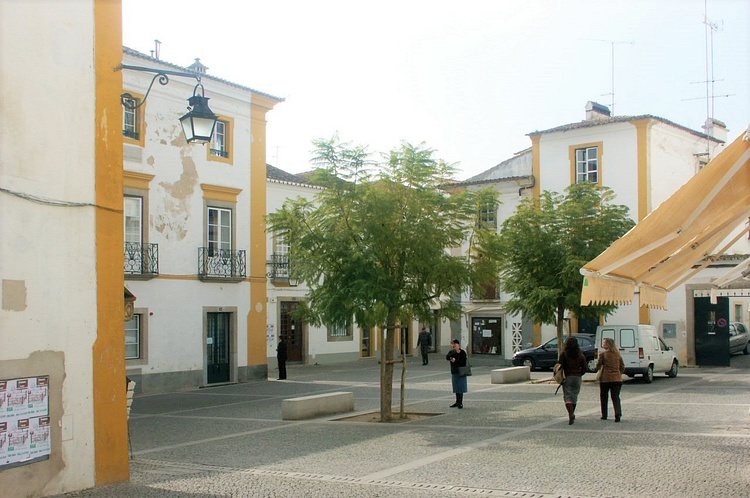 Evora Kim Martins (CC BY-NC-SA) ](https://www.worldhistory.org/image/11868/evora/ "Evora")With the decline and fall of the Roman Empire, there was a period of [Visigoth](https://www.worldhistory.org/visigoth/) presence in the 6th century CE when King Leovigild (c. 512-586 CE) ruled Evora. In 715 CE, a Moorish army led by Abd al-Alaziz ibn Musa (d. 717 CE) occupied the city and Coimbra. Evora was under Moorish rule until 1165 CE and was called Jabura. The influence of Moorish [architecture](https://www.worldhistory.org/disambiguation/architecture/) can be seen today in the city's whitewashed houses with mustard-coloured trim, the arched alleyways, and tiled patios.
The Moors were then expelled from the Alentejo region by the Portuguese Christian knight, Geraldo Sem Pavor (d. 1173 CE) who is known as Gerald the Fearless, and Evora was ruled by Afonso Henriques I (1109/11 - 1185 CE) who was Portugal's first king. Praca do Giraldo *-* the central square that served as Evora's market during the Moorish period - is named after Gerald the Fearless.
What follows is roughly 400 years during which Evora was the preferred residence of the kings of the Afonsine (1139-1383 CE) and Avis (1383-1580 CE) dynasties. Evora became a cultural centre and a meeting point for scholars, writers, and artists. The University of Evora was established in 1559 CE.
[  Peacocks in Jardim Publico de Evora Kim Martins (CC BY-NC-SA) ](https://www.worldhistory.org/image/11866/peacocks-in-jardim-publico-de-evora/ "Peacocks in Jardim Publico de Evora")The Portuguese version of the Spanish Inquisition arrived in 1536 CE when a court to try heretics was set up, and you can still see the building that was the Court of the Inquisition across from the city museum. It displays the cross with the sword and olive branch - the symbols of the Spanish Inquisition.
These historical layers have resulted in a city that has many intriguing stories to tell.
### The Chapel of Bones
The first story is that of the 5,000 or more human bones and skulls in the ossuary of [Capela dos Ossos](http://igrejadesaofrancisco.pt/) (The Chapel of Bones) attached to the Igreja de São Francisco, a church in the middle of the city. You do not expect to find human remains stacked from floor to ceiling on walls or lining columns in a chapel, but this is exactly what the visitor will see at this somewhat macabre historical site.
[ 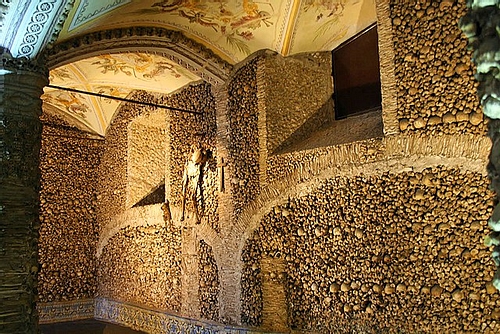 Capela dos Ossos, Skeleton Wall Laredawg (CC BY-NC-SA) ](https://www.worldhistory.org/image/11869/capela-dos-ossos-skeleton-wall/ "Capela dos Ossos, Skeleton Wall")The Chapel of Bones was constructed by Franciscan monks in the late 16th century CE when the city faced the dilemma of crowded cemeteries. Bones were exhumed and relocated to the chapel as a creative solution to the problem of overcrowding but also to provide a *memento mori* or reminder of the inevitability of [death](https://www.worldhistory.org/disambiguation/Death/).
Ossuaries or bone chapels are common throughout history and were often the result of a need to house thousands of dead in a mass [grave](https://www.worldhistory.org/burial/) due to [plague](https://www.worldhistory.org/disambiguation/plague/) or atrocities of [war](https://www.worldhistory.org/disambiguation/War/). There is a bone chapel in Faro in the Algarve region of Portugal, complete with a gold skeleton, and the catacombs in [Paris](https://www.worldhistory.org/disambiguation/paris/) is the final resting place for 6,000,000 of its former inhabitants.
Evora's chapel of bones is small, and its design is based on the ossuary of San Bernadino alle Ossa in Milan, [Italy](https://www.worldhistory.org/italy/). You feel you are in a cave and somewhat overwhelmed by thousands of bones and skulls meticulously arranged. The remains of the Franciscan monks are contained in a small white [tomb](https://www.worldhistory.org/tomb/) to the right of the main altar.
[ 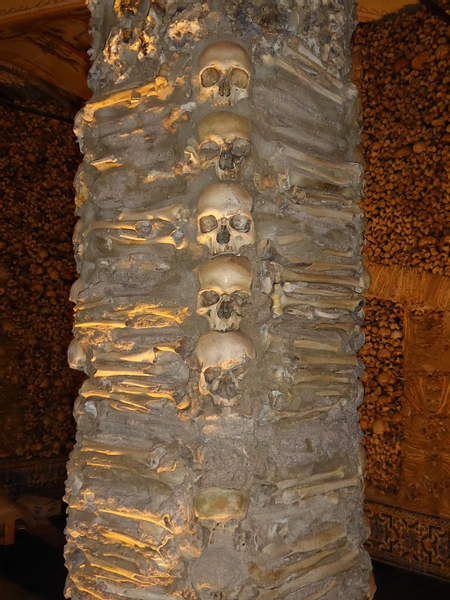 Capela dos Ossos Bone Pillar Stephen Colebourne (CC BY-NC-SA) ](https://www.worldhistory.org/image/11862/capela-dos-ossos-bone-pillar/ "Capela dos Ossos Bone Pillar")Evora was a materialistic, wealthy city and the Franciscans wanted to provide a space for contemplation on human existence. Above the chapel door is an inscription that is guaranteed to unsettle any visitor:
> *Nos ossos que aqui estamos, pelos vossos esperamos*
> \[We, the bones that are here, await yours\]
There is also a poem in a wooden frame that hangs from one of the chapel pillars and reads in part:
> Where are you going in such a hurry traveler?
> Stop … do not proceed;
> You have no greater concern,
> Than this one: that on which you focus your sight.
A tour guide will also point out two desiccated corpses hanging by chains from a [wall](https://www.worldhistory.org/wall/) next to a cross. One is that of an adult man, the other is a child, possibly his son, and legend says that the son mistreated his mother and so she cursed them both to hang there for eternity.
[ 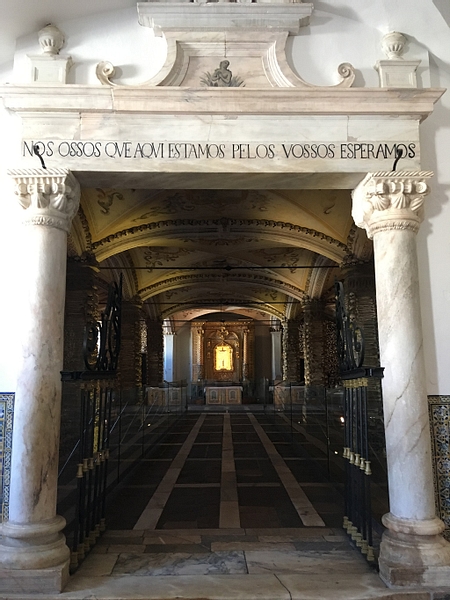 Capela dos Ossos, Evora, Portugal Sergei Gussev (CC BY-NC-SA) ](https://www.worldhistory.org/image/11863/capela-dos-ossos-evora-portugal/ "Capela dos Ossos, Evora, Portugal")What remains to be seen in the chapel before heading out the door to see more historical sites are the beautiful frescoes on the vaulted ceiling, dating from 1810 CE and featuring symbols illustrating biblical passages.
### The Temple of Diana
The Temple of Diana (*Templo Romano Evora*) is the oldest historical site in Evora and tells the story of Roman dominance in the city. It is a ten-minute walk from the Chapel of Bones and is located in the Largo Conde Vila Flor square, up a hill and on one of the highest points of Evora.
Visitors are free to walk around the Corinthian-style temple at any time of the day or night. A night-time visit is highly recommended as the temple is lit by floodlights and is very impressive, if not a little eerie.
[ 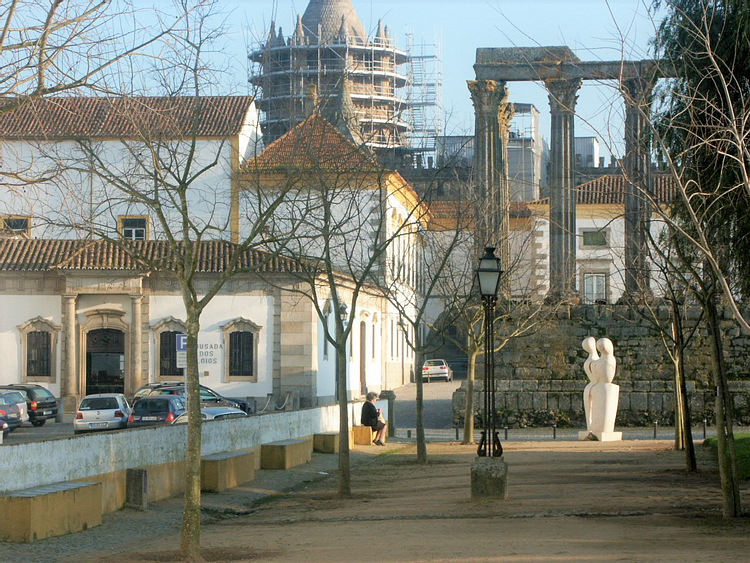 Temple of Diana Kim Martins (CC BY-NC-SA) ](https://www.worldhistory.org/image/11864/temple-of-diana/ "Temple of Diana")The south-facing temple was built in the 1st century CE and is thought to have been dedicated to the Roman hunting goddess Diana, although there is no archaeological evidence in support. Most likely, it was dedicated to [Augustus](https://www.worldhistory.org/augustus/) [Caesar](https://www.worldhistory.org/disambiguation/caesar/) (r. 27 BCE - 14 CE).
Only 14 of the original 32 fluted columns remain. The columns are in a *peripteros* layout (rectangular plan framed on all four sides by a colonnade) and stand on a granite base that is 3.5 m (11.4 ft) high. On the north side of the temple, you can still see six granite columns that are 7.68 m (25.1 ft) in height. The columns, architrave and base are made from local granite and the columns rest on a base of marble sourced from nearby Estremoz.
[ 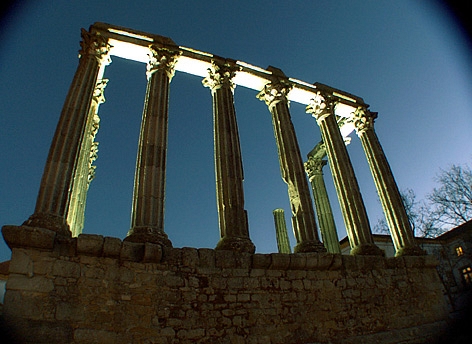 Temple of Diana João Miguel (CC BY-NC-SA) ](https://www.worldhistory.org/image/11865/temple-of-diana/ "Temple of Diana")The temple suffered extensive damage in the 5th century CE when Germanic marauders invaded the city. In the 11th century CE, the Castle of Evora (now dismantled) was constructed around the temple and its base, columns and architrave were incorporated into the castle's tower, which was later converted into an abattoir. Restoration work began on the temple in 1836 CE, and the temple the visitor sees today is the result of conservation theories of the time, particularly those of the English art critic John Ruskin (1819-1900 CE).
### Evora Cathedral
Our last stop is the cathedral located in Evora's [Acropolis](https://www.worldhistory.org/Acropolis/), the highest point of the city and a short walk from the Temple of Diana - the two buildings practically stand side by side. It is the largest medieval cathedral in Portugal and was designed in the shape of a Latin cross. It is thought that the cathedral was purposely erected on the site of a former mosque as a symbolic act by the 12th-century CE crusaders.
The [cathedral](http://www.evoracathedral.com/?lang=en) is also known as Sé Catedral de Évora, but its correct name is Basilica Se de Nossa Senhora da Assuncao (Basilica of Our Lady of the Assumption).
It was constructed during the 12th-13th centuries CE and has a beautiful facade of rose granite, which gives the cathedral its distinctive pink hue. Construction started c. 1186 CE, the cathedral was consecrated in 1204 CE, and completed in 1250 CE.
[ 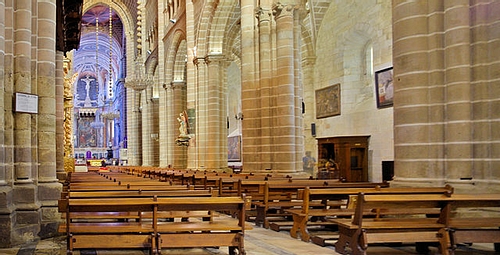 Interior of Evora Cathedral Ken & Nyetta (CC BY-NC-SA) ](https://www.worldhistory.org/image/11871/interior-of-evora-cathedral/ "Interior of Evora Cathedral")Although the cathedral was built in the Romano-Gothic style, renovation and restoration over the years have produced a blend of architectural styles. It was restored in the Gothic style (c. 1400 CE), and you can still see two large rose windows that bring light into the interior of the cathedral. It is said that the Portuguese explorer, Vasco de Gama, had the flags for his fleet of ships blessed in the cathedral in 1497 CE.
An interesting feature of the building is the two asymmetric towers constructed between c. 1200 CE and the 16th century CE. The turreted clock tower on the south side has a spiral staircase, and its bells ring the time across the city; the northern tower has a blue ceramic tiled cone spire in the Manueline style (Portuguese late Gothic, early 16th century CE).
[ 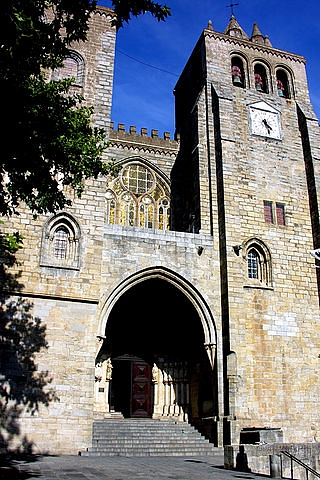 Evora Cathedral Felicity and Phillip (CC BY-NC-SA) ](https://www.worldhistory.org/image/11870/evora-cathedral/ "Evora Cathedral")There are three entrances to the cathedral: the south door (Porta do Sol) features Gothic arches, the north entrance was reconstructed during the Baroque period (c. 1600-1750 CE), and the main entrance between the two towers has six archivolts supported by sculptures of the twelve apostles, attributed to Pero and Telo de Garcia (Spanish sculptors of the 14th century CE).
There is a further blend of artistic styles in the interior of the church. The central altar is from the 18th century CE and is made from pink, black, and white marble; there is an unusual 15th-century CE [sculpture](https://www.worldhistory.org/disambiguation/Sculpture/) of a pregnant [Virgin Mary](https://www.worldhistory.org/Mary,_Mother_of_Jesus/); the tubular organ is from the late 16th century CE; and the choir is from the Manueline period.
[ 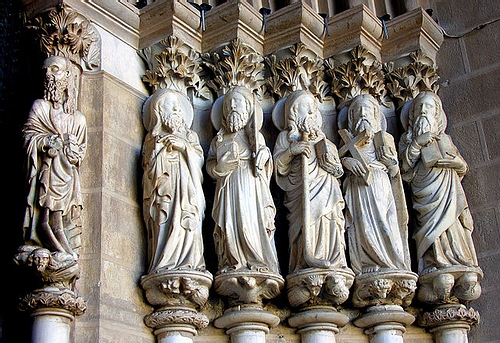 Statues of the Apostles Rei Artur (CC BY-NC-SA) ](https://www.worldhistory.org/image/11867/statues-of-the-apostles/ "Statues of the Apostles")The visitor will certainly see that Evora cathedral is a wonderful example of a building that has transitioned through different historical periods and architectural styles, yet has still retained an overall Gothic appearance.
Before leaving the cathedral, climb to the rooftop terrace for a 360-degree panoramic view of Evora.
### How to Get There
You can visit Evora on a day-trip from Portugal's capital, Lisbon, as the drive is only about 1.5 [hours](https://www.worldhistory.org/Horae/) (80 miles or 130 km) or you can take the train from Lisbon's Oriente Station to Evora station or intercity bus from Lisbon's Sete Rios Bus Station.
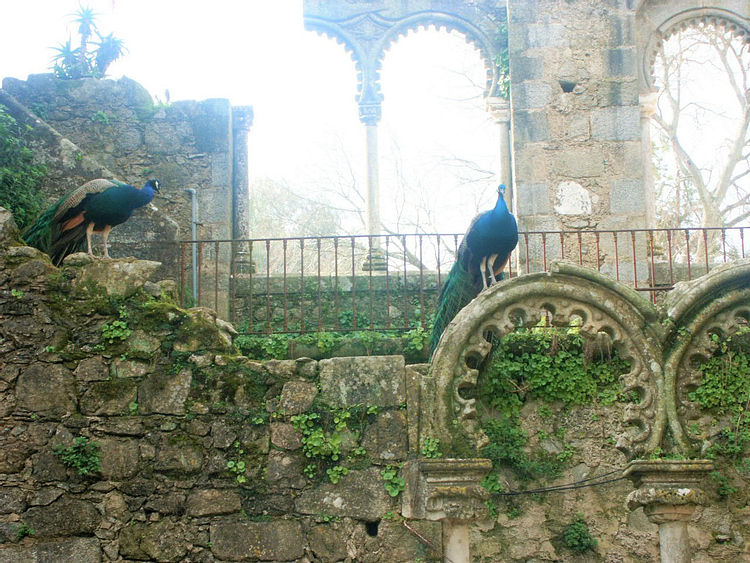
But it is far better to take your time exploring the many historical sites Evora has to offer and enjoy a walk in the *Jardim Publico de Evora* (Evora Public Garden) where you will see peacocks parading their plumage. Since the public garden is not far from the central market, pop in and pick up some *pasteis de toucinho*, which is a sweet pie made with lard, egg, almonds, sugar, and cinnamon. After this, you should have all the energy you need to see Evora's skulls, temples, and churches.
#### Editorial Review
This human-authored article has been reviewed by our editorial team before publication to ensure accuracy, reliability and adherence to academic standards in accordance with our [editorial policy](https://www.worldhistory.org/static/editorial-policy/).
## Bibliography
- [Alarcaon, J. de. *Roman Portugal Volume II& Lagos.* Liverpool University Press, 1988.](https://www.worldhistory.org/books/0856683914/)
- [Birmingham, D. *A Concise History of Portugal.* Cambridge University Press, 2018.](https://www.worldhistory.org/books/1108439551/)
- [Everett-Heath, J. *The Concise Dictionary of World Place-Names.* Oxford University Press, 2005.](https://www.worldhistory.org/books/0198605374/)
- Guerreiro, A. *A Catedral de Évora – Arte e História.* Sé de Évora., 1975
- [Historic Centre of Évora](https://whc.unesco.org/en/list/361 "Historic Centre of Évora"), accessed 14 Feb 2020.
- [Rick Steves: Explore historic Évora, Portugal, from Roman ruins to a chapel of bones](https://www.usatoday.com/story/travel/destinations/2019/04/08/rick-steves-evora-portugal/3398200002/ "Rick Steves: Explore historic Évora, Portugal, from Roman ruins to a chapel of bones"), accessed 13 Feb 2020.
## About the Author
Kim is a freelance writer based in New Zealand. She has a B.A. (Hons) in History and an M.A. in Chaos and Complexity Science. Her special interests include the exploration of the early modern world and the history of science.
- [Facebook Profile](https://www.facebook.com/kim.martins)
- [Linkedin Profile](https://www.linkedin.com/kimsbarcea)
## External Links
- [Catacombs: See Inside The World's Spookiest Crypts](https://allthatsinteresting.com/catacombs)
## Cite This Work
### APA
Martins, K. (2020, February 17). Skulls, Temples & Churches: A Visit to the Walled City of Evora. *World History Encyclopedia*.
### Chicago
Martins, Kim. "Skulls, Temples & Churches: A Visit to the Walled City of Evora." *World History Encyclopedia*, February 17, 2020. .
### MLA
Martins, Kim. "Skulls, Temples & Churches: A Visit to the Walled City of Evora." *World History Encyclopedia*, 17 Feb 2020, .
## License & Copyright
Submitted by [Kim Martins](https://www.worldhistory.org/user/kim.martins/ "User Page: Kim Martins"), published on 17 February 2020. The copyright holder has published this content under the following license: [Creative Commons Attribution-NonCommercial-ShareAlike](https://creativecommons.org/licenses/by-nc-sa/4.0/deed.en). This license lets others remix, tweak, and build upon this content non-commercially, as long as they credit the author and license their new creations under the identical terms. When republishing on the web a hyperlink back to the original content source URL must be included. Please note that content linked from this page may have different licensing terms.