---
title: Religion in the Mongol Empire
author: Mark Cartwright
source: https://www.worldhistory.org/article/1469/religion-in-the-mongol-empire/
format: machine-readable-alternate
license: Creative Commons Attribution-NonCommercial-ShareAlike (https://creativecommons.org/licenses/by-nc-sa/4.0/)
updated: 1970-01-01
---
# Religion in the Mongol Empire
_Authored by [Mark Cartwright](https://www.worldhistory.org/user/markzcartwright/)_
The [Mongol Empire](https://www.worldhistory.org/Mongol_Empire/) (1206-1368 CE) covered Asia from the Black Sea to the Korean peninsula and so naturally included all manner of religions within its borders, but the [Mongols](https://www.worldhistory.org/Mongol_Empire/) themselves had their own particular religious beliefs and rituals, even if there were no priesthoods, no sacred texts, and no public services, except funerals. [Mongol](https://www.worldhistory.org/Mongol_Empire/) [religion](https://www.worldhistory.org/religion/) included a strong element of shamanism mixed with ancestor worship and a belief in natural spirits such as might be found in the elements of fire, earth, and water. Following the [conquest](https://www.worldhistory.org/warfare/) of [China](https://www.worldhistory.org/china/) and conversion of [Kublai Khan](https://www.worldhistory.org/Kublai_Khan/) (r. 1260-1294 CE) many Mongols there adopted Tibetan [Buddhism](https://www.worldhistory.org/buddhism/) which became the official religion of the [Yuan Dynasty](https://www.worldhistory.org/Yuan_Dynasty/) (1271-1368 CE).
[  Khan Tengri Chen Zao (CC BY) ](https://www.worldhistory.org/image/11424/khan-tengri/ "Khan Tengri")### Gods & Spirits
The Mongols believed in the spiritual powers of divine beings and sacred locations. Supreme amongst the gods, although they were likely not envisaged as having any human-like form, were the powers of Heaven and Earth. The Earth or Mother Earth goddess, known as Etugen (aka Itugen), represented fertility. The main cult, though, was to Tengri (aka Gok Monggke Tenggeri), the 'Blue Sky' or 'Eternal Heaven.' This protector [god](https://www.worldhistory.org/God/) was thought to have given the Mongols their right to rule the entire world, and he was often referenced in the opening lines of Mongol edits and other official documents with the phrase *Mongke Tenggiri-[yin](https://www.worldhistory.org/Yin_and_Yang/) Kucun-dur* or 'By the Power of Eternal Heaven.' Prayers were offered to these gods, but in a simple way, without the buildings and ceremonies seen in other religions. Although mountaintops, hill peaks, or simple stone cairns (*ovoo*) were regarded as an especially favourable spot, simply standing in the open air and removing one's hat and belt before prayer were sufficient acts to demonstrate one's submission to the all-powerful.
Directions, places, and natural features were held important by the Mongols because they were considered as contact points with spirits. For example, the doorway of a [yurt](https://www.worldhistory.org/Yurt/) tent was traditionally made to face the south. Natural phenomena, especially thunder and lightning which is particularly impressive on the wide plains of the Asian steppe, were held in awe as the work of the gods. Earth and waters spirits, in particular, acted as protectors; for example, it was thought that moving water such as rivers were capable of blocking and even nullifying evil.
In order to ensure the gods and spirits had a favourable influence on human affairs, certain rituals and taboos were observed. Taboos, designed not to offend any spirits, included not shedding royal blood (considered along with a person's bones to contain the soul), not urinating or washing objects or one's person in rivers, not stepping on the threshold of a yurt tent, and not putting a knife anywhere near a fire. The conventions were taken seriously, and anyone caught breaking them risked severe punishments, even [death](https://www.worldhistory.org/disambiguation/Death/) in some cases. Offenders had to be purified, usually, by walking between two fires, a strategy also used with visiting ambassadors to the Mongol court to ensure that their intentions were honourable and they harboured no evil to the khan rulers.
### Shamanism
Shamans were the nearest thing the Mongols had to a priesthood, and they could be both men (*bo'e*) or, more rarely, [women](https://www.worldhistory.org/disambiguation/women/) (*iduqan*). It was quite common for shamans to pass on their position and skills to their children although one might also become a shaman following a near-death experience or by displaying a particular sensitivity to the spirit world. Essentially, they acted as a tribe's intermediary between this world and the spirit world. The white robes worn by shamans often carried symbols such as a drum and hobby horse, representing the guardian and protector spirit of the Mongol people. Riding a white horse, a shaman might carry an actual drum, wear a mirror around his or her neck or, when walking, use a staff, another symbol of their office.
Shamans went into trances while singing special songs, and it was in this state that they could contact the spirit world. Shamans were believed capable of reading signs such as the cracks which appeared in sheep's shoulder blades and other bones after they had been ritually burnt, allowing them to divine future events (*tolgeci*). Shamans sometimes called on certain animal spirits - particularly powerful animals like the bear and wolf - to help them as they spiritually travelled between the layers of the universe in order to find the location of lost or stolen property or even lost souls. Shamans were often called on to perform rites of exorcism, releasing a troubled or trapped soul into the next life. [Mongol warfare](https://www.worldhistory.org/Mongol_Warfare/) was another area where shamans could help by identifying auspicious dates to begin campaigns, and they gave their views on which strategies of attack might bring the best results.
An ability to alter the weather was another shaman skill, particularly as a bringer of rain to the often arid steppe. Shamans, it was believed, could help with medical problems by returning a troubled spirit back to its rightful body, and they blessed babies, herds, and hunting parties. Shamans were even consulted when electing a new Great Khan or 'universal ruler.' Those shamans who had success in their various predictions achieved a position of great prestige in the local community, sometimes rivalling the tribal chief, a position they sometimes held themselves. On the other hand, a powerful shaman might be seen as rather too influential for some rulers. This was the case with the troublesome shaman Kokchu whom [Genghis Khan](https://www.worldhistory.org/Genghis_Khan/) ordered executed, the method being to break his back and so avoid spilling his blood which might then seep into the ground and entrap his spirit where it would haunt this world and not the next.
### The Afterlife
The Mongols concern to bury their dead with the deceased's weapons and personal possessions indicates some sort of belief in an afterlife. Further support for this belief is the fact that leaders were placed in grandiose tombs, usually of a secret location but somewhere near a sacred mountain like Burkan Kuldun in Mongolia, along with a quantity of riches and slaves. Genghis Khan was given just such a treatment and even had 40 of his concubines and 40 horses sacrificed to accompany him in his [tomb](https://www.worldhistory.org/tomb/). This would suggest that the Mongols considered the afterlife some sort of continuation of this one and so one's social status and even profession continued as before. In addition, physical requirements had to be met, at least for the initial journey there. Curiously, a Mongol tradition was to disembowel a horse and impale it above the gravesite, presumably this was to honour Tengri whose symbol was that animal.
[  Ink Painting of Groom & Horse Metropolitan Museum of Art (Copyright) ](https://www.worldhistory.org/image/11241/ink-painting-of-groom--horse/ "Ink Painting of Groom & Horse")At the same time as sending them on their way, Mongols believed that ancestors (*ongghot*) were not unreachable in a remote afterlife but were capable of overseeing the well-being of their descendants. In gratitude for protection, ancestors were regularly offered small food and drink offerings at mealtimes. In addition, the interior of yurts often displayed pictures or finely dressed effigies representing the family's ancestors. When moving camp, all the group's effigies were placed in the same wagon and then supervised by a shaman.
Mongol rulers had the added bonus that they were considered to have passed on to some sort of divine status, which meant that the laws they had passed and the policies they had pursued had to be respected by their successors. Another peculiarity was the taboo of not using a deceased person's name lest one disturb their spirit. Again, this was particularly so for powerful rulers who were, after their deaths, most often referred to with such simple names as 'The Good', 'Late Khan' or 'Great Lord.'
### Buddhism & Other Religions
As the Mongols expanded their impressive [empire](https://www.worldhistory.org/empire/) so more peoples and more religions came under their control. Missionaries, too, came from China, Tibet, [Persia](https://www.worldhistory.org/Persia/), and [Europe](https://www.worldhistory.org/europe/) to peddle their faiths in the world's largest empire. Nestorian [Christianity](https://www.worldhistory.org/christianity/), Western Christianity, [Islam](https://www.worldhistory.org/islam/), Buddhism, Tibetan Buddhism (Lamaism), [Taoism](https://www.worldhistory.org/Taoism/), and [Confucianism](https://www.worldhistory.org/Confucianism/) were all practised in Mongol-controlled territories. These religions and their converts were largely left to pursue their path of faith (with the exception of the Muslim-dominated [Ilkhanate](https://www.worldhistory.org/Ilkhanate/) in the western part of the empire) provided that the state was never threatened by them. Even [Karakorum](https://www.worldhistory.org/Karakorum/), the Mongol capital during the 13th century CE, for example, had dedicated places of worship for all the major religions then practised in Asia.
[ 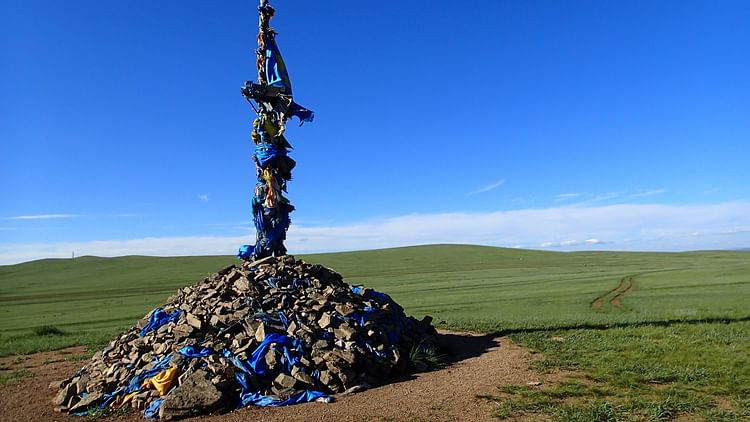 Mongolian Ovoo Johanna Remus (CC BY-NC-ND) ](https://www.worldhistory.org/image/11425/mongolian-ovoo/ "Mongolian Ovoo")In addition to observing their own faith, all subjects within the empire were expected to pray to whichever god they believed in for the well-being of the khan. In return, most priests and religious institutions were made exempt from taxation, either in kind or in the form of labour, and when the Mongols laid siege to [cities](https://www.worldhistory.org/city/), often clerics were permitted to leave before the onslaught began.
Some missionaries even made converts among the Mongols themselves and sometimes rulers and their consorts, too. Kublai Khan converted to Tibetan Buddhism, probably thanks to the Tibetan monk Phags-pa Lama (1235-1280 CE). This form of Buddhism no doubt appealed because of its shamanistic-like elements such as tantric chanting and its mystical references. Tibetan Buddhism was made the official religion of the Mongol Yuan Dynasty in China. The adoption of Lamaism in China led, for a brief period, to the persecution of Taoists and the destruction of their sacred texts from the 1250s CE. However, recognising the long history and widespread popularity of Taoism and Confucianism amongst the Chinese, Yuan emperors abandoned such attacks as detrimental to the economic and political stability of the country. In contrast, Khans, emperors, and imperial women could be generous patrons of certain religions they personally favoured and their institutions, especially [Buddhist](https://www.worldhistory.org/buddhism/) temples.
The general tolerance for other religions and the Mongol's adoption of some of them and adaptation of others while still keeping some of their nomadic and shamanistic roots is a particular feature of religion within their empire as it evolved. As the historian, D. Morgan notes, "The Mongols believed in taking as much celestial insurance as possible" (40).
#### Editorial Review
This human-authored article has been reviewed by our editorial team before publication to ensure accuracy, reliability and adherence to academic standards in accordance with our [editorial policy](https://www.worldhistory.org/static/editorial-policy/).
## Bibliography
- [Broadbridge, A.F. *Women and the Making of the Mongol Empire.* Cambridge University Press, 2018.](https://www.worldhistory.org/books/1108441009/)
- [Buell, P.D. *Historical Dictionary of the Mongol World Empire.* Rowman & Littlefield Publishers, 2018.](https://www.worldhistory.org/books/1538111365/)
- [Lane, G. *Daily Life in the Mongol Empire.* Hackett Publishing Company, Inc., 2009.](https://www.worldhistory.org/books/0872209687/)
- [May, T. *The Mongol Empire.* Edinburgh University Press, 2018.](https://www.worldhistory.org/books/0748642366/)
- [Morgan, D. *The Mongols by David Morgan.* Wiley-Blackwell, 2019.](https://www.worldhistory.org/books/B01FGL17HW/)
- [Saunders, J.J. *The History of the Mongol Conquests.* University of Pennsylvania Press, 2001.](https://www.worldhistory.org/books/0812217667/)
- [Turnbull, S. *Mongol Warrior 1200-1350.* Osprey Publishing, 2003.](https://www.worldhistory.org/books/184176583X/)
## About the Author
Mark is WHE’s Publishing Director and has an MA in Political Philosophy (University of York). He is a full-time researcher, writer, historian and editor. Special interests include art, architecture and discovering the ideas that all civilizations share.
## Cite This Work
### APA
Cartwright, M. (2019, November 01). Religion in the Mongol Empire. *World History Encyclopedia*.
### Chicago
Cartwright, Mark. "Religion in the Mongol Empire." *World History Encyclopedia*, November 01, 2019. .
### MLA
Cartwright, Mark. "Religion in the Mongol Empire." *World History Encyclopedia*, 01 Nov 2019, .
## License & Copyright
Submitted by [Mark Cartwright](https://www.worldhistory.org/user/markzcartwright/ "User Page: Mark Cartwright"), published on 01 November 2019. The copyright holder has published this content under the following license: [Creative Commons Attribution-NonCommercial-ShareAlike](https://creativecommons.org/licenses/by-nc-sa/4.0/deed.en). This license lets others remix, tweak, and build upon this content non-commercially, as long as they credit the author and license their new creations under the identical terms. When republishing on the web a hyperlink back to the original content source URL must be included. Please note that content linked from this page may have different licensing terms.