---
title: Game Review: Aggressors: Ancient Rome
author: Jan van der Crabben
source: https://www.worldhistory.org/article/1410/game-review-aggressors-ancient-rome/
format: machine-readable-alternate
license: Creative Commons Attribution-NonCommercial-ShareAlike (https://creativecommons.org/licenses/by-nc-sa/4.0/)
updated: 1970-01-01
---
# Game Review: Aggressors: Ancient Rome
_Authored by [Jan van der Crabben](https://www.worldhistory.org/user/jvdc/)_
**Genre:** Turn-Based Strategy **Audience:** Hardcore Strategy Gamers **Difficulty:** Hard
[Aggressors: Ancient Rome](https://store.steampowered.com/app/783210/Aggressors_Ancient_Rome/) is a turn-based 4X strategy game in which you control the fate of an ancient [Mediterranean](https://www.worldhistory.org/disambiguation/mediterranean/) state around the time of the [Punic Wars](https://www.worldhistory.org/Punic_Wars/). You build [cities](https://www.worldhistory.org/city/), raise and control armies, engage in diplomacy, [conquer](https://www.worldhistory.org/warfare/) territories, research new technologies and expand your [empire](https://www.worldhistory.org/empire/).
[  Campaign Map in Aggressors: Ancient Rome Jan van der Crabben (CC BY-NC-SA) ](https://www.worldhistory.org/image/10947/campaign-map-in-aggressors-ancient-rome/ "Campaign Map in Aggressors: Ancient Rome")The game is clearly aimed at experienced strategy games. Even though the gameplay is very similar to the [Civilization](https://amzn.to/2IUh4E7) series, it is more complex and the game mechanics are at times obtuse and difficult to understand. In terms of complexity, the game is somewhere in between the [Endless Space](https://amzn.to/2Rlu8Gu) series and the [Europa Universalis](https://amzn.to/2Xp69f0) series. It is one of those games where it is worth reading the manual, even for experienced strategists.
Upon starting the game, the player chooses from a large number of states. The big three are [Rome](https://www.worldhistory.org/Rome/), [Carthage](https://www.worldhistory.org/carthage/) and [Ptolemaic Egypt](https://www.worldhistory.org/Ptolemaic_Egypt/), but the player can also choose smaller states such as [Athens](https://www.worldhistory.org/Athens/) or [Sparta](https://www.worldhistory.org/sparta/), as well as tiny “barbarian” nations from northern [Europe](https://www.worldhistory.org/europe/). Not all states are equally difficult; Rome, Carthage, and [Egypt](https://www.worldhistory.org/egypt/) already have established empires and are technologically advanced (with strong military units) while many smaller nations start with a single [city](https://www.worldhistory.org/city/) and weak units.
[ 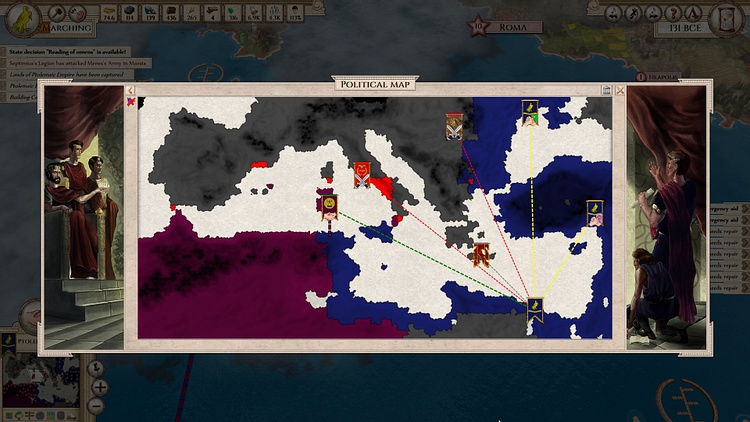 Political Map - Aggressors: Ancient Rome Jan van der Crabben (CC BY-NC-SA) ](https://www.worldhistory.org/image/10948/political-map---aggressors-ancient-rome/ "Political Map - Aggressors: Ancient Rome")This is an indie game and has to be taken as such. Compared to similar big-budget titles like [Civilization](https://amzn.to/2IUh4E7) or [Total War: Rome 2](https://amzn.to/2RouPP4), the game's graphics, [music](https://www.worldhistory.org/disambiguation/Music/), and general atmosphere are lacking. The game feels like it is from a different era, but that is not necessarily a bad thing. It really does add some charm to the game.
What the game really excels in is —quite surprisingly— its AI. The computer plays well, even on easy difficulty, and manages to outmanoeuvre the player's armies. Just like in history, Rome seems to always get out on top, while the smaller states get eaten up by their bigger neighbours. This way, towards the end of the game, the player is facing a few large empires. The typical “oh I have won anyway” point that you often encounter in [Civilization](https://amzn.to/2IUh4E7) or [Total War](https://amzn.to/2RouPP4) rarely occurs in this game.
Diplomacy and [trade](https://www.worldhistory.org/disambiguation/trade/) work pretty much as expected from other games. You can make proposals, deals, alliances, and exchange resources. One mechanic that is quite nice is the fact that the AI sometimes offers to become a vassal state of a larger neighbour. The larger state then controls cities and armies of the vassal state. Surprisingly, the AI also sometimes offers to become vassal of the player, which is extremely rare in many other games.
[ 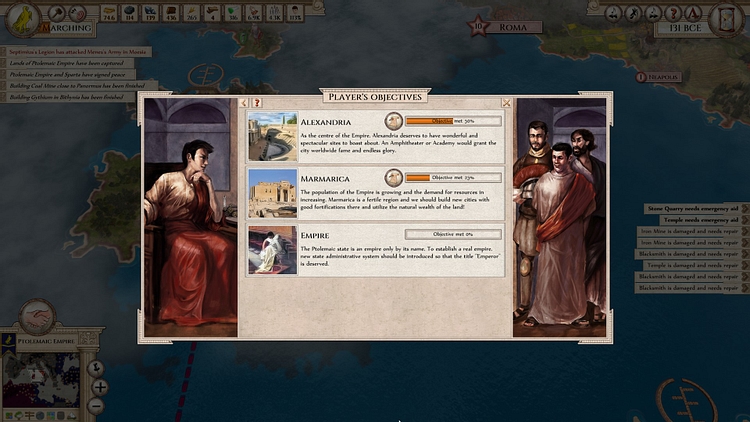 Objectives - Aggressors: Ancient Rome Jan van der Crabben (CC BY-NC-SA) ](https://www.worldhistory.org/image/10949/objectives---aggressors-ancient-rome/ "Objectives - Aggressors: Ancient Rome")Like in many other games, there are several ways the player can win the game, the most straightforward being military [conquest](https://www.worldhistory.org/warfare/). However, there are also political and economic options for victory available.
The game's 3D graphics look like they were made about ten years ago, and some of the 2D graphics are taken straight from online sources. For example, one of the technology icons is a straight copy of a [Hoplite](https://www.worldhistory.org/hoplite/) illustration from Wikipedia. The music is also not amazing. Even though many songs attempt to create an ancient ambience, they sound very computer-generated, like a computer game from the 1990s.
The game's controls are also at times counterintuitive. For example, in most games left-click means select and right-click means action. However, the developers of *Aggressors* decided that right-click would deselect and left-click would be used for both selection and action. Strange! There are many other smaller usability issues like this, but none of them will stop you from enjoying the game.
As I have mentioned before, the game is difficult. It took me more attempts and several evenings to feel that I have come to grips with most of the game's mechanics. And then only a few evenings later I googled how population growth (an important mechanic) works and only by reading the developers' explanation on a forum was I able to get to grips with that, too.
Despite these issues, this indie game is fun to play and I would recommend it… if you are up for a challenge, that is. You can take a deep dive into the ancient world and get hooked on empire-building with this game. Its setting alone will surely appeal to our readers, after all!
[Get the Game on Steam](https://store.steampowered.com/app/783210/Aggressors_Ancient_Rome/)
***Disclaimer:** The author received a free game code to review this game. The author has previously professionally worked on the competitor game series Total [War](https://www.worldhistory.org/disambiguation/War/).*
#### Editorial Review
This human-authored article has been reviewed by our editorial team before publication to ensure accuracy, reliability and adherence to academic standards in accordance with our [editorial policy](https://www.worldhistory.org/static/editorial-policy/).
## About the Author
Jan is the Founder & Chairman of World History Encyclopedia and is the organisation's Director of Design & Technology. He holds an MA War Studies from King's College, and he has worked in the field of history-related digital media since 2006.
- [Linkedin Profile](https://www.linkedin.com/in/janvdc)
## Cite This Work
### APA
Crabben, J. v. d. (2019, June 27). Game Review: Aggressors: Ancient Rome. *World History Encyclopedia*.
### Chicago
Crabben, Jan van der. "Game Review: Aggressors: Ancient Rome." *World History Encyclopedia*, June 27, 2019. .
### MLA
Crabben, Jan van der. "Game Review: Aggressors: Ancient Rome." *World History Encyclopedia*, 27 Jun 2019, .
## License & Copyright
Submitted by [Jan van der Crabben](https://www.worldhistory.org/user/jvdc/ "User Page: Jan van der Crabben"), published on 27 June 2019. The copyright holder has published this content under the following license: [Creative Commons Attribution-NonCommercial-ShareAlike](https://creativecommons.org/licenses/by-nc-sa/4.0/deed.en). This license lets others remix, tweak, and build upon this content non-commercially, as long as they credit the author and license their new creations under the identical terms. When republishing on the web a hyperlink back to the original content source URL must be included. Please note that content linked from this page may have different licensing terms.