---
title: Greek Temples of Sicily
author: Heinrich Hall
source: https://www.worldhistory.org/article/1402/greek-temples-of-sicily/
format: machine-readable-alternate
license: Creative Commons Attribution-NonCommercial-ShareAlike (https://creativecommons.org/licenses/by-nc-sa/4.0/)
updated: 1970-01-01
---
# Greek Temples of Sicily
_Authored by Heinrich Hall_
There are at least a thousand reasons to visit [Sicily](https://www.worldhistory.org/sicily/), the great island – indeed the largest in the [Mediterranean](https://www.worldhistory.org/disambiguation/mediterranean/) – that forms the triangular football to the boot that is the Italian peninsula. They are all very good reasons, including amazing landscapes, a uniquely complex and delicious cuisine, a history that is diverse and multifaceted beyond belief, excellent wines, a vast array of archaeological sites, an even vaster one of historical towns and villages. But one key reason to visit the island is missing from the list above: [Greek](https://www.worldhistory.org/disambiguation/greek/) temples!
[  Doric Temple, Segesta Heinrich Hall (CC BY-NC-SA) ](https://www.worldhistory.org/image/10927/doric-temple-segesta/ "Doric Temple, Segesta")Greek temples are one of the earliest well-defined expressions of what we now recognise as the Western tradition in [architecture](https://www.worldhistory.org/disambiguation/architecture/), and one of the most influential ones by a vast margin to this day. They go back to the 8th or 7th centuries BCE, and, as the name entails, they are indeed a key achievement of the [Archaic](https://www.worldhistory.org/disambiguation/Archaic/) Greeks. They originated in what is the south of modern [Greece](https://www.worldhistory.org/greece/), namely the [Peloponnese](https://www.worldhistory.org/Peloponnese/) and Central Greece, where Greek [temple](https://www.worldhistory.org/temple/) architecture appears to have its main roots, probably derived from local wooden predecessors.
#### Magazine Syndication
[](http://bit.ly/timeless-travels "Timeless Travels Magazine")### Timeless Travels Magazine
Available in Print & Digital Editions This article was first published in Timeless Travels Magazine and republished with permission. Timeless Travels is the unique travel magazine for those who are inspired to travel by their love or interest in archaeology, history or art. Our editorial team highly recommends this magazine! [Get the Magazine](http://bit.ly/timeless-travels)
.button_container {
margin-top: 2em;
}
.sponsor.book h3 {
text-transform: none;
margin-top: 0px;
margin-bottom: 15px;
font-family: "Libre Baskerville", "Palatino Linotype", "Book Antiqua", Palatino, serif;
}
.sponsor_message {
margin-left: 190px;
font-family: Karla, Arial, Helvetica, sans-serif;
line-height: 140%;
min-height: 200px;
}
.sponsor.book {
padding: 10px 0px 25px 0px;
margin: 25px 0px;
border-top: 1px dotted #dadada;
border-bottom: 1px dotted #dadada;
}
.sponsor.book .key_art {
margin-top: 0px;
margin-bottom: 10px;
float: left;
border: 1px solid #f3f3f3;
}
.sponsor h4 {
font-weight: normal;
text-transform: uppercase;
color: silver;
margin-bottom: 10px;
margin-top: 0px;
font-family: Karla,Arial,Helvetica,sans-serif;
font-size: 13px;
padding: 0;
}
.sponsor_book_author {
color: silver;
margin: -10px 0px 20px;
}
@media (max-width: 1199px) {
.sponsor.book .key_art {
float: none;
width: 100%;
}
.sponsor.book .sponsor_message {
margin-left: 0px;
}
.sponsor.book h3 {
margin-top: 20px;
margin-bottom: 10px;
}
}
@media (max-width: 767px) {
}
The Greek mainland's architectural style is the Doric one, considered to be the most austere and 'male' in character. The eastern [Aegean](https://www.worldhistory.org/aegean/) and [Asia Minor](https://www.worldhistory.org/Asia_Minor/) were famous for their own development, the more elegant and 'female' Ionic style, conceived about a century after the Doric one. Its most prominent examples at [Samos](https://www.worldhistory.org/samos/), [Ephesus](https://www.worldhistory.org/ephesos/), and Didyma (much better preserved than the other two) are also marked by their vast monumental size. What is so remarkable about the Greek temples of Sicily then?
The short answer is simply that Sicily possessed a greater density of monumental temples than any other area of the Mediterranean and now contains more well-preserved examples than anywhere else. Not only do they make for an unusually rich ensemble of particularly impressive ancient monuments but, moreover, each of them has its own distinctive character and peculiar features, its own history, and its own specific setting within a town or landscape.
### [Greek Colonization](https://www.worldhistory.org/Greek_Colonization/)
The reason for Sicily's wealth in such a specific type of monument lies in the early history of the island. In the 8th century BCE, Sicily became a target of the movement known as Greek colonisation, which affected much of the Mediterranean and the Black Sea. Greek settlers, mostly from the [city](https://www.worldhistory.org/city/)-states of the southern Greek mainland, set off to found a whole series of new [cities](https://www.worldhistory.org/city/) on the island, including Syrakousai (modern [Syracuse](https://www.worldhistory.org/syracuse/)), [Akragas](https://www.worldhistory.org/agrigento/) ([Agrigento](https://www.worldhistory.org/agrigento/)), Messene (Messina) and [Selinus](https://www.worldhistory.org/Selinus/) ([Selinunte](https://www.worldhistory.org/Selinus/)). In fact, Sicily (and the south of the Italian mainland) received so many Greek colonies that the region was later called Megale Hellas or [Magna Graecia](https://www.worldhistory.org/Magna_Graecia/) ('Great Greece').
[  Temple of Juno, Agrigento Mark Cartwright (CC BY-NC-SA) ](https://www.worldhistory.org/image/2625/temple-of-juno-agrigento/ "Temple of Juno, Agrigento")These settlers brought their Greek identity, lifestyle, [culture](https://www.worldhistory.org/disambiguation/culture/), and traditions with them, a package that also included their [religion](https://www.worldhistory.org/religion/). The great temples of Sicily are the most striking expression of that package. First of all, they fulfilled the practical need of providing a place of worship or sanctuary with a house for the statue of the respective [god](https://www.worldhistory.org/God/) or goddess. At the same time, the choice of an architectural type from the 'motherland', the Doric temple, served as a clear indication of the colonists' background and cultural alignment. Soon, the size, format, and individual characteristics also began to express the 'new' cities' wealth, ambition, and specific Sicilian identities.
### Syracuse
Syracuse (Syrakousai), founded by Corinthians in 733 BCE, was originally limited to the small island of Ortygia, which is still the heart of its Old Town and two major temples are found on the islet.
The temple of [Apollo](https://www.worldhistory.org/apollo/) is one of the oldest among the Greek temples of Sicily, built before
550 BCE. Although it is only partially preserved, its monumental character is still appreciable through the closely placed thick columns, as is its already very Sicilian plan, with an *adyton*, an inner holy-of-holies housing the statue of Apollo, at the back of the internal sanctuary. An inscription on the front steps names Kleomenes as its architect and Epikles as the creator of the columns – such a proud commemoration of the builders would have been unthinkable in mainland Greece at that time.
For the modern visitor, the temple of Apollo at Syracuse is outshone by that of Athena, one of the most spectacular sights in Sicily. Erected by the local tyrant Gelon after a great victory over the Carthaginians in 480 BCE, this was another monumental Doric temple, built of local limestone (which would have been covered in fine stucco), with a superstructure of marble imported from the [Cyclades](https://www.worldhistory.org/Cyclades/), some 900 km (550 miles) away. What makes the temple of Athena unique, is the fact that it still serves as a place of worship for its city after nearly 2,500 years. It was rededicated as a Christian church around 600 CE, later served as a mosque, and now is Syracuse's [Roman](https://www.worldhistory.org/disambiguation/Roman/) Catholic cathedral. Hidden behind an ornate baroque façade, the visitor finds what is essentially an Early Christian basilica built into and around the basic structure of a Late Archaic Doric temple.
### Agrigento
Agrigento (Akragas) was settled by people from nearby [Gela](https://www.worldhistory.org/Gela/) and from faraway [Rhodes](https://www.worldhistory.org/Rhodes/) around 582 BCE. The city flourished, especially in 6th and 5th centuries BCE, after which it frequently changed hands between Greeks and Carthaginians before eventually falling to [Rome](https://www.worldhistory.org/Rome/). During its heyday, Akragas appears to have spent a lot of resources on lavish architecture, a fact criticised by the 5th-century BCE philosopher [Empedocles](https://www.worldhistory.org/Empedocles/), who was himself a citizen there: "The Agrigentines live delicately as if tomorrow they would die, but they build their houses well as if they thought they would live for ever". Indeed, Akragas is known to have had at least ten large temples.
[  Temple of Concordia, Agrigento Mark Cartwright (CC BY-NC-SA) ](https://www.worldhistory.org/image/2624/temple-of-concordia-agrigento/ "Temple of Concordia, Agrigento")The most impressive of them today is the one traditionally called the Temple of Concordia, although its deity remains unknown. Dated to c. 425 BCE, it is among the last of the Greek temples of Sicily to be completed. It counts as one of the three most completely preserved Greek temples across the ancient world (the others being the so-called Temple of [Poseidon](https://www.worldhistory.org/poseidon/) at [Paestum](https://www.worldhistory.org/Paestum/) near Naples and that of [Hephaistos](https://www.worldhistory.org/Hephaistos/) in [Athens](https://www.worldhistory.org/Athens/)). The inner shrine, outer colonnades and pediments all survive in what is essentially their original state, showcasing the fine proportions of Classical architecture. Its good preservation is thanks to its early conversion into a Christian church.
Also visible at Agrigento are substantial remains of three further large temples, including the structure known (probably falsely) as the Temple of [Hera](https://www.worldhistory.org/Hera/). The most noteworthy of them, however, must be the huge Temple of Olympian [Zeus](https://www.worldhistory.org/zeus/), of which only foundations and fallen masonry survive. Built by the local tyrant Theron (brother of the aforementioned Gelon) after the 480 BCE victory, it was dedicated to the chief god. While modelled on the idea of the Doric temple, it was in fact a highly unusual structure for several reasons, including its huge dimensions (110 x 52 metres or 360 x 170 feet), its partially walled-off colonnade, and the use of massive block-built atlantids, relief figures of [giants](https://www.worldhistory.org/Giants/) to support the superstructure. Some scholars have interpreted the Temple of Olympian Zeus as a hybrid of a Greek Doric exterior and a more Carthaginian/Phoenician interior.
[ 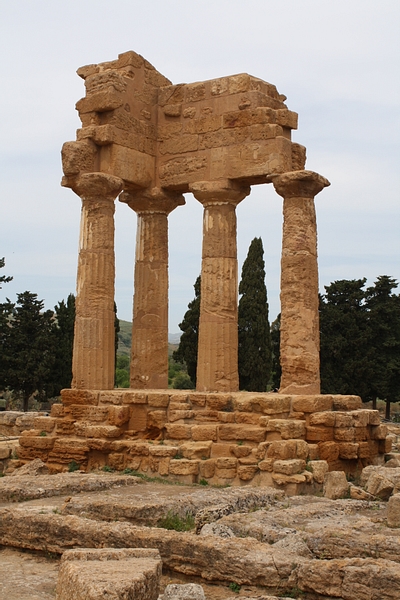 Temple of the Dioscuri, Agrigento Mark Cartwright (CC BY-NC-SA) ](https://www.worldhistory.org/image/2626/temple-of-the-dioscuri-agrigento/ "Temple of the Dioscuri, Agrigento")### Selinunte
Selinunte (Selinus) is located in the far west of Sicily. It was founded in 628/627 BCE by Sicilian Greeks from Gela, with some involvement from [Megara](https://www.worldhistory.org/disambiguation/Megara/) near Athens. In many ways, it was an outpost among the Greek cities of Sicily, located close to the Phoenician/Carthaginian centres of power. This did certainly not stop its inhabitants from engaging in the construction of temples: we know of at least seven, several of them of massive dimensions.
[ 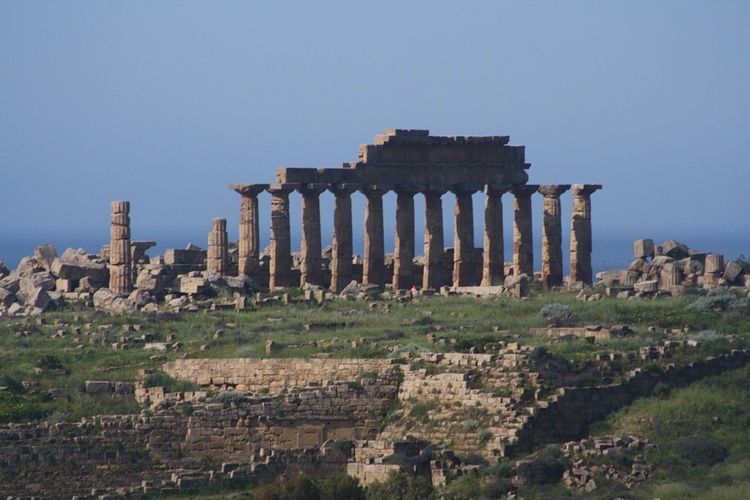 Temple C, Selinus Mark Cartwright (CC BY-NC-SA) ](https://www.worldhistory.org/image/2606/temple-c-selinus/ "Temple C, Selinus")Four were located on the [acropolis](https://www.worldhistory.org/Acropolis/), the hilltop citadel of the city. One of them, Temple C, is still very impressive. We do not know what deity was worshipped at Temple C, of which one side is preserved. It dates to before 550 BCE. It shares some similarities with the slightly older temple of Apollo at Syracuse, such as the *adyton* at the western end of the sanctuary, housing a statue of its god or goddess. Nonetheless, its columns and overall proportions are more graceful. Especially impressive, however, are the grooves that allowed the huge [bronze](https://www.worldhistory.org/disambiguation/bronze/) doors at its eastern end to open and close. It was approached via a monumental stairway of eight steps, the oldest we know in the Greek World. The museum at Palermo holds examples of its rich sculptural decoration.
[  Temple of Hera, Selinus Mark Cartwright (CC BY-NC-SA) ](https://www.worldhistory.org/image/2600/temple-of-hera-selinus/ "Temple of Hera, Selinus")A second group of three huge temples stood just to the east of Selinunte, by its harbour. Two, G and F, lie in ruins, but the third, temple E stands proud, partially as the result of modern reconstructions. This was the temple of Hera, wife (and sister) of Zeus and goddess of matrimony. From the mid-5th century BCE, this temple incorporated a strong influence from the Greek motherland, where the style we now call 'Classical' was then in full swing, while also following Sicilian architectural traditions. Temple E is characterised by a harmony of proportion that is unusual among the great temples of Sicily. Its sculptural decoration, while modest in quantity, is among the finest achievements of Greek art in Sicily. Overall, it is strongly reminiscent of the very slightly older and far less well-preserved temple of Zeus in [Olympia](https://www.worldhistory.org/Olympia/), a site that would have been familiar to many Sicilian Greeks, due to the athletic competitions held there every four years.
### [Segesta](https://www.worldhistory.org/Segesta/)
Segesta, inland from Sicily's northwestern extremity, is in a way the odd one out among the cities mentioned here. It was not the product of Greek colonisation but founded in the mists of time by Elymians, a local Sicilian tribe. Throughout its history, it chose a role between the Greek and Carthaginian spheres, adopting aspects of [Greek culture](https://www.worldhistory.org/disambiguation/Greek_Culture/), but not necessarily allying itself with its Greek neighbours. Segesta was in constant conflict with nearby Selinus. Nevertheless, late in the 5th century BCE, the Segestans engaged in the construction of a fine Doric temple on a hill outside their city, probably using expert builders from their rival and enemy Selinus. Perhaps due to the outbreak of [war](https://www.worldhistory.org/disambiguation/War/), it was never completed. Its remains look complete at first sight, with the exterior colonnades and pediments in place. On a closer look, one notes that the delicate [column](https://www.worldhistory.org/column/) flutings and other sculptural details were not applied and that the temple is lacking an interior sanctuary.
[  Doric Temple, Segesta Mark Cartwright (CC BY-NC-SA) ](https://www.worldhistory.org/image/2597/doric-temple-segesta/ "Doric Temple, Segesta")So while there are many reasons to visit Sicily, which include its wonderful climate, food, and wine, hopefully you will agree that its temples, full of ancient splendour and beauty, are definitely a priority.
You can explore these temples and much else in Sicily with [Peter Sommer Travels](http://www.petersommer.com), a UK-based tour operator specialising in expert-led archaeological and cultural tours in Sicily and on the Italian mainland and in [Turkey](https://www.worldhistory.org/Asia_Minor/), Greece and Croatia.
#### Editorial Review
This human-authored article has been reviewed by our editorial team before publication to ensure accuracy, reliability and adherence to academic standards in accordance with our [editorial policy](https://www.worldhistory.org/static/editorial-policy/).
## Cite This Work
### APA
Hall, H. (2019, June 25). Greek Temples of Sicily. *World History Encyclopedia*.
### Chicago
Hall, Heinrich. "Greek Temples of Sicily." *World History Encyclopedia*, June 25, 2019. .
### MLA
Hall, Heinrich. "Greek Temples of Sicily." *World History Encyclopedia*, 25 Jun 2019, .
## License & Copyright
Original article by **Heinrich Hall**. Submitted by [Wanda Marcussen](https://www.worldhistory.org/user/wanda.marcussen/ "User Page: Wanda Marcussen"), published on 25 June 2019. The copyright holder has published this content under the following license: [Creative Commons Attribution-NonCommercial-ShareAlike](https://creativecommons.org/licenses/by-nc-sa/4.0/deed.en). This license lets others remix, tweak, and build upon this content non-commercially, as long as they credit the author and license their new creations under the identical terms. When republishing on the web a hyperlink back to the original content source URL must be included. Please note that content linked from this page may have different licensing terms.