---
title: The Nazca Lines: A Life's Work
author: Ana Maria Cogorno Mendoza
source: https://www.worldhistory.org/article/1395/the-nazca-lines-a-lifes-work/
format: machine-readable-alternate
license: Creative Commons Attribution-NonCommercial-ShareAlike (https://creativecommons.org/licenses/by-nc-sa/4.0/)
updated: 1970-01-01
---
# The Nazca Lines: A Life's Work
_Authored by Ana Maria Cogorno Mendoza_
*The World Heritage-listed [Nazca lines](https://www.worldhistory.org/article/665/nazca-lines/) are a well-known part of the ancient heritage of Peru. One woman spent over 50 years studying and protecting them. Ana Maria Cogorno Mendoza shares the story of Dr Maria Reiche.*
The[ lines and geoglyphs of ](https://www.ancient.eu/article/665/nazca-lines/)*[Nazca](https://www.ancient.eu/article/665/nazca-lines/)* are one of the most impressive-looking archaeological areas in the world and an extraordinary example of the traditional and millenary magical-religious world of the ancient Pre-Hispanic societies. They are located in the desert plains of the basin river of *Rio Grande de [Nazca](https://www.worldhistory.org/Nazca_Civilization/)*, the archaeological site covering an area of approximately 75,358.47 hectares.
For nearly 2,000 uninterrupted years, the region's ancient inhabitants drew thousands of large-scale zoomorphic and anthropomorphic figures and lines on the arid ground - animals, birds, insects, other living creatures and flowers, plants and trees, as well as geometric shapes and miles of lines of deformed or fantastic figures. In 1939 CE they were rediscovered and a year later, Dr Maria Rieche, began a lifetime of study and protection of these remarkable sites.
[ 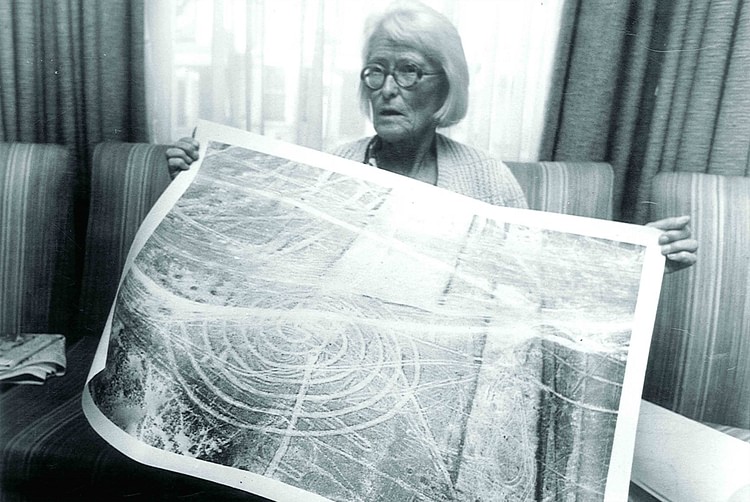 Maria Reiche The Maria Reiche Foundation (See Original Source) ](https://www.worldhistory.org/image/10863/maria-reiche/ "Maria Reiche")The impressive story of the Pre-Hispanic [culture](https://www.worldhistory.org/disambiguation/culture/) in Peru dates back to before the arrival of the Spanish [Conquest](https://www.worldhistory.org/warfare/) (1532 – 1572 CE). Over many centuries, ancient civilisations created a vast array of wonderful monuments all over Peru, but all of them had in common an astronomical connection. These cultures developed advanced techniques of [agriculture](https://www.worldhistory.org/disambiguation/Agriculture/), [gold](https://www.worldhistory.org/gold/) and [silver](https://www.worldhistory.org/Silver/) work, [pottery](https://www.worldhistory.org/pottery/), metallurgy and weaving. Some of the social structures from the 12th century CE formed the basis of the later [Inca](https://www.worldhistory.org/Inca_Civilization/) [Empire](https://www.worldhistory.org/empire/).
In the arid coastal plain, 400 km south of *Lima*, in the department of *Ica*, we find one of the oldest, most extraordinary civilisations: the *Paracas* culture. This culture flourished on the southern Pacific coast of the central Andes around 600 - 150 BCE and is one of the earliest known complex societies in Peru. The great *Paracas* Necropolis was discovered by archaeologist Dr Julio C Tello. In 1927 CE, he discovered 429 mummy bundles in *Cerro Colorado* in the *Paracas* Peninsula. In the vast communal [burial](https://www.worldhistory.org/burial/) site, he found these mummy bundles, each with their body in the foetal position and bound with cords. They were wrapped in many layers of wonderful woven textiles, considered some of the finest ever produced, and dated to around 300 - 200 BCE.
The *Paracas* Peninsula is a desert within the boundaries of the *Paracas* National Reservation, a marine reserve which extends south along the coast. The only marine reserve in Peru, it is a designated UNESCO World Heritage Site. This Protected Natural Area is considered one of the strangest and richest ecosystems in the world and is home to colonies of sea lions and thousands of resident and migratory sea birds, including pelicans, flamingos, boobies, cormorants, terns, gulls, and in summer, condors.
#### Magazine Syndication
[](http://bit.ly/timeless-travels "Timeless Travels Magazine")### Timeless Travels Magazine
Available in Print & Digital Editions This article was first published in Timeless Travels Magazine and republished with permission. Timeless Travels is the unique travel magazine for those who are inspired to travel by their love or interest in archaeology, history or art. Our editorial team highly recommends this magazine! [Get the Magazine](http://bit.ly/timeless-travels)
.button_container {
margin-top: 2em;
}
.sponsor.book h3 {
text-transform: none;
margin-top: 0px;
margin-bottom: 15px;
font-family: "Libre Baskerville", "Palatino Linotype", "Book Antiqua", Palatino, serif;
}
.sponsor_message {
margin-left: 190px;
font-family: Karla, Arial, Helvetica, sans-serif;
line-height: 140%;
min-height: 200px;
}
.sponsor.book {
padding: 10px 0px 25px 0px;
margin: 25px 0px;
border-top: 1px dotted #dadada;
border-bottom: 1px dotted #dadada;
}
.sponsor.book .key_art {
margin-top: 0px;
margin-bottom: 10px;
float: left;
border: 1px solid #f3f3f3;
}
.sponsor h4 {
font-weight: normal;
text-transform: uppercase;
color: silver;
margin-bottom: 10px;
margin-top: 0px;
font-family: Karla,Arial,Helvetica,sans-serif;
font-size: 13px;
padding: 0;
}
.sponsor_book_author {
color: silver;
margin: -10px 0px 20px;
}
@media (max-width: 1199px) {
.sponsor.book .key_art {
float: none;
width: 100%;
}
.sponsor.book .sponsor_message {
margin-left: 0px;
}
.sponsor.book h3 {
margin-top: 20px;
margin-bottom: 10px;
}
}
@media (max-width: 767px) {
}
### The Nazca Lines
One of the most sophisticated of the early Peruvian cultures is the pre-Hispanic *Nazca* [civilisation](https://www.worldhistory.org/civilization/), known for the carvings which they etched onto the surface of the ground between 400 BCE and 650 CE. The builders of these magic and mysterious lines and geoglyphs of *Nazca* and *Palpa* created a sacred place. The geoglyphs are one of the most unique and extraordinary artistic achievements, unrivalled in their diversity and dimensions, anywhere in the world. In the arid Peruvian coastal plains, 450 km south of *Lima*, in the high and arid plateau of the basin of *Rio Grande*, the area stretches 50 km between the towns of *Palpa* and *Nazca*.
[  Nazca Line Monkey Maria Reiche (Public Domain) ](https://www.worldhistory.org/image/10829/nazca-line-monkey/ "Nazca Line Monkey")The *Nazca* plain is unique in its preservation due to the combination of the climate, one of the driest in the world, with little rainfall each year, and the flat stony ground which minimises the effect of the wind at ground level. Beneath the desert's crust of pebbles, which contain ferrous oxide, is a lighter-coloured subsoil. The exposure over centuries has given the crust of pebbles a dark patina. When the dark gravel is removed, it contrasts with the paler-coloured soil underneath.
In this way, the lines were drawn as furrows of a lighter colour, even though in some cases they became prints. In other cases, the stones defining the lines and drawings form small lateral humps of different sizes. Some drawings, especially the early ones, were made by removing the stones and gravel from their contours and in this way the figures stood out in high relief. The concentration and juxtaposition of the lines and drawings leave no doubt that they required intensive long-term labour, as is demonstrated by the stylistic continuity of the designs, which clearly correspond to the different stages of cultural changes.
The images represent a remarkable manifestation of a common [religion](https://www.worldhistory.org/religion/) and social homogeneity that lasted a considerable period of time. They are the most outstanding group of geoglyphs anywhere in the world and are unmatched in their extent, magnitude, quantity, size, diversity and ancient tradition. The concentration and juxtaposition of the lines, as well as their cultural continuity, demonstrate that this was an important and long-lasting activity, lasting approximately 1,000 years.
[  Maria Reiche with Paul Kosok The Maria Reiche Foundation (See Original Source) ](https://www.worldhistory.org/image/10862/maria-reiche-with-paul-kosok/ "Maria Reiche with Paul Kosok")Apart from the anthropomorphic figures, the lines, which are generally straight lines, criss-cross certain parts of the *pampas* in all directions. Some are several kilometres in length and form designs of many different geometrical figures, triangles, spirals, rectangles and wavy lines. Others radiate from a central promontory or encircle it. Another group consists of so-called '"tracks", which appear to have been laid out to accommodate large numbers of people.
This unique and magnificent artistic achievement of the Andean culture is unrivalled in its extension, dimensions and diversity and long existence anywhere in the prehistoric world. The designs are laid out with outstanding geometric precision, transforming the vast land into the highly symbolic, ritualistic and social-cultural landscape that remains to this day.
Quite apart from the geometric shapes and several zoomorphic designs, what it is amazing is the abstract conception of the designs, which demonstrate a perfect harmony. The inspiration of their work suggests they may have been ritual offerings to a goddess, which even now relates to extraordinary natural celestial events.
[  Nazca Line Hummingbird Tobias Lange (CC BY-NC-SA) ](https://www.worldhistory.org/image/2366/nazca-line-hummingbird/ "Nazca Line Hummingbird")One of the best known of the prehistoric geoglyphs, called *El Candelabro* (the Trident), is 600 feet tall and can be seen from twelve miles out to sea. It is on the slope of a hill facing the ocean and was created by the *Paracas* people by removing the top layer to reveal the lighter layer underneath in low relief. This geoglyph is related to the geoglyphs, lines and figures of *Nazca*. When archaeologist Dr Maria Reiche was measuring the geoglyphs she found pieces of broken pottery belonging to the *Paracas* people on the site. Although the exact age of the design is still unknown, Dr Reiche analysed the broken pottery through carbon dating to around 200 BCE.
What is interesting is that the design looks out towards the ocean from the hillside. It is amazing to see how the *Paracas* people observed where to place the figure for good natural conservation, with the salt of the sea breeze, the sun and the strong wind making a perfect crust of layers to create a patina over hundreds of years.
The wise men of the *Paracas* culture, fathers of the *Nazca* people, were great astronomers. They observed celestial events and realised the importance of time, nature, and cosmos. Almost all their temples were near the ocean, mountains, rivers, hills and valleys, which were considered sacred and alive. Their [philosophy](https://www.worldhistory.org/philosophy/) was for a peaceful way of life. *El Candelabro* has a special appearance when rain has fallen, as the patina of salt which naturally conserves the figure can be seen.
[ 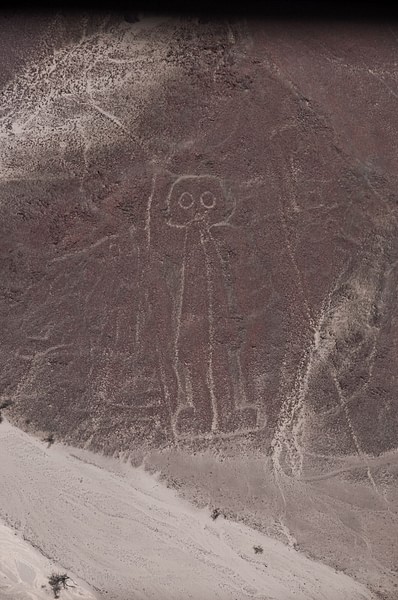 Nazca Line Human Figure Tobias Lange (CC BY-NC-SA) ](https://www.worldhistory.org/image/2368/nazca-line-human-figure/ "Nazca Line Human Figure")The system of lines and geoglyphs, which has survived intact for more than two millennia, evidences an unusual way of using the land and the natural environment that represents a highly symbolic cultural landscape. The construction technology allowed them to design large-scale figures with outstanding geometric precision. Set in their surrounding landscape they create a harmonious relationship that has survived virtually unaltered over the centuries.
The authenticity of the lines and geoglyphs of *Nazca* is indisputable. The method of their formation, by removing the overlying weathered gravels to reveal the lighter bedrock, is such that their authenticity is assured. The creation, design, morphology, size and variety of the geoglyphs and lines correspond to the original designs produced during the historical evolution of the regions and have remained unchanged. The ideology, symbolism and sacred and ritual character of the geoglyphs and the landscape are clearly represented, and their significance remains intact even today.
### Dr Maria Reiche
Dr Maria Reiche was born on May 15, 1903 CE in Dresden, Germany, where she graduated in Mathematics, Geography and Astronomy, as well as speaking five languages. In 1932 CE she arrived in Peru to work in *[Cusco](https://www.worldhistory.org/Cuzco/)* [city](https://www.worldhistory.org/city/) as a teacher to the sons of the German Consulate, where she lived for three years.
[  Maria Reiche in 1910 Fotógrafo de 1910 (Public Domain) ](https://www.worldhistory.org/image/10828/maria-reiche-in-1910/ "Maria Reiche in 1910")Her first astronomical investigation was at *[Machu Picchu](https://www.worldhistory.org/Machu_Picchu/)* in the *Intihuatana* [temple](https://www.worldhistory.org/temple/). The notable ritual stone related to an astronomical clock or calendar; it was aligned with the sun's position during the winter solstice. She carried out more important astronomical research near *Lima*, perhaps one of the most important contributions to [archaeology](https://www.worldhistory.org/Archaeology/), relating to the astronomical positions of the religious temple. Established in 200 CE, the temple's main power lay in its deity *[Pachacamac](https://www.worldhistory.org/Pachacamac/)*, the 'Earth Maker' creator [god](https://www.worldhistory.org/God/), who made the earth tremble and brought life to everything in the universe.
It was not until the 20th century CE, however, that the *Nazca* lines drawn in the sand were actually discovered. Peruvian archaeologist *Toribio Mejía Xesspe* first saw the lines in 1927 CE after finding them almost by accident, since they are practically invisible at the surface. He assumed that they were “sacred pathways”.
In 1939 CE, [Paul](https://www.worldhistory.org/disambiguation/Paul/) Kosok, an American professor in History at Long Island University in New York and the main expert on irrigation systems of ancient cultures of the world, came to Peru. He was interested in the irrigation system in the *Nazca* region and became the first scholar to explore the lines in depth. The following year, he introduced Maria Reiche to the site and a new hypothesis soon developed. They happened to be standing near one of the long straight lines at sunset when they both made a discovery that would change their lives.
[ 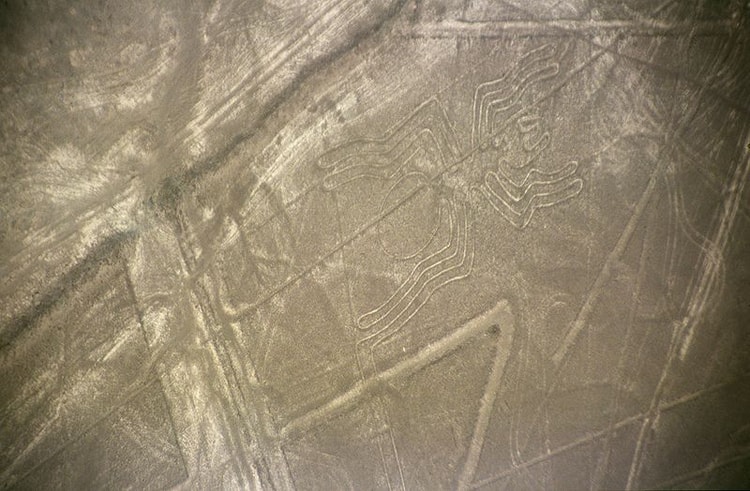 Nazca Line Spider Colegota (CC BY-SA) ](https://www.worldhistory.org/image/10864/nazca-line-spider/ "Nazca Line Spider")This happened on June 21, 1939 CE, the southern hemisphere's shortest day of the year. Kosok and Reiche noticed that the sun was setting almost exactly over the end of one of the *Nazca* Lines, so it appeared to be a solstice line. Pronouncing the lines “the largest astronomy book in the world”, Kosok then took aerial photographs in order to get a complete overview. The following December, on the summer solstice, Reiche also found such lines and, captivated by the landscape and the scope of Kosok's project, found her own life changed forever.
With their new information, Reiche and Kosok quickly refuted the “sacred pathways” hypothesis. In Reiche's view, which has changed little over the decades, the lines represented a gigantic astronomical calendar recording the passage of the [seasons](https://www.worldhistory.org/Horae/) and predicting solar and lunar eclipses. The lines plot the directions of the stars: for example, the spider (150 feet long) is associated with the constellation of *[Orion](https://www.worldhistory.org/Orion/)*, as is the monkey with the *Pleiades*. The latter, covering over 300 feet, was Reiche's favourite figure and, like Reiche herself (who lost a finger at *[Cuzco](https://www.worldhistory.org/Cuzco/)*), displays only four fingers on one hand, a divine characteristic that is found in other drawings as well.
> The Nazca people were able to become a part of the grand astronomical design, observing the movements of heavenly bodies and learning exactly when to begin planting and when to harvest', Reiche said.
Reiche also associated the enormous figure of the monkey with the Big Dipper constellation by uncovering lines connected to the figure that indicates the position of this constellation's largest star. The monkey could also be considered a god of water since the appearance of the Big Dipper announces the arrival of the rainy season.
After Kosok left in 1948 CE, she continued the work and mapped the entire area and determined there were 18 different kinds of animals and birds. She also discovered how the *Nazca* solved calculus problems in order to trace perfectly proportioned figures on a gigantic scale. Not only did they employ charts to measure small distances and then multiply them by using stakes and long cords in the manner of [giant](https://www.worldhistory.org/Giants/) compasses, but they also knew how to measure angles. In other words, they understood the principles of geometry.
Because the lines can be seen best from above, she persuaded the Peruvian Air Force to help her make aerial photographic surveys. Reiche devoted her life to saving this archaeological site which is unique in the world. She worked alone from her home in *Nazca* and funded all her research herself, only helped financially by her sister, Dr Renata Reiche.
In 1949 CE she published her theories in the book *The Mystery on the Desert* (reprinted in 1968 CE) and used the profits from the book to campaign for the preservation of the *Nazca* desert and to hire guards to protect the Lines. The [Pan](https://www.worldhistory.org/Pan/) American Highway, a government development, cut into some of the pictographs, especially the longest, a lizard measuring over 600 feet and so she spent a lot of money lobbying the government and educating the public about the lines. After paying for private security to protect the geoglyphs, she finally convinced the government to restrict public access to the area but provided towers near the highway so that visitors could have an overview of the lines to appreciate them without damaging them.
Many scholars have followed her investigations but it is through her lonely struggles against destruction and her passion for preservation that the *Nazca* lines and geoglyphs have been conserved for a new generation.
[ 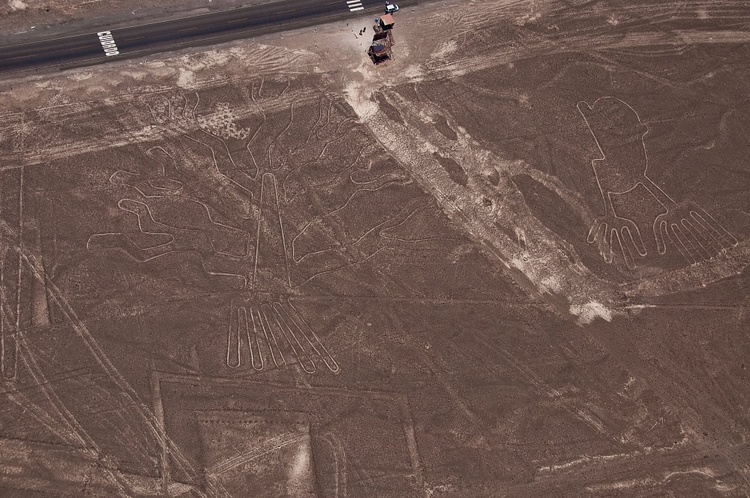 Nazca Line Cactus Tobias Lange (CC BY-NC-SA) ](https://www.worldhistory.org/image/2367/nazca-line-cactus/ "Nazca Line Cactus")Now the lines and geoglyphs of *Nazca*, with their protection area that extends over 75,358.47 ha, are well defined and, together with their surrounding landscape, make a harmonious relationship that has survived virtually unaltered over the centuries.
Reiche spent almost 60 years of her life in the *pampas*. Still remembered well in the town of *Nazca* for regaling locals and visitors with her magnetic storytelling, she is also revered for her unceasing life's work, which included cleaning the contours of almost 1,000 lines with ladder and broom. She has also defied those who wanted to convert the area into an immense agricultural operation. Her studies (collected in 60 notebooks) are illuminated by her conservationist zeal. Her contributions to the geometry and astronomy of ancient Peru were published in 1993 CE when she was 90 years old.
Maria Reiche died on June 8, 1998 CE, at the age of 95. She had devoted more than half her life to the measuring and mapping of the lines. Her intensive work for so many years was also costly to her health as exposure to the bright sun eventually caused her to go blind. During her lifetime she received much acknowledgement and numerous honours from all over the world and inspired many new generations of scientists with her passion for preserving the *Nazca* Lines.
One of her greatest achievements was the nomination of the lines and geoglyphs of *Nazca* and *Palpa* World Cultural Heritage as a UNESCO World Heritage Site in 1995 CE, and her great efforts in the protection and maintenance work of the site became the responsibility of the Peruvian Government.
#### Editorial Review
This human-authored article has been reviewed by our editorial team before publication to ensure accuracy, reliability and adherence to academic standards in accordance with our [editorial policy](https://www.worldhistory.org/static/editorial-policy/).
## External Links
- [Unlocking The Mystery Of Peru's Massive Nazca Lines](https://allthatsinteresting.com/nazca-lines)
## Cite This Work
### APA
Mendoza, A. M. C. (2019, June 04). The Nazca Lines: A Life's Work. *World History Encyclopedia*.
### Chicago
Mendoza, Ana Maria Cogorno. "The Nazca Lines: A Life's Work." *World History Encyclopedia*, June 04, 2019. .
### MLA
Mendoza, Ana Maria Cogorno. "The Nazca Lines: A Life's Work." *World History Encyclopedia*, 04 Jun 2019, .
## License & Copyright
Original article by **Ana Maria Cogorno Mendoza**. Submitted by Kim Martins, published on 04 June 2019. The copyright holder has published this content under the following license: [Creative Commons Attribution-NonCommercial-ShareAlike](https://creativecommons.org/licenses/by-nc-sa/4.0/deed.en). This license lets others remix, tweak, and build upon this content non-commercially, as long as they credit the author and license their new creations under the identical terms. When republishing on the web a hyperlink back to the original content source URL must be included. Please note that content linked from this page may have different licensing terms.