---
title: Traditional Maori Tattoo of New Zealand
author: Kim Martins
source: https://www.worldhistory.org/article/1393/traditional-maori-tattoo-of-new-zealand/
format: machine-readable-alternate
license: Creative Commons Attribution-NonCommercial-ShareAlike (https://creativecommons.org/licenses/by-nc-sa/4.0/)
updated: 1970-01-01
---
# Traditional Maori Tattoo of New Zealand
_Authored by [Kim Martins](https://www.worldhistory.org/user/kim.martins/)_
*Te Papa Tongawera* (or simply Te Papa) is New Zealand's innovative national museum situated near the foreshore of beautiful Wellington harbour. *Te Papa Tongawera* means “container of treasures” in *Te Reo Maori*, which is the indigenous language of *Aotearoa* (New Zealand). It is a fitting name because at Te Papa you will find 2.4 million treasures that tell the stories and colourful history of New Zealand and its peoples. Because Te Papa also houses the national art collection among its *taonga* (or treasures) you will find magnificent artwork from the mid-to-late 1800s CE showing the indigenous tattoo art.
[  Maori Woman with Chin Moko Google Art Project (Public Domain) ](https://www.worldhistory.org/image/10739/maori-woman-with-chin-moko/ "Maori Woman with Chin Moko")Te Papa began life as the Colonial Museum in 1865 CE. Headed by Sir James Hector, a Scottish-born geologist and explorer, the Colonial Museum featured ethnographic curiosities, as well as items from antiquity. The museum's focus broadened when it was renamed the Dominion Museum and it shared space with the National Art Gallery. The current landmark Te Papa building opened in 1988 CE.
### A Few Facts About Te Papa
A visit just to see the building itself is worthwhile as it is an architectural and engineering feat, rich with symbolism.
[ 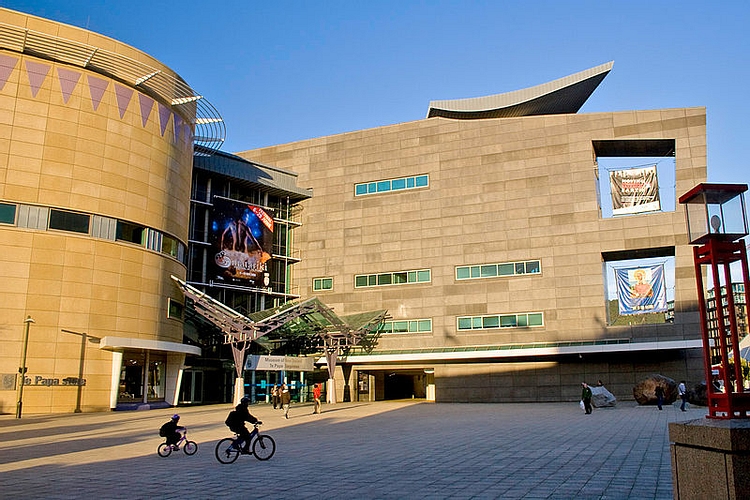 National Museum of New Zealand: Te Papa Tongarewa Partyzane (CC BY) ](https://www.worldhistory.org/image/10689/national-museum-of-new-zealand-te-papa-tongarewa/ "National Museum of New Zealand: Te Papa Tongarewa")- it weighs 64,000 tonnes.
- it has enough reinforcing steel to stretch from Wellington to Sydney, Australia (2,224 km or 1,382 miles).
- the North or *Maori* face overlooks the harbour and the cliff-like walls symbolise the sea, hills and sky.
- the South or *Pakeha* (European) face has grid-like patterns that reflect the patterns of European settlement.
- the central wedge between the North and South faces unite Maori and Pakeha and it is here that you will find the *Treaty of Waitangi* exhibition. The treaty is New Zealand's founding document (1840 CE) made between the British Crown and 540 Maori *rangatira* (chiefs). It governs the relationship between the *tangata whenua* (indigenous people) and Pakeha.
New Zealand is known as the shaky isles due to frequent and often strong seismic activity. Possibly the most comforting thing to know about Te Papa, since it sits close to a major fault line, is that should a one-in-2000 year [earthquake](https://www.worldhistory.org/disambiguation/earthquake/) hit (known as The Big One), the building, its collections and people inside should be safe. This is because Te Papa was built on 152 flexible base isolators that sit between the building and its concrete slab.
### Polynesian Migration
Aotearoa is perhaps best known for its distinctive indigenous tattoo art that was introduced by Polynesian settlers who arrived by canoe in several waves between 1250 and 1300 CE. Te Papa has many exhibitions, paintings and photographic works that preserve and curate the historical and cultural importance of Maori tattoo practice.
Maori [mythology](https://www.worldhistory.org/mythology/) tells us that the first explorer to reach New Zealand around 1,000 years ago was *Kupe*, whose ancestral homeland was *Hawaiki* in Polynesia. He sailed across the Pacific in his *waka hourua* (or voyaging canoe), guided by the brilliance of the stars and the strength of ocean currents. Kupe landed in *Hokianga Harbour* in the North Island.
[  Polynesian Migration Map David Eccles (CC BY) ](https://www.worldhistory.org/image/10691/polynesian-migration-map/ "Polynesian Migration Map")You will not find *Hawaiki* on the map but what we do know is that the Polynesians ancestral homeland was most likely Taiwan, which they left somewhere between 3,000 to 1,000 BCE. Collectively known as the *Lapitas*, they eventually settled in the geographic area called the Polynesian triangle that encompasses New Zealand, Hawaii and [Easter](https://www.worldhistory.org/Easter/) Island as its corners. This triangle includes more than 1,000 islands. The descendants of the Lapitas settled in New Zealand around 900 CE and other parts of Oceania such as the Marquesas in 100 CE and Tahiti in 600 CE.
The Polynesians had no form of written language so tattooing was used to express individuality, genealogy, life history, achievements, social status and rank. *Ta moko* is the Maori customary form of a tattooing tradition that extends back thousands of years, and it is still an extremely visible component of contemporary New Zealand [culture](https://www.worldhistory.org/disambiguation/culture/). *Ta moko* is related to the *tatu* of Eastern Polynesia and the *tatau* of Samoa (settled around 200 CE). Both words mean “to [mark](https://www.worldhistory.org/disambiguation/Mark/)”.
[ 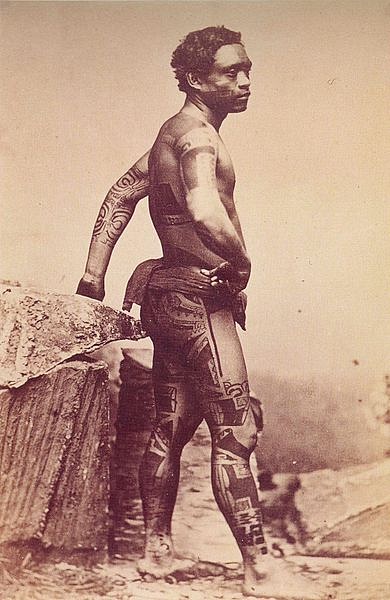 Tattooed Warrior from the Marquesas Islands Madame S. Hoare (Public Domain) ](https://www.worldhistory.org/image/10693/tattooed-warrior-from-the-marquesas-islands/ "Tattooed Warrior from the Marquesas Islands")Tattoo patterns and art on the face and body differed from one Polynesian island group to the next, but the Marquesan culture is said to have evolved the most elaborate tattoo art. Tattooing or inking remained an isolated practice until 1771 CE when Captain James Cook encountered the heavily-tattooed Tahitians on his first voyage to observe the transit of [Venus](https://www.worldhistory.org/venus/).
Almost everyone in the Polynesian culture was tattooed and Cook witnessed the painful inking process of a young Tahitian girl. He likened the rhythmic tapping sound of the bone chisel used to mark the girl's body with the word *tattaow* and Cook would most certainly have heard the Tahitian word *tatau*. When he returned to [England](https://www.worldhistory.org/disambiguation/england/), *tattaow* was translated into the word we are familiar with today - tattoo.
Many sailors onboard Cook's ship HMS Endeavour obtained tattoos, particularly on the buttock region, and this established a socially distinct group of men who were marked as members of a wider Polynesian community. It is also probable that Cook's crew felt pressured to be tattooed since having no tattoos was a source of great shame in the Polynesian culture.
As the popularity of Maori tattoos spread throughout [Europe](https://www.worldhistory.org/europe/) following Cook's return, Maori would raid neighbouring tribes or behead their enemies so they could obtain tattooed heads to [trade](https://www.worldhistory.org/disambiguation/trade/) for guns and ammunition. Many of these heads were sold to museums or private collections as curiosities. The British explorer Major General Horatio Gordon Robley (1840 – 1930 CE) was a well-known collector of the macabre, including *mokomokai* (preserved tattooed heads of deceased Maori).
Te Papa has a wonderful collection of historical images that show tattoo art since Cook popularised tattooing in the Western world. There is no need to fly to New Zealand though because [the collection is available online](http://www.tepapa.govt.nz/about/past-exhibitions/2016-past-exhibitions/adorned). There are many examples of Polynesian and Maori tattoos from the full face moko or tattoo to the *puhoro* or thigh tattoo.
[ 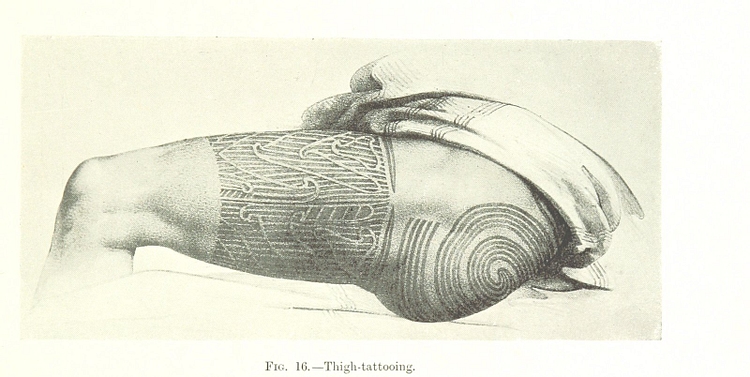 Thigh Moko or Tattoo Horatio Gordon Robley (Public Domain) ](https://www.worldhistory.org/image/10746/thigh-moko-or-tattoo/ "Thigh Moko or Tattoo")In fact, anything you might want to know about Maori tattoo art can be searched via [Te Papa's online collection](http://collections.tepapa.govt.nz/), which has over 800,000 items.
Given the relative isolation of New Zealand, the tattooing techniques practised by Maori differed significantly from those of their Polynesian counterparts and Maori developed specific combs and *uhi* or chisels that cut deeper into the skin. These comb-like instruments helped to place pigment into the skin and Maori used two types of chisels that produced a distinctive grooved tattoo with spiral motifs: *uhi matarau* or serrated chisels and *uhi kohiti* or flat-bladed chisels. The *uhi matarau* was also known as *uhi puru* and was used to deposit pigment into the wound.
### Ta Moko
To the Maori, tattooing is linked to *mana* or a sense of pride and prestige. The head is considered to be the most sacred part of the body, so *ta moko* was reserved for the face only and for Maori of high social status. Facial moko for Maori [women](https://www.worldhistory.org/disambiguation/women/) was a chin tattoo or *moko kauae*. The upper lips were also outlined, using a dark blue pigment, and the nostrils were incised. The *tikanga* (custom, values, protocol) behind *moko kauae* was that only *kuia* (elderly women) would receive them, but today in New Zealand, you will see many Maori women wearing *moko kauae.*
[ 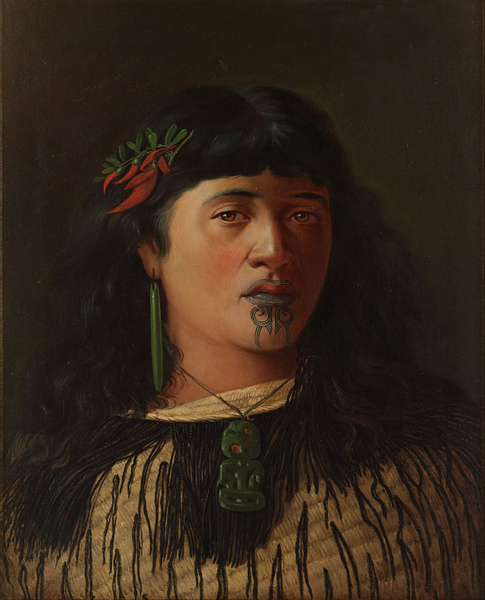 Portrait of a Young Maori Woman with Moko Google Art Project (Public Domain) ](https://www.worldhistory.org/image/10688/portrait-of-a-young-maori-woman-with-moko/ "Portrait of a Young Maori Woman with Moko")The inking process was steeped in ritual and the designs themselves were considered highly sacred. The tattoo craftsman or *tohunga ta moko* was a respected specialist in a given *iwi* (tribe) and he was considered *tapu* (sacred and revered). Interestingly, Captain James Cook was also responsible for introducing the word “taboo” into the English language, which he heard as tapu during his 1771 CE visit to Tahiti.
Most *tohunga ta moko* were men and the tattooing process, which itself was *tapu*, began at puberty as a rite of passage and would continue throughout life to mark important events and ancestral history. A *moko* was an identity card that chronicled a person's ancestral and life history, as well as their tribal affiliation. It indicated the *whakapapa* or line of ancestors a person descended from and the land to which they were connected. A *moko* also carried values such as loyalty and commitment from the past to those in the future.
*Whakapapa* was indicated on each side of the face with the left side being the father's ancestry and the right side being the mother's - although which side of the face was tattooed depended on *iwi*.
[ 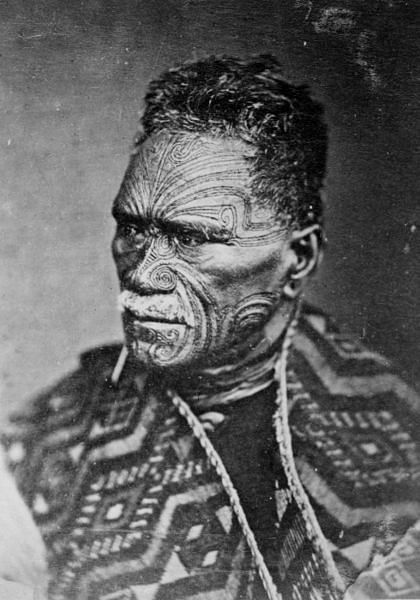 Tāwhiao - Second King of the Māori Unknown (Public Domain) ](https://www.worldhistory.org/image/10690/tawhiao----second-king-of-the-maori/ "Tāwhiao - Second King of the Māori")A warrior of the *Urewera* and *Ngai-Tama* tribes described moko in this way:
> You may lose your most valuable property through misfortune in various ways... your house, your weaponry, your spouse, and other treasures. You may be robbed of all that you cherish. But of your moko, you cannot be deprived, except by [death](https://www.worldhistory.org/disambiguation/Death/). It will be your ornament and your companion until your final day.
> Netana Whakaari of Waimana, 1921 CE
### Ta Moko Process & Technology
*Ta moko* was a long and painful process and as the subject lay down, the *tohunga ta moko* would often say a *karakia* or prayer as he pierced the skin by striking the left shoulder with his *uhi.* Chant poems were recited and songs were sung to comfort the person being tattooed.
The toolkit of the *tohunga* included various chisels that had wide blades for cutting into the flesh and inserting pigment. The chisels were highly ornamented artefacts with handles made of whalebone, albatross, *kauri, totara* or *maire* wood and they were struck by a small mallet made from *mahoe* or whitey-wood - a small New Zealand tree that is a member of the violet family. The mallet was called “*He Mahoe*” and it was also used to wipe away the blood (considered *tapu*). A balm made from the leaves of the *karaka* tree was applied to encourage healing.
[  Samoan Tattooist Using Traditional Tools Thomas Andrew (Public Domain) ](https://www.worldhistory.org/image/10692/samoan-tattooist-using-traditional-tools/ "Samoan Tattooist Using Traditional Tools")The *tohunga* toolkit included small pots of *wai ngarahu* or pigment. The pigment used varied between tribes but was basically soot from resinous tree matter that was burned in a specially-designed *ahi kauri* or furnace. The prepared *awe* or soot was mixed with liquids from the *hinau* and *mahoe* trees, the *ti* (cabbage tree), the *karetu* or the *poroporo* plants. The process of producing the pigment was known as *whakataerangi* and the material was covered by the skins of rats or birds to prevent it from drying out. Dark pigments were prized but lighter pigments were also used and were derived from caterpillars infected with a certain type of fungus. During *ta moko*, sexual intimacy and the eating of solid foods were forbidden.
Pigments were often considered a family heirloom and were kept for decades in beautifully designed containers made from pumice stone or wood. As European settlement spread, Maori adopted the use of gunpowder which gave a blue tinge to the tattooed skin. From 1840 CE, Colonial laws were passed (1907 Tohunga Suppression Act) banning *tohunga* and by the 1970s CE, the *moko* had largely died out.
[ 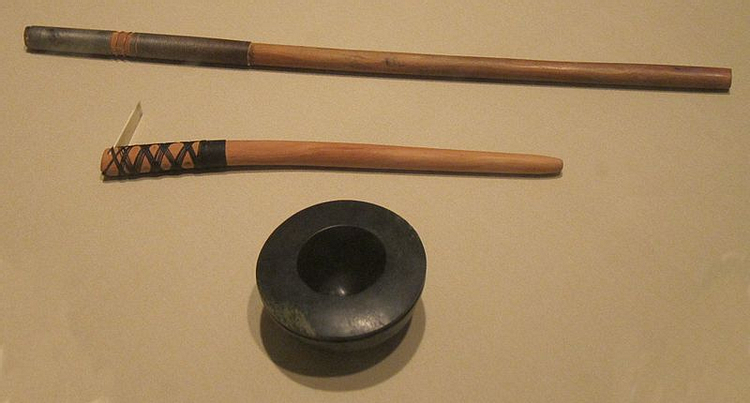 Traditional Pacific Island Tattoo Tools Haa900 (Public Domain) ](https://www.worldhistory.org/image/10737/traditional-pacific-island-tattoo-tools/ "Traditional Pacific Island Tattoo Tools")There has been a renaissance since the 1980s CE of the practice of ta moko using modern tattooing machines, ink and needles, which produce a smooth surface and not the raised grooves of traditional tattoos. It is now fashionable for *pakeha* or white New Zealanders (and even tourists) to be inked with traditional Maori designs - although this raises the issue of cultural appropriation as the spiritual and cultural significance of tattoos is often not understood.
### Some Traditional Designs
Maori used a number of traditional designs and many of them are still in use today. The most recognisable is perhaps the *koru* (or loop) design, along with the *[hei tiki](https://www.worldhistory.org/article/1659/hei-tiki/)* (or tiki). The *koru* represents the spiral shape of an unfurling New Zealand fern frond and stands for new life, renewal and hope for the future as exemplified in this Maori proverb:
> *Ka hinga atu he tete-kura - ka hara-mai he tete-kura*
> As one fern frond dies - one is born to take its place.
Each *koru* in a tattoo signifies a loved one and loving relationships. The tail design of Air New Zealand aircraft displays the *koru* and you can see the *koru* in the facial moko below*.*
[ 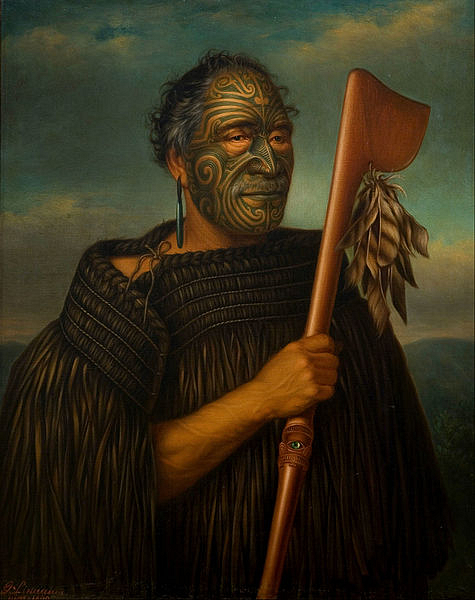 Maori Rangatira - Tamati Waka Nene Google Art Project (Public Domain) ](https://www.worldhistory.org/image/10738/maori-rangatira---tamati-waka-nene/ "Maori Rangatira - Tamati Waka Nene")The *pikorua* or twist shows two intertwined *pikopiko* ferns and represents an eternal bond between two people. The *pikorua* is a newer design since the pre-European settlement Maori chisels would have been unable to create the complex intertwining of this design. It was most likely introduced when diamond-cutting tools became available post-1800 CE. The *pikorua* also reflects the joining together of two different things, such as the sea and the earth. The Maori creation myth of *Ranginui* (sky father) and *Papatuanuku* (earth mother) tells how heaven and earth were once joined together in a tight embrace.
The *hei tiki* is an important talisman for the Maori people and is a symbol of the unborn human embryo. According to Te Papa, various forms of *tiki* were common throughout Polynesia but the meaning of the Maori *hei tiki* is obscure. The *tiki* symbol is said to represent Tiki, the first man in Maori mythology but it could also represent *Hine-te-iwaiwa*, a celebrated ancestress associated with fertility and the virtuous qualities of Maori womanhood.
[  Hinepare - A Woman of the Ngāti Kahungunu Tribe Gottfried Lindauer (Public Domain) ](https://www.worldhistory.org/image/10694/hinepare---a--woman-of-the-ngati-kahungunu-tribe/ "Hinepare - A Woman of the Ngāti Kahungunu Tribe")It is certainly considered a good luck charm and the most valuable *tikis* were carved from *pounamu* (New Zealand greenstone). They were handed down through the generations and the *mana* of the tiki was believed to increase. Air New Zealand used to hand out green plastic *tikis* to passengers on their flights during the 1960s and 1970s CE.
The *manaia* is a mythological creature in Maori culture. It has the head of a bird, the body of a human and the tail of a fish, and is a spiritual guardian and messenger between the spirit world and the living. *Manaia* designs vary subtly in form between *iwi* but it can be likened to a bird sitting on your shoulder (or a guardian angel) warding off evil spirits.
The *hei matau* or fish hook design is based on the trolling lures and fish hooks that were made from wood, shell, or bone and used by the ancestors of the Maori who arrived on New Zealand shores in what is known as the "Moahunter" or "Colonisation" period of settlement (1280 - 1500 CE). The hei matau is *taonga* (a cultural treasure) for the Maori as it represents not only the land but also prosperity, fertility and safe passage over water.
[ 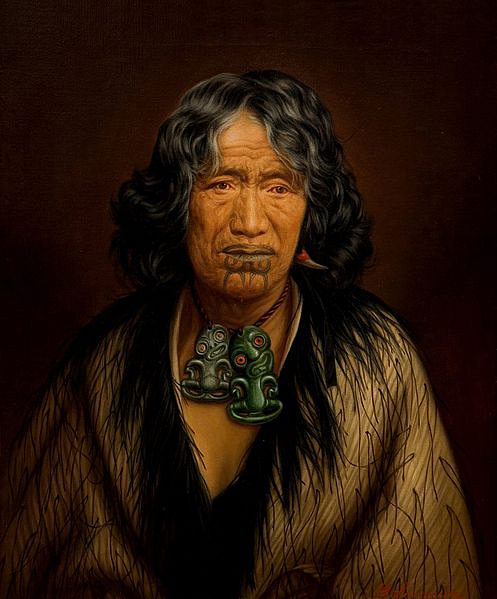 Kuinioroa - Daughter of Rangi Kopinga - Te Rangi Pikinga Gottfried Lindauer (Public Domain) ](https://www.worldhistory.org/image/10698/kuinioroa---daughter-of-rangi-kopinga---te-rangi-p/ "Kuinioroa - Daughter of Rangi Kopinga - Te Rangi Pikinga")Polynesian legend tells us of the demi-[god](https://www.worldhistory.org/God/) of supernatural parents, Maui, who fished up the North Island of New Zealand with his magic fish hook made from the jawbone of his grandmother. The Maori name for the North Island is *Te Ika-a-Maui* or "The fish of Maui”.
With the resurgence in popularity of *ta moko*, these traditional designs (along with others such as the stingray, lizard and geckos, turtles, spearheads, and ocean patterns) are frequently seen on the streets and [cities](https://www.worldhistory.org/city/) of New Zealand.
You can [read a detailed article and watch videos](http://www.tepapa.govt.nz/discover-collections/read-watch-play/maori/ta-moko-maori-tattoos-history) on Te Papa's website that further detail the origins and development of *ta moko* and the tattooing process.
### Visiting Te Papa
Should you be able to visit Te Papa, you will need at least a day to make your way around the museum and have a bite to eat at the Te Papa cafe. You can even decide what to eat by looking at the [online menu](http://www.tepapa.govt.nz/sites/default/files/te.papa_.cafe-all-day.menu_.pdf) before you get there but you should certainly try kumara chips - an iconic New Zealand snack made from sweet potato.
For those with a taste for the curious, the [ten lesser known secrets in Te Papa's collection](http://www.tepapa.govt.nz/discover-collections/read-watch-play/behind-scenes/10-things-you-might-not-know-about-te-papa) makes for fascinating reading. Which one is your favourite? Mine is number five.
#### Editorial Review
This human-authored article has been reviewed by our editorial team before publication to ensure accuracy, reliability and adherence to academic standards in accordance with our [editorial policy](https://www.worldhistory.org/static/editorial-policy/).
## Bibliography
- Best, Elsdon. "The Uhi-Maori or Native Tattooing Instruments." *The Journal of the Polynesian Society.*, Issue 3, Volume 13, September 1904, pp. 166-172.
- [Hambly, Wilfred Dyson. *The History of Tattooing.* Dover Publications, 2009.](https://www.worldhistory.org/books/0486468127/)
- [King, Michael. *Moko: Maori Tattooing in the 20th Century.* David Bateman Ltd, 2014.](https://www.worldhistory.org/books/1869530888/)
- [Krutak, Lars. *Spiritual Skin.* Edition Reuss, 2012.](https://www.worldhistory.org/books/3943105113/)
- [Mallon, Sean. & Galliot, Sebastian. *Tatau: A History of Samoan Tattoo.* University of Hawaii Press, 2018.](https://www.worldhistory.org/books/0824878493/)
- Matsuda, Matt, K. *Pacific Worlds : A History of Seas, Peoples, and Cultures.* Cambridge University Press., 2018
- [Pacheco, R. *Fundamentals of Traditional and Modern Polynesian Tattoo.* CreateSpace Independent Publishing Platform, 2013.](https://www.worldhistory.org/books/1478367148/)
- Panoho, Rangihiroa. & Adams, Mark Bentley. *Maori Art: History, Architecture, Landscape and Theory.* David Bateman Limited, 2015
- Riria, Ko Te. & Simmons, David. *Moko Rangatira - MÄori Tattoo.* Reed Publishing, 1999
- [Robley, H.G. *Moko, The Art and History of Maori Tattooing.* Senate, 1998.](https://www.worldhistory.org/books/1859585280/)
- [Simmons, D.R. *Ta moko: The Art of Maori Tattoo.* Reed, 1997.](https://www.worldhistory.org/books/0790005689/)
## About the Author
Kim is a freelance writer based in New Zealand. She has a B.A. (Hons) in History and an M.A. in Chaos and Complexity Science. Her special interests include the exploration of the early modern world and the history of science.
- [Facebook Profile](https://www.facebook.com/kim.martins)
- [Linkedin Profile](https://www.linkedin.com/kimsbarcea)
## Cite This Work
### APA
Martins, K. (2019, June 06). Traditional Maori Tattoo of New Zealand. *World History Encyclopedia*.
### Chicago
Martins, Kim. "Traditional Maori Tattoo of New Zealand." *World History Encyclopedia*, June 06, 2019. .
### MLA
Martins, Kim. "Traditional Maori Tattoo of New Zealand." *World History Encyclopedia*, 06 Jun 2019, .
## License & Copyright
Submitted by [Kim Martins](https://www.worldhistory.org/user/kim.martins/ "User Page: Kim Martins"), published on 06 June 2019. The copyright holder has published this content under the following license: [Creative Commons Attribution-NonCommercial-ShareAlike](https://creativecommons.org/licenses/by-nc-sa/4.0/deed.en). This license lets others remix, tweak, and build upon this content non-commercially, as long as they credit the author and license their new creations under the identical terms. When republishing on the web a hyperlink back to the original content source URL must be included. Please note that content linked from this page may have different licensing terms.