---
title: An Ancient City Beneath Rome: Visiting The Catacombs of Priscilla
author: Kim Martins
source: https://www.worldhistory.org/article/1358/an-ancient-city-beneath-rome-visiting-the-catacomb/
format: machine-readable-alternate
license: Creative Commons Attribution-NonCommercial-ShareAlike (https://creativecommons.org/licenses/by-nc-sa/4.0/)
updated: 1970-01-01
---
# An Ancient City Beneath Rome: Visiting The Catacombs of Priscilla
_Authored by [Kim Martins](https://www.worldhistory.org/user/kim.martins/)_
Any visitor to [Rome](https://www.worldhistory.org/Rome/) will want to see and explore the popular historical and cultural sites - the [Colosseum](https://www.worldhistory.org/Colosseum/), the Forum, the Trevi Fountain and, of course, the Vatican. But a large part of the [city](https://www.worldhistory.org/city/)'s ancient history actually lies underground in the [tomb](https://www.worldhistory.org/tomb/)-lined tunnels or catacombs that weave beneath the streets of Rome.
The city has more than 40 catacombs that extend over hundreds of kilometres and they tell us about the customs and funereal traditions of the ancient Romans and early Christians. Many of these catacombs are open to the public, including the Catacombs of Priscilla.
The word *catacomb* was used by archaeologists to describe the extensive underground cemeteries and *cubicula* or small rooms that are found along their galleries and branching passageways. It is also thought that *catacomb* refers to a place near the Appian Way called Catacumbus, which means “near the hollows”.
[  The Catacombs of Priscilla Kim Martins (CC BY-NC-SA) ](https://www.worldhistory.org/image/10347/the-catacombs-of-priscilla/ "The Catacombs of Priscilla")The catacombs were carved out of *tufa* - a soft and porous volcanic stone that is surprisingly strong. From the early 2nd century to the 5th century CE, *fossores* or specialized workers built these subterranean wonders that became the final resting place for many Christian martyrs, as well as Jewish and pagan citizens.
Rome's underground necropolises were forgotten by the Middle Ages due to the practice of blocking the entrance ways to prevent theft by relic hunters. They were rediscovered in the 16th century CE when the Maltese-born archaeologist, Antonio Bosio (1576 – 1629 CE), realized the significance of an entrance way stumbled upon along the Via Salaria in 1578 CE.
In 1593 CE, Bosio descended into the [labyrinth](https://www.worldhistory.org/Labyrinth/) of the Catacombs of Domitilla making him the first person to systematically explore Rome's catacombs. He has been called the “Columbus of the Catacombs”, and his book *[Roma](https://www.worldhistory.org/disambiguation/Roma/) Sotterranea*, which was published posthumously in 1632 CE, established the discipline of Christian [archaeology](https://www.worldhistory.org/Archaeology/). Unfortunately, some of the catacombs he explored have since been destroyed.
### WHY WERE THE CATACOMBS BUILT?
In the 2nd century CE, Rome faced the dual problems of overpopulation and a shortage of land. The city was being built upwards and many buildings were four or five stories high. Burials were not permitted within the city walls and the early Christians did not agree with the pagan custom of cremating the bodies of their dead, so communal underground cemeteries offered a practical solution.
The soft *tufa* meant that multi-levelled catacombs were relatively easy to construct. The undergrown cemeteries could be built to reach a height of five meters and with thousands of horizontal niches or *loculi* to accommodate bodies. *Loculi* were stacked one above the other in the *tufa* walls.
[ 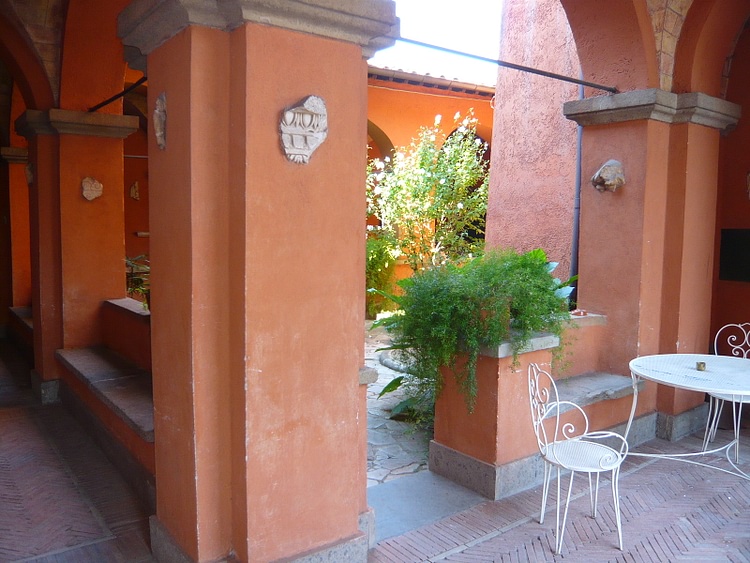 The Catacombs of Priscilla Kim Martins (CC BY-NC-SA) ](https://www.worldhistory.org/image/10348/the-catacombs-of-priscilla/ "The Catacombs of Priscilla")For wealthy [Roman](https://www.worldhistory.org/disambiguation/Roman/) citizens, *cubicula* could be excavated for a family to be buried together. Within the *cubicula*, recessed tombs in the [wall](https://www.worldhistory.org/wall/) could be decorated with frescoes.
One of the first and most ancient catacombs to be rediscovered in the 16th century CE is the Catacombs of Priscilla. These catacombs are known as the *regina catacumbarum*, or the queen of the catacombs, due to the great number of martyrs and popes buried there.
### THE CATACOMBS OF PRISCILLA
The Catacombs of Priscilla is the best preserved early Christian cemetery in Rome and was originally dug from the 2nd to 5th centuries CE. They are located under the expansive Villa Ada Park on Via Salaria, an ancient road leading north out of Rome.
The modern entrance to these catacombs is down a winding marble staircase in the convent of the Benedictine Sisters of Priscilla. The wealthy Christian noblewoman Priscilla (1st century CE) was a benefactor to the Christian community and donated the land, originally a *tufa* quarry, under which the catacombs were excavated.
Priscilla was the wife of the Roman [consul](https://www.worldhistory.org/Consul/), Manius Acilius Glabrio (91 CE), and mother of the Roman senator Saint Pudens. All three are said to have been Christian martyrs: Glabrio was forced to fight a lion on the orders of Emperor [Domitian](https://www.worldhistory.org/domitian/) (r. 81-96 CE) and was later executed, Saint Pudens was martyred under [Nero](https://www.worldhistory.org/Nero/) (r. 54-68 CE), and Priscilla was also martyred for her Christian faith and buried on the land the convent now occupies.
In 313 CE, Emperor [Constantine](https://www.worldhistory.org/disambiguation/Constantine/) issued the Edict of Milan that permanently established religious tolerance for [Christianity](https://www.worldhistory.org/christianity/). From the 4th century CE, there was a great desire to be buried with the martyrs in the catacombs. Pope Marcellinus (r. 296-304 CE) lies in the Priscilla catacombs - another victim of persecution under [Diocletian](https://www.worldhistory.org/Diocletian/) - along with Pudenziana, daughter of Saint Pudens. Although it has been suggested that Pudenziana refers to the house of Pudens, rather than a specific Christian [martyr](https://www.worldhistory.org/martyr/).
### EARLY CHRISTIAN ICONOGRAPHY
The Priscilla catacombs are a network of dimly-lit tunnels that stretch over eight kilometres underneath Villa Ada Park. Around 40,000 tombs are stacked and, at some points, these catacombs reach three stories.
After making your way down the marble staircase, the first thing you notice is the cool, musty air as you enter a narrow passageway that leads into the catacombs. The ceilings are low and the earthen floor is rough in places. Light bulbs are strung along the length of the ceiling and have been known to flicker on and off. In fact, power can be disrupted leaving you in utter darkness - quite an eerie feeling! If you do not like confined spaces, then perhaps enjoy a day out in beautiful Villa Ada Park instead.
There are no bodies or bones in these catacombs. In the mid-17th century CE, both Pope Innocent X (r. 1644-1655 CE) and Clement IX (r. 1667-1669 CE) sent treasure-hunters in to plunder the tombs. They were not as thorough as perhaps hoped for because a large white and brown onyx cameo pendant was found on the third floor in 2018 CE. The cameo has been dated to the 4th century CE and shows the profile of a woman wearing a draped, embroidered gown.
On the first level, empty *loculi* are to the left and right of the passageways, with the smaller niches being for children. Sometimes the passageways are so tight that your shoulders will touch the *tufa* walls on both sides.
*Loculi* were the most common type of tomb and were principally for the poor. The bodies were laid within them, wrapped in a shroud and sprinkled with lime to slow the normal process of decay and to control odours. The tomb was then closed up using marble, terracotta tiles or plaster.
Also on this level are *cubicula* and *arcosolia*, as well as the tombs of martyrs. The oldest Christian art can be found here as there are many stone inscriptions marked with the [Greek](https://www.worldhistory.org/disambiguation/greek/) word for fish - *Ichthys* - a symbol used by the early Christians. *Ichthys* is an acronym, a word formed from the first letters of several words, and it stands for "[Jesus Christ](https://www.worldhistory.org/Jesus_Christ/) [God](https://www.worldhistory.org/God/)'s Son Saviour”. You will also find many touching inscriptions left by the ordinary citizens of Rome in memory of a departed loved one. One such inscription reads: “You were a sweet son”.
Along the passageways and tunnels, there are also niches that would have contained oil lamps to light the way for workers and visiting families.
Biblical scenes can be seen on some of the walls and ceilings, particularly in a square chamber called *Capella Greca* or the Greek Chapel, known for its Pompeian-style paintings, faux marble and stucco work. The Greek Chapel has three niches for *sarcophagi* and a long seat for funeral banquets, which were held at the tombs in honour of the dead. These feasts were called *refrigeria* or *agapae*.
[ 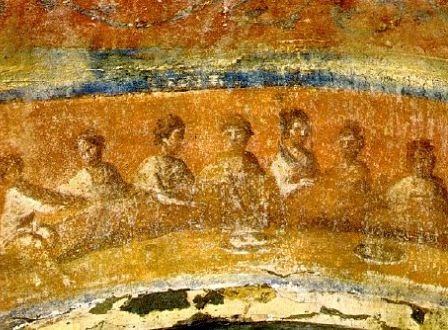 Fractio Panis Fresco, Rome Leinad-Z~commonswiki (Public Domain) ](https://www.worldhistory.org/image/10350/fractio-panis-fresco-rome/ "Fractio Panis Fresco, Rome")There is a controversial [fresco](https://www.worldhistory.org/disambiguation/Fresco/) in this chapel that dates back to the first half of the 2nd century CE. *Fractio Panis* (or 'The Breaking of the Bread') is the name of this rich illustration that shows seven figures seated at a long table laden with bread and fish. The fresco is found on the face of the arch above the altar tomb and is reminiscent of The Last Supper. The assumption has long been that the figures depicted are male, but recently, this has been called into question by Nicola Denzey Lewis, a professor of religious studies at Rhode Island's Brown University.
Denzey Lewis suggests that the figures are wearing female clothing and that the middle figure is leading a religious ceremony or funeral banquet. This would imply that [women](https://www.worldhistory.org/disambiguation/women/) played a larger role in the early church than previously assumed.
[ 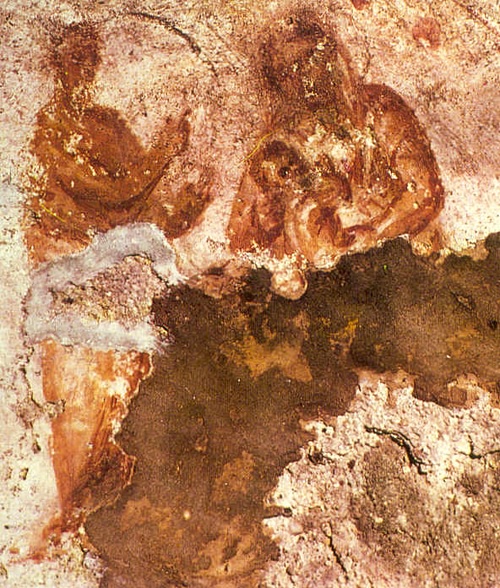 Virgin and Child with Balaam the Prophet Leinad-Z~commonswiki (Public Domain) ](https://www.worldhistory.org/image/10351/virgin-and-child-with-balaam-the-prophet/ "Virgin and Child with Balaam the Prophet")The Priscilla catacombs are also believed to have a 3rd century CE fresco of the [Virgin Mary](https://www.worldhistory.org/Mary,_Mother_of_Jesus/), which is considered to be the oldest known Marian painting still in existence. Dated from between c. 230 and c. 240 CE, the fresco depicts Mary who appears to be nursing the infant [Jesus](https://www.worldhistory.org/Jesus_Christ/) on her lap. It is the only Marian image that pre-dates the 431 CE Council of [Ephesus](https://www.worldhistory.org/ephesos/), which officially recognized Mary as the mother of God.
One of the most informative scenes is that of The Good Shepherd (c. 225 CE). We are familiar with the image of Christ as a humble shepherd or protector watching over his flock, as it is an established part of Christian art. But there are also pre-Christian images that show a man with a goat or ram slung across his shoulders. The early Christians adapted this imagery, and in a shallow dome of a ceiling in the catacombs of Priscilla, you will see this early adaptation in a large painting that shows Christ surrounded by three goats. He carries one of the goats over his shoulders and it has been suggested that the painter was familiar with [Roman sculpture](https://www.worldhistory.org/Roman_Sculpture/) because Christ's stance is *contrapposto*. This term refers to a pose where one leg holds the body's full weight and the other leg is relaxed, while the hips and shoulders rest at opposite angles, giving a slight S-curve to the torso. A painting or representation of a man carrying a goat or ram is referred to as *criophore* or *kriophoros.*
The Good Shepherd painting also displays paradise imagery with two doves clutching olive branches (representing peace and the Holy Spirit) and the peacock, which was an early Christian symbol of resurrection, renewal, and immortality. Ancient legend said that the flesh of a peacock did not decay and so it represented eternal life.
[ 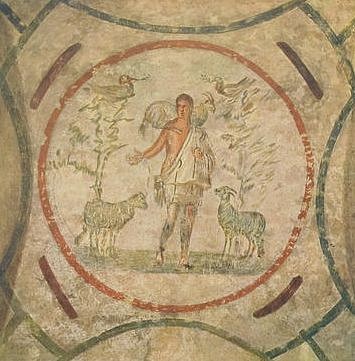 The Good Shepherd, Catacombs of Priscilla Wilpert, Joseph (Public Domain) ](https://www.worldhistory.org/image/10352/the-good-shepherd-catacombs-of-priscilla/ "The Good Shepherd, Catacombs of Priscilla")This early Christian art focused on the teachings of Christ and adapted from pagan art the notion of a shepherd guarding his flock. It is only from the 4th century CE that we start to see artwork showing the [crucifixion](https://www.worldhistory.org/crucifixion/) and resurrection of Christ.
A final stop on any visit to the catacombs of Priscilla is the Cubiculum of the Veiled Woman. In this room, there is a fresco (250 CE) on a back wall showing a woman wearing a rich purple garment and a veil, with her hands raised in the position used by priests for public worship. The garment is similar to a liturgical gown and once again raises the issue of the role of women priests in the early church.
[ 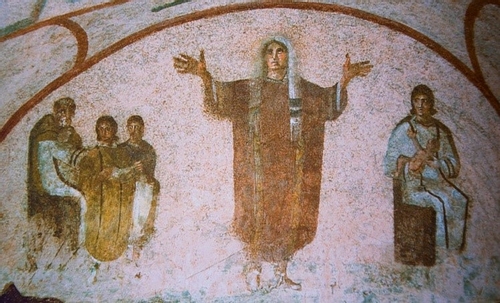 The Cubiculum of the Veiled Woman Kristicak (CC BY-SA) ](https://www.worldhistory.org/image/10353/the-cubiculum-of-the-veiled-woman/ "The Cubiculum of the Veiled Woman")### HOW TO GET TO THE CATACOMBS OF PRISCILLA
There are a number of ways to reach these beautiful and peaceful catacombs. You can travel by underground on metro line B from *Stazione Termini* (Termini Station) and stop at Annibaliano. It is just a few minutes' walk from the station to the Priscilla catacombs.
If you would like to make a day of it, you can travel to Bologna, which is the third stop on metro line B from Termini. This is not to be confused with the city of Bologna in the north of [Italy](https://www.worldhistory.org/italy/). Have a look around the town and its *piazza* or town square before walking for approximately 2.5 miles via *Circonvallazione Nomentana* to the catacombs.
To travel by bus, you would take line 86, 92 and 310 from Termini; or 63 from Piazza Venezia / Largo Argentina / Barberini.
You are not allowed to take photos in the catacombs and you should note the two important words on the sign at the entrance to the Catacombs of Priscilla – *Silenzio*, and *Rispetto*. Silence, and Respect.
### TAKE A VIRTUAL TOUR
No need to go to Rome though. You can enjoy a [virtual tour of the Catacombs of Priscilla](https://www.google.com/maps/place/Catacombs+of+Priscilla/@41.9293053,12.5090837,2a,75y,111.03h,90t/data=!3m6!1e1!3m4!1ssfiLnF1scbgAAAQJOCH0Sw!2e0!7i13312!8i6656!4m5!3m4!1s0x0:0x6ac5a8c1e54625b!8m2!3d41.9295352!4d12.5084331), thanks to Google Maps.
#### Editorial Review
This human-authored article has been reviewed by our editorial team before publication to ensure accuracy, reliability and adherence to academic standards in accordance with our [editorial policy](https://www.worldhistory.org/static/editorial-policy/).
## Bibliography
- [Denzey, Nicola. *The Bone Gatherers.* Beacon Press, 2008.](https://www.worldhistory.org/books/0807013099/)
- [Grabar, Andre. *Christian Iconography.* Princeton University Press, 1968.](https://www.worldhistory.org/books/0691018308/)
- [Green, Bernard. *Christianity in Ancient Rome.* T&T Clark, 2010.](https://www.worldhistory.org/books/0567032507/)
- [Pergola, Philippe. *Roman Catacombs - Past and Present (Past & Present).* Vision Srl, 1994.](https://www.worldhistory.org/books/8881620170/)
- [Stevenson, James. *The Catacombs.* T. Nelson, 1985.](https://www.worldhistory.org/books/0840775008/)
## About the Author
Kim is a freelance writer based in New Zealand. She has a B.A. (Hons) in History and an M.A. in Chaos and Complexity Science. Her special interests include the exploration of the early modern world and the history of science.
- [Facebook Profile](https://www.facebook.com/kim.martins)
- [Linkedin Profile](https://www.linkedin.com/kimsbarcea)
## External Links
- [Inside The Roman Catacombs](https://allthatsinteresting.com/catacombs-of-rome)
## Cite This Work
### APA
Martins, K. (2019, April 08). An Ancient City Beneath Rome: Visiting The Catacombs of Priscilla. *World History Encyclopedia*.
### Chicago
Martins, Kim. "An Ancient City Beneath Rome: Visiting The Catacombs of Priscilla." *World History Encyclopedia*, April 08, 2019. .
### MLA
Martins, Kim. "An Ancient City Beneath Rome: Visiting The Catacombs of Priscilla." *World History Encyclopedia*, 08 Apr 2019, .
## License & Copyright
Submitted by [Kim Martins](https://www.worldhistory.org/user/kim.martins/ "User Page: Kim Martins"), published on 08 April 2019. The copyright holder has published this content under the following license: [Creative Commons Attribution-NonCommercial-ShareAlike](https://creativecommons.org/licenses/by-nc-sa/4.0/deed.en). This license lets others remix, tweak, and build upon this content non-commercially, as long as they credit the author and license their new creations under the identical terms. When republishing on the web a hyperlink back to the original content source URL must be included. Please note that content linked from this page may have different licensing terms.