---
title: Bhutan: Land of the Thunder Dragon
author: Kim Martins
source: https://www.worldhistory.org/article/1348/bhutan-land-of-the-thunder-dragon/
format: machine-readable-alternate
license: Creative Commons Attribution-NonCommercial-ShareAlike (https://creativecommons.org/licenses/by-nc-sa/4.0/)
updated: 1970-01-01
---
# Bhutan: Land of the Thunder Dragon
_Authored by [Kim Martins](https://www.worldhistory.org/user/kim.martins/)_
It is a breathtaking flight with dramatic sweeps over fertile valleys and blue pine forests. You fly past Mt. Everest, Mt. Kanchenjunga and Mt. Gangkhar Puensum, which is the highest, unclimbed mountain in the world soaring to almost 7,570 metres. The aircraft wings appear to be almost touching these towering, snow-capped Himalayan mountains.
Only eight pilots in the world are trained to manoeuvre an aircraft through this narrow mountain terrain as it heads towards Paro International Airport, Bhutan. The single runway airport at Paro is located in a deep valley and is surrounded by sharp peaks of up to 5,486 metres. It was built in 1961 CE near the bank of the river Paro Chhu. Planes have to weave by the dozens of houses that are scattered across the mountainside - coming within feet of clipping the roofs. It is considered to be the most dangerous landing in the world.
[ 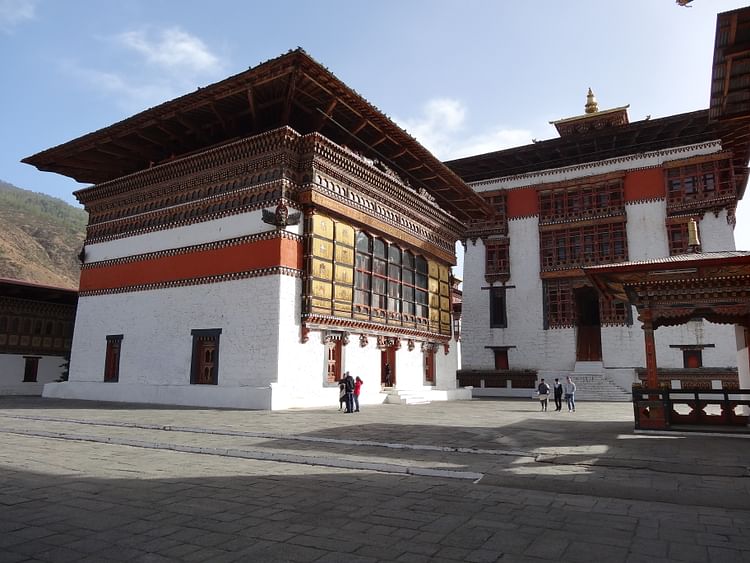 Tashichho Dzong - Thimphu Bhutan Kim Martins (CC BY-NC-SA) ](https://www.worldhistory.org/image/10228/tashichho-dzong---thimphu-bhutan/ "Tashichho Dzong - Thimphu Bhutan")The flight into Paro is not for the faint-hearted, but you will catch a glimpse of the famous Tiger's Nest Monastery constructed in 1692 CE. It is a sacred [Buddhist](https://www.worldhistory.org/buddhism/) [temple](https://www.worldhistory.org/temple/) complex that clings to the side of a sheer cliff “like a gecko” as the Bhutanese say.
### EARLY HISTORY
The documented history of this geographically isolated country is said to begin in 747 CE when the spiritual leader, Guru Rinpoche, flew from Tibet across the Himalayas on the back of a flaming tigress. He arrived in Paro Valley at Tiger's Nest, which is also known as Paro Taktsang or the Temple of the Guru with Eight Names.
At Tiger's Nest, he conquered the local demon, Singye Samdrup, who was standing in the way of the spread of [Buddhism](https://www.worldhistory.org/buddhism/). Although Bhutan's early history is steeped in Buddhist folklore and [mythology](https://www.worldhistory.org/mythology/) such as this, Guru Rinpoche was a historical 8th century CE Buddhist master who established the *Drukpa* sect of Buddhism that is still followed in Bhutan today.
After disembarking in Paro and walking across the tarmac, the first thing you notice is the crystal sharp air and the white-washed stone buildings with painted wood lintels that are a curious mix of old and new. The most impressive structure is Rinpung Dzong (or “the fortress on a heap of jewels”), which is regarded as one of the finest examples of the distinctive Bhutanese [architecture](https://www.worldhistory.org/disambiguation/architecture/). *Dzongs* were garrisons built along key mountain passes and roads. They were used by the Bhutanese army to protect the country when it faced incursions from neighbouring [India](https://www.worldhistory.org/india/) and Tibet. *Dzongs* also served as administrative centres and as houses for the clergy.
Bhutan has been known by many names over the centuries, including *Lho Jong* (The Valleys of the South); *Lho Jong Men Jong* (The Southern Valleys of Medicinal Herbs); and *Lho Mon Tsenden Jong* (Sandalwood Country).
[  Distinctive Bhutanese Architecture in Paro. Kim Martins (CC BY-NC-SA) ](https://www.worldhistory.org/image/10255/distinctive-bhutanese-architecture-in-paro/ "Distinctive Bhutanese Architecture in Paro.")Bhutan is a small, landlocked country with an area of roughly 38,394 square kilometres with a population of less than one million. It is slightly larger than the European state of Montenegro or the U.S. state of Maryland. It is bordered on the north and east by Tibet and on the south, west and east by India.
### A STUNNING LANDSCAPE
The stunning but very winding drive to the capital of Thimphu from Paro takes around one hour or 45 minutes for locals who seem to zoom along the roads effortlessly. The landscape is dotted with colourful prayer flags fluttering in the breeze. They are hung on long wooden poles or strung between trees and bridges and are erected for the dead or inscribed with prayers, mantras, and auspicious symbols. Prayer flags are called *lung ta*, meaning wind horse, because the Bhutanese believe that their silent prayers will be spread by the wind at the speed of a horse.
[  Bhutanese Prayer Flags Kim Martins (CC BY-NC-SA) ](https://www.worldhistory.org/image/10184/bhutanese-prayer-flags/ "Bhutanese Prayer Flags")Buddhist prayer flags come in five colours:
- blue represents the sky
- white is for [the clouds](https://www.worldhistory.org/The_Clouds/)
- red is fire
- green symbolises water
- yellow is for the soil.
Stone implements and structures indicate that Bhutan was settled as early as 2000 BCE. Unfortunately, much of early Bhutanese history has been lost because most historical records were destroyed when fire ravaged the ancient capital of Punakha in 1827 CE. So Bhutan's national history really begins in the 17th century CE with Guru Rinpoche's flamboyant arrival into Paro.
One can imagine that the journey into Thimphu is similar to the route taken by a young British explorer in 1774 CE. Scottish-born George Bogle was the first westerner to enter the mysterious and reclusive realm of *Bhootan*, as the British referred to it. Bogle was private secretary to the British [East India Company](https://www.worldhistory.org/East_India_Company/)'s [Warren Hastings](https://www.worldhistory.org/Warren_Hastings/), who sent him from Calcutta to undertake a diplomatic and fact-finding mission.
He was very taken with the Bhutanese people and wrote that “the simplicity of their manners and strong sense of [religion](https://www.worldhistory.org/religion/), preserve the Bhutanese from many vices to which more polished nations are addicted." It has been suggested that Bogle's accounts of his adventures in Bhutan were the inspiration for James Hilton's kingdom of Shangri-La in his 1933 novel, *Lost Horizon.*
Thimphu, which became the capital in 1961 CE and is home to the royal family, is at an altitude of 2,350 metres. This is higher than most people are used to, and the first-time traveller might suffer some altitude sickness.
There are a number of fascinating facts about Thimphu. It is one of only two capital [cities](https://www.worldhistory.org/city/) in Asia without traffic lights. The other is [Pyongyang](https://www.worldhistory.org/Pyongyang/) in North [Korea](https://www.worldhistory.org/Korea/). The main street is Norzim Lam and traffic is controlled by a policeman wearing crisp white gloves. It is a small walkable [city](https://www.worldhistory.org/city/) with Norzim Lam being the only main street.
[ 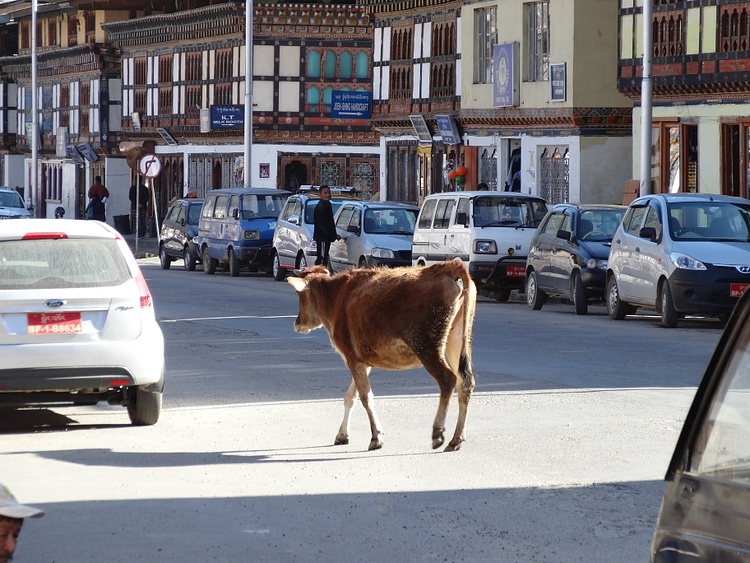 Thimphu Bhutan Kim Martins (CC BY-NC-SA) ](https://www.worldhistory.org/image/10229/thimphu-bhutan/ "Thimphu Bhutan")Stray dogs are a feature of the capital and are often seen lying lazily in the sun along Norzim Lam. Even horses and cows have been seen on the road at the top of Norzim Lam where there is a traffic circle. At night, it is not unusual to see horses dashing through apartment complexes or galloping down Norzim Lam. Some have ribbons threaded through their tails, which locals will tell you indicates it is a lead horse. Animals are allowed to roam wherever they wish since Buddhist principles dictate that no animal is allowed to be harmed or killed. But it does make for a surreal experience for the unwary traveller.
Jigme Khesar Namgyel Wangchuck is the reigning monarch or Dragon King of Bhutan and the royal family's residence, Dechencholing [Palace](https://www.worldhistory.org/disambiguation/palace/), is in Thimphu. He came to the throne in 2008 CE as the youngest monarch at the age of 28. He is revered by the Bhutanese and has freely given up his absolute power in favour of democracy, and the promotion of national happiness. Bhutan is the only country in the world to officially measure national happiness and well-being.
### THE NATIONAL TEXTILE MUSEUM
There are any number of historical sites and places of interest to visit in Thimphu, but as Bhutan is renowned for its brightly-coloured and intricately woven textiles, a visit to the National Textile Museum at the top of Norzim Lam is a must.
Her Majesty the Queen, Ashi Sangay Choden Wangchuck, inaugurated the National Textile Museum in 2001 CE. It displays important Bhutanese historical artefacts such as the pearl robe worn by the Buddhist monk Tsamdrak Goenpa; a princess crown worn by the sister of the first king Ashi Wangmo; and the first version of the Raven Crown, a hat topped with the head of a raven and worn by the kings of Bhutan.
Hand-woven fabrics are one of the 13 traditional arts and crafts or *zorig chosum* of Bhutan, which were formally categorised during the reign of Gyalse Tenzin Rabgay (1638-1696 CE). Weaving has been a flourishing art for centuries and cloth is integral to every aspect of Bhutanese history and [culture](https://www.worldhistory.org/disambiguation/culture/), with motifs and patterns signalling social status, wealth, and political rank. In fact, the creation of cloth is considered a religious act and colour selection a spiritual exercise.
[ 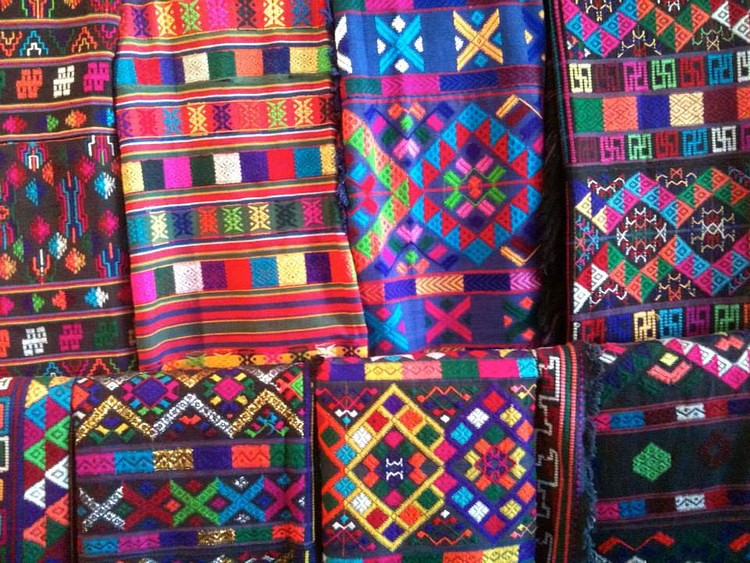 Bhutanese Textiles Kim Martins (CC BY-NC-SA) ](https://www.worldhistory.org/image/10187/bhutanese-textiles/ "Bhutanese Textiles")On the ground floor of the museum, the visitor learns just how important the skills of weaving and spinning are to the Bhutanese and their historical memory. Here you will see displays of looms, woven ceremonial blankets, and clothing - including the national dress - as well as the types of cloth or fibre favoured by each region of Bhutan. *Bura* or raw [silk](https://www.worldhistory.org/Silk/) is popular in Trashigang for example; whereas *sesho* or fine silk is preferred in Kurtoe and Lhuntse.
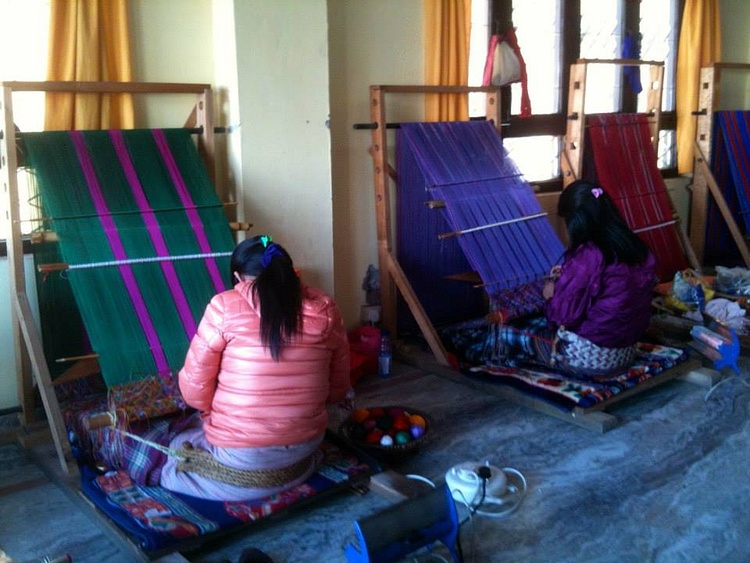
Weaving is a woman's art and generations of Bhutanese [women](https://www.worldhistory.org/disambiguation/women/) continue to pass down weaving techniques through oral tradition. Locals say that over half the population is involved in weaving, and you will often see a group of five or six women sitting for many [hours](https://www.worldhistory.org/Horae/) before pedal looms with a leather backstrap to support the lower back. The Bhutanese have a special word to describe this demanding process—*hingtham* or heart-woven.
[  Bhutanese Women Weaving Kim Martins (CC BY-NC-SA) ](https://www.worldhistory.org/image/10185/bhutanese-women-weaving/ "Bhutanese Women Weaving")### THE NATIONAL DRESS
The historical importance of Bhutanese textiles and weaving was firmly established in the 17th century CE when Zhabdrung Ngawang Namgyel introduced the *gho* and the *kira* - the traditional Bhutanese national dress. Known as the Bearded Lama, Ngawang Namgyal was the founder of Bhutan as a nation state in 1637 CE and used the national dress as a means of unifying a disparate population and feuding regions.
The national dress code or *driglam namzha* is still enforced in Bhutan and requires men and women when appearing in public to wear the *gho* or *kira*. The *gho* is a knee-length robe tied at the waist with a belt. The way it is folded produces a pocket in the front for men to keep keys and money. The *gho* is worn with knee-length socks.
The *kira* consists of an ankle-length dress worn over a blouse or *wonju*. The fabric of the dress is pinned at the shoulder with *komas* or brooches, and an open jacket or *toego* completes the outfit. Individual expression is achieved through a choice of fabric, patterns and colours.
[ 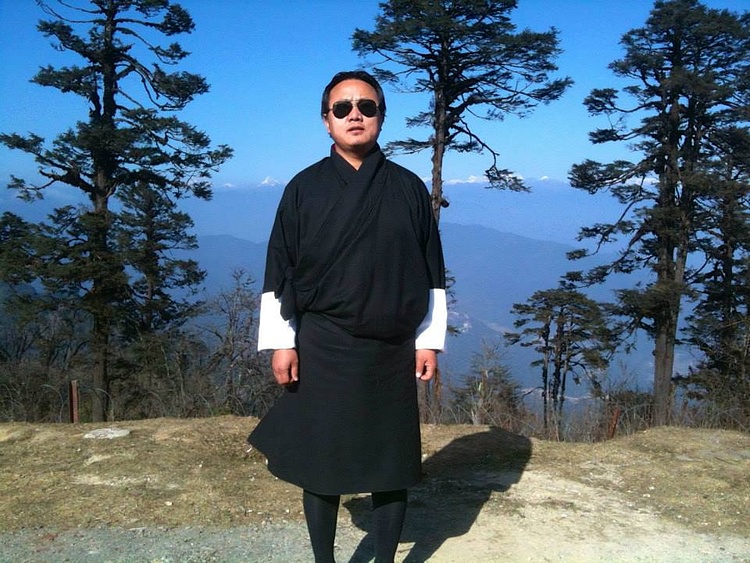 Bhutanese National Costume - Gho Kim Martins (CC BY-NC-SA) ](https://www.worldhistory.org/image/10252/bhutanese-national-costume---gho/ "Bhutanese National Costume - Gho")So appealing is the national dress, you might even want to purchase a *gho* or *kira*. You can do so at the national museum or at the Norzim Lam Craft Stalls. At the very least, taking home a vibrantly-coloured Bhutanese textile will be a wonderful reminder of a visit to a country that time almost seems to have forgotten.
During unification under Ngawang Namgyal, cloth was so highly valued that villagers would fulfil their yearly tax obligations by presenting quantities of cloth. Bhutanese still keep woven fabrics in a *yanggam* or box of prosperity. The *yanggam* might contain cloth such as a ceremonial textile and passed down as a family heirloom, and it will be kept along with jewellery and contribute to the family's abundance or *locho*.
### AT THE END OF YOUR VISIT
After spending a few hours in the National Textile Museum, you might be in need of refreshment. [Karma](https://www.worldhistory.org/Karma/)'s Coffee in the Zhamling Building on Phendey Lam and Ambient Cafe, which is upstairs in a building opposite Druk PNB Bank on Norzim Lam, both serve great coffee.
[ 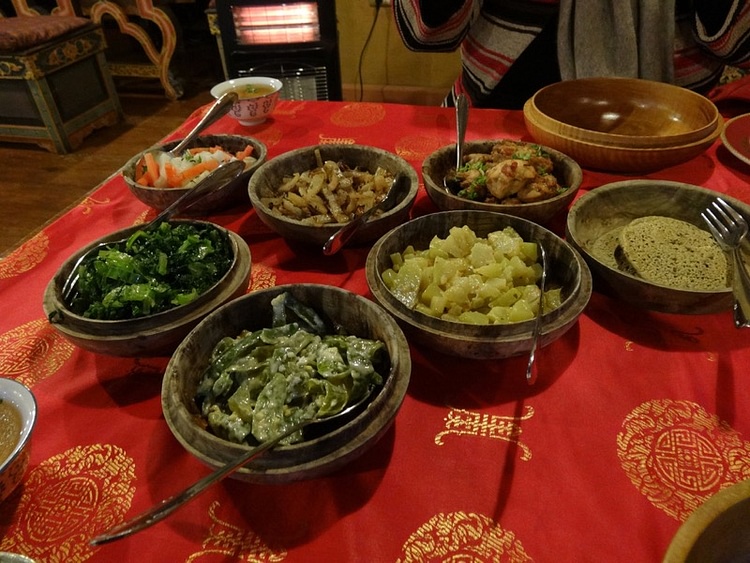 Traditional Bhutanese Food Kim Martins (CC BY-NC-SA) ](https://www.worldhistory.org/image/10256/traditional-bhutanese-food/ "Traditional Bhutanese Food")No visit to this remote Himalayan kingdom is complete without sampling *ema datchi* - the Bhutanese national dish. It is made from chilli peppers and yak milk cheese and comes with a plate of *momo* or hot dumplings stuffed with meat. Wash this all down with some salty Bhutanese butter tea or *suja*. This is made with yak butter, tea leaves, and salt and is infused with Bhutanese happiness as is everything in this magical Shangri-La - the Land of the Thunder Dragon.
#### Editorial Review
This human-authored article has been reviewed by our editorial team before publication to ensure accuracy, reliability and adherence to academic standards in accordance with our [editorial policy](https://www.worldhistory.org/static/editorial-policy/).
## Bibliography
- [Aris, M. *The Raven Crown.* Serindia Publications, 2005.](https://www.worldhistory.org/books/1932476210/)
- [Myers, D.K. *From the Land of the Thunder Dragon.* Serindia Publications, Inc., 2008.](https://www.worldhistory.org/books/1932476423/)
- [Phuntsho, K. *The History of Bhutan.* Vintage Books, 2016.](https://www.worldhistory.org/books/8184007671/)
- [Singye Dorji, K. *Dreaming of Prayer Flags ~ Stories and Images from Bhutan.* Shum Press, 2008.](https://www.worldhistory.org/books/0615193358/)
## About the Author
Kim is a freelance writer based in New Zealand. She has a B.A. (Hons) in History and an M.A. in Chaos and Complexity Science. Her special interests include the exploration of the early modern world and the history of science.
- [Facebook Profile](https://www.facebook.com/kim.martins)
- [Linkedin Profile](https://www.linkedin.com/kimsbarcea)
## Cite This Work
### APA
Martins, K. (2019, March 19). Bhutan: Land of the Thunder Dragon. *World History Encyclopedia*.
### Chicago
Martins, Kim. "Bhutan: Land of the Thunder Dragon." *World History Encyclopedia*, March 19, 2019. .
### MLA
Martins, Kim. "Bhutan: Land of the Thunder Dragon." *World History Encyclopedia*, 19 Mar 2019, .
## License & Copyright
Submitted by [Kim Martins](https://www.worldhistory.org/user/kim.martins/ "User Page: Kim Martins"), published on 19 March 2019. The copyright holder has published this content under the following license: [Creative Commons Attribution-NonCommercial-ShareAlike](https://creativecommons.org/licenses/by-nc-sa/4.0/deed.en). This license lets others remix, tweak, and build upon this content non-commercially, as long as they credit the author and license their new creations under the identical terms. When republishing on the web a hyperlink back to the original content source URL must be included. Please note that content linked from this page may have different licensing terms.