---
title: Pausanius' Guide To Ancient Athens
author: Joshua J. Mark
source: https://www.worldhistory.org/article/133/pausanius-guide-to-ancient-athens/
format: machine-readable-alternate
license: Creative Commons Attribution-NonCommercial-ShareAlike (https://creativecommons.org/licenses/by-nc-sa/4.0/)
updated: 2022-11-11
---
# Pausanius' Guide To Ancient Athens
_Authored by [Joshua J. Mark](https://www.worldhistory.org/user/JPryst/)_
Pausanius (l. 110-180 CE) was a geographer and historian who traveled extensively, taking notes on points of interest, then wrote on them in guide books which could be used by tourists visiting the sites described. His works have long been recognized for their accuracy and have served as guides for archaeologists and historians in the modern era as in antiquity.
Born in [Lydia](https://www.worldhistory.org/lydia/), in [Asia Minor](https://www.worldhistory.org/Asia_Minor/) (present day [Turkey](https://www.worldhistory.org/Asia_Minor/)) Pausanius (also given as [Pausanias](https://www.worldhistory.org/disambiguation/Pausanias/)) traveled to Macedonia, [Jerusalem](https://www.worldhistory.org/jerusalem/), [Egypt](https://www.worldhistory.org/egypt/), and [Rome](https://www.worldhistory.org/Rome/) and wrote of seeing the ruins of the [city](https://www.worldhistory.org/city/) of [Troy](https://www.worldhistory.org/troy/), an especially important passage for later archaeologists, most notably Heinrich Schliemann, seeking to prove Troy was more than a myth. He is best known for his ten-volume work, *Description of [Greece](https://www.worldhistory.org/greece/)*, in which he records, in great detail, his travels through the country, city by city. The work was completed between c. 15 - c. 170 CE.
[  Propylaea, Athenian Acropolis Mark Cartwright (CC BY-NC-SA) ](https://www.worldhistory.org/image/3265/propylaea-athenian-acropolis/ "Propylaea, Athenian Acropolis")Pausanius' precision in detailing the statues, monuments, temples, and buildings of ancient Greece is fascinating in its exactitude in that those buildings and monuments still extant fit his descriptions perfectly; because of this, it may be assumed that those buildings which he describes which no longer exist were, also, just as he recorded them. Pausanius, therefore, remains one of the most important writers of antiquity, providing modern-day readers with an invaluable guide to ancient [cities](https://www.worldhistory.org/city/) in Greece.
In the following passages, from his *Description of Greece*, Pausanius leads a reader on a walk from the Port of [Piraeus](https://www.worldhistory.org/Piraeus/), through [Athens](https://www.worldhistory.org/Athens/), up to the [Acropolis](https://www.worldhistory.org/Acropolis/), noting interesting statues and bits of history along the way. Any reader who has walked this same route in the modern day will recognize it from Pausanius' description of almost 2,000 years ago. The translation is by scholar W.H.S. Jones from his *Pausanius' Description of Greece*.
### Arrival
> \[1.1.1\] On the [Greek](https://www.worldhistory.org/disambiguation/greek/) mainland facing the [Cyclades](https://www.worldhistory.org/Cyclades/) Islands and the [Aegean](https://www.worldhistory.org/aegean/) Sea the [Sunium](https://www.worldhistory.org/sounion/) promontory stands out from the Attic land. When you have rounded the promontory you see a harbor and a [temple](https://www.worldhistory.org/temple/) to [Athena](https://www.worldhistory.org/athena/) of Sunium on the peak of the promontory. Farther on is Laurium, where once the Athenians had [silver](https://www.worldhistory.org/Silver/) mines, and a small uninhabited island called the Island of [Patroclus](https://www.worldhistory.org/Patroclus/). For a fortification was built on it and a palisade constructed by Patroclus, who was admiral in command of the [Egyptian](https://www.worldhistory.org/disambiguation/Egyptian/) men-of-[war](https://www.worldhistory.org/disambiguation/War/) sent by [Ptolemy](https://www.worldhistory.org/disambiguation/Ptolemy/), son of Ptolemy, son of Lagus, to help the Athenians, when [Antigonus](https://www.worldhistory.org/disambiguation/Antigonus/), son of Demetrius, was ravaging their country, which he had invaded with an army, and at the same time was blockading them by sea with a fleet.
### The Pireaus
> \[1.1.2\] The Peiraeus was a parish from early times, though it was not a port before Themistocles became an archon of the Athenians. Their port was Phalerum, for at this place the sea comes nearest to Athens, and from here men say that Menestheus set sail with his fleet for Troy, and before him [Theseus](https://www.worldhistory.org/Theseus/), when he went to give satisfaction to Minos for the [death](https://www.worldhistory.org/disambiguation/Death/) of Androgeos. But when Themistocles became archon, since he thought that the Peiraeus was more conveniently situated for mariners, and had three harbors as against one at Phalerum, he made it the Athenian port. Even up to my time there were docks there, and near the largest harbor is the [grave](https://www.worldhistory.org/burial/) of Themistocles. For it is said that the Athenians repented of their treatment of Themistocles, and that his relations took up his bones and brought them from Magnesia. And the children of Themistocles certainly returned and set up in the [Parthenon](https://www.worldhistory.org/parthenon/) a painting, on which is a portrait of Themistocles.
> \[1.1.3\] The most noteworthy sight in the Peiraeus is a precinct of Athena and [Zeus](https://www.worldhistory.org/zeus/). Both their images are of [bronze](https://www.worldhistory.org/disambiguation/bronze/); Zeus holds a staff and a Victory, Athena a spear. Here is a portrait of Leosthenes and of his sons, painted by Arcesilaus. This Leosthenes at the head of the Athenians and the united Greeks defeated the Macedonians in Boeotia and again outside [Thermopylae](https://www.worldhistory.org/thermopylae/) forced them into [Lamia](https://www.worldhistory.org/lamia/) over against Oeta, and shut them up there. The portrait is in the long portico, where stands a market-place for those living near the sea—those farther away from the harbor have another—but behind the portico near the sea stand a Zeus and a Demos, the work of Leochares. And by the sea Conon built a sanctuary of [Aphrodite](https://www.worldhistory.org/Aphrodite/), after he had crushed the Lacedaemonian warships off Cnidus in the Carian peninsula. For the Cnidians hold Aphrodite in very great honor, and they have sanctuaries of the goddess; the oldest is to her as Doritis (Bountiful), the next in age as Acraea (Of the Height), while the newest is to the Aphrodite called Cnidian by men generally, but Euploia (Fair Voyage) by the Cnidians themselves.
[  Piraeus & The Long Walls Dept. of History, US Military Academy (CC BY-SA) ](https://www.worldhistory.org/image/1254/piraeus--the-long-walls/ "Piraeus & The Long Walls")> \[1.1.4\] The Athenians have also another harbor, at Munychia, with a temple of [Artemis](https://www.worldhistory.org/artemis/) of Munychia, and yet another at Phalerum, as I have already stated, and near it is a sanctuary of [Demeter](https://www.worldhistory.org/demeter/). Here there is also a temple of Athena Sciras, and one of Zeus some distance away, and altars of the gods named Unknown, and of heroes, and of the children of Theseus and Phalerus; for this Phalerus is said by the Athenians to have sailed with Jason to Colchis. There is also an altar of Androgeos, son of Minos, though it is called that of Heros; those, however, who pay special attention to the study of their country's antiquities know that it belongs to Androgeos.
> \[1.1.5\] Twenty stades away is the Coliad promontory; on to it, when the Persian fleet was destroyed, the wrecks were carried down by the waves. There is here an image of the Coliad Aphrodite, with the goddesses Genetyllides (Goddesses of Birth), as they are called. And I am of opinion that the goddesses of the Phocaeans in [Ionia](https://www.worldhistory.org/ionia/), whom they call Gennaides, are the same as those at Colias. On the way from Phalerum to Athens there is a temple of [Hera](https://www.worldhistory.org/Hera/) with neither doors nor roof. Men say that Mardonius, son of Gobryas, burnt it. But the image there to-day is, as report goes, the work of Alcamenes So that this, at any rate, cannot have been damaged by the Persians.
### City Outskirts & Walls
> \[1.2.1\] On entering the city there is a monument to Antiope the [Amazon](https://www.worldhistory.org/amazon/). This Antiope, [Pindar](https://www.worldhistory.org/Pindar/) says, was carried of by Peirithous and Theseus, but Hegias of Troezen gives the following account of her. Heracles was besieging Themiscyra on the Thermodon, but could not take it, but Antiope, falling in love with Theseus, who was aiding Heracles in his campaign, surrendered the stronghold. Such is the account of Hegias. But the Athenians assert that when the [Amazons](https://www.worldhistory.org/amazon/) came, Antiope was shot by Molpadia, while Molpadia was killed by Theseus. To Molpadia also there is a monument among the Athenians.
[  Themistocles Sailko (CC BY) ](https://www.worldhistory.org/image/4570/themistocles/ "Themistocles")> \[1.2.2\] As you go up from the Peiraeus you see the ruins of the walls which Conon restored after the naval [battle](https://www.worldhistory.org/disambiguation/battle/) off Cnidus. For those built by Themistocles after the retreat of the Persians were destroyed during the rule of those named the Thirty. Along the road are very famous graves, that of Menander, son of Diopeithes, and a cenotaph of [Euripides](https://www.worldhistory.org/Euripides/). He himself went to King [Archelaus](https://www.worldhistory.org/disambiguation/Archelaus/) and lies buried in Macedonia; as to the manner of his death (many have described it), let it be as they say.
> \[1.2.3\] So even in his time poets lived at the courts of kings, as earlier still Anacreon consorted with [Polycrates](https://www.worldhistory.org/Polycrates/), despot of [Samos](https://www.worldhistory.org/samos/), and [Aeschylus](https://www.worldhistory.org/Aeschylus/) and Simonides journeyed to Hiero at [Syracuse](https://www.worldhistory.org/syracuse/). Dionysius, afterwards despot in [Sicily](https://www.worldhistory.org/sicily/) had Philoxenus at his court, and Antigonus, ruler of Macedonia, had Antagoras of [Rhodes](https://www.worldhistory.org/Rhodes/) and Aratus of Soli. But [Hesiod](https://www.worldhistory.org/hesiod/) and [Homer](https://www.worldhistory.org/homer/) either failed to win the society of kings or else purposely despised it, Hesiod through boorishness and reluctance to travel, while Homer, having gone very far abroad, depreciated the help afforded by despots in the acquisition of wealth in comparison with his reputation among ordinary men. And yet Homer, too, in his poem makes Demodocus live at the court of Alcinous, and [Agamemnon](https://www.worldhistory.org/disambiguation/Agamemnon/) leave a poet with his wife. Not far from the gates is a grave, on which is mounted a soldier standing by a horse. Who it is I do not know, but both horse and soldier were carved by Praxiteles.
### Temple of Demeter
> \[1.2.4\] On entering the city there is a building for the preparation of the processions, which are held in some cases every year, in others at longer intervals. Hard by is a temple of Demeter, with images of the goddess herself and of her daughter, and of Iacchus holding a torch. On the [wall](https://www.worldhistory.org/wall/), in Attic characters, is written that they are works of Praxiteles. Not far from the temple is [Poseidon](https://www.worldhistory.org/poseidon/) on horseback, hurling a spear against the [giant](https://www.worldhistory.org/Giants/) Polybotes, concerning whom is prevalent among the Coans the story about the promontory of Chelone. But the inscription of our time assigns the statue to another, and not to Poseidon. From the gate to the Cerameicus there are porticoes, and in front of them brazen statues of such as had some title to fame, both men and [women](https://www.worldhistory.org/disambiguation/women/).
[  Seated Demeter Statue Osama Shukir Muhammed Amin (Copyright) ](https://www.worldhistory.org/image/5072/seated-demeter-statue/ "Seated Demeter Statue")> \[1.2.5\] One of the porticoes contains shrines of gods, and a [gymnasium](https://www.worldhistory.org/Gymnasium/) called that of [Hermes](https://www.worldhistory.org/Hermes/). In it is the house of Pulytion, at which it is said that a mystic rite was performed by the most notable Athenians, parodying the Eleusinian mysteries. But in my time it was devoted to the worship of [Dionysus](https://www.worldhistory.org/Dionysos/). This Dionysus they call Melpomenus (Minstrel), on the same principle as they call [Apollo](https://www.worldhistory.org/apollo/) Musegetes (Leader of the [Muses](https://www.worldhistory.org/muse/)). Here there are images of Athena Paeonia (Healer), of Zeus, of Mnemosyne (Memory) and of the Muses, an Apollo, the votive offering and work of Eubulides, and Acratus, a daemon attendant upon Apollo; it is only a face of him worked into the wall. After the precinct of Apollo is a building that contains earthen ware images, Amphictyon, king of Athens, feasting Dionysus and other gods. Here also is [Pegasus](https://www.worldhistory.org/Pegasus/) of Eleutherae, who introduced the [god](https://www.worldhistory.org/God/) to the Athenians. Herein he was helped by the oracle at [Delphi](https://www.worldhistory.org/delphi/), which called to mind that the god once dwelt in Athens in the days of Icarius.
> \[1.2.6\] Amphictyon won the kingdom thus. It is said that Actaeus was the first king of what is now Attica. When he died, Cecrops, the son-in-[law](https://www.worldhistory.org/disambiguation/law/) of Actaeus, received the kingdom, and there were born to him daughters, Herse, Aglaurus and Pandrosus, and a son Erysichthon. This son did not become king of the Athenians, but happened to die while his father lived, and the kingdom of Cecrops fell to Cranaus, the most powerful of the Athenians. They say that Cranaus had daughters, and among them Atthis; and from her they call the country Attica, which before was named Actaea. And Amphictyon, rising up against Cranaus, although he had his daughter to wife, deposed him from power. Afterwards he himself was banished by Erichthonius and his fellow rebels. Men say that Erichthonius had no human father, but that his parents were [Hephaestus](https://www.worldhistory.org/Hephaistos/) and Earth.
### Kerameikos
> \[1.3.1\] The district of the Cerameicus has its name from the hero Ceramus, he too being the reputed son of Dionysus and [Ariadne](https://www.worldhistory.org/Ariadne/). First on the right is what is called the Royal Portico, where sits the king when holding the yearly office called the kingship. On the tiling of this portico are images of baked earthenware, Theseus throwing Sciron into the sea and Day carrying away Cephalus, who they say was very beautiful and was ravished by Day, who was in love with him. His son was Phaethon,. . . and made a guardian of her temple. Such is the tale told by Hesiod, among others, in his poem on women.
[ 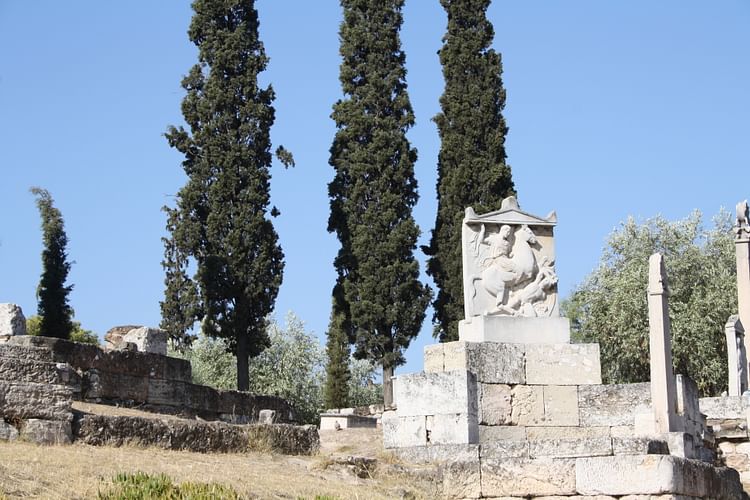 Dexileos Stele James Lloyd (CC BY-NC-SA) ](https://www.worldhistory.org/image/2144/dexileos-stele/ "Dexileos Stele")> \[1.3.2\] Near the portico stand Conon, Timotheus his son and Evagoras King of [Cyprus](https://www.worldhistory.org/cyprus/), who caused the Phoenician men-of-war to be given to Conon by King Artaxerxes. This he did as an Athenian whose ancestry connected him with [Salamis](https://www.worldhistory.org/disambiguation/Salamis/), for he traced his pedigree back to Teucer and the daughter of Cinyras. Here stands Zeus, called Zeus of Freedom, and the Emperor [Hadrian](https://www.worldhistory.org/hadrian/), a benefactor to all his subjects and especially to the city of the Athenians.
> \[1.3.3\] A portico is built behind with pictures of the gods called the Twelve. On the wall opposite are painted Theseus, Democracy and Demos. The picture represents Theseus as the one who gave the Athenians political equality. By other means also has the report spread among men that Theseus bestowed sovereignty upon the people, and that from his time they continued under a democratical government, until [Peisistratus](https://www.worldhistory.org/Pisistratus/) rose up and became despot. But there are many false beliefs current among the mass of mankind, since they are ignorant of historical [science](https://www.worldhistory.org/science/) and consider trustworthy whatever they have heard from childhood in choruses and tragedies; one of these is about Theseus, who in fact himself became king, and afterwards, when Menestheus was dead, the descendants of Theseus remained rulers even to the fourth generation. But if I cared about tracing the pedigree I should have included in the list, besides these, the kings from Melanthus to Cleidicus the son of Aesimides.
> \[1.3.4\] Here is a picture of the exploit, near Mantinea, of the Athenians who were sent to help the Lacedaemonians. [Xenophon](https://www.worldhistory.org/xenophon/) among others has written a history of the whole war—the taking of the Cadmea, the defeat of the Lacedaemonians at Leuctra, how the Boeotians invaded the Peloponnesus, and the contingent sent to the Lacedaemonians from the Athenians. In the picture is a cavalry battle, in which the most famous men are, among the Athenians, Grylus the son of Xenophon, and in the Boeotian cavalry, [Epaminondas](https://www.worldhistory.org/Epaminondas/) the Theban. These pictures were painted for the Athenians by Euphranor, and he also wrought the Apollo surnamed Patrous (Paternal) in the temple hard by. And in front of the temple is one Apollo made by Leochares; the other Apollo, called Averter of evil, was made by Calamis. They say that the god received this name because by an oracle from Delphi he stayed the pestilence which afflicted the Athenians at the time of the [Peloponnesian War](https://www.worldhistory.org/Peloponnesian_War/).
[ 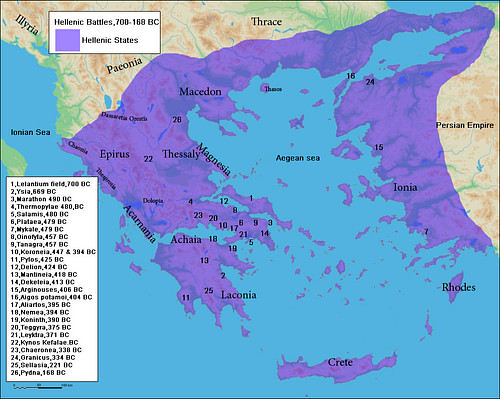 Battles of Ancient Greece Megistias (CC BY-SA) ](https://www.worldhistory.org/image/327/battles-of-ancient-greece/ "Battles of Ancient Greece")> \[1.3.5\] Here is built also a sanctuary of the Mother of the gods; the image is by Pheidias. Hard by is the council chamber of those called the Five Hundred, who are the Athenian councillors for a year. In it are a wooden figure of Zeus Counsellor and an Apollo, the work of Peisias, and a Demos by Lyson. The thesmothetae (lawgivers) were painted by Protogenes the Caunian, and Olbiades portrayed Callippus, who led the Athenians to Thermopylae to stop the incursion of the Gauls into Greece. Evagoras was a king of Salamis in Cyprus, who reigned from about 410 to 374 B.C. He favoured the Athenians, and helped Conon to defeat the Spartan fleet off Cnidus in 394 B.C.
### Thermopylae
> \[1.4.1\] These Gauls inhabit the most remote portion of [Europe](https://www.worldhistory.org/europe/), near a great sea that is not navigable to its extremities, and possesses ebb and flow and creatures quite unlike those of other seas. Through their country flows the river Eridanus, on the bank of which the daughters of Helius (Sun) are supposed to lament the fate that befell their brother Phaethon. It was late before the name "Gauls" came into vogue; for anciently they were called [Celts](https://www.worldhistory.org/celt/) both amongst themselves and by others. An army of them mustered and turned towards the Ionian Sea, dispossessed the Illyrian people, all who dwelt as far as Macedonia with the Macedonians themselves, and overran [Thessaly](https://www.worldhistory.org/disambiguation/Thessaly/). And when they drew near to Thermopylae, the Greeks in general made no move to prevent the inroad of the barbarians, since previously they had been severely defeated by [Alexander](https://www.worldhistory.org/disambiguation/Alexander/) and Philip. Further, [Antipater](https://www.worldhistory.org/disambiguation/Antipater/) and [Cassander](https://www.worldhistory.org/Cassander/) afterwards crushed the Greeks, so that through weakness each state thought no shame of itself taking no part in the defence of the country.
[  Battle of Thermopylae 480 BCE Dept. of History, US Military Academy (CC BY-SA) ](https://www.worldhistory.org/image/1134/battle-of-thermopylae-480-bce/ "Battle of Thermopylae 480 BCE")> \[1.4.2\] But the Athenians, although they were more exhausted than any of the Greeks by the long Macedonian war, and had been generally unsuccessful in their battles, nevertheless set forth to Thermopylae with such Greeks as joined them, having made the Callippus I mentioned their general. Occupying the pass where it was narrowest, they tried to keep the foreigners from entering Greece; but the Celts, having discovered the path by which Ephialtes of Trachis once led the Persians, overwhelmed the Phocians stationed there and crossed Oeta unperceived by the Greeks.
> \[1.4.3\] Then it was that the Athenians put the Greeks under the greatest obligation, and although outflanked offered resistance to the foreigners on two sides. But the Athenians on the fleet suffered most, for the Lamian gulf is a swamp near Thermopylae—the reason being, I think, the hot water that here runs into the sea. These then were more distressed; for taking the Greeks on board they were forced to sail through the mud weighted as they were by arms and men.
> \[1.4.4\] So they tried to save Greece in the way described, but the Gauls, now south of the Gates, cared not at all to capture the other towns, but were very eager to sack Delphi and the treasures of the god. They were opposed by the Delphians themselves and the Phocians of the cities around Parnassus; a force of Aetolians also joined the defenders, for the Aetolians at this time were pre-eminent for their vigorous activity. When the forces engaged, not only were thunderbolts and rocks broken off from Parnassus hurled against the Gauls, but terrible shapes as armed warriors haunted the foreigners. They say that two of them, Hyperochus and Amadocus, came from the Hyperboreans, and that the third was [Pyrrhus](https://www.worldhistory.org/pyrrhus/) son of [Achilles](https://www.worldhistory.org/achilles/). Because of this help in battle the Delphians sacrifice to Pyrrhus as to a hero, although formerly they held even his [tomb](https://www.worldhistory.org/tomb/) in dishonor, as being that of an enemy.
> \[1.4.5\] The greater number of the Gauls crossed over to Asia by ship and plundered its coasts. Some time after, the inhabitants of Pergamus, that was called of old Teuthrania, drove the Gauls into it from the sea. Now this people occupied the country on the farther side of the river Sangarius capturing Ancyra, a city of the Phrygians, which [Midas](https://www.worldhistory.org/midas/) son of Gordius had founded in former time. And the anchor, which Midas found, was even as late as my time in the sanctuary of Zeus, as well as a spring called the Spring of Midas, water from which they say Midas mixed with wine to capture [Silenus](https://www.worldhistory.org/Silenus/). Well then, the Pergameni took Ancyra and Pessinus which lies under Mount Agdistis, where they say that Attis lies buried.
[  The Parthenon Andrew Griffith (CC BY-NC-SA) ](https://www.worldhistory.org/image/943/the-parthenon/ "The Parthenon")> \[1.4.6\] They have spoils from the Gauls, and a painting which portrays their deed against them. The land they dwell in was, they say, in ancient times sacred to the Cabeiri, and they claim that they are themselves Arcadians, being of those who crossed into Asia with Telephus. Of the wars that they have waged no account has been published to the world, except that they have accomplished three most notable achievements; the subjection of the coast region of Asia, the expulsion of the Gauls therefrom, and the exploit of Telephus against the followers of Agamemnon, at a time when the Greeks after missing Troy, were plundering the Meian plain thinking it Trojan territory. Now I will return from my digression.
### Tholos
> \[1.5.1\] Near to the Council Chamber of the Five Hundred is what is called Tholos (Round House); here the presidents sacrifice, and there are a few small statues made of silver. Farther up stand statues of heroes, from whom afterwards the Athenian tribes received their names. Who the man was who established ten tribes instead of four, and changed their old names to new ones—all this is told by [Herodotus](https://www.worldhistory.org/herodotus/).
> \[1.5.2\] The eponymoi—this is the name given to them—are Hippothoon son of Poseidon and Alope daughter of Cercyon, Antiochus, one of [the children of Heracles](https://www.worldhistory.org/The_Children_of_Heracles/) borne to him by Meda daughter of Phylas, thirdly, [Ajax](https://www.worldhistory.org/disambiguation/Ajax/) son of Telamon, and to the Athenians belongs Leos, who is said to have given up his daughters, at the command of the oracle, for the safety of the commonwealth. Among the eponymoi is Erechtheus, who conquered the Eleusinians in battle, and killed their general, Immaradus the son of Eumolpus. There is Aegeus also and Oeneus the bastard son of Pandion, and Acamas, one of the children of Theseus.
> \[1.5.3\] I saw also among the eponymoi statues of Cecrops and Pandion, but I do not know who of those names are thus honored. For there was an earlier ruler Cecrops who took to wife the daughter of Actaeus, and a later—he it was who migrated to Euboea—son of Erechtheus, son of Pandion, son of Erichthonius. And there was a king Pandion who was son of Erichthonius, and another who was son of Cecrops the second. This man was deposed from his kingdom by the Metionidae, and when he fled to [Megara](https://www.worldhistory.org/disambiguation/Megara/)—for he had to wife the daughter of Pylas king of Megara—his children were banished with him. And Pandion is said to have fallen ill there and died, and on the coast of the Megarid is his tomb, on the rock called the rock of Athena the Gannet.
> \[1.5.4\] But his children expelled the Metionidae, and returned from banishment at Megara, and Aegeus, as the eldest, became king of the Athenians. But in rearing daughters Pandion was unlucky, nor did they leave any sons to avenge him. And yet it was for the sake of power that he made the marriage alliance with the king of Thrace. But there is no way for a mortal to overstep what the deity thinks fit to send. They say that Tereus, though wedded to Procne, dishonored Philomela, thereby transgressing Greek custom, and further, having mangled the body of the damsel, constrained the women to avenge her. There is another statue, well worth seeing, of Pandion on the Acropolis.
#### Editorial Review
This human-authored article has been reviewed by our editorial team before publication to ensure accuracy, reliability and adherence to academic standards in accordance with our [editorial policy](https://www.worldhistory.org/static/editorial-policy/).
## Bibliography
- [Hatzfeld, J. *History of Ancient Greece.* W. W. Norton & Company, 2010.](https://www.worldhistory.org/books/B01FGNEARY/)
- [Jones, W. H. S. *Pausanius' Description of Greece.* Harvard University Press, 2000.](https://www.worldhistory.org/books/B07QVKC2CJ/)
- [Levi, P. *Pausanias Guide to Greece, Vol. 1.* Penguin Classics, 1979.](https://www.worldhistory.org/books/B01FGMVD1Q/)
- [Martin, T. R. *Ancient Greece: From Prehistoric to Hellenistic Times.* Yale University Press, 2013.](https://www.worldhistory.org/books/0300160054/)
## About the Author
Joshua J. Mark is World History Encyclopedia's co-founder and Content Director. He was previously a professor at Marist College (NY) where he taught history, philosophy, literature, and writing. He has traveled extensively and lived in Greece and Germany.
- [Linkedin Profile](https://www.linkedin.com/pub/joshua-j-mark/38/614/339)
## Questions & Answers
### Is Pausanias a reliable source?
Yes. Pausanias is famous for his accuracy.
### What is Pausanias' Description of Greece about?
Pausanias' Description of Greece is the author's observations of places he visited in Greece. The work served as a travel guide for tourists.
### When did Pausanias write his Description of Greece?
Pausanias Description of Greece was written between c. 150 - c. 170 CE.
### What is Pausanias famous for?
Pausanias is famous as the author of the Description of Greece.
## Cite This Work
### APA
Mark, J. J. (2022, November 11). Pausanius' Guide To Ancient Athens. *World History Encyclopedia*.
### Chicago
Mark, Joshua J.. "Pausanius' Guide To Ancient Athens." *World History Encyclopedia*, November 11, 2022. .
### MLA
Mark, Joshua J.. "Pausanius' Guide To Ancient Athens." *World History Encyclopedia*, 11 Nov 2022, .
## License & Copyright
Submitted by [Joshua J. Mark](https://www.worldhistory.org/user/JPryst/ "User Page: Joshua J. Mark"), published on 11 November 2022. The copyright holder has published this content under the following license: [Creative Commons Attribution-NonCommercial-ShareAlike](https://creativecommons.org/licenses/by-nc-sa/4.0/deed.en). This license lets others remix, tweak, and build upon this content non-commercially, as long as they credit the author and license their new creations under the identical terms. When republishing on the web a hyperlink back to the original content source URL must be included. Please note that content linked from this page may have different licensing terms.