---
title: Top 10 Archaeological Sites in Provence
author: Carole Raddato
source: https://www.worldhistory.org/article/1316/top-10-archaeological-sites-in-provence/
format: machine-readable-alternate
license: Creative Commons Attribution-NonCommercial-ShareAlike (https://creativecommons.org/licenses/by-nc-sa/4.0/)
updated: 1970-01-01
---
# Top 10 Archaeological Sites in Provence
_Authored by [Carole Raddato](https://www.worldhistory.org/user/FollowingHadrian/)_
Provence has inherited a rich legacy from antiquity, boasting some of the best-preserved [Roman](https://www.worldhistory.org/disambiguation/Roman/) ruins in [Europe](https://www.worldhistory.org/europe/). In the 2nd century BCE, the Romans began their [conquest](https://www.worldhistory.org/warfare/) of the region and called it “Provincia Romana,” giving us the region's present name, “Provence.” Thanks to the [Pax Romana](https://www.worldhistory.org/Pax_Romana/), which was to last for several centuries, the province, later renamed “Gallia Narbonensis” (after its capital “Narbo Martius” which is present-day Narbonne, France), experienced a period of unprecedented growth. Roads, bridges, and [aqueducts](https://www.worldhistory.org/aqueduct/) were built to eliminate the isolation of the conquered territories, and there are hundreds of ancient sites in Provence. Additionally, replicas of the major monuments of [Rome](https://www.worldhistory.org/Rome/) were raised in many urban centers.
Scattered throughout Provence, there are countless ancient monuments that have survived the centuries, allowing us to enjoy what was once a vibrant part of the [Roman Empire](https://www.worldhistory.org/Roman_Empire/). On a recent trip to Provence, I followed [Roman roads](https://www.worldhistory.org/article/758/roman-roads/), crossed Roman bridges, and marveled at Roman theaters, arenas, and temples. Here is a list of 10 must-see ancient sites in Provence, France.
### 1. Nîmes
Nîmes was known to the Romans as “Nemausus”, and it is one of the most impressive ancient sites in France. (It is technically located in Languedoc-Roussillon, but the [city](https://www.worldhistory.org/city/) has historic and strong ties to Provence.) The name is believed to have been derived from the [Celtic](https://www.worldhistory.org/celt/) [god](https://www.worldhistory.org/God/) of the spring that originally provided water for the settlement. It was the capital of the Volcae Arecomici — a Gaulish tribe which surrendered to the [Roman Republic](https://www.worldhistory.org/Roman_Republic/) in 121 BCE — and became a Roman colony sometime before c. 28 BCE. The city has produced wonderful Roman architectural remains including the so-called [Maison Carrée](http://arenes-nimes.com/en/discovering-site/maison-carree) (Square House), an admirably preserved first century BCE Corinthian [temple](https://www.worldhistory.org/temple/) commissioned by [Marcus Agrippa](https://www.worldhistory.org/Marcus_Agrippa/) (right-hand man, son-in-[law](https://www.worldhistory.org/disambiguation/law/), and intended successor of [Caesar](https://www.worldhistory.org/disambiguation/caesar/) [Augustus](https://www.worldhistory.org/augustus/)).
[ 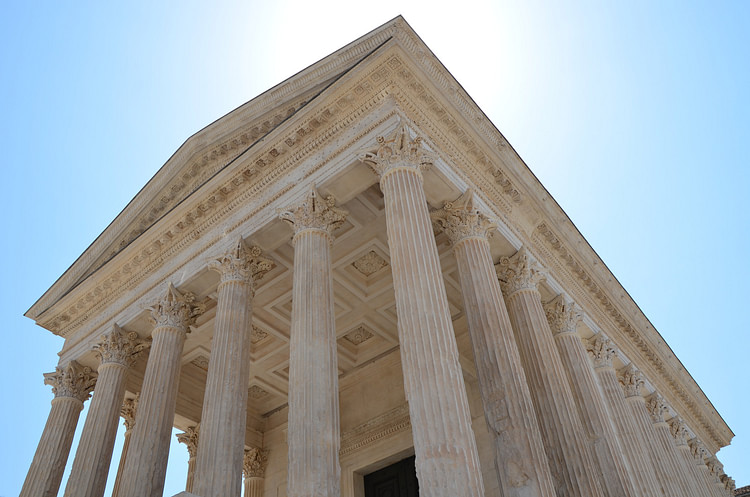 Maison Carrée, Nîmes Carole Raddato (CC BY-NC-SA) ](https://www.worldhistory.org/image/9813/maison-carree-nimes/ "Maison Carrée, Nîmes")An excellent new film, “Nemausus: The Birth of Nîmes,” is being shown daily every 30 minutes at the Maison Carrée. Shot partially in the Cinecittà studios in Rome, the 22-minute film takes you to the heart of the story of how Nîmes was founded, through the eyes of one family from 55 BCE-90 CE. (You can see a trailer [here](https://www.youtube.com/watch?v=LDHW7BckZOY).)
[ 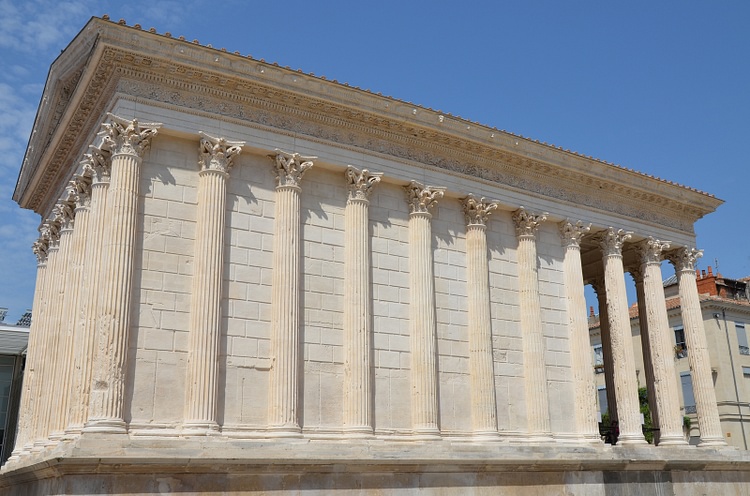 Maison Carrée, Side View Carole Raddato (CC BY-NC-SA) ](https://www.worldhistory.org/image/9814/maison-carree-side-view/ "Maison Carrée, Side View")The amphitheater of Nîmes, known as “les Arènes,” is one of the best preserved in Europe. Built around 70 CE, it could seat upwards of 24,000 spectators. Presently, it still draws large crowds during its two annual bullfights and other public events in the summer.
Other places of interest include the Augusteum/nymphaeum (the so-called Temple of [Diana](https://www.worldhistory.org/diana/)), the Tour Magne and the Porte d'Auguste (the only remnants of the ancient Augustan fortifications) as well as the Castellum divisorium (the terminal point of the [aqueduct](https://www.worldhistory.org/aqueduct/) that brought water to the city).
[ 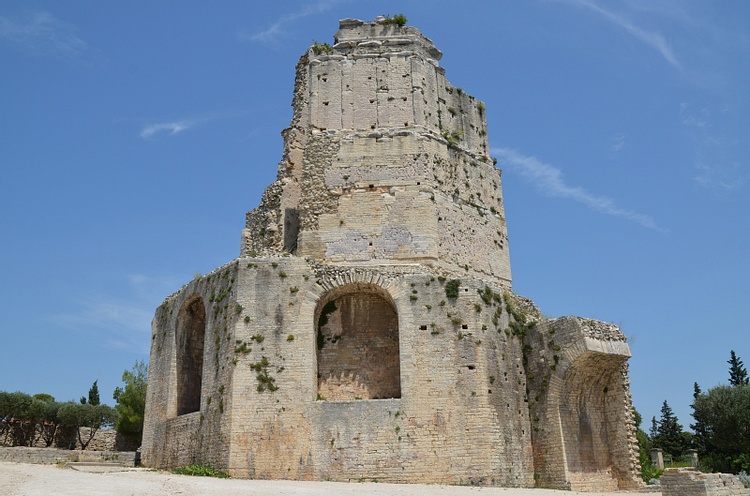 Tour Magne Carole Raddato (CC BY-NC-SA) ](https://www.worldhistory.org/image/9816/tour-magne/ "Tour Magne") [ 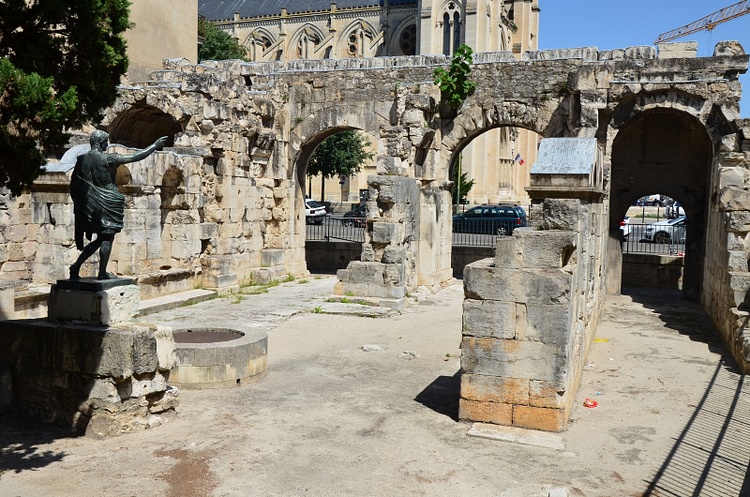 Porte d'Auguste, Nimes Carole Raddato (CC BY-NC-SA) ](https://www.worldhistory.org/image/9817/porte-dauguste-nimes/ "Porte d'Auguste, Nimes") [ 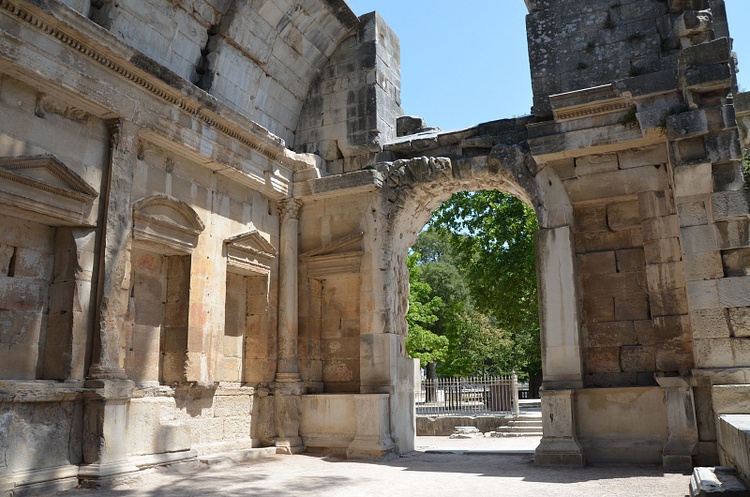 Temple of Diana, Nimes Carole Raddato (CC BY-NC-SA) ](https://www.worldhistory.org/image/9818/temple-of-diana-nimes/ "Temple of Diana, Nimes")The [Musée de la Romanité](https://museedelaromanite.fr/en/) (Museum of Roman [Civilization](https://www.worldhistory.org/civilization/)), is highly recommended. It houses a collection of some 25,000 pieces including exquisite mosaics.
### 2. Pont du Gard
A true masterpiece of ancient [architecture](https://www.worldhistory.org/disambiguation/architecture/), the Pont du Gard aqueduct is one of the most beautiful Roman ruins in all of Europe. It has been a UNESCO World Heritage Site since 1985 CE.
[ 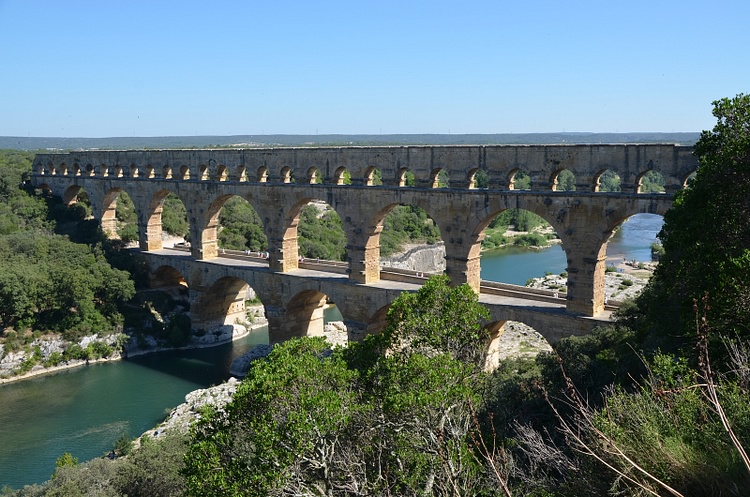 Pont du Gard Carole Raddato (CC BY-NC-SA) ](https://www.worldhistory.org/image/9812/pont-du-gard/ "Pont du Gard")The Pont du Gard was part of an extended channel built to carry water to Nîmes from a source immediately to the north of the city. The difference in level between the two ends of the aqueduct is only 17 m (56 ft) or an average of 34 cm (13 in) per km, while the bridge descends by a mere 2.5 cm (1 in). The construction of the aqueduct has long been credited to Augustus' son-in-law Marcus [Agrippa](https://www.worldhistory.org/Marcus_Agrippa/) (64/63-12 BCE), but more recent excavations suggest the construction may have taken place between c. 40-60 CE.
On the site of the Pont du Gard, you will find a museum tracing the history of the Roman aqueduct and water in the Roman world. Models, virtual reconstructions, multimedia screens, and sounds whisk you into the world of the Romans.
[  The Roman Aqueduct of Pont du Gard Michael Gwyther-Jones (CC BY) ](https://www.worldhistory.org/image/125/the-roman-aqueduct-of-pont-du-gard/ "The Roman Aqueduct of Pont du Gard")### 3. Arles
Once called the “little Rome of [Gaul](https://www.worldhistory.org/gaul/),” Arles (or *Arelate* in Latin) occupied an important strategic position at the crossroads between [Italy](https://www.worldhistory.org/italy/) and Spain. In 46 BCE, [Julius Caesar](https://www.worldhistory.org/Julius_Caesar/) founded a Roman colony in this city which had supported him in his long struggle against [Pompey](https://www.worldhistory.org/pompey/). Consequently, the city changed and splendid Roman buildings were built. A number of these Roman structures are still standing. These include the amphitheater (Arènes d'Arles) and the theater (Théâtre Antique), remains of a [circus](https://www.worldhistory.org/disambiguation/Circus/), baths (Thermae of [Constantine](https://www.worldhistory.org/disambiguation/Constantine/)), a necropolis (the Alyscamps), and a large cryptoporticus built as foundations for the forum. The Roman and Romanesque monuments in Arles have been UNESCO World Heritage Sites since 1981 CE.
[ 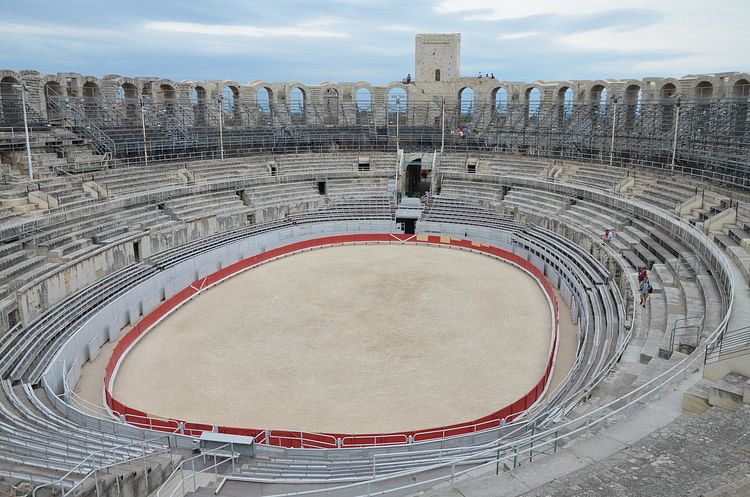 Arles Amphitheatre Carole Raddato (CC BY-NC-SA) ](https://www.worldhistory.org/image/9819/arles-amphitheatre/ "Arles Amphitheatre") [ 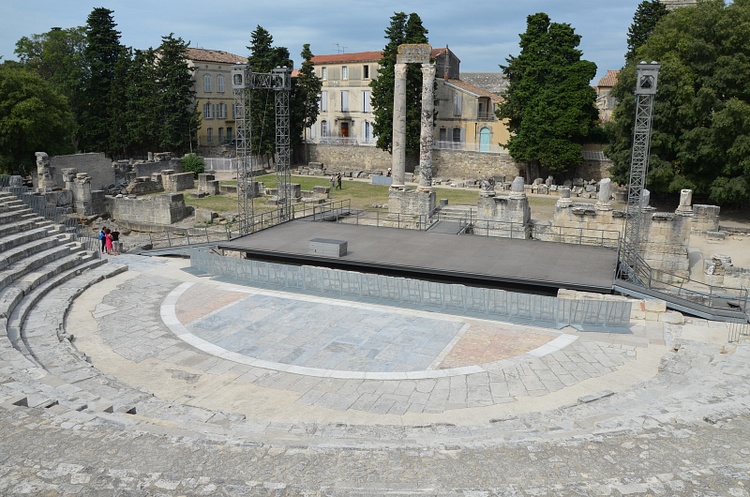 The Roman Theatre of Arles Carole Raddato (CC BY-NC-SA) ](https://www.worldhistory.org/image/9820/the-roman-theatre-of-arles/ "The Roman Theatre of Arles")Arles made headlines around the world in 2008 CE when a bust, thought to be of [Julius](https://www.worldhistory.org/disambiguation/Julius/) Caesar, was found at the bottom of the Rhône River. Although its identification has been disputed, it is generally considered to be the only known portrait-bust of Julius Caesar carved during his lifetime.
[ 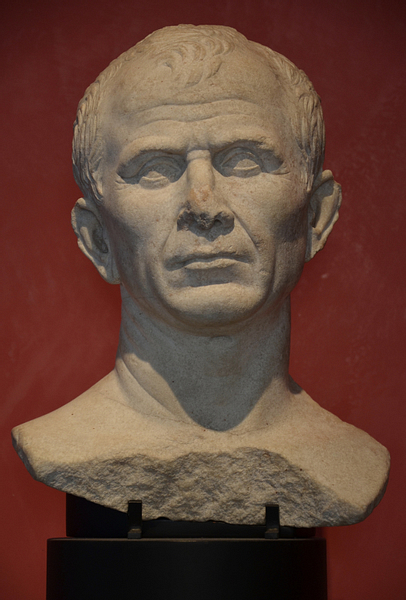 Possible Bust of Julius Caesar Carole Raddato (CC BY-NC-SA) ](https://www.worldhistory.org/image/9822/possible-bust-of-julius-caesar/ "Possible Bust of Julius Caesar")### 4. Vaison-la-Romaine
With the gradual romanization of the city of Narbonensis, present-day Vaison-la-Romaine (Vasio in Latin) became one of the wealthiest [cities](https://www.worldhistory.org/city/) in Roman Provence. Nowhere in Provence does a city feel as “Roman” as in Vaison. The ruined remains of the Gallo-Roman city that flourished here, between the 1st and 3rd centuries CE, cover two main sites: La Villasse and Puymin. At La Villasse, a magnificent paved street, raised and colonnaded, runs straight through the central district, flanked by luxurious houses, shops, baths, gardens, and fountains. At Puymin, you can see the remains of the Roman theater (heavily restored), a rich private domus of exceptional size, as well as a porticoed sanctuary.
[ 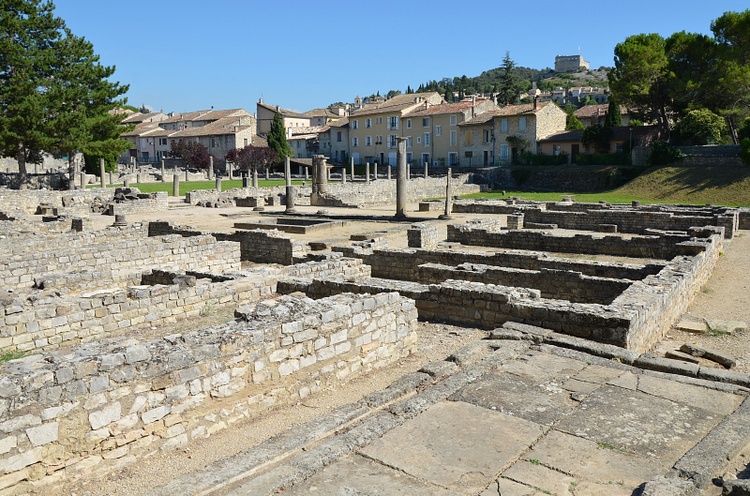 Dolphin House, Vaison-la-Romaine Carole Raddato (CC BY-NC-SA) ](https://www.worldhistory.org/image/9823/dolphin-house-vaison-la-romaine/ "Dolphin House, Vaison-la-Romaine") [ 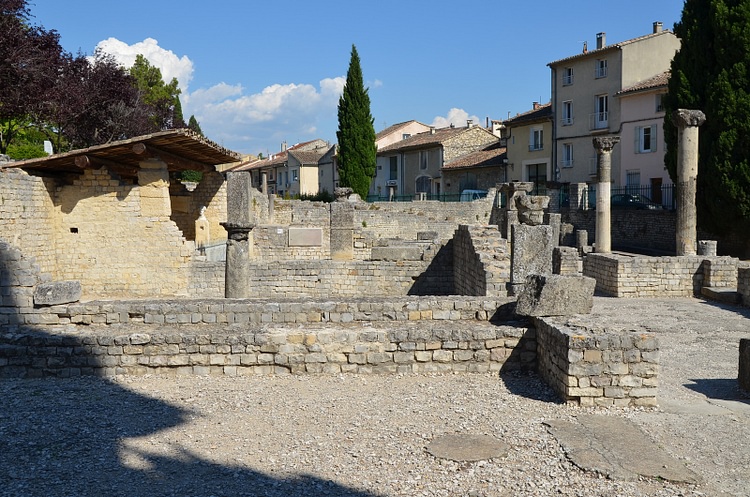 House of the Laurelled Apollo Carole Raddato (CC BY-NC-SA) ](https://www.worldhistory.org/image/9824/house-of-the-laurelled-apollo/ "House of the Laurelled Apollo")The Roman bridge — built in the first century BCE — spans the Ouvèze River, linking the lower part of the city to the upper medieval part of town. The bridge is unique due to its semicircular 17 m (55 ft) arch. It is still in use and survived a devastating flood, which caused great damage on September 22, 1992 CE.
[  Roman Bridge, Vaison-la-Romaine Carole Raddato (CC BY-NC-SA) ](https://www.worldhistory.org/image/9825/roman-bridge-vaison-la-romaine/ "Roman Bridge, Vaison-la-Romaine")The Museum of Vaison-la-Romaine, which can be found at the heart of the archaeological remains of Puymin, has some very fine artifacts including the splendid “Peacock [Mosaic](https://www.worldhistory.org/Mosaic/),” which is 33 m² (355 ft²). There are also marble statues of [Hadrian](https://www.worldhistory.org/hadrian/) and his wife, Sabina, located in the Roman theater.
[ 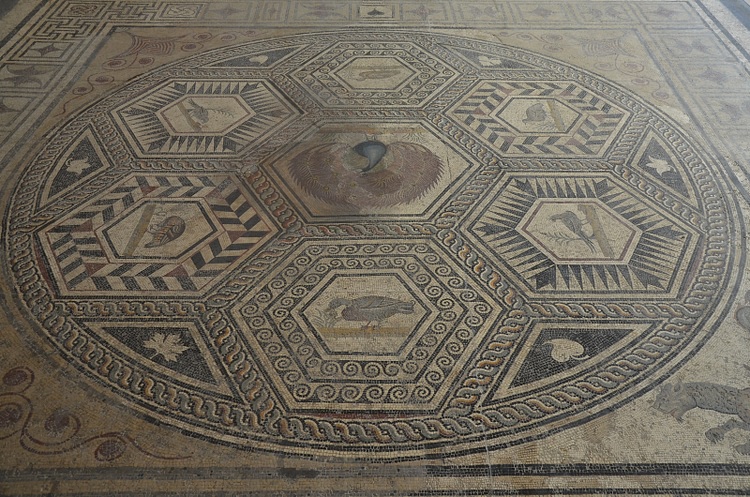 The Peacock Mosaic Carole Raddato (CC BY-NC-SA) ](https://www.worldhistory.org/image/9826/the-peacock-mosaic/ "The Peacock Mosaic")### 5. [Glanum](https://www.worldhistory.org/Glanum/)
At the heart of the magnificent Alpilles mountains, lies the impressive archaeological site of Glanum at Saint-Rémy-de-Provence, which features the remains of important religious and civic monuments. These ruins present a fine example of ancient urban development. Originally a simple Gaulish settlement built by the Salyens around a sacred spring in the 6th century BCE, the city later expanded due to contact with the ancient Greeks. Glanum also benefited from the construction of the Via Domitia and became a Roman colony in the early years of Augustus' reign (27 BCE-14 CE). Today, Glanum is particularly known for two well-preserved Roman monuments of the first century BCE, known locally as “les antiques”: a mausoleum (one of the best-preserved monuments from the ancient world) and a [triumphal arch](https://www.worldhistory.org/Triumphal_Arch/) (one of the earliest built in France).
[  Monumental Arch, Glanum Mark Cartwright (CC BY-NC-SA) ](https://www.worldhistory.org/image/5578/monumental-arch-glanum/ "Monumental Arch, Glanum") [ 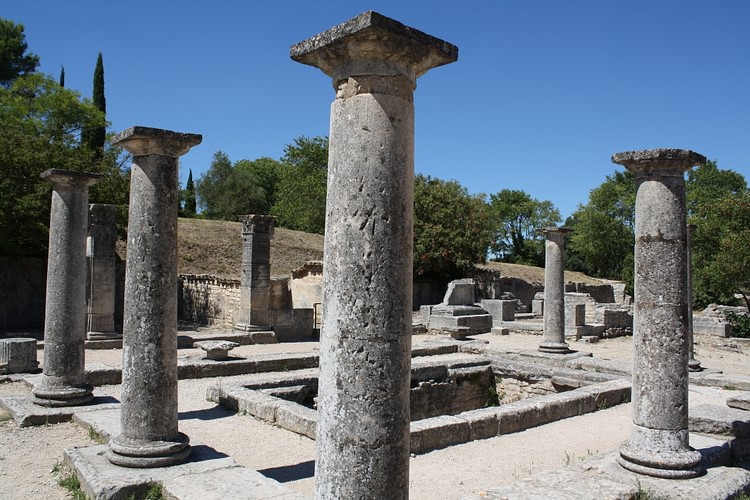 Greek-Style House, Glanum Mark Cartwright (CC BY-NC-SA) ](https://www.worldhistory.org/image/5581/greek-style-house-glanum/ "Greek-Style House, Glanum")### 6. Orange
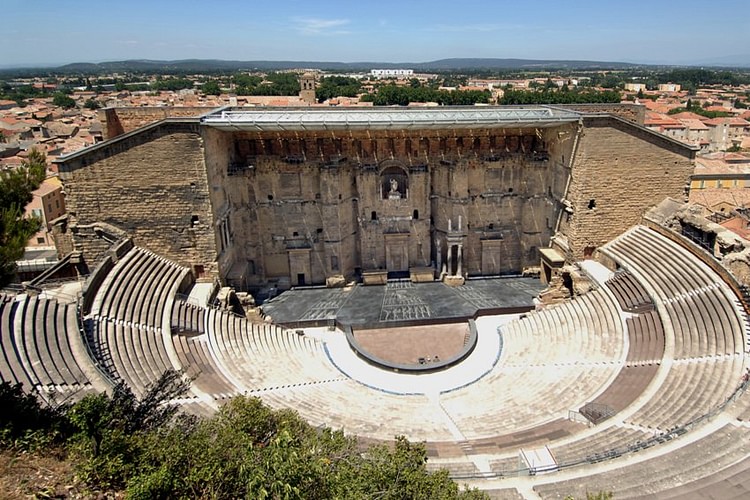
Located in the heart of the Rhône Valley, the Théâtre antique d'Orange is, without a doubt, one of the finest and most interesting ruins from the Roman era. It was designated a UNESCO World Heritage site in 1981 CE. Its magnificent *scaenae frons* (stage [wall](https://www.worldhistory.org/wall/)) is incredibly well-preserved. The cavea could hold as many as 10,000 spectators and was divided into three separate sections to accommodate spectators according to their social rank. The Roman Theater of Orange was a great center for entertainment in Roman times and still draws large audiences to musical events even today.
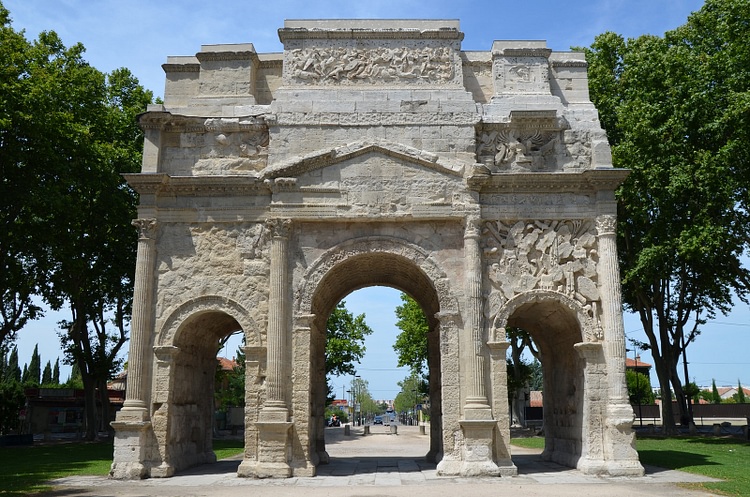
[  Roman Theatre, Orange Gromelle Grand Angle (CC BY-SA) ](https://www.worldhistory.org/image/5514/roman-theatre-orange/ "Roman Theatre, Orange")The 20m-high (65 ft-high) Triumphal Arch of Orange, built during the reign of Augustus on the Via Agrippa (a road leading to Lyon, France), is one of the largest and best preserved of its kind. Erected as a tribute to the veterans of the Second Gallic legion, who founded the town, the arch is richly decorated with various low reliefs commemorating the establishment of the Pax Romana. Eventually, the monument was dedicated to Emperor [Tiberius](https://www.worldhistory.org/Tiberius/) (r. 14-37 CE) to commemorate the victories of General [Germanicus](https://www.worldhistory.org/Germanicus/) over the German tribes in the Rhineland.
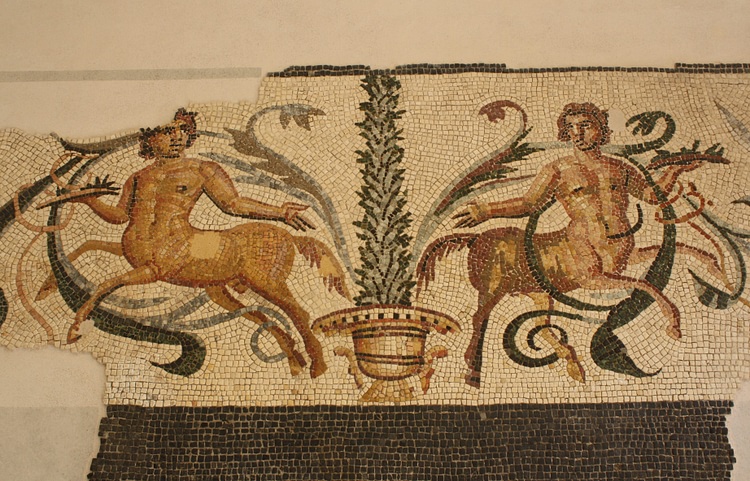
[  Triumphal Arch of Orange Carole Raddato (CC BY-SA) ](https://www.worldhistory.org/image/2973/triumphal-arch-of-orange/ "Triumphal Arch of Orange")The Art and History Museum of Orange, just opposite the ancient theater, exhibits a delightful and impressive work of [Roman art](https://www.worldhistory.org/Roman_Art/): a recently restored [centaur](https://www.worldhistory.org/centaur/) mosaic. Reliefs that decorated the stage wall of the theater are also on display in the rooms of the ground floor.
[  Centaur Mosaic Mark Cartwright (CC BY-NC-SA) ](https://www.worldhistory.org/image/5504/centaur-mosaic/ "Centaur Mosaic")### 7. The Pont Flavien
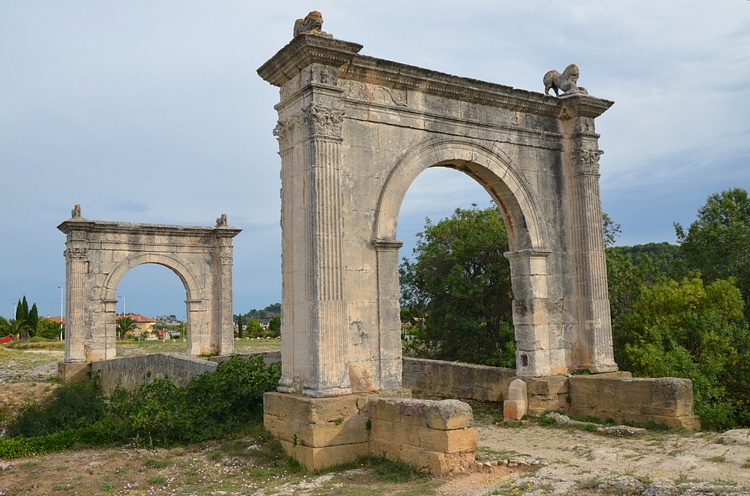
In Provence, as everywhere else, the Romans proved what outstanding engineers they were by adapting bridges to meet the geophysical characteristics of rivers. Of all the bridges built in the province, the Pont Flavien, at Saint-Chamas, is the only surviving example of a Roman bridge flanked by triumphal arches. The name “Flavien” refers to a certain Lucius Donnius Flavius, and an inscription on the bridge itself states that it was built at his instigation. The bridge was completed around 12 BCE and consists of a single arch spanning the Toulourde River on the Via Julia Augusta.
[  Roman Bridge, Pont Flavien Carole Raddato (CC BY-SA) ](https://www.worldhistory.org/image/4402/roman-bridge-pont-flavien/ "Roman Bridge, Pont Flavien")### 8. Ambrussum
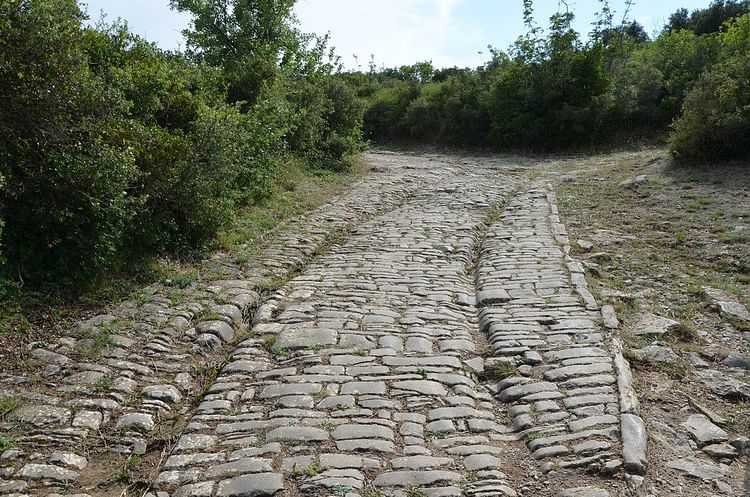
Ambrussum is a magnificent Gallo-Roman archaeological site which has revealed an exceptional collection of buildings from the Gallic and Roman periods. It is close to the modern town Lunel, located between Nîmes and Montpellier. The site is notable for its [Iron age](https://www.worldhistory.org/disambiguation/Iron_Age/) settlement, its Roman staging post on the Via Domitia and its celebrated bridge spanning the Vidourle River, the Pont Ambroix. At the end of the 4th century BCE, a Gaulish tribe — the Volscians — settled and built a city surrounded by strong ramparts and towers (some of which can still be seen). The Romans conquered the area in 120 BCE and the city grew rapidly; thereafter, a new district was created next to the Vidourle River, serving as a staging post for travelers. The Via Domitia at the foot of the settlement and a paved road leading out of the settlement are visible along with traces of Roman [chariot](https://www.worldhistory.org/chariot/) tracks.
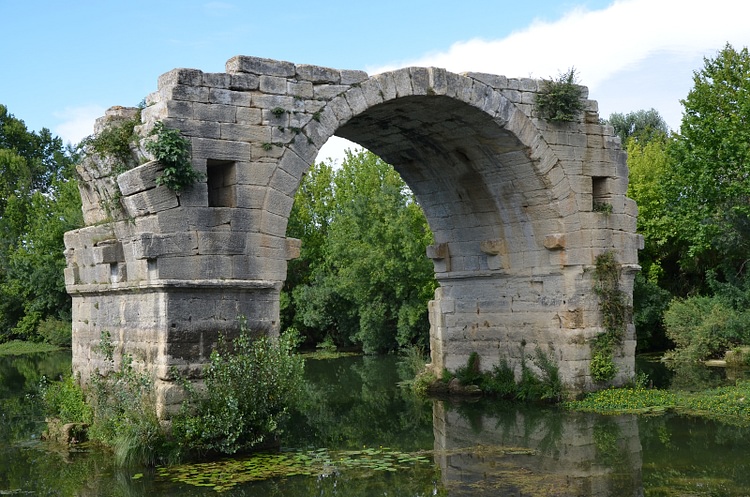
[  Roman Road in Ambrussum, a Roadside Town in Gaul Carole Raddato (CC BY-NC-SA) ](https://www.worldhistory.org/image/9827/roman-road-in-ambrussum-a-roadside-town-in-gaul/ "Roman Road in Ambrussum, a Roadside Town in Gaul")The Ambroix Bridge is unquestionably the most spectacular ruin of this ancient site. It is an impressive work of engineering, which allowed the Via Domitia to cross the Vidourle River. It is thought to have had 11 arches and to have been over 175 m (574 ft) in length. Unfortunately, the ravages of time and numerous floods took out all but one arch. Two had stood as recently as 81 years ago — which are reflected in Gustave Courbet's famous 1857 CE painting of the bridge — but a violent flood in 1933 CE left only one arch standing.
[  Pont Ambroix Carole Raddato (CC BY-NC-SA) ](https://www.worldhistory.org/image/9828/pont-ambroix/ "Pont Ambroix")### 9. The Pont Julien
The Pont Julien, owing its name to the nearby city of Apt (Julia Apta in Latin), whose territory it was built upon, is a beautiful three-arched bridge spanning over the Calavon River. Today, it is close to the town of Bonnieux, France. It was originally built in 3 BCE on the Via Domitia, an important Roman road that connected Italy and Spain through the Roman province of [Gallia](https://www.worldhistory.org/gaul/) Narbonensis. (Gallia Narbonensis encompassed Roussillon, Languedoc, and Provence in southern France.) The Pont Julien is perfectly preserved and remained in use until a neighboring bridge was built in 2005 CE. However, it is now reserved for pedestrians and cyclists only.
[  Roman Bridge, Pont Julien Carole Raddato (CC BY-SA) ](https://www.worldhistory.org/image/4403/roman-bridge-pont-julien/ "Roman Bridge, Pont Julien")### 10. Les Trémaïé
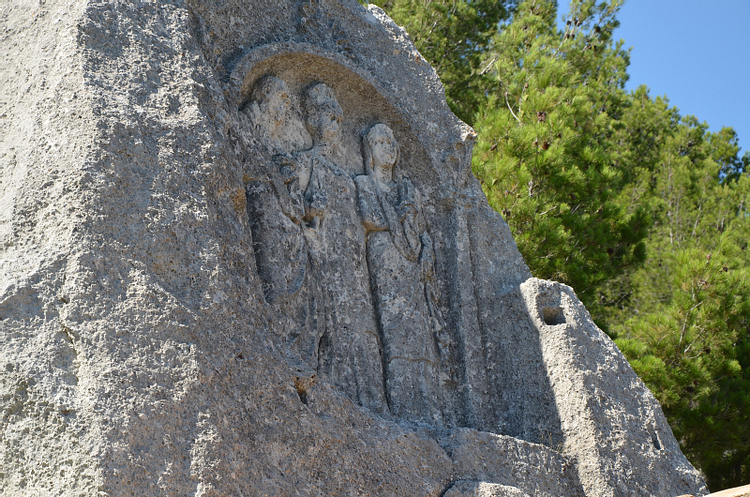
Below the medieval citadel and ruined castle of Les Baux-de-Provence stands a bas-relief skillfully carved on a block of limestone known as “Les Trémaïé.” It depicts three life-size standing figures; a man and two [women](https://www.worldhistory.org/disambiguation/women/), in Roman clothing. Archaeologists have generally believed that the carvings date from the Augustan period. However, the characters' identities are hotly debated. Some see the figures as the Roman [consul](https://www.worldhistory.org/Consul/), [Marius](https://www.worldhistory.org/Gaius_Marius/), his wife, Julia, and the Syrian prophetess, Martha. Traditionally, Christians have seen the “Three Marys” (hence the name “Trémaïé”), all of whom were followers of Christ. An epitaph was identified below the bas-relief and states with absolute certainty that this was a Gallo-Roman votive relief.
[  Les Trémaïé Carole Raddato (CC BY-NC-SA) ](https://www.worldhistory.org/image/9829/les-tremaie/ "Les Trémaïé")
#### Editorial Review
This human-authored article has been reviewed by our editorial team before publication to ensure accuracy, reliability and adherence to academic standards in accordance with our [editorial policy](https://www.worldhistory.org/static/editorial-policy/).
## About the Author
Carole maintains the popular ancient history photo-blog Following Hadrian, where she travels the ancient world in the footsteps of Emperor Hadrian.
- [Facebook Profile](https://www.facebook.com/FollowingHadrian)
- [X/Twitter Profile](https://twitter.com/carolemadge)
## Cite This Work
### APA
Raddato, C. (2019, January 09). Top 10 Archaeological Sites in Provence. *World History Encyclopedia*.
### Chicago
Raddato, Carole. "Top 10 Archaeological Sites in Provence." *World History Encyclopedia*, January 09, 2019. .
### MLA
Raddato, Carole. "Top 10 Archaeological Sites in Provence." *World History Encyclopedia*, 09 Jan 2019, .
## License & Copyright
Submitted by [Carole Raddato](https://www.worldhistory.org/user/FollowingHadrian/ "User Page: Carole Raddato"), published on 09 January 2019. The copyright holder has published this content under the following license: [Creative Commons Attribution-NonCommercial-ShareAlike](https://creativecommons.org/licenses/by-nc-sa/4.0/deed.en). This license lets others remix, tweak, and build upon this content non-commercially, as long as they credit the author and license their new creations under the identical terms. When republishing on the web a hyperlink back to the original content source URL must be included. Please note that content linked from this page may have different licensing terms.