---
title: The Horse-rider Theory in Ancient Japan
author: Mark Cartwright
source: https://www.worldhistory.org/article/1105/the-horse-rider-theory-in-ancient-japan/
format: machine-readable-alternate
license: Creative Commons Attribution-NonCommercial-ShareAlike (https://creativecommons.org/licenses/by-nc-sa/4.0/)
updated: 1970-01-01
---
# The Horse-rider Theory in Ancient Japan
_Authored by [Mark Cartwright](https://www.worldhistory.org/user/markzcartwright/)_
The 'horse-rider theory' is a controversial proposal that [Japan](https://www.worldhistory.org/disambiguation/Japan/) was conquered around the 4th or 5th century CE by a [culture](https://www.worldhistory.org/disambiguation/culture/) from northern Asia to whom the horse was especially important. Although archaeological evidence and genetics point to a close relationship between Japan and East Asia, especially [Korea](https://www.worldhistory.org/Korea/), during that period, the idea that a full military takeover ever occurred is deemed unlikely by most historians. The exact relations between the young states of the region remain unclear, and the issue is further clouded by nationalist agendas and a persistent projection of modern concepts of statehood and nationality on geographical areas which at that time would not have existed.
[  Silla Ceramic Warrior ëŒ€í•œë¯¼êµ ì •ë¶€ (CC BY) ](https://www.worldhistory.org/image/5820/silla-ceramic-warrior/ "Silla Ceramic Warrior")### The 'Horse-rider Theory'
The 'horse-rider theory' (*kiba minzoku setsu*) was proposed by the historian Egami Namio in 1948 CE to explain the cultural and political development of Japan in the 4th and 5th century CE. Namio suggested that 'horse-riders', or more accurately, members of a culture originally from North Asia and then present in mainland Asia and the Korean peninsula for whom the horse was especially important, had travelled to Japan and spread their ideas and culture. The resulting [conquest](https://www.worldhistory.org/warfare/) of the indigenous tribes in Japan led to a more unified country and what would become known as the Yamato state. Namio pointed to the archaeological evidence of large numbers of horse trappings discovered within Japanese tombs of the later [Kofun Period](https://www.worldhistory.org/Kofun_Period/) (c. 250-538 CE) and their absence in the earlier part of the period as support for his theory.
### Cultural Contact in East Asia
A significant Korean influence on Japanese culture is attested by both archaeological and genetic evidence, which points to a migration of both people and ideas in the period in question. The Japanese Imperial family did mix with a Korean bloodline prior to the 7th century CE and the presence of an influential clan with Korean heritage, the Soga, is noted in the historical record. In addition, from the 4th century CE, friendly relations were established with the Korean state of [Baekje](https://www.worldhistory.org/Baekje/) ([Paekche](https://www.worldhistory.org/Baekje/)), which was firmly established by the late 3rd century CE and lasted until the conquest by its neighbour the [Silla](https://www.worldhistory.org/Silla/) Kingdom in the mid-7th century CE. Baekje culture was exported abroad, especially via teachers, scholars, and artists travelling to Japan, and with them went Chinese culture such as classic Confucian texts but also elements of Korean-wide culture, for example, the court titles which closely resembled the [bone rank system](https://www.worldhistory.org/Bone_Rank_System/) of the Silla kingdom or the wooden buildings constructed there by Korean architects and the large [burial](https://www.worldhistory.org/burial/) mounds of the period which are similar to those in Korea.
The Japanese state, then known as Wa, also sent a 30,000-man army to aid the deposed Baekje rulers, but this was wiped out by a joint Silla-[Tang](https://www.worldhistory.org/Tang_Dynasty/) naval force on the Paekchon (modern Kum) River c. 660 CE. In addition to these activities, the 4th and 5th century CE saw diplomatic missions and trading between Japan and [China](https://www.worldhistory.org/china/), further highlighting that the presence of continental cultural practices and goods in Japan does not necessarily mean they came via conquering invaders.
### Difficulties in a Military Explanation
That a Korean force actually invaded and conquered Japan so that it became no more than a vassal state is quite a different matter, then, from a cultural interaction between neighbouring states. It seems unlikely a conquest did actually occur, and some sources, including the Japanese c. 720 CE *[Nihon Shoki](https://www.worldhistory.org/Nihon_Shoki/)* (*Chronicle of Japan*), controversially suggest the reverse and that Japan had established a colony in southern Korea in part of the [Gaya](https://www.worldhistory.org/Gaya/) ([Kaya](https://www.worldhistory.org/Gaya/)) confederation. This is now largely considered a tall tale by the Yamato court in order to increase its prestige as the reality is it lacked both the political and military where-with-all to carry out such a conquest.
[  East Asia in 400 CE Stone Chen (CC BY-NC-SA) ](https://www.worldhistory.org/image/6459/east-asia-in-400-ce/ "East Asia in 400 CE")There was certainly an influx of Korean manufactured goods, weapons, and raw materials such as iron from Gaya but there is a notable absence of any new and distinct culture which one might expect to see following a military conquest. The historian M. J. [Seth](https://www.worldhistory.org/Set_(Egyptian_God)/) offers this plausible alternative explanation to a military invasion:
> More likely, the peoples on both sides of the Korean Straits were related and interacted with each other. Evidence suggests that between 300 BCE and 300 CE large numbers of people migrated from the Korean peninsula to the Japanese archipelago, where they introduced rice culture, [bronze](https://www.worldhistory.org/disambiguation/bronze/) and iron working, and other technologies. Thus rather than the existence of Korean and Japanese peoples there was a continuum of peoples and cultures. The Wa of western Japan, for example, may have lived on both sides of the Korean Straits, and they appeared to have close links with Kaya. It is even possible that the Wa and Kaya were the same ethnic group. The fact that Japanese and Korean political evolution followed similar patterns is too striking to be coincidental. (31-32)
Japanese historians have traditionally sought to counter the 'horse-rider theory', and it has never been widely accepted in that country. Indeed, when Japan invaded Korea at the end of the 19th century CE, the government claimed that it was merely retaking possession of its former colony mentioned in the *Nihon Shoki*. More serious arguments against Namio's theory have since developed and these include problems with and manipulation of the chronology to match an invasion with the dating of tombs and relevant artefacts, an incomplete consideration of all the archaeological evidence, the false assumption that tombs show a clear and distinct break between the period with or without horse paraphernalia and other continental goods in them, and an assumption that an agricultural society and/or ruling elite would not adopt the cultural practices and luxury goods of foreign peoples without military conquest.
[ 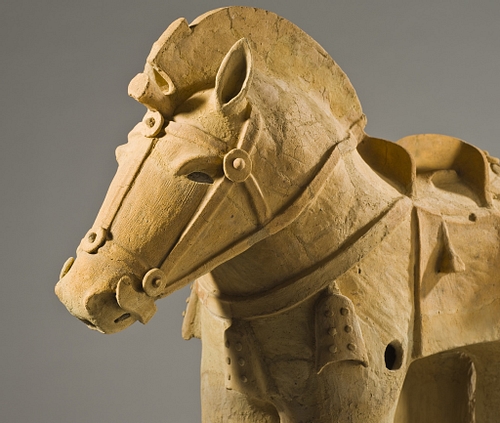 Haniwa Horse Ashley Van Haeften (CC BY) ](https://www.worldhistory.org/image/6509/haniwa-horse/ "Haniwa Horse")Korean historians and others have countered these arguments, insisting that a sudden cultural change is possible to identify in the archaeological and historical records and that the gradual nature of the change in [tomb](https://www.worldhistory.org/tomb/) finds, tomb [architecture](https://www.worldhistory.org/disambiguation/architecture/), and political elites is greatly exaggerated. Some argue that linguistics and [mythology](https://www.worldhistory.org/mythology/) both point to a mixing of the two cultures of Korea and Japan. Still others point to significant climate change which eventually resulted in a period of extended droughts around 400 CE and which motivated peoples to seek conditions more favourable to [agriculture](https://www.worldhistory.org/disambiguation/Agriculture/) in the Japanese archipelago. No one, though, has as yet been able to provide direct evidence of how this transferral of culture occurred if not by peaceful means.
### Conclusion
In conclusion, the merits and weaknesses of the theory are well summarised here by the historian K. Henshall:
> Like most theories, it has some plausible elements and some weaknesses. It is not impossible that horse-riders from Korea or Manchuria or northern China did establish a presence in early Japan - possibly even a ruling presence, and possibly by force - but if so they would surely have realized there was nowhere further to go and either settled in Japan or returned whence they came. (158)
The controversial 'horse-rider theory' not only lacks concrete and persuasive evidence to support it but even its very emphasis on one dramatic moment of history being responsible for significant cultural and political changes in Japan seems rather dated and simplistic in terms of modern studies in history where the complexities, subtleties, and multidirectional nature of cultural exchange over long periods of time are now much more appreciated by historians, archaeologists, and the public alike.
This content was made possible with generous support from the [Great Britain Sasakawa Foundation](http://www.gbsf.org.uk/?utm_source=ancient.eu&utm_medium=link&utm_campaign=ancient.eu).
#### Editorial Review
This human-authored article has been reviewed by our editorial team before publication to ensure accuracy, reliability and adherence to academic standards in accordance with our [editorial policy](https://www.worldhistory.org/static/editorial-policy/).
## Bibliography
- [Ebrey, P.B. *Pre-Modern East Asia.* Wadsworth Publishing, 2013.](https://www.worldhistory.org/books/1133606512/)
- Edwards, W. "Event and Process in the Founding of Japan: The Horserider Theory in Archeological Perspective." *The Journal of Japanese Studies*, Vol. 9, No. 2 (Summer, 1983), pp. 265-295.
- Farris, W.W. "Ancient Japan's Korean Connection
." *Korean Studies*, Vol. 20 (1996), pp. 1-22.
- [Henshall, K. *Historical Dictionary of Japan to 1945.* Scarecrow Press, 2013.](https://www.worldhistory.org/books/0810878712/)
- Hong, W. "Yayoi Wave, Kofun Wave, and Timing: The Formation of the Japanese People and Japanese." *Korean Studies*, Vol. 29 (2005), pp. 1-29.
- [Mason, R.H.P. *A History of Japan.* Tuttle Publishing, 1997.](https://www.worldhistory.org/books/080482097X/)
- SONG-NAI RHEE, C. MELVIN AIKENS, SUNG-RAK CHOI and HYUK-JIN RO,. "Korean Contributions to Agriculture, Technology, and State Formation in Japan: Archaeology and History of an Epochal Thousand Years, 400 B.C.–A.D. 600." *Asian Perspectives*, Vol. 46, No. 2 (Fall 2007), pp. 404-459.
- [Seth, M.J. *A History of Korea.* Rowman & Littlefield Publishers, 2010.](https://www.worldhistory.org/books/0742567168/)
## About the Author
Mark is WHE’s Publishing Director and has an MA in Political Philosophy (University of York). He is a full-time researcher, writer, historian and editor. Special interests include art, architecture and discovering the ideas that all civilizations share.
## Cite This Work
### APA
Cartwright, M. (2017, July 19). The Horse-rider Theory in Ancient Japan. *World History Encyclopedia*.
### Chicago
Cartwright, Mark. "The Horse-rider Theory in Ancient Japan." *World History Encyclopedia*, July 19, 2017. .
### MLA
Cartwright, Mark. "The Horse-rider Theory in Ancient Japan." *World History Encyclopedia*, 19 Jul 2017, .
## License & Copyright
Submitted by [Mark Cartwright](https://www.worldhistory.org/user/markzcartwright/ "User Page: Mark Cartwright"), published on 19 July 2017. The copyright holder has published this content under the following license: [Creative Commons Attribution-NonCommercial-ShareAlike](https://creativecommons.org/licenses/by-nc-sa/4.0/deed.en). This license lets others remix, tweak, and build upon this content non-commercially, as long as they credit the author and license their new creations under the identical terms. When republishing on the web a hyperlink back to the original content source URL must be included. Please note that content linked from this page may have different licensing terms.