---
title: A Tour in Ancient Athens
author: Spyros Kamilalis
source: https://www.worldhistory.org/article/1094/a-tour-in-ancient-athens/
format: machine-readable-alternate
license: Creative Commons Attribution-NonCommercial-ShareAlike (https://creativecommons.org/licenses/by-nc-sa/4.0/)
updated: 2023-04-20
---
# A Tour in Ancient Athens
_Authored by [Spyros Kamilalis](https://www.worldhistory.org/user/spykamilalis/)_
[Athens](https://www.worldhistory.org/Athens/) is mostly associated with its ancient past rather than its modern turbulent state of the latest two [hundred years](https://www.worldhistory.org/disambiguation/Hundred_Years/). While walking the centre of the luminous [city](https://www.worldhistory.org/city/), the visitor can easily observe both ends of [Hellenic](https://www.worldhistory.org/greece/) [culture](https://www.worldhistory.org/disambiguation/culture/). The city offers plenty of ancient examples in every corner, the visitor must only roam aimlessly in the narrow alleys of the old town, and they will stumble upon these details that paint the picture of a thriving ancient Metropolis. On the other hand, the city's modern history has produced a culture that reflects the recent two centuries of [Greek](https://www.worldhistory.org/disambiguation/greek/) independent evolution and radiates taste and nobility.
[ ![The Parthenon [Rear View]](https://www.worldhistory.org/img/r/p/750x750/6800.jpg?v=1732959733) The Parthenon \[Rear View\] Spyros Kamilalis (CC BY-NC-SA) ](https://www.worldhistory.org/image/6800/the-parthenon-rear-view/ "The Parthenon [Rear View]")Though Athens is a big city, its historical centre is walkable, which makes it easy for the visitor to enjoy. I visited the city for a 3-day-long weekend which practically only gave me two full days to visit everything I wanted; a challenging task but certainly not impossible.
### ODEON of Herodes Atticus
My visit could not start anywhere else other than the world-famous [Acropolis](https://www.worldhistory.org/Acropolis/) in Athens. On a sunny Saturday morning, I set eyes at the rear of the [theatre](https://www.worldhistory.org/disambiguation/theatre/) of Herodes Atticus (aka Herod the Attic). If a visitor is not sure what they are looking at, the structure bears a resemblance to [Roman](https://www.worldhistory.org/disambiguation/Roman/) [aqueducts](https://www.worldhistory.org/aqueduct/), and since Athens was not only part of the [Roman empire](https://www.worldhistory.org/Roman_Empire/) but also in the heart of Emperor [Hadrian](https://www.worldhistory.org/hadrian/), it is easy to make this mistake. But, of course, it is not an [aqueduct](https://www.worldhistory.org/aqueduct/), it is the building that housed the tragedians, comedians and actors' equipment and preparation activities. It is what we would call today 'backstage'.
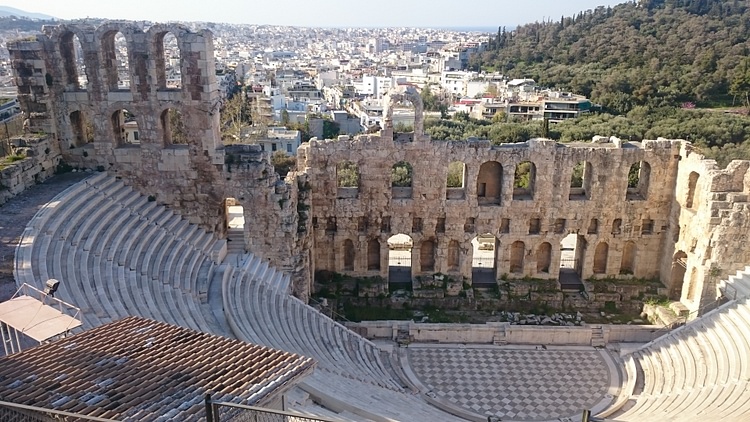
[ 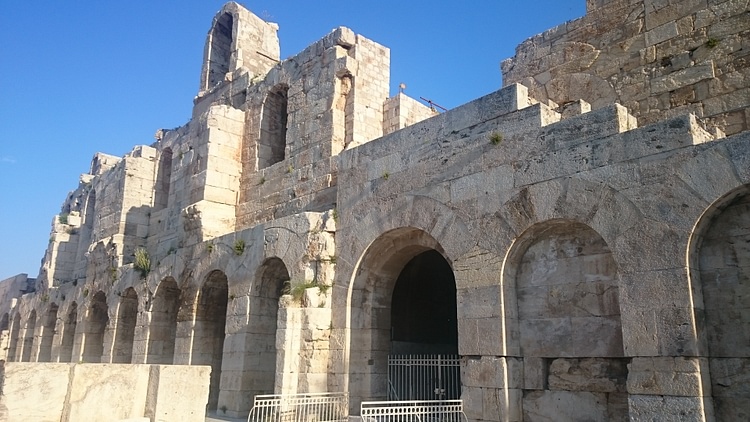 Arches, Theatre of Herod Atticus Spyros Kamilalis (CC BY-NC-SA) ](https://www.worldhistory.org/image/6784/arches-theatre-of-herod-atticus/ "Arches, Theatre of Herod Atticus")A set of bushes and trees lie next to the theatre and hide several little secrets. Systems of water supply and waste extraction, cesspits and cisterns, pipelines that hide underground and lead to the rest of what would be the ancient city dwellings. One can spot the different materials that the architects used. Most structures are marble, which was and still is in abundant supply in most parts of the [Hellenic world](https://www.worldhistory.org/Hellenic_World/), especially in the Islands and northern [Greece](https://www.worldhistory.org/greece/). The pipeline systems, as well as the cistern, are mainly constructed using ceramic material for the pipes and a combination of ceramic plates and stones for the cisterns. The latter type of construction is particularly visible on the structures built during the Roman era when Hadrian put a lot of effort in upgrading and maintaining the city. People used to say that half of Athens was built by [Pericles](https://www.worldhistory.org/pericles/) and the other half by Hadrian.[  Water Supply Systems at the Acropolis Spyros Kamilalis (CC BY-NC-SA) ](https://www.worldhistory.org/image/6935/water-supply-systems-at-the-acropolis/ "Water Supply Systems at the Acropolis")Moving on, I followed the road uphill, which led me to the top of the theatre of Herod the Attic. The structure was as magnificent as I imagined, I could count at least four floors. A small semi-circular footway divides the first and second tiers of the seats. This footway follows the amphitheatrical shape and leads to the main 'backstage' building, on its second floor. The rooms are visible, and it does not require much imagination to picture the activities of the actors as they were preparing to come on stage. I am fairly sure that the height of the structure would play a part in the directors' effort in induce awe to their audiences. Add a full summer moon to this, and you can almost feel [Apollo](https://www.worldhistory.org/apollo/) and his [muses](https://www.worldhistory.org/muse/) whispering through the ages.
[  Stage, Theatre of Herod Atticus Spyros Kamilalis (CC BY-NC-SA) ](https://www.worldhistory.org/image/6790/stage-theatre-of-herod-atticus/ "Stage, Theatre of Herod Atticus")### [Propylaea](https://www.worldhistory.org/Propylaea/)
Next stop would be the main entrance to the Acropolis, the Propylaea. A little bit of history is due at this point. The Acropolis of Athens is a renovation. It was not always like it is today. During the Greco-[Persian wars](https://www.worldhistory.org/Persian_Wars/) Athens was sacked and the temples of the Acropolis burned to the ground. Pericles was the one that commissioned the rebuilding of Acropolis, employing the greatest architects and sculptors of his time. The project was led by [Phidias](https://www.worldhistory.org/Phidias/), while [Parthenon](https://www.worldhistory.org/parthenon/) itself was designed and built by the architects Ictinos and Kallicrates. [ 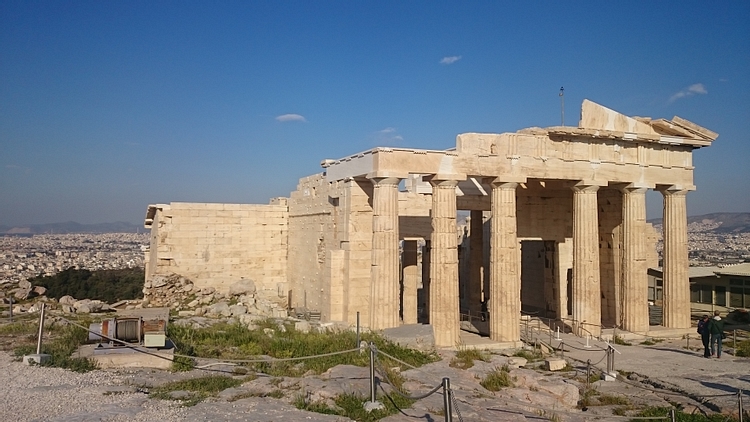 Propylaea - The Entrance to the Acropolis Spyros Kamilalis (CC BY-NC-SA) ](https://www.worldhistory.org/image/6795/propylaea---the-entrance-to-the-acropolis/ "Propylaea - The Entrance to the Acropolis")
The Propylaea is constructed using Pentelic marble from hills neighbouring Athens. Its [architecture](https://www.worldhistory.org/disambiguation/architecture/) is similar to the rest of the Acropolis, typical of ancient Greek structures of the same type but infused with the extravagance that the golden age of Greece provided. It was used many years later as a pattern for the Brandenburg Gate in Berlin and the Propylaea in Munich.
Standing on the stairs of Propylaea, there is only one way the visitor's head turns; and that is up. Up to the Propylaea themselves and the [temple of Athena Nike](https://www.worldhistory.org/article/62/temple-of-athena-nike/) ([Athena](https://www.worldhistory.org/athena/) Victory); a small but imposing structure, probably one in the best condition with regards to delamination. In the Greek language, the word 'Propylaea' means 'before the gates'. Once the visitor goes through the gates of the Acropolis and into the central plateau, the two most famous temples rise to greet them; the Parthenon, the main [temple](https://www.worldhistory.org/temple/) of Athena, and the Erechteion, a temple dedicated to both Athena and [Poseidon](https://www.worldhistory.org/poseidon/). I decided to leave Parthenon last due to its fame but also because, despite its size, it is a much more straightforward structure.
[  Temple of Athena Nike - Acropolis, Athens Spyros Kamilalis (CC BY-NC-SA) ](https://www.worldhistory.org/image/6794/temple-of-athena-nike---acropolis-athens/ "Temple of Athena Nike - Acropolis, Athens")### Erechteion
The Erechteion has a rather odd name, even by Greek standards. Its lady-columns, the Caryatids, are closely related to the origins of the name. The Caryatids are 'the maidens of Karyai' a small town in the [Peloponnese](https://www.worldhistory.org/Peloponnese/) with a temple to the goddess [Artemis](https://www.worldhistory.org/artemis/). The Caryatids were her servants. The Erechteion comprises two sectors. The main temple and a smaller chamber called Kekropion. Legend has it that the ancient semi-legendary Athenian kings of the [Bronze Age](https://www.worldhistory.org/disambiguation/Bronze_Age/), Erechtheus and Cecrops are buried underneath the temple, under their respectively dedicated chambers. More specifically, the box-shaped protruding structure that houses the Caryatids is on top of the actual [grave](https://www.worldhistory.org/burial/) of King Erechtheus.[  Erechtheion - Acropolis, Athens Spyros Kamilalis (CC BY-NC-SA) ](https://www.worldhistory.org/image/6796/erechtheion---acropolis-athens/ "Erechtheion - Acropolis, Athens")
The [Erechtheion](https://www.worldhistory.org/Erechtheion/) has had many uses over the ages, hence its relatively well-preserved state. Built in 421 BCE, it was initially a temple, as mentioned before. Following the establishment of [Christianity](https://www.worldhistory.org/christianity/) as the state [religion](https://www.worldhistory.org/religion/) by the [Roman Emperor](https://www.worldhistory.org/Roman_Emperor/) [Constantine I](https://www.worldhistory.org/Constantine_I/) the Great, the Erechtheion became a Christian church. This use held until the fall of [Constantinople](https://www.worldhistory.org/Constantinople/) in 1453 CE. After that, it became the house of the Ottoman commander of Athens and his harems until 1830 CE. Of course, one cannot have a Greek monument without a little bit of controversy. The situation started in 1801 when a British nobleman, Lord Elgin, removed one of the Caryatids along with several parts of the Parthenon's pediment, to decorate his mansion in [Scotland](https://www.worldhistory.org/disambiguation/Scotland/). Elgin's people later sold the pieces to the British Museum where they are today. The debate over the Elgin Marbles is a subject of much discussion and controversy between the Greek and British states.
### Parthenon
Moving on to the Parthenon, I immediately became sad after looking at it. Despite its magnificence, its size, its importance, and its worldwide radiance, it is not a restored temple. The damage it has sustained through the ages is unspeakable. The story of this extensive damage goes back to the Greek [War](https://www.worldhistory.org/disambiguation/War/) of Independence during the 1820's CE. Turkish ships laid siege to Athens that was occupied by Greek fighters. They bombarded of the area, resulting in the destruction of much of the Parthenon. It is a shame to see it in such condition, and it makes me wonder what it would look like if it were fully restored, even using modern materials in the place of the destroyed ones.[ 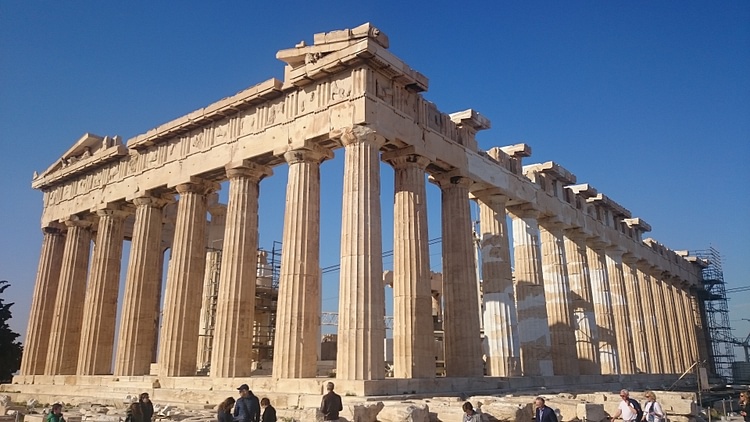 Parthenon - Acropolis, Athens Spyros Kamilalis (CC BY-NC-SA) ](https://www.worldhistory.org/image/6798/parthenon---acropolis-athens/ "Parthenon - Acropolis, Athens")
An excellent piece of structural engineering history that the Parthenon provides is the use of reinforcement inside the [column](https://www.worldhistory.org/column/). The round pieces of marble that make the columns are not discs but rather rings. Every piece has a hole in the middle that used to contain lead rods that acted as reinforcement, thus increasing the effectiveness of the load bearing elements of the temple, especially in the instances of earthquakes that were and are so common in Greece.
Additional to the temples of the golden age of Athens, on the Acropolis, the visitor can admire what remains of the altar of [Octavian](https://www.worldhistory.org/augustus/) [Augustus](https://www.worldhistory.org/augustus/); an offering to the divine from the first of the Roman emperors to one of the most sacred sites of the ancient world.
### Theatre of [Dionysus](https://www.worldhistory.org/Dionysos/)
After concluding my tour of the Acropolis, I headed back outside from the Propylaea and descended towards the remains of the Temple of [Themis](https://www.worldhistory.org/Themis/) and the Theatre of Dionysus. Several scribed stones are on display along the way, and I tested my memory on the attic dialect of ancient Greek, trying to figure out the meaning of the inscriptions. I might not have been able to comprehend the full meaning, but I got a decent understanding. These inscriptions were written 2500 years ago, and that fills me with awe about this living and evolving language.[ 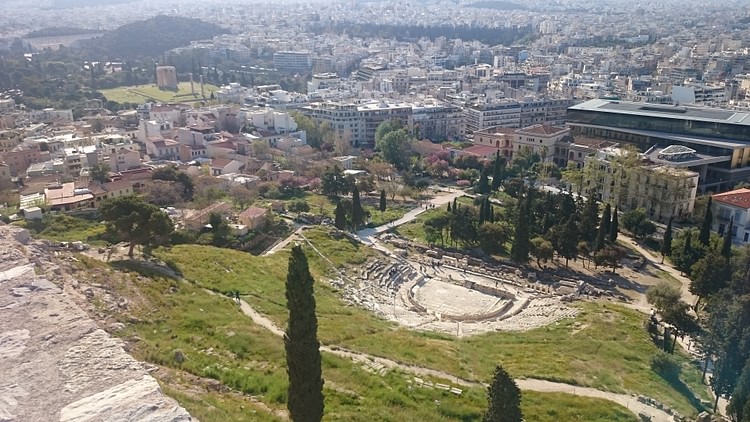 Theatre of Dionysus - Acropolis, Athens Spyros Kamilalis (CC BY-NC-SA) ](https://www.worldhistory.org/image/6801/theatre-of-dionysus---acropolis-athens/ "Theatre of Dionysus - Acropolis, Athens")
The walk led me in front of the Theatre of Dionysus, where one can observe the 'VIP' seats of the theatre, with the names of the people inscribed on the seats.
### Acropolis Museum
Within walking distance from the Theatre of Dionysus, it is the entrance of the new Acropolis Museum, about which I had heard so much. I must say that three elements of the museum caught my attention. The first is the original Caryatids that stand on an interior balcony, where the visitor can enjoy from a very close (touching) distance.
[ 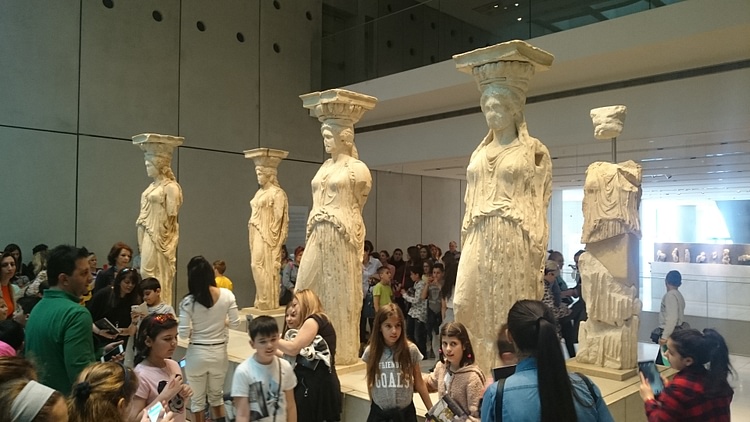 Erechtheion Caryatids Spyros Kamilalis (CC BY-NC-SA) ](https://www.worldhistory.org/image/6805/erechtheion-caryatids/ "Erechtheion Caryatids")The second breath-taking exhibit of the museum is on the top floor. It is none other than the full pediment of the Parthenon, with the Titanomachy described at a succession in every piece of it. I needed a significant amount of time to go through all the parts and understand the depicted scenes, but it was an incredible sight to behold, especially if imagined painted. Finally, the third characteristic that adds to the whole experience is the top floor's view. The Acropolis itself with all its magnificence fills the window view, and it is just awe-inspiring.
### [Roman Forum](https://www.worldhistory.org/Roman_Forum/)
To be completely honest, I was not acutely aware of the extent of the Roman [Agora](https://www.worldhistory.org/agora/) in Athens. I was surprised to see a large complex of buildings with different uses and meanings that opened a new view of the city in my eyes. Emperor Hadrian did an excellent job extending the city, leaving a remarkable footprint. Before entering the site, the visitor must cross a small bridge over the urban railway and while on the bridge, on the right-hand side, the remains of the altar of the twelve gods are visible. I entered the site and headed to the left. My first stop was the Stoa of [Attalos](https://www.worldhistory.org/disambiguation/attalos/). A small Roman rotunda is the first thing you see and right next to it a very long building that is the Stoa and houses the Agora Museum.
[ 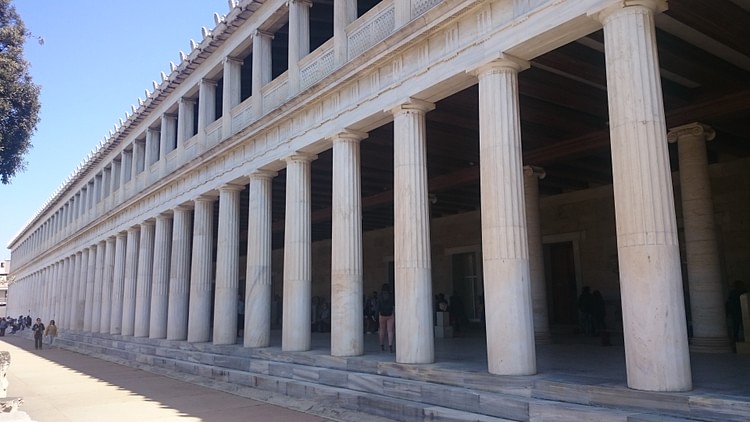 Stoa of Attalos, Athens Spyros Kamilalis (CC BY-NC-SA) ](https://www.worldhistory.org/image/6807/stoa-of-attalos-athens/ "Stoa of Attalos, Athens")I continued walking the Panathenaic Way towards the church of the Holy Apostles, and with the Library of Pantainos on my left, I headed right towards the [Gymnasium](https://www.worldhistory.org/Gymnasium/). I descended towards the Odeon of [Agrippa](https://www.worldhistory.org/Marcus_Agrippa/) on my way to the Temple of [Hephaestus](https://www.worldhistory.org/Hephaistos/). Passing from the Bouleuterion and the Metroon I was looking at the Stoa of [Zeus](https://www.worldhistory.org/zeus/); all buildings formed something like an entrance to the Temple. At the entry to the road leading upwards to the Temple stands the statue of Emperor Hadrian.[  Agora of Athens and the Temple of Hephaestus Spyros Kamilalis (CC BY-NC-SA) ](https://www.worldhistory.org/image/6810/agora-of-athens-and-the-temple-of-hephaestus/ "Agora of Athens and the Temple of Hephaestus")
The Temple of Hephaestus is smaller than the Parthenon but much better preserved. The visitor can see the inside of the temple with the roof and all, to get a complete idea of a typical Greek temple's interior architecture.[ 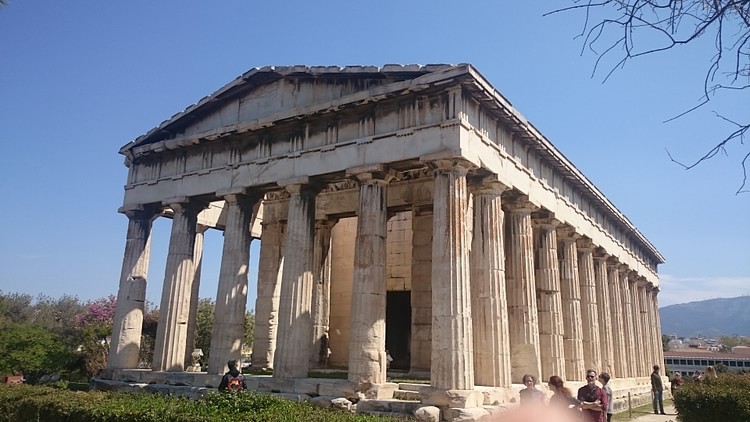 Temple of Hephaestus Spyros Kamilalis (CC BY-NC-SA) ](https://www.worldhistory.org/image/6811/temple-of-hephaestus/ "Temple of Hephaestus")
I descended from the temple via the same road and walked towards the exit of the site passing by the remains of the Temple and Altar of the [god](https://www.worldhistory.org/God/) [Ares](https://www.worldhistory.org/Ares/).
### Panathenaic [Stadium](https://www.worldhistory.org/Stadium/)
Later in the afternoon, I went to see the Panathenaic Stadium, which has a long and fascinating history covering not only the ancient festival but it holds a world record in modern times. It was first set up as a racecourse for charioteers at some point in the 6th century BCE. In 330 BCE the Architect Lycourgos built the first version of the stadium with limestone, whereas in 144 CE the stadium was renovated using marble by Herod Atticus. The festival, the Great Panathenaia, was a mixture of ceremonial, athletic, and cultural competitions that were held every four years and lasted for about a week. The Panathenaic games continued until the reign of Emperor Theodosius I, who banned all ancient pagan events to suppress the respective pagan religions in favour of Christianity.
In the modern era, the stadium was home to the basketball team of AEK Athens. In 1969 FIBA European Cup Winner's Cup final, AEK Athens competed against Slavia Prague. Watching the final in the stadium were 80000 seated spectators and 40000 standing ones, making this the basketball game with the most attendance in history. The stadium still holds this record.
### Temple of Olympian Zeus
Moving forward, I headed west towards the Temple of Olympian Zeus. The temple was the biggest in ancient Greece, and the remains are a testament to this regarding height and length, but it is a shame that only a few columns remain.[ 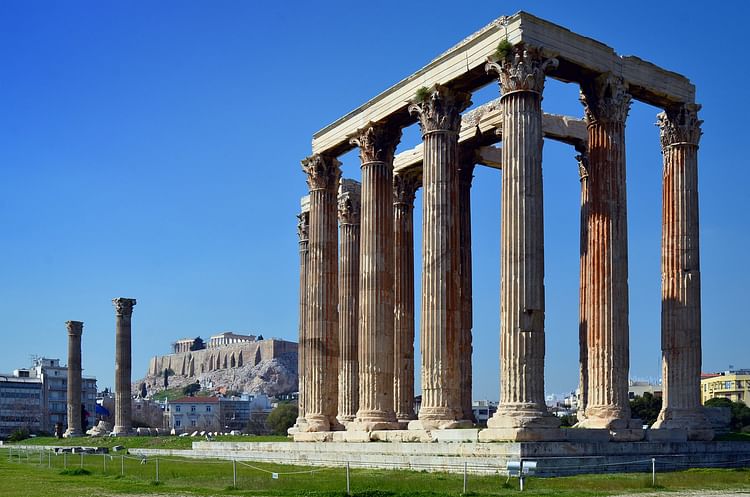 The Temple of Olympian Zeus, Athens George Rex (CC BY-SA) ](https://www.worldhistory.org/image/4005/the-temple-of-olympian-zeus-athens/ "The Temple of Olympian Zeus, Athens")
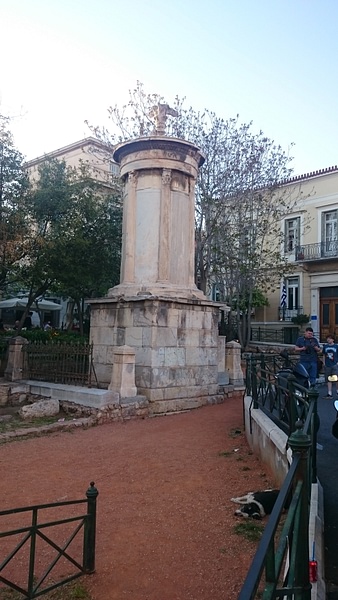
In front of the entrance to the Columns of Olympian Zeus, the visitor can find the Arch of Hadrian. The emperor loved Athens, and you can see this all around the city. Opposite the monument of, in front of the [Byzantine](https://www.worldhistory.org/disambiguation/Byzantine/) Orthodox Christian Church of Saint Catherine's front garden, there are some ancient ruins. Apparently, these ruins are the remains of the [Roman baths](https://www.worldhistory.org/Roman_Baths/) built by Emperor Hadrian. On the street that bears the name of Lysicrates, I noticed a tavern with the Hellenised name of the emperor, 'Adrianos'.
[  Choragic Monument of Lysicrates Spyros Kamilalis (CC BY-NC-SA) ](https://www.worldhistory.org/image/6934/choragic-monument-of-lysicrates/ "Choragic Monument of Lysicrates")###
Prison of [Socrates](https://www.worldhistory.org/socrates/) & Ecclesia of DEMOS
The following day, I decided to go to the hill of Philopappos, a forested hill with a pleasant feeling and peaceful walks. The first notable historical site is the prison of Socrates, the place where he was held before his execution by hemlock (Conium) poisoning in 399 BCE.[  Socrates' Prison, Athens Mark Cartwright (CC BY-NC-SA) ](https://www.worldhistory.org/image/404/socrates-prison-athens/ "Socrates' Prison, Athens")
On the top of the hill, I stood in the very place that the meetings of the Ecclesia of Demos took place, complete with the podium of the orators and the best view of the monuments of the Acropolis and Athens in general.[  Pnyka - The Orator's Podium Spyros Kamilalis (CC BY-NC-SA) ](https://www.worldhistory.org/image/6818/pnyka---the-orators-podium/ "Pnyka - The Orator's Podium")
I headed downhill leaving behind all the antiquities. This journey through time and the beauty that one can observe within it left me thankful for my decision to visit the place. Two days are not nearly enough to enjoy the city's history, let alone the rest of what it has to offer. On my flight home, I was left reflecting on the trip and already planning my next visit to the cradle of western [civilisation](https://www.worldhistory.org/civilization/). There are a few things that I missed like [Plato](https://www.worldhistory.org/plato/)'s Academy, the temple of Poseidon in [Sounion](https://www.worldhistory.org/sounion/) and of course more earthly indulges, taverns, bars and the beautiful seaside neighbourhoods that bring the Greek islands to the Athenians' feet.
#### Editorial Review
This human-authored article has been reviewed by our editorial team before publication to ensure accuracy, reliability and adherence to academic standards in accordance with our [editorial policy](https://www.worldhistory.org/static/editorial-policy/).
## Bibliography
- [Acropolis Museum](http://www.theacropolismuseum.gr/en "Acropolis Museum"), accessed 9 Aug 2017.
- [Herodotus. *The Histories.* Penguin Classics, 2003.](https://www.worldhistory.org/books/0140449086/)
- [Official Website of the Acropolis of Athens](http://odysseus.culture.gr/h/3/eh351.jsp?obj_id=2384 "Official Website of the Acropolis of Athens"), accessed 9 Aug 2017.
- [Thucydides. *History of the Peloponnesian War.* Penguin Classics, 1972.](https://www.worldhistory.org/books/0140440399/)
## About the Author
Contributor for World History Encyclopedia.
- [X/Twitter Profile](https://twitter.com/SpyrosKam)
## Cite This Work
### APA
Kamilalis, S. (2017, August 11). A Tour in Ancient Athens. *World History Encyclopedia*.
### Chicago
Kamilalis, Spyros. "A Tour in Ancient Athens." *World History Encyclopedia*, August 11, 2017. .
### MLA
Kamilalis, Spyros. "A Tour in Ancient Athens." *World History Encyclopedia*, 11 Aug 2017, .
## License & Copyright
Submitted by [Spyros Kamilalis](https://www.worldhistory.org/user/spykamilalis/ "User Page: Spyros Kamilalis"), published on 11 August 2017. The copyright holder has published this content under the following license: [Creative Commons Attribution-NonCommercial-ShareAlike](https://creativecommons.org/licenses/by-nc-sa/4.0/deed.en). This license lets others remix, tweak, and build upon this content non-commercially, as long as they credit the author and license their new creations under the identical terms. When republishing on the web a hyperlink back to the original content source URL must be included. Please note that content linked from this page may have different licensing terms.