---
title: The Historical King Arthur
author: Joshua J. Mark
source: https://www.worldhistory.org/article/1068/the-historical-king-arthur/
format: machine-readable-alternate
license: Creative Commons Attribution-NonCommercial-ShareAlike (https://creativecommons.org/licenses/by-nc-sa/4.0/)
updated: 1970-01-01
---
# The Historical King Arthur
_Authored by [Joshua J. Mark](https://www.worldhistory.org/user/JPryst/)_
The legends surrounding [King Arthur](https://www.worldhistory.org/King_Arthur/) and his knights have charmed and intrigued people for centuries and their popularity continues in the present day. As with any famous figure, however, the question arises as to whether the legend is based on any fact. There have been many suggestions over the years as to the best candidate for the 'historical Arthur,' but the most reasonable response is that he was based on a British leader of the 5th or 6th century CE.
Early sources either name Arthur as the hero of the [Battle](https://www.worldhistory.org/disambiguation/battle/) of Badon Hill or describe a warrior with some similar attributes. The historian Nennius (9th century CE) is the first writer to introduce Arthur as a great historical leader of the Britons and later writers support this view. In the present day, Arthurian scholars like John Morris, Norris J. Lacy, and Geoffrey Ashe continue to support the claim that Arthur was historical, citing his name as one of the proofs: Arthur is the Welsh version of the [Roman](https://www.worldhistory.org/disambiguation/Roman/) name Artorius, Roman names were typically given to children in the regions of [Britain](https://www.worldhistory.org/disambiguation/Britain/) and Wales during the Roman occupation, the Arthurian stories originate with Welsh writers, and the name becomes more popular in the late 6th century CE which suggests an earlier hero who inspired this practice.
[  King Arthur, Winchester David Spender (CC BY) ](https://www.worldhistory.org/image/6652/king-arthur-winchester/ "King Arthur, Winchester")Other scholars claim that Arthur was fictional from the beginning; citing a lack of any mention of him in the earliest sources from any region. If a king as great as Arthur really lived, the argument goes, why is he not mentioned in any historical records of his supposed time? This question was asked from a fairly early point in the development of the legends which begin with the work *History of the Kings of Britain* by Geoffrey of Monmouth (c. 1100 - c. 1155 CE) published in 1136 CE. Although Arthur was referenced in works before Geoffrey, no one had written a comprehensive account of his reign and accomplishments prior to *History of the Kings of Britain* which claimed Arthur was a great king who not only ruled Britain but conquered most of [Europe](https://www.worldhistory.org/europe/) and defeated [Rome](https://www.worldhistory.org/Rome/). Geoffrey's book was a bestseller, but there were many who doubted its historical value. The English monk Ranulf Higden (c. 1280-1364 CE) expresses this thought in a section of his *Polychronicon* (c. 1327 CE):
> Many men wonder about this Arthur, whom Geoffrey extols so much singly, how the things that are said of him could be true, for, as Geoffrey repeats, he conquered thirty realms. If he subdued the king of France to him, and did slay Lucius the Procurator of Rome, [Italy](https://www.worldhistory.org/italy/), then it is astonishing that the chronicles of Rome, of France, and of the [Saxons](https://www.worldhistory.org/Saxons/) should not have spoken of so noble a prince in their stories, which mentioned little things about men of low degree. (Brengle, 11)
Higden's point is still valid today. It is generally accepted that Geoffrey made up most of his 'history' and claimed authority for it from a book, also a product of his imagination, given to him by a friend. Geoffrey claims that he is only translating this ancient book into Latin when, actually, he was creating the stories in order to give Britain an illustrious past. There is no question that the legend of Arthur begins with Geoffrey, but there was almost certainly an actual Arthur who inspired the legend.
### Britain After Rome
The historical Arthur would have lived during the chaotic period following Rome's withdrawal from Britain. [Julius Caesar](https://www.worldhistory.org/Julius_Caesar/) had first led troops to Britain in 55 and 54 BCE, but the Roman legions arrived in force in 43 CE under the reign of [Claudius](https://www.worldhistory.org/claudius/). Britain would be occupied until 410 CE when the last troops were withdrawn to the continent to defend the weakened [Western Roman Empire](https://www.worldhistory.org/Western_Roman_Empire/), but Rome had been pulling its garrisons out of Britain for decades prior to this time.
For over 300 years, the people of Britain had been used to Roman protection from the [Picts](https://www.worldhistory.org/picts/) and Scots and their periodic incursions, and, in the 4th century CE, the [Saxon](https://www.worldhistory.org/Saxons/) confederacy broke apart on the continent and Saxon immigrants and raiders began appearing on the southeast coast of Britain. The people appealed to Rome for help and the emperors sent what troops they could until 410 CE when the [Goths](https://www.worldhistory.org/Goths/) invaded Rome and all available troops were recalled to the continent. The Britons were told they should learn to mount their own defense, and Rome had no more to do with them.
The first history to touch on the subject is by the Romano-British monk Gildas (c. 500-570 CE). In his *On the Ruin and [Conquest](https://www.worldhistory.org/warfare/) of Britain*, he attempts to explain why the land is suffering and attributes the problem to selfish kings who care more for themselves than their subjects. Gildas' work is more of a subjective lecture on sin and repentance than an objective treatment of history but, still, includes important information about [Roman Britain](https://www.worldhistory.org/Roman_Britain/) and the era following Rome's withdrawal.
### The Early Sources
Gildas records the so-called *Groans of the Britons*, the messages sent to Rome for help and Rome's refusal. He characterizes the Saxons as savage dogs who fell upon the land and destroyed everything in their path until they were defeated by the Britons at the Battle of Badon Hill which he dates to c. 460 CE.
He is the first to mention the Battle of Badon Hill and the Briton victory over the Saxons but never mentions Arthur. He instead cites Ambrosius Aurelianus as the leader who rallies the Britons following the Saxon Invasion and leads them to victory in battle. Ambrosius is described as the last of the Romans, of noble birth, whose parents seem to have been killed by the Saxons.
His designation as 'last of the Romans' or 'alone of the Romans' is a term which has been applied to many who embodied the highest values and greatest virtues of ancient Roman [civilization](https://www.worldhistory.org/civilization/) at different times in history. Ambrosius Aurelianus is presented in the first part of Gildas' work, which provides the history of Britain, as the embodiment of these virtues. Gildas chooses to exalt him as a true Christian hero in order to highlight the difference between a good leader who cares for his people and the five kings of his own time whom he criticizes and condemns in the second part of his work. Since Gildas is primarily concerned with the juxtaposition of sin and virtue (which he explores in the third section of his work criticizing the lax clergy), it is possible he embellished upon Aurelianus' character to make his point. This characterization, some claim, would later give rise to the legends surrounding Arthur.
The English monk [Bede](https://www.worldhistory.org/Bede/) (672-735 CE) follows Gildas' lead in his *The Ecclesiastical History of the English People*, published in 731 CE. Bede never mentions Arthur either and, using Gildas as a source, also claims the leader of the Britons was Ambrosius Aurelianus. In his work, Ambrosius is more clearly defined as a Christian leader whose parents were murdered by the Saxons in their invasion. Ambrosius wins The Battle of Badon Hill with [God](https://www.worldhistory.org/God/)'s help and then goes on to further victories. Bede's characterization of Ambrosius has also been claimed as a source for the figure of Arthur.
[  King Arthur, English Manuscript timechaser (CC BY-NC-ND) ](https://www.worldhistory.org/image/6649/king-arthur-english-manuscript/ "King Arthur, English Manuscript")The Welsh monk Nennius (9th century CE) in his *History of Britain* is the first to mention Arthur by name. Scholars disagree on whether one man wrote the work or many, and the date of composition at c. 828 CE is disputed, but Nennius' book is accepted as mostly historical. According to Nennius, after the Romans left Britain, the Picts and Scots began invading at will. A king named [Vortigern](https://www.worldhistory.org/Vortigern/), failing to receive any aid from Rome, invited Saxon assistance. According to scholar Ward Rutherford, he may have done so under a time-honored [Celtic](https://www.worldhistory.org/celt/) policy of clientship known as *celsine* (135).
*Celsine* was routinely practiced by the [Celts](https://www.worldhistory.org/celt/) and consisted of a weaker individual or group placing themselves under the protection of a stronger authority in times of need. In Celtic practice, once the crisis had passed, the arrangement was dissolved. In this case, as Rutherford points out, Vortigern may have thought he could use the policy of *celsine* to control the Saxons without considering that a non-Celtic people might not honor the pact. This is precisely what happened, according to Nennius, and once the Picts and Scots were defeated the Saxons turned on the Britons. There was now no one the people of Britain could call upon for help, and they needed to take care of the problem themselves; it is at this point that Arthur enters the story.
Nennius describes Arthur as a *dux bellorum* ([war](https://www.worldhistory.org/disambiguation/War/) chief) who, if the Britons followed the same policy as the Goths, would have been a formidable warrior chosen to lead the different tribes against a common enemy. This practice among the Goths prevented a single chieftain of a specific tribe from claiming superiority over others as the various chiefs would have agreed in choosing the war chief.
Arthur, then, would not have been a king but a temporary leader chosen in time of conflict based on his particular skills. Nennius claims that Arthur won twelve battles against the Saxons and places Badon Hill as the final conflict in which the Saxons are completely defeated. His account of Badon Hill matches the earlier sources but he expands upon these and also, as he states in the preface, is working from a number of different sources which Bede and Gildas never used. Nennius' work, he says, is a compilation of information from many different sources which he "heaped together" in trying to relate a comprehensive history of Britain. In doing so, he includes events which are accepted as historical but also introduces legendary aspects of Arthur which are clearly exaggerations or myths.
He claims Arthur possessed superhuman abilities and, on his own, killed 960 Saxons in the charge at Badon Hill and "there was great slaughter of them by the virtue of our Lord, [Jesus Christ](https://www.worldhistory.org/Jesus_Christ/), and by the virtue of Saint Mary the Virgin, His Mother" (Brengle, 5). Nennius also relates the magical qualities of a cairn in the region of Buelt on which a stone rests with the pawprint of Arthur's dog Cabal; if one carries the stone away, it will return to its original spot the next day. The same kind of story is related regarding the [tomb](https://www.worldhistory.org/tomb/) of Arthur's son Anir: whenever one measures it, the tomb is of a different length.
[ 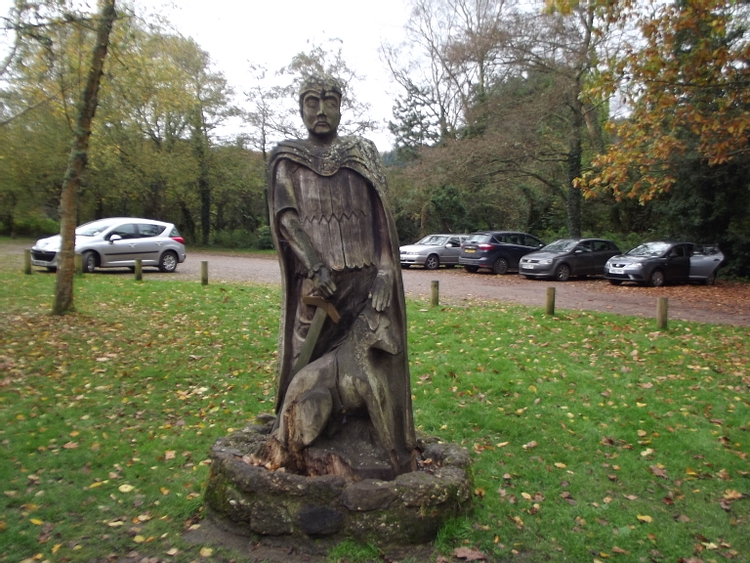 King Arthur Statue ndl642m (CC BY-NC-ND) ](https://www.worldhistory.org/image/6651/king-arthur-statue/ "King Arthur Statue")These mystical aspects of the figure of Arthur make clear that he was already a legendary figure by the 9th century. The *Welsh Annals* of about the same time also mention Arthur and claim he carried the cross of Christ on his shield throughout the three days of the battle of Badon Hill and emerged victorious through his deep devotion to God. The *Welsh Annals* date the battle to 516 CE and also mention the Battle of Camlann of 537 CE in which Arthur and Mordred are killed.
Another Welsh work citing Arthur is the elegiac poem *Y Gododdin* (pronounced Ay-Guh-doe-in) commemorating those who died fighting the Angles at the Battle of Catraeth c. 600 CE. Arthur does not appear in the poem but is alluded to in comparison with another warrior being praised. The poet writes of the courage and bravery of Gwawruddur but says he "was no Arthur". If the poem could be conclusively dated to shortly after the battle then it would be the first literary reference to the figure of Arthur; unfortunately, the only extant manuscript dates from the 13th century CE and many of the details in the piece are thought to be additions by later scribes.
### Malmesbury, Huntingdon, & Geoffrey of Monmouth
The historian William of Malmesbury (c. 1095 - c. 1143 CE) in his *Deeds of the British Kings* (c. 1125 CE), continues the tradition of Arthur-as-history as he expands on Nennius' account. Malmesbury was a reputable historian, still highly regarded, who relied on the accounts of Bede and Nennius (and, by extension, Gildas) as well as, perhaps, other records which are now lost. He describes Vortigern as the weak and easily manipulated king of the Britons who brought the Saxons to Britain but, at the same time, makes the point that the [death](https://www.worldhistory.org/disambiguation/Death/) of even so weak a king shatters the Briton's morale and leaves them defenseless. His successor, Ambrosius "alone of the Romans", rallies the people "with the distinguished service of the warlike Arthur" and defeats the Saxons. Malmesbury writes:
> This is the Arthur about whom the trifles of the Britons rave even now, one certainly not to be dreamed of in false myths, but proclaimed in truthful histories - indeed, who for a long time held up his tottering fatherland, and kindled the broken spirits of his countrymen to war. At last, at the siege of Mount Badon, trusting in the image of our Lord's Mother which he had sewn on his armor, rising alone against nine hundred of the enemy, he dashed them to the ground with incredible slaughter. (Brengle, 8)
Another well-respected historian, Henry of Huntingdon (c. 1088-1157 CE) develops the story further in his *History of the English* (c. 1129 CE). Huntingdon follows Nennius' narrative of the twelve battles culminating in the great victory at Badon Hill but claims how, afterwards, the Saxons regrouped and were reinforced by recruits sent by other regions on the continent. Huntingdon describes Arthur as a "mighty warrior" who is "constantly victorious" but adds the elements of doubt and difficulty to his account of the Battle of Badon Hill. He relates how the Britons did not present a united front, lost 440 men in a single day, and only Arthur received help from God in the conflict. Huntingdon presents a realistic battle in which the Britons are not magically victorious on the first day and Arthur has to struggle to defeat his enemy.
It may have been Huntingdon's pessimism or Malmesbury's call to proclaim Arthur in "truthful histories" or simply an ambition to write the definitive account of the hero but, whatever the motivation, these sources were all drawn together to create the first complete work on the story of King Arthur: Geoffrey of Monmouth's *History of the Kings of Britain*.
[  Geoffrey of Monmouth ndl642m (CC BY-NC-ND) ](https://www.worldhistory.org/image/6650/geoffrey-of-monmouth/ "Geoffrey of Monmouth")From its first appearance in 1136 CE up through the present day, *History of the Kings of Britain* has informed the [Arthurian legend](https://www.worldhistory.org/collection/226/the-arthurian-legend/). Arthurian [literature](https://www.worldhistory.org/literature/), in fact, is defined by the Latin form of Geoffrey's name (Galfridius): anything written before Geoffrey's work is known as Pre-Galfridian and everything after as Galfridian or Post-Galfridian. Regarded as the Father of the Arthurian Legend, Geoffrey did more than simply compile older stories or, as he said, translate them from an ancient book; he created the figure of King Arthur which would then be developed by later writers into the legendary king.
Geoffrey combines historical and mythical aspects in his account. He claims Ambrosius is Arthur's uncle, brother to Uther Pendragon, and the rightful heir to the throne who has been denied his heritage by Vortigern. Once Vortigern is dead, Ambrosius becomes king and battles the Saxons until he dies, and Uther takes the throne. His story follows more or less the same course as Ambrosius, and he is succeeded by his son Arthur. This part of Geoffrey's story is consistent with the earlier histories - there was a Saxon invasion which was halted by a great British king - but he then goes on to record Arthur's brilliant and expansive reign; it is at this point that Arthur becomes elevated from history to legend.
### The Historical Arthur
There have been many possibilities suggested as the 'real' Arthur: [Roman military](https://www.worldhistory.org/Roman_Army/) leader Lucius Artorius Castus (c. 3rd century CE); the Briton king Riothamus (c. 470 CE); the Welsh hero Caradoc Vreichvras (c. 6th century CE); the Saxon king [Cerdic](https://www.worldhistory.org/Cerdic/) (519-534 CE); the son of Ambrosius Aurelianus or Ambrosius himself (c. 5th century CE); the Scottish prince and war chief Artur mac Aedan of Dal Riata (c. 6th century CE). Even though all of these may have some qualities of the legendary Arthur, none of them have all, and some, like Castus, have almost none.
[  King Arthur by C.E.Butler Charles Ernest Butler (Public Domain) ](https://www.worldhistory.org/image/6630/king-arthur-by-cebutler/ "King Arthur by C.E.Butler")It is difficult to justify Castus as Arthur since he lived long before Arthur's time, in a different region, and has Arthur's name but none of his qualities. One cannot maintain that Cerdic, king of the Saxons, was Arthur when they are presented as two different people, even as enemies. Ambrosius Aurelianus is cited as Arthur's king, not Arthur himself (though it is possible Arthur was his son). Caradoc Vreichvras is named as a noble knight and Welsh king who served under Uther Pendragon and Arthur; he has none of Arthur's qualities himself. Riothamus, probably the best candidate, fought a completely different enemy (the Goths) in a completely different region ([Gaul](https://www.worldhistory.org/gaul/)). In the case of Artur mac Aedan, the Scottish prince never became king and has no association with the region where the Arthurian tales are set.
Considering the early sources for the legend and its later development it is entirely possible that the Arthur of history was none of these on the list nor any others who have been suggested; most likely King Arthur was based on a war chief named Arthur of the 5th or 6th century CE who became a champion of the people in a dark time. In seeking out the historical Arthur, it does not make sense to look too far from the original sources which first mention him. There does not have to be any great mystery surrounding the king's 'real' identity: the true King Arthur was most likely a British king named Arthur.
#### Editorial Review
This human-authored article has been reviewed by our editorial team before publication to ensure accuracy, reliability and adherence to academic standards in accordance with our [editorial policy](https://www.worldhistory.org/static/editorial-policy/).
## Bibliography
- [Ashe, G. *The Discovery of King Arthur.* Anchor Books, 1985.](https://www.worldhistory.org/books/0385190328/)
- [Barber, R. *The Figure of Arthur.* Dorset Press, 1990.](https://www.worldhistory.org/books/0880295074/)
- [Brengle, R. L. *Arthur: King of Britain.* Appleton Century Crofts, 1964.](https://www.worldhistory.org/books/0130492701/)
- [Geoffrey of Monmouth. *The History of the Kings of Britain.* E.P. Dutton & Company, 1958.](https://www.worldhistory.org/books/0140441700/)
- [Inghram, J. *The Saxon Chronicles.* Studio Editions, London, 1993.](https://www.worldhistory.org/books/0061144835/)
- [Lacy, N. J. *The Arthurian Encyclopedia.* Peter Bedrick Books, 1986.](https://www.worldhistory.org/books/0872261646/)
- [Morris, J. *The Age of Arthur: A History of the British Isles from 350 to 650.* Charles Scribner's Sons, 1973.](https://www.worldhistory.org/books/068413313X/)
- [Rutherford, W. *Celtic Mythology: The Nature and Influence of Celtic Myth - from Druidism to Arthurian Legend.* Sterling Publishing Company, 1990.](https://www.worldhistory.org/books/1537584359/)
- [Zesmer, D. M. *Guide to English Literature from Beowulf Through Chaucer and Medieval Drama.* Barnes & Noble, 1961.](https://www.worldhistory.org/books/0389000477/)
## About the Author
Joshua J. Mark is World History Encyclopedia's co-founder and Content Director. He was previously a professor at Marist College (NY) where he taught history, philosophy, literature, and writing. He has traveled extensively and lived in Greece and Germany.
- [Linkedin Profile](https://www.linkedin.com/pub/joshua-j-mark/38/614/339)
## Cite This Work
### APA
Mark, J. J. (2017, May 16). The Historical King Arthur. *World History Encyclopedia*.
### Chicago
Mark, Joshua J.. "The Historical King Arthur." *World History Encyclopedia*, May 16, 2017. .
### MLA
Mark, Joshua J.. "The Historical King Arthur." *World History Encyclopedia*, 16 May 2017, .
## License & Copyright
Submitted by [Joshua J. Mark](https://www.worldhistory.org/user/JPryst/ "User Page: Joshua J. Mark"), published on 16 May 2017. The copyright holder has published this content under the following license: [Creative Commons Attribution-NonCommercial-ShareAlike](https://creativecommons.org/licenses/by-nc-sa/4.0/deed.en). This license lets others remix, tweak, and build upon this content non-commercially, as long as they credit the author and license their new creations under the identical terms. When republishing on the web a hyperlink back to the original content source URL must be included. Please note that content linked from this page may have different licensing terms.