---
title: Tower of the Winds
author: Mark Cartwright
source: https://www.worldhistory.org/article/1044/tower-of-the-winds/
format: machine-readable-alternate
license: Creative Commons Attribution-NonCommercial-ShareAlike (https://creativecommons.org/licenses/by-nc-sa/4.0/)
updated: 1970-01-01
---
# Tower of the Winds
_Authored by [Mark Cartwright](https://www.worldhistory.org/user/markzcartwright/)_
The Tower of the Winds, also known as the Clock of Andronicus Cyrrhestes, is a [timekeeping](https://www.worldhistory.org/Timekeeping/) tower on the eastern side of the [Roman](https://www.worldhistory.org/disambiguation/Roman/) [agora](https://www.worldhistory.org/agora/) of [Athens](https://www.worldhistory.org/Athens/). Built in the 2nd century BCE, it once had nine sundials and contained a large water clock. Recently cleaned and restored, visitors can now finally enter the tower as part of the visit to the agora.
[ 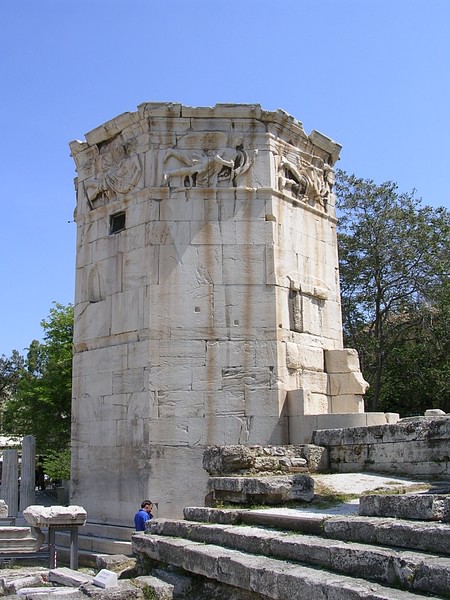 The Clock of Andronicus Cyrrhestes Mark Cartwright (CC BY-NC-SA) ](https://www.worldhistory.org/image/678/the-clock-of-andronicus-cyrrhestes/ "The Clock of Andronicus Cyrrhestes")The Tower of the Winds in Athens, as indicated by an inscription on one sundial, was built by the astronomer Andronikos (Andronicus), son of Hermias, and from Kyrrhos (Cyrrhus) in ancient [Macedon](https://www.worldhistory.org/macedon/), and so it became known as the Horologion of Kyrrhestos. The precise date of the tower's construction is not recorded and, although some scholars suggest on astronomical grounds it was built in the early 1st century BCE, the majority of historians give greater weight to the architectural style which suggests construction in the 2nd century BCE.
The tower is an octagonal structure which stands 13.5 metres high on a base of three steps, all built using Pentelic marble. There are two doorways, both with short porches, one on the northeast side and the other on the northwest side. On the south side of the building is a cylindrical annexe. The ribbed marble roof is conical and once had a [bronze](https://www.worldhistory.org/disambiguation/bronze/) weathervane which indicated the direction of the wind. The historian R. Hannah points out that the form of the roof, when seen by approaching from the [acropolis](https://www.worldhistory.org/Acropolis/), resembles Mt. Lycabettus, a large hill now surrounded by the urban sprawl of Athens.
[ 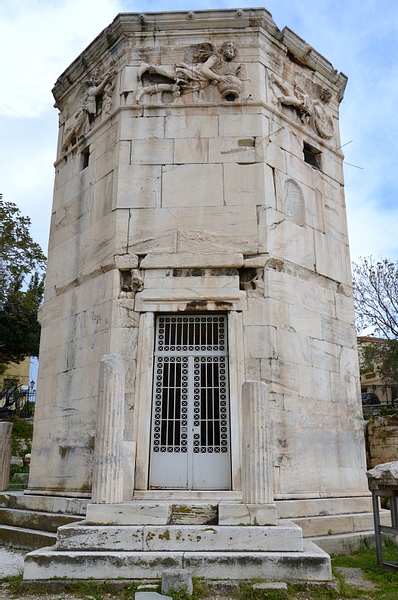 Tower of the Winds (Athens) Carole Raddato (CC BY-NC-SA) ](https://www.worldhistory.org/image/6462/tower-of-the-winds-athens/ "Tower of the Winds (Athens)")Personifications of the winds are carved in relief at the top of the tower on all eight sides, hence the popular name for the structure as the Tower of the Winds. The tower's vane took the form of Triton, the mythical fish-tailed monster, holding a rod in his right hand which would point down at the [sculpture](https://www.worldhistory.org/disambiguation/Sculpture/) of whichever wind was blowing at the time. The representations of the winds gods all bear their names and each carries a particular symbol to help identify them. Below are the gods, their direction, and a short description of their appearance on the tower reliefs:
- **[Boreas](https://www.worldhistory.org/Boreas/)** – North - A bearded male wearing a tunic and cloak. He holds a shell trumpet.
- **Kaikias** – Northeast – A bearded male in a tunic and cloak. He holds a shield full of hailstones.
- **Apeliotes** – East – A young male whose cloak is filled with fruit and grain.
- **Euros** – Southeast – A bearded male whose cloak billows in the wind.
- **Notos – South – A young male in a tunic and cloak. He is emptying an [amphora](https://www.worldhistory.org/Amphora/) of water.
- **Lips** – Southwest – A young male in a cloak. He is holding the stern of a ship.
- **Zephyros** – West – A young male whose cloak is filled with flowers.
- **Skiron** – Northwest - A bearded male in a tunic and cloak. He has an overturned [metal](https://www.worldhistory.org/disambiguation/metal/) vase which has spilt hot coals.
[ 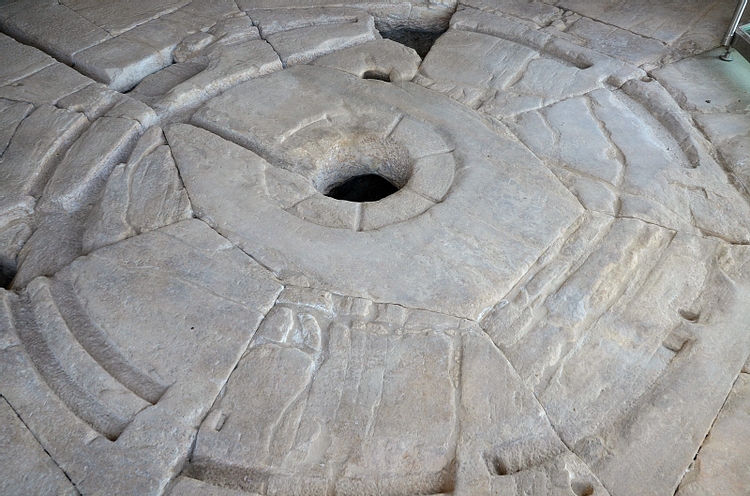 The interior of the Tower of the Winds (Athens) Carole Raddato (CC BY-NC-SA) ](https://www.worldhistory.org/image/6463/the-interior-of-the-tower-of-the-winds-athens/ "The interior of the Tower of the Winds (Athens)")The tower was much more than a glorified weather vane, though, for it also contained a large water clock which ran on water from the acropolis spring and it had no fewer than nine sundials on its outer walls, both spherical and plain types. The clock was referenced in the works of [Vitruvius](https://www.worldhistory.org/Vitruvius/) (*On [Architecture](https://www.worldhistory.org/disambiguation/architecture/)* 1.6.4-7) and Varo (*On Farming* 3.5.17) but has, unfortunately, been lost. All that remains today are channel holes in the flooring which conducted water from a reservoir adjoining the south [wall](https://www.worldhistory.org/wall/). Vitruvius was impressed with the tower and based its design on his sketch of the perfect [city](https://www.worldhistory.org/city/) with octagonal walls facing each of the winds.
The location of the tower is not coincidental as merchants at the nearby agora would have been able to better estimate when their goods might be arriving by sea. The Tower was converted into a church or baptistry during the early Christian period and became a Dervish place of worship or *tekke* in the mid-18th century CE. Restoration work was completed in 2016 CE and now, after many years closed, visitors can once again enter the tower.
#### Editorial Review
This human-authored article has been reviewed by our editorial team before publication to ensure accuracy, reliability and adherence to academic standards in accordance with our [editorial policy](https://www.worldhistory.org/static/editorial-policy/).
## Bibliography
- Bagnall, R.S. *The Encyclopedia of Ancient History.* Wiley-Blackwell, 2012
- Choremi-Spetsieri, A. *Roman Agora – Library of Hadrian.* Association of Friends of the Acropolis
- Choremi-Spetsieri, A. *The Roman Agora of Athens.* Archaeological Receipts Fund
- [Oleson, J.P. *The Oxford Handbook of Engineering and Technology in the Classical World.* Oxford University Press, 2017.](https://www.worldhistory.org/books/B01FKUNB6E/)
- [Vitruvius. *On Architecture.* Cambridge University Press, 2001.](https://www.worldhistory.org/books/0521002923/)
## About the Author
Mark is WHE’s Publishing Director and has an MA in Political Philosophy (University of York). He is a full-time researcher, writer, historian and editor. Special interests include art, architecture and discovering the ideas that all civilizations share.
## Cite This Work
### APA
Cartwright, M. (2017, March 31). Tower of the Winds. *World History Encyclopedia*.
### Chicago
Cartwright, Mark. "Tower of the Winds." *World History Encyclopedia*, March 31, 2017. .
### MLA
Cartwright, Mark. "Tower of the Winds." *World History Encyclopedia*, 31 Mar 2017, .
## License & Copyright
Submitted by [Mark Cartwright](https://www.worldhistory.org/user/markzcartwright/ "User Page: Mark Cartwright"), published on 31 March 2017. The copyright holder has published this content under the following license: [Creative Commons Attribution-NonCommercial-ShareAlike](https://creativecommons.org/licenses/by-nc-sa/4.0/deed.en). This license lets others remix, tweak, and build upon this content non-commercially, as long as they credit the author and license their new creations under the identical terms. When republishing on the web a hyperlink back to the original content source URL must be included. Please note that content linked from this page may have different licensing terms.