---
title: Etruscan Banquets
author: Mark Cartwright
source: https://www.worldhistory.org/article/1024/etruscan-banquets/
format: machine-readable-alternate
license: Creative Commons Attribution-NonCommercial-ShareAlike (https://creativecommons.org/licenses/by-nc-sa/4.0/)
updated: 1970-01-01
---
# Etruscan Banquets
_Authored by [Mark Cartwright](https://www.worldhistory.org/user/markzcartwright/)_
The [Etruscans](https://www.worldhistory.org/Etruscan_Civilization/), who flourished in central [Italy](https://www.worldhistory.org/italy/) between the 8th and 3rd century BCE, were noted in antiquity for their sumptuous banquets, drinking parties, and general easy-living. Although such pleasures were probably restricted to the wealthy elite, strong evidence of the popularity of the practice is seen in many [Etruscan](https://www.worldhistory.org/Etruscan_Civilization/) [tomb](https://www.worldhistory.org/tomb/) [wall](https://www.worldhistory.org/wall/) paintings and carved sarcophagi. Banquets may also have had a political purpose and so been used as an opportunity for rulers to spread a little happiness amongst those they governed.
[  Tomb of The Lionesses, Tarquinia AlMare (Public Domain) ](https://www.worldhistory.org/image/6261/tomb-of-the-lionesses-tarquinia/ "Tomb of The Lionesses, Tarquinia")### Seating Arrangements
Paintings suggest two kinds of social activity: banquets where food was served and diners reclined on one-armed couches which were covered in colourful rugs and cushions, and drinking parties where participants sat on the floor on mats. There are a few examples in early [Etruscan art](https://www.worldhistory.org/Etruscan_Art/) of diners sat on upright chairs, but by the 6th century BCE, the habit had changed to low couches in the style of those used at a [Greek](https://www.worldhistory.org/disambiguation/greek/) drinking party or [symposium](https://www.worldhistory.org/Symposium/). Seating was arranged around the walls of the room so that all the guests could see each other as they ate. Food and wine were served by slaves and set on low, three-legged tables positioned in front of each diner.
### Food & Drink
Not only were the Etruscans accomplished farmers but they were also great traders, exchanging goods with all the [Mediterranean](https://www.worldhistory.org/disambiguation/mediterranean/) cultures of the time from [Phoenicia](https://www.worldhistory.org/phoenicia/) to southern Spain and North [Africa](https://www.worldhistory.org/disambiguation/africa/). Consequently, for those who could afford such things, the banquet tables would have been piled high with all manner of exotic foodstuffs alongside home-grown staples. Meat included beef, lamb, pork, deer, boar, hare, and game birds. There was fish (especially tuna) and seafood aplenty, enormous rounds of sheep's cheese, olives, porridge, bread pancakes, vegetables, fruit, eggs, raisins and nuts. Flavours were enhanced by the addition of herbs, mint, honey, vinegar, [pepper](https://www.worldhistory.org/Pepper/), and other spices. The Etruscans were great exporters of wine, too, so there would have been no shortage in that department either.
Such was the magnificent spread at Etruscan banquets that [Diodorus Siculus](https://www.worldhistory.org/Diodorus_Siculus/), the 1st-century BCE Greek historian wrote, with a hint of envy in his disapproval,
> As they inhabit a land fertile in fruits of all kinds and cultivate it assiduously, they enjoy an abundance of agricultural produce which not only is sufficient for themselves but by its excess leads them to unbridled luxury and indolence. For twice a day they have tables sumptuously dressed and laid with everything that can contribute towards delicate living; they have coverings embroidered with flowers and are served wine in quantities of [silver](https://www.worldhistory.org/Silver/) bowls, and they have at their call a considerable number of slaves. (Heurgon, 36)
This view is confirmed by his contemporary, the [Roman](https://www.worldhistory.org/disambiguation/Roman/) historian [Livy](https://www.worldhistory.org/livy/), who describes the Etruscan elite as spending "most of their leisure enjoying themselves in entertainments on the most lavish scale" (Keller, 196).
[  Etruscan Banquet Scene The British Museum (Copyright) ](https://www.worldhistory.org/image/6393/etruscan-banquet-scene/ "Etruscan Banquet Scene")### Entertainment
Besides a good spread, musicians would have been present to liven up the atmosphere playing tortoiseshell lyres, castanets, and the double [aulos](https://www.worldhistory.org/Aulos/) flute. Diners seemed to have dressed for the occasion as they all wear extravagant, colourful, and expensive-looking clothes with wreaths of myrtle in their hair, and that is just the men; [women](https://www.worldhistory.org/disambiguation/women/) have all that and fine jewellery too. For the drinking parties, an additional entertainment was the Greek game of *kottabos* where drinkers tried to throw their wine slops into a vase placed across the room or at an individual holding ceramic targets or even at a hapless passing slaveboy.
### Representations in Art
Although only 2% of Etruscan tombs had their interior walls painted with scenes from daily life and [mythology](https://www.worldhistory.org/mythology/), of those the majority have at least one area devoted to a banqueting or drinking scene. The misleadingly named Tomb of the Lionesses at [Tarquinia](https://www.worldhistory.org/Tarquinia/), built 530-520 BCE, actually has two painted panthers, a large drinking party scene, and is interesting for its unusual checkered pattern ceiling and six painted wooden columns. Does this recreate the older practice of covering the dead in tents or does it merely show an Etruscan love of eating outdoors?
[ 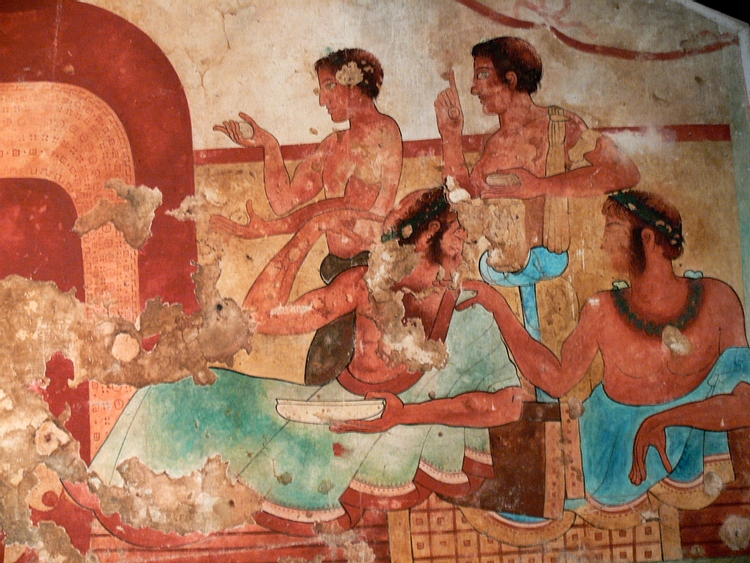 Etruscan Diners, Tarquinia Wolfgang Sauber (CC BY-SA) ](https://www.worldhistory.org/image/6395/etruscan-diners-tarquinia/ "Etruscan Diners, Tarquinia")The Tomb of the Monkey at [Chiusi](https://www.worldhistory.org/Chiusi/), constructed 480-470 BCE, has another drinking party scene which includes a female figure dancing while balancing an incense burner on her head in order to provide a target for drinkers to play *kottabos*. A rare glimpse behind the scenes is provided by the Golini Tomb at [Orvieto](https://www.worldhistory.org/volsinii/) (Volsini), where one wall shows the kitchens with eleven slaves, both male and female, busy preparing dinner with meat and birds hanging ready to be diced by one slave boy acting as butcher. Another figure is kneading or grinding something in a bowl and doing so to the [music](https://www.worldhistory.org/disambiguation/Music/) of a flute player nearby.
Banqueting scenes also frequently appear in Etruscan stone relief [sculpture](https://www.worldhistory.org/disambiguation/Sculpture/) on the sides of funerary urns and sarcophagi. Two fine examples are from Chiusi. Dating to the 6th and 5th century BCE, respectively, they both have scenes where diners recline on one-armed couches while holding stemmed cups, with large wine-mixing kraters, musicians and even a dog in the background. Such scenes of festivity happily sit with more serious reliefs of mourning scenes on other sides of the same sarcophagus. Finally, sometimes terracotta moulded plaques used to decorate buildings depict banqueting scenes very similar to those already described. An example is a 6th-century BCE plaque from [Acquarossa](https://www.worldhistory.org/Acquarossa/), which, again, has male and female diners, musicians, and dogs looking for scraps under the chairs.
[ 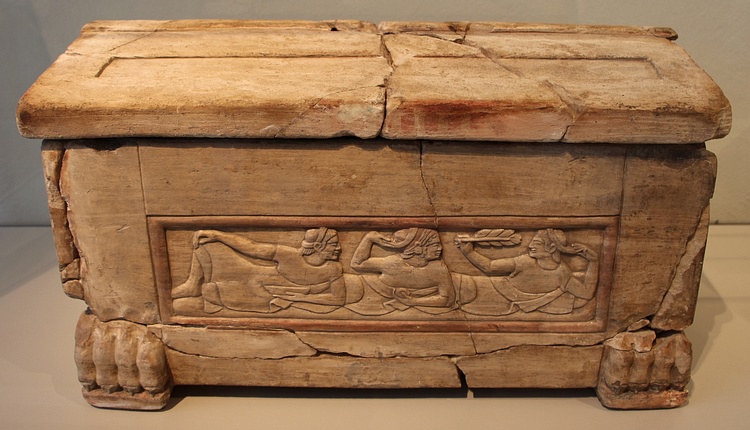 Etruscan Drinking Party Sailko (CC BY) ](https://www.worldhistory.org/image/6394/etruscan-drinking-party/ "Etruscan Drinking Party")Taken together these social scenes give an important insight into the status of Etruscan women as they illustrate that they could attend when their counterparts in [Greece](https://www.worldhistory.org/greece/) could not. There only courtesans (*hetaerae*) could entertain the guests, but the inscriptions of some scenes indicate that respectable women participated on an equal footing with males in these Etruscan soirées. This was rather shocking to Greek writers, as seen in this extract from Athenaeus who quotes the 4th-century BCE writer Theopompus in his *Learned Banquet*,
> They \[Etruscan women\] sit down to table not beside their own husbands but besides any of the guests, and they even drink to the health of anyone they please. Moreover they are great wine-bibbers and very beautiful to behold. (Heurgon, 34)
### Social Function
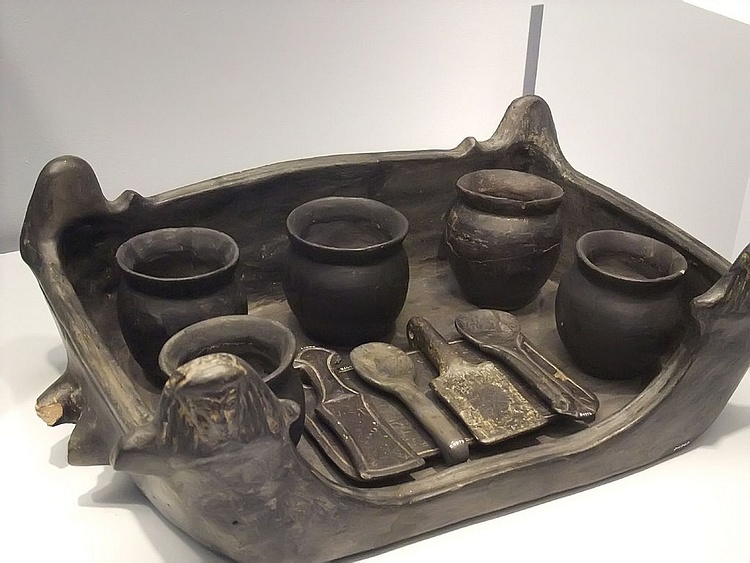
We can only speculate as to the true significance of the painted banquets. Are they depictions of the deceased in a happy moment long since passed or mourners putting on a funeral feast for their lost loved one? Could they even be a view of the afterlife where food and drink and merriment never cease? The depositing of [bucchero](https://www.worldhistory.org/Bucchero/) [pottery](https://www.worldhistory.org/pottery/) dinner sets with cups, bowls, and utensils all neatly placed on a tray with the deceased suggests so. Perhaps, we shall never really know the link between Etruscan art and life.
[  Bucchero Dinner Set Mary Harrsch (Photographed at the Art Institute of Chicago) (CC BY-SA) ](https://www.worldhistory.org/image/6277/bucchero-dinner-set/ "Bucchero Dinner Set")One thing which is clear, Etruscan art and clothing were influenced by Near Eastern cultures and [Ionia](https://www.worldhistory.org/ionia/), thanks to their [trade](https://www.worldhistory.org/disambiguation/trade/) connections, and so it would seem natural that habits of banqueting and drinking parties would also have been adopted. We should consider, too, that banquets might have been important opportunities for rulers to display their largesse with the common people and ensure their continued support of the status quo. This was a practice dating back to the [Iron age](https://www.worldhistory.org/disambiguation/Iron_Age/) [Villanovan culture](https://www.worldhistory.org/Villanovan_Culture/) in [Etruria](https://www.worldhistory.org/Etruscan_Civilization/).
Whatever the function of the banquets, whenever they were held, and whoever might have enjoyed them, it is clear from the paintings that enjoy them they did for rarely has the pure pleasure of eating and drinking been so vividly depicted in ancient art. The Etruscans knew how to let their hair down, of that there is no doubt.
#### Editorial Review
This human-authored article has been reviewed by our editorial team before publication to ensure accuracy, reliability and adherence to academic standards in accordance with our [editorial policy](https://www.worldhistory.org/static/editorial-policy/).
## Bibliography
- [Haynes, S. *Etruscan Civilization.* J. Paul Getty Museum, 2005.](https://www.worldhistory.org/books/0892366001/)
- [Heurgon, J. *Daily Life of the Etruscans.* Phoenix, 2002.](https://www.worldhistory.org/books/1842125923/)
- [Keller, W. *The Etruscans.* Random House Inc (T), 1974.](https://www.worldhistory.org/books/0394473019/)
- [Spivey, N.J. *Etruscan Art.* Thames & Hudson, 1997.](https://www.worldhistory.org/books/0500203040/)
## About the Author
Mark is WHE’s Publishing Director and has an MA in Political Philosophy (University of York). He is a full-time researcher, writer, historian and editor. Special interests include art, architecture and discovering the ideas that all civilizations share.
## Cite This Work
### APA
Cartwright, M. (2017, February 27). Etruscan Banquets. *World History Encyclopedia*.
### Chicago
Cartwright, Mark. "Etruscan Banquets." *World History Encyclopedia*, February 27, 2017. .
### MLA
Cartwright, Mark. "Etruscan Banquets." *World History Encyclopedia*, 27 Feb 2017, .
## License & Copyright
Submitted by [Mark Cartwright](https://www.worldhistory.org/user/markzcartwright/ "User Page: Mark Cartwright"), published on 27 February 2017. The copyright holder has published this content under the following license: [Creative Commons Attribution-NonCommercial-ShareAlike](https://creativecommons.org/licenses/by-nc-sa/4.0/deed.en). This license lets others remix, tweak, and build upon this content non-commercially, as long as they credit the author and license their new creations under the identical terms. When republishing on the web a hyperlink back to the original content source URL must be included. Please note that content linked from this page may have different licensing terms.