---
title: Regolini-Galassi Tomb
author: Mark Cartwright
source: https://www.worldhistory.org/article/1020/regolini-galassi-tomb/
format: machine-readable-alternate
license: Creative Commons Attribution-NonCommercial-ShareAlike (https://creativecommons.org/licenses/by-nc-sa/4.0/)
updated: 1970-01-01
---
# Regolini-Galassi Tomb
_Authored by [Mark Cartwright](https://www.worldhistory.org/user/markzcartwright/)_
The Regolini-Galassi [Tomb](https://www.worldhistory.org/tomb/) is located in the [Etruscan](https://www.worldhistory.org/Etruscan_Civilization/) town of [Cerveteri](https://www.worldhistory.org/Cerveteri/) (aka Cisra or Caere) near the western coast of central [Italy](https://www.worldhistory.org/italy/), around 50 km north of [Rome](https://www.worldhistory.org/Rome/). Cerveteri flourished between the 7th and 4th century BCE and has hundreds of rock-cut tombs from that period. The Regolini-Galassi tomb dates to c. 680-660 BCE and is one of the most important as its discoverers, Regolini and Galassi, found the tomb intact and full of Etruscan artefacts including the largest horde of [gold](https://www.worldhistory.org/gold/) jewellery found at any Etruscan site.
[  Etruscan Gold Fibula, Cerveteri Sailko (CC BY-SA) ](https://www.worldhistory.org/image/6276/etruscan-gold-fibula-cerveteri/ "Etruscan Gold Fibula, Cerveteri")### The Discovery
The *Tomba Regolini-Galassi* is named after the Italian priest Alessandro Regolini and the general Vicenzo Galassi, who discovered it in 1836 CE at the Sorbo necropolis just outside Cerveteri. The pair of amateur archaeologists had previously dug out five tombs from a huge earth mound north of the town, but all of them had been looted, and then their luck changed. Tomb number six was, miraculously, intact. Untouched for over two and a half millennia, it would be the most spectacular discovery in the region up to that time and the treasures within would fire the public imagination and create a whole new interest in the [Etruscans](https://www.worldhistory.org/Etruscan_Civilization/).
[ 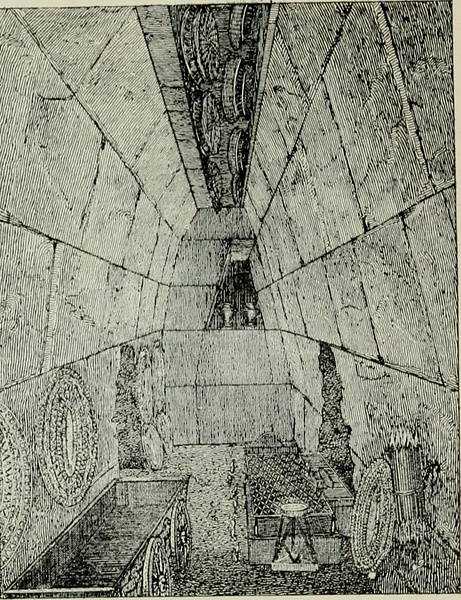 Regolini-Galassi Tomb Chamber Interactive Archive Book Images (Public Domain) ](https://www.worldhistory.org/image/6382/regolini-galassi-tomb-chamber/ "Regolini-Galassi Tomb Chamber")The rock-cut tomb takes the form of a long gabled rectangular corridor with two oval chambers, one on either side at the mid-point, and the main chamber at the end. Unfortunately for posterity, Regolini and Galassi were rather clumsy in their excavations. Entering the tomb from above, their digging caused the roof to collapse damaging some of the furniture inside. In addition, there was so much gold and precious goods inside that they mostly discarded any [pottery](https://www.worldhistory.org/pottery/) finds.
### Larthia's Gold
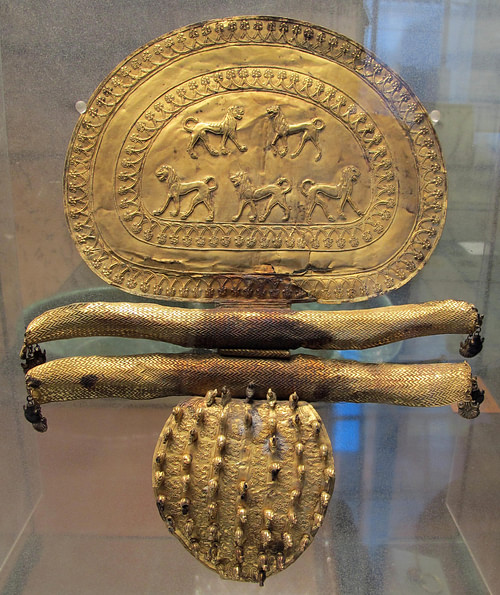
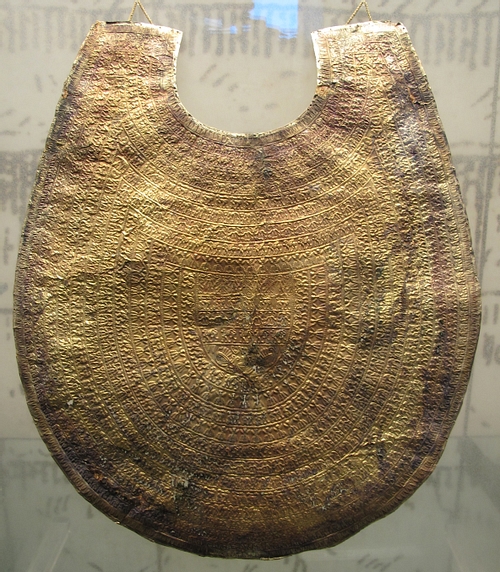
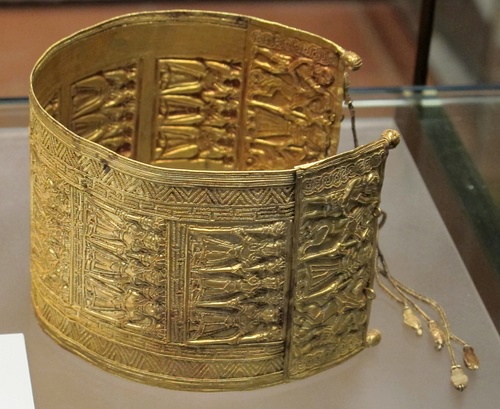
On entering the main chamber, Regolini and Galassi came face to face with the skeleton, bedecked in fine jewellery, of the tomb's female occupant. She wore a gold pectoral 42 cm across decorated with hundreds of tiny animals and plants, a symbol of her high social, perhaps even royal, status. The woman also wore a belt with a magnificent gold fibula made with repoussé and granulation techniques. It is decorated with five lions on its upper disk and 50 minute ducks in three dimensions, arranged in seven rows on the lower disk which covers the pin. She wore two wide gold bracelets decorated with trios of dancing females with long hair and long dresses. Two necklaces are in gold, one with alternating round and elongated beads which are incised with lines, and the other with three large gold and [amber](https://www.worldhistory.org/Amber/) pendants. Finally, there are gold earrings, spiral finger rings, and pins.
[  Gold Etruscan Pectoral Sailko (CC BY) ](https://www.worldhistory.org/image/6380/gold-etruscan-pectoral/ "Gold Etruscan Pectoral")Whatever the role of this person was in life – certainly an aristocrat and likely a priestess, princess, or queen - we do know her name: Larthia, inscribed on each piece of an eleven-piece [silver](https://www.worldhistory.org/Silver/) service set found at her feet. Neither was she interred alone in the tomb, for one of the side chambers contained the ashes of a male, set inside a pottery funerary urn in a [wall](https://www.worldhistory.org/wall/) niche. The second side chamber had no occupant (despite some early accounts of a third 'warrior' remains which has led to a repetition of the error in many sources ever since) but did have a quantity of silver gilt bowls.
[  Gold Etruscan Bracelet Sailko (CC BY-SA) ](https://www.worldhistory.org/image/6384/gold-etruscan-bracelet/ "Gold Etruscan Bracelet")### Other Finds
Other items in the tomb, many with Near Eastern-like decoration include a large [bronze](https://www.worldhistory.org/disambiguation/bronze/) latticework couch with six legs and a headrest; eight round bronze shields – some with molded panther heads with inlaid enamel eyes; bronze incense burners; cauldrons decorated with lion and griffin heads (*protomes*), and a throne with embossed lions, stags, and plants in the same material; silver cups, vases, and dishes; carved ivory boxes; and [bucchero](https://www.worldhistory.org/Bucchero/) wares in the form of bowls, pitchers, beakers, and 33 grieving effigy figures. One bucchero bottle has a helpful complete Etruscan [alphabet](https://www.worldhistory.org/alphabet/) inscribed on its base. A magnificent gilded silver bowl is decorated with a lion hunt and procession of warriors and clearly indicates links with the [Near East](https://www.worldhistory.org/Near_East/). Finally, there was a four-wheeled bed-carriage on which lay the woman of the tomb when she was in state and a two-wheeled [chariot](https://www.worldhistory.org/chariot/) or *biga* which the Etruscans used for ceremonies and processions.
[ 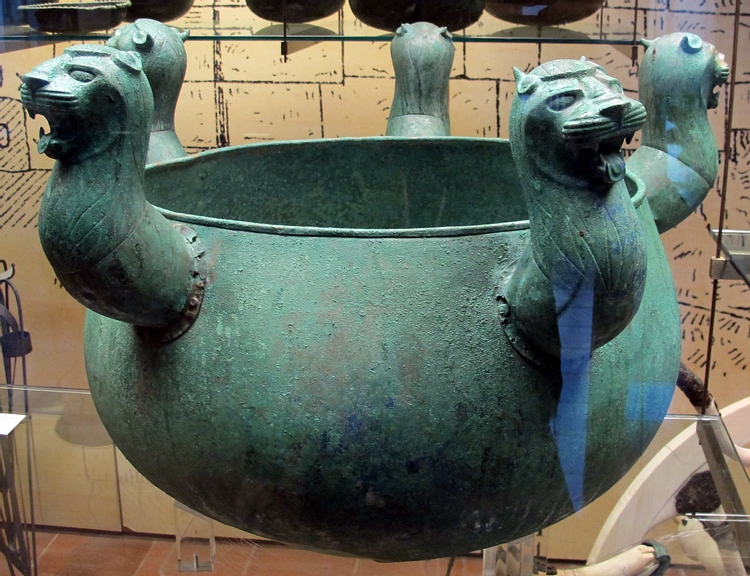 Etruscan Bronze Cauldron Sailko (CC BY-SA) ](https://www.worldhistory.org/image/6383/etruscan-bronze-cauldron/ "Etruscan Bronze Cauldron")More everyday items to metaphorically feed and amuse the deceased on their way to, or actually in, the next life include iron tools and several large terracotta vases which once contained foodstuffs such as wheat, oil, honey, and eggs. There was an ivory dice, and even a bronze stand with suspended disks used for the [Greek](https://www.worldhistory.org/disambiguation/greek/) drinking game of *kottabos* where drinkers tried to swish the slops from their wine cup at a target. The contents of the tomb can be seen today in its own dedicated room in the Museo Gregoriano Etrusco of the Vatican Museums, Rome.
#### Editorial Review
This human-authored article has been reviewed by our editorial team before publication to ensure accuracy, reliability and adherence to academic standards in accordance with our [editorial policy](https://www.worldhistory.org/static/editorial-policy/).
## Bibliography
- [Brendel, O.J. *Etruscan Art.* Yale University Press, 1995.](https://www.worldhistory.org/books/0300064462/)
- [Haynes, S. *Etruscan Civilization.* J. Paul Getty Museum, 2005.](https://www.worldhistory.org/books/0892366001/)
- [Heurgon, J. *Daily Life of the Etruscans.* Phoenix, 2002.](https://www.worldhistory.org/books/1842125923/)
- [Spivey, N. *Etruscan Italy.* B T Batsford Ltd, 1992.](https://www.worldhistory.org/books/0713465212/)
- [Spivey, N.J. *Etruscan Art.* Thames & Hudson, 1997.](https://www.worldhistory.org/books/0500203040/)
## About the Author
Mark is WHE’s Publishing Director and has an MA in Political Philosophy (University of York). He is a full-time researcher, writer, historian and editor. Special interests include art, architecture and discovering the ideas that all civilizations share.
## Cite This Work
### APA
Cartwright, M. (2017, February 23). Regolini-Galassi Tomb. *World History Encyclopedia*.
### Chicago
Cartwright, Mark. "Regolini-Galassi Tomb." *World History Encyclopedia*, February 23, 2017. .
### MLA
Cartwright, Mark. "Regolini-Galassi Tomb." *World History Encyclopedia*, 23 Feb 2017, .
## License & Copyright
Submitted by [Mark Cartwright](https://www.worldhistory.org/user/markzcartwright/ "User Page: Mark Cartwright"), published on 23 February 2017. The copyright holder has published this content under the following license: [Creative Commons Attribution-NonCommercial-ShareAlike](https://creativecommons.org/licenses/by-nc-sa/4.0/deed.en). This license lets others remix, tweak, and build upon this content non-commercially, as long as they credit the author and license their new creations under the identical terms. When republishing on the web a hyperlink back to the original content source URL must be included. Please note that content linked from this page may have different licensing terms.