---
title: Etruscan Society
author: Mark Cartwright
source: https://www.worldhistory.org/article/1016/etruscan-society/
format: machine-readable-alternate
license: Creative Commons Attribution-NonCommercial-ShareAlike (https://creativecommons.org/licenses/by-nc-sa/4.0/)
updated: 1970-01-01
---
# Etruscan Society
_Authored by [Mark Cartwright](https://www.worldhistory.org/user/markzcartwright/)_
The social organisation of the ancient [Etruscans](https://www.worldhistory.org/Etruscan_Civilization/), a [civilization](https://www.worldhistory.org/civilization/) which flourished in central [Italy](https://www.worldhistory.org/italy/) between the 8th and 3rd century BCE, can only be pieced together from a collection of rather unsatisfactory sources which, unfortunately, do not include texts written by the Etruscans themselves. These sources include short inscriptions, art, tombs and their contents, [pottery](https://www.worldhistory.org/pottery/) graffiti, and descriptions by [Greek](https://www.worldhistory.org/disambiguation/greek/) and [Roman](https://www.worldhistory.org/disambiguation/Roman/) writers who often struggled to fathom this strange foreign [culture](https://www.worldhistory.org/disambiguation/culture/) and could only inadequately apply to it their own familiar terms and concepts. Nevertheless, by combining all of the historical records available to us some important elements of [Etruscan](https://www.worldhistory.org/Etruscan_Civilization/) society become clear: a strong sense of family and heritage, defining symbols of rule and status, and a more liberal attitude to the role and rights of [women](https://www.worldhistory.org/disambiguation/women/) compared to contemporary [ancient societies](https://www.worldhistory.org/collection/62/ancient-societies/).
[  Etruscan Mother & Child PHGCOM (CC BY-SA) ](https://www.worldhistory.org/image/6354/etruscan-mother--child/ "Etruscan Mother & Child")### Family
Probably the most important element which held together the fabric of Etruscan society was the family and kinship. The separation of particular families as individually identifiable groups is first seen in the earliest cemeteries at Etruscan sites where each settlement has multiple cemeteries, probably one for each kin group, in a trend which would persist throughout the culture's history. Family was important whatever one's social position as it was from one's parents that one's status derived, whether it be the throne or a pottery work bench.
From the 7th and 6th century BCE, the presence of large, well-built stone tombs for certain members of the community and the higher value [grave](https://www.worldhistory.org/burial/) goods they contained are an indicator that a wealthy elite had formed within Etruscan society. Over time, the number of such tombs grew as a proportion of all burials within a community, illustrating that this elite grew in numbers from a few tribal leaders to a separate upper class all of its own. Indeed, such was the growth in elite tombs that they were constructed according to orderly grid plans at such places as [Cerveteri](https://www.worldhistory.org/Cerveteri/), creating, in effect, [cities](https://www.worldhistory.org/city/) of the dead with their own streets. Instrumental in this prosperity was the increase in mining of [Etruria](https://www.worldhistory.org/Etruscan_Civilization/)'s rich mineral resources and the resulting [trade](https://www.worldhistory.org/disambiguation/trade/) benefits from that exploitation. There was also an elite within an elite as only 2% of tombs at [Tarquinia](https://www.worldhistory.org/Tarquinia/), for example, had expensive [wall](https://www.worldhistory.org/wall/) paintings in their interior. Finally, many tombs were used over several generations, again illustrating the importance and continuation of strong family ties.
### Monarchy & Aristocracy
At the top of the Etruscan social ladder were the royals. Inheriting their right to the throne, the early kings, no doubt, also performed a religious function in a culture where [religion](https://www.worldhistory.org/religion/) and politics were not separated. We know some of the names of Etruscan sovereigns: the Tarquins from Tarquinia who ruled early [Rome](https://www.worldhistory.org/Rome/); the Tolumnia clan of [Veii](https://www.worldhistory.org/Veii/); Porsenna, king of [Chiusi](https://www.worldhistory.org/Chiusi/); and Mezentius, ruler of Cerveteri. Kings carried the title of *lauchume* and were recognised by various symbols and insignia such as an ivory throne or stool, a sceptre topped by an eagle, the *[fasces](https://www.worldhistory.org/Fasces/)* symbol of axe and rods, and a purple robe; all of which would later be adopted by the Romans.
[ 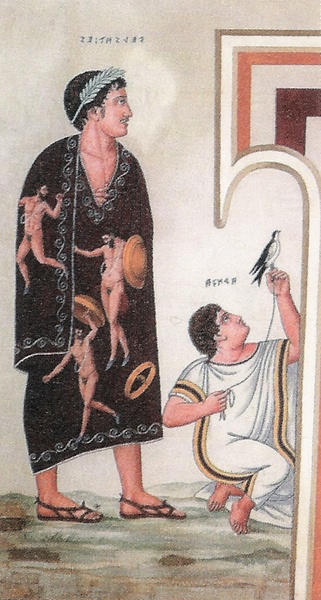 Vel Saties & Arnza, Francois Tomb Louis-garden (CC BY-SA) ](https://www.worldhistory.org/image/6313/vel-saties--arnza-francois-tomb/ "Vel Saties & Arnza, Francois Tomb")Eventually, kings gave way to rule by a council of elders or an assembly of citizens where the [city](https://www.worldhistory.org/city/)'s most powerful men met and debated government. The wealth of these individuals was based on land ownership and trade. They voted for a leader amongst themselves, the *princeps civitatis*, to hold office for one year and, with him, various magistrates to perform public duties, perhaps represent the interests of certain sections of society, and to dispense justice. Inscriptions indicate that a magistrate (*zilath*) could hold office several times and there was no minimum age. Senior magistrates from each of the major Etruscan towns met annually, although that probably had more to do with religious matters as there is no evidence of a common political policy amongst the towns.
### Other Classes & Occupations
[Etruscan art](https://www.worldhistory.org/Etruscan_Art/) and especially those tombs with wall paintings reveal other layers of society. Besides the depiction of such elite-only pastimes as feasting and hunting, there are, either by direct depiction or intimation, clearly other, lower members of society such as slaves who serve at banquets, cooks, or beaters during hunts, as well as dancers, acrobats and musicians to provide entertainment. Some jobs are also directly depicted such as fishermen, priests, shepherds, and farmers.
We can deduce, then, from this pictorial evidence and the presence of manufactured goods within the tombs that Etruscan society consisted of slaves, artisans, metalworkers, potters, the [tomb](https://www.worldhistory.org/tomb/) painters themselves, those who worked the land (including serfs) and kept animals (whether for themselves or an estate owner), merchants, administrators, a priesthood, and an aristocracy. Further, art can also reveal social attitudes, as for example, in the convention of depicting slaves in wall paintings as of smaller stature than citizens. Similarly, elite members of society were easily identified in real life from the mass of ordinary citizens by their particular clothes, hats, and various staffs of authority. The full significance of such symbols remains uncertain, nevertheless, it is clear that Etruscan society had many levels of complexity. Inscriptions and naming conventions also show that there was some movement between social groups, even if it took several generations to get there.
[  Musicians Wall-painting, Tarquinia Yann Forget (Public Domain) ](https://www.worldhistory.org/image/6262/musicians-wall-painting-tarquinia/ "Musicians Wall-painting, Tarquinia")### Slaves
As in contemporary ancient cultures, the Etruscans, or those who could afford them, used slaves for all manner of daily tasks. Taken as prisoners of [war](https://www.worldhistory.org/disambiguation/War/) from conflicts with fellow Etruscan cities or communities outside Etruria, or simply bought from the Etruscan's trading partners, they came from all over the [Mediterranean](https://www.worldhistory.org/disambiguation/mediterranean/) and were used as household servants, agricultural workers, miners, quarry workers, potters, metalworkers, soldiers, and entertainers. They were not entirely anonymous as some tomb paintings sometimes carry the names of slaves depicted in banqueting scenes. One can imagine that the life of a household slave was rather more bearable than slavery in the mines or countryside and their accommodation certainly was, residing as they did, in the family home.
Unsurprisingly, slave revolts frequently broke out into an armed uprising, especially from the 4th century BCE onwards. These revolts probably involved Etruscan citizens too, as the distinction between slaves, freed slaves, and labourers has been difficult to identify and confused Greek and Roman writers whose descriptions we rely upon for an insight into the Etruscan world. Dionysius of [Halicarnassus](https://www.worldhistory.org/halicarnassus/) famously described those disenfranchised in Etruscan society as free men who were treated like slaves. Clearly, there was a wide divide between the have and have-nots, whatever their political and legal status. Then, as perhaps still today, only economic power brought real political influence and the opportunity to improve one's lot.
### Women
While paintings in tombs depict the elite's pleasures and pastimes, they also reveal an attitude to women which is quite different from, for example, contemporary [Greek culture](https://www.worldhistory.org/disambiguation/Greek_Culture/). Although the Etruscan drinking parties, and even the after-dinner games, are taken from Greek habits, the presence of respectable married women (identified as such by inscriptions), and not courtesans, illustrates that Etruscan women had rather more social freedom than their counterparts elsewhere. In one tomb painting, three women are spectators at a [chariot](https://www.worldhistory.org/chariot/) race, again, something unheard of at Greek sporting events.
[ 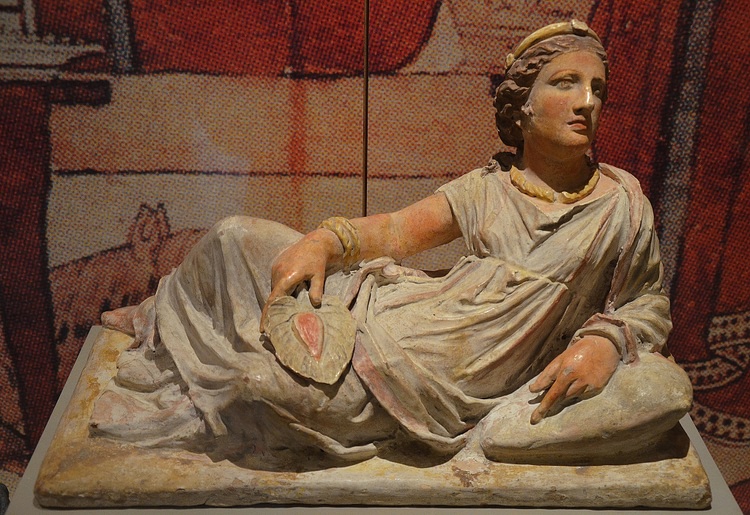 Etruscan Funerary Portrait Carole Raddato (CC BY-SA) ](https://www.worldhistory.org/image/6297/etruscan-funerary-portrait/ "Etruscan Funerary Portrait")Further, records show that Etruscan women were literate and enjoyed greater legal rights, too. In Etruria, a woman could inherit family property if there were no surviving male line, not so in [Greece](https://www.worldhistory.org/greece/). Property ownership and the right to drink wine is additionally proven by graffiti on pottery vessels which tell of a female owner. That women had their own legal personalities, as it were, is further indicated by numerous inscriptions where they are referred to by both their first and family names, a convention not seen, for example, in ancient Rome. Grave goods buried with females from all periods show their important societal role as weavers, but there are even large grandiose tombs built specifically for a female occupant, the mid-7th century BCE [Regolini-Galassi tomb](https://www.worldhistory.org/article/1020/regolini-galassi-tomb/) at Cerveteri being the best example. Finally, sarcophagi with lids carrying sculpted figures of deceased couples show the husband in the subservient act of anointing his wife with oil, a touching scene not often depicted in the art of other ancient cultures.
#### Editorial Review
This human-authored article has been reviewed by our editorial team before publication to ensure accuracy, reliability and adherence to academic standards in accordance with our [editorial policy](https://www.worldhistory.org/static/editorial-policy/).
## Bibliography
- Bagnall, R.S. *The Encyclopedia of Ancient History.* Wiley-Blackwell, 2012
- [Haynes, S. *Etruscan Civilization.* J. Paul Getty Museum, 2005.](https://www.worldhistory.org/books/0892366001/)
- [Heurgon, J. *Daily Life of the Etruscans.* Phoenix, 2002.](https://www.worldhistory.org/books/1842125923/)
- [Hornblower, S. *The Oxford Classical Dictionary.* Oxford University Press, 2012.](https://www.worldhistory.org/books/0199545561/)
- [Keller, W. *The Etruscans.* Random House Inc (T), 1974.](https://www.worldhistory.org/books/0394473019/)
- [Spivey, N. *Etruscan Italy.* B T Batsford Ltd, 1992.](https://www.worldhistory.org/books/0713465212/)
## About the Author
Mark is WHE’s Publishing Director and has an MA in Political Philosophy (University of York). He is a full-time researcher, writer, historian and editor. Special interests include art, architecture and discovering the ideas that all civilizations share.
## Cite This Work
### APA
Cartwright, M. (2017, February 14). Etruscan Society. *World History Encyclopedia*.
### Chicago
Cartwright, Mark. "Etruscan Society." *World History Encyclopedia*, February 14, 2017. .
### MLA
Cartwright, Mark. "Etruscan Society." *World History Encyclopedia*, 14 Feb 2017, .
## License & Copyright
Submitted by [Mark Cartwright](https://www.worldhistory.org/user/markzcartwright/ "User Page: Mark Cartwright"), published on 14 February 2017. The copyright holder has published this content under the following license: [Creative Commons Attribution-NonCommercial-ShareAlike](https://creativecommons.org/licenses/by-nc-sa/4.0/deed.en). This license lets others remix, tweak, and build upon this content non-commercially, as long as they credit the author and license their new creations under the identical terms. When republishing on the web a hyperlink back to the original content source URL must be included. Please note that content linked from this page may have different licensing terms.