---
title: Etruscan Trade
author: Mark Cartwright
source: https://www.worldhistory.org/article/1014/etruscan-trade/
format: machine-readable-alternate
license: Creative Commons Attribution-NonCommercial-ShareAlike (https://creativecommons.org/licenses/by-nc-sa/4.0/)
updated: 1970-01-01
---
# Etruscan Trade
_Authored by [Mark Cartwright](https://www.worldhistory.org/user/markzcartwright/)_
The [Etruscan civilization](https://www.worldhistory.org/Etruscan_Civilization/) flourished in central [Italy](https://www.worldhistory.org/italy/) between the 8th and 3rd century BCE, and their prosperity was largely based on their exploitation of local mineral resources, both through manufactured goods and [trade](https://www.worldhistory.org/disambiguation/trade/). The [Etruscans](https://www.worldhistory.org/Etruscan_Civilization/) exchanged goods not only with their fellow [cities](https://www.worldhistory.org/city/) in [Etruria](https://www.worldhistory.org/Etruscan_Civilization/) but also with contemporary [Mediterranean](https://www.worldhistory.org/disambiguation/mediterranean/) civilizations such as the Greeks, [Phoenicians](https://www.worldhistory.org/phoenicia/), and [Near East](https://www.worldhistory.org/Near_East/) cultures. Especially noted for their production and export of iron, the Etruscans received in exchange, amongst other things, ivory from [Egypt](https://www.worldhistory.org/egypt/), [amber](https://www.worldhistory.org/Amber/) from the Baltic, and [pottery](https://www.worldhistory.org/pottery/) from [Greece](https://www.worldhistory.org/greece/) and [Ionia](https://www.worldhistory.org/ionia/). With these trade relations came cultural influences as seen in both [Etruscan](https://www.worldhistory.org/Etruscan_Civilization/) daily life and art.
[  Etruscan Gold Coin Sailko (CC BY) ](https://www.worldhistory.org/image/6290/etruscan-gold-coin/ "Etruscan Gold Coin")### A Network of Independent Cities
It is perhaps important to note here that when speaking of Etruscan trade we are describing the trade arrangements of individual towns. The Etruscans did not form a cohesive political and economic state, as the historian N. Spivey explains,
> It is clear that there was no administered trade at this stage; many small political units were competing on relatively equal terms in an exchange network. Access to this exchange network was restricted to a 'chiefly' elite but was not heavily centralised. (Spivey & Stoddart, 83)
Having said that, it is true that the Etruscan coastal towns generally acted as emporia, especially from the 7th century BCE onwards. From sites such as [Cerveteri](https://www.worldhistory.org/Cerveteri/), [Tarquinia](https://www.worldhistory.org/Tarquinia/), and [Populonia](https://www.worldhistory.org/Populonia/) goods would then have been traded on into the interior of Etruria. One can imagine that goods from inland sources would have travelled in the opposite direction.
[  Etruscan Civilization NormanEinstein (GNU FDL) ](https://www.worldhistory.org/image/119/etruscan-civilization/ "Etruscan Civilization")Goods would have been bartered and paid for in kind, although from the 6th century BCE there is evidence that [bronze](https://www.worldhistory.org/disambiguation/bronze/) ingots stamped with a branch without leaves were used to pay for bulk orders. From the 5th century BCE, several Etruscan towns minted their own [gold](https://www.worldhistory.org/gold/) or [silver](https://www.worldhistory.org/Silver/) [coinage](https://www.worldhistory.org/coinage/), although this was, as elsewhere in the Mediterranean, probably driven by a necessity to pay soldiers rather than for trade.
### Villanovan Trade
Early [Etruscan culture](https://www.worldhistory.org/Etruscan_Civilization/), known as the [Iron Age](https://www.worldhistory.org/disambiguation/Iron_Age/) [Villanovan culture](https://www.worldhistory.org/Villanovan_Culture/), developed between 1000 and 750 BCE in western central Italy. The initial prosperity of these peoples was based on rich mineral deposits in the area which included lead, tin, [copper](https://www.worldhistory.org/copper/), silver, and most of all, iron. [Agriculture](https://www.worldhistory.org/disambiguation/Agriculture/) developed with [metal](https://www.worldhistory.org/disambiguation/metal/) implements improving productivity, which brought a stability and the possibility of a small-scale manufacturing industry of pottery and metal goods. Thus, an exchange of goods took place between Etruscan towns, especially those on the coast and near rivers where access inland was made easier. In addition, bronze works discovered at Etruscan sites indicate contact with Sardinia, central [Europe](https://www.worldhistory.org/europe/), the Balkans and even the [Cyclades](https://www.worldhistory.org/Cyclades/). These links brought about a more advanced metallurgy, but the flowering of Etruscan trade was only just beginning.
### Expanding Horizons
Eventually, the mineral resources and the increased wealth of the Etruscans began to attract foreigners to the area. In the 8th century BCE Euboeans, via their base at Pithecusae (Ischia), introduced themselves to the Etruscans. Also in the 8th century BCE, or even earlier, trade links were established with contemporary cultures in Egypt, [Phoenicia](https://www.worldhistory.org/phoenicia/), Ionia, and the Near East, all eager to find new metal sources. This is evidenced by finds of, for example, ostrich eggs (decorated in Etruria), ivory goods, glass paste jewellery, and metal objects distinctive to their place of production such as small bronze boats from Sardinia and scarabs from Egypt. Fine [Greek pottery](https://www.worldhistory.org/Greek_Pottery/) seems to have been especially esteemed by the Etruscans, and this came from workshops in [Sparta](https://www.worldhistory.org/sparta/), [Corinth](https://www.worldhistory.org/corinth/), Eastern Greece, and above all, Attica. There is also evidence that pottery wares were even made to suit Etruscan tastes. Foreign imports did not put a stop to local production as wares by the Micali painter of [Vulci](https://www.worldhistory.org/Vulci/) illustrate. His vessels have been found at sites across Etruria and show that local trade prospered alongside international exchange. Other foreign imports would have included gold, ivory, fine wooden furniture, glass bottles for perfumes and creams, oil lamps, and slaves.
[  Attic Black-figure Plate, Vulci Egisto Sani (CC BY-NC-SA) ](https://www.worldhistory.org/image/6259/attic-black-figure-plate-vulci/ "Attic Black-figure Plate, Vulci")Such was the Etruscan maritime presence in this period that they gained a reputation for [piracy](https://www.worldhistory.org/Piracy/) which lasted throughout antiquity. The manufacturing industry, already booming thanks to a ready supply of raw materials, further benefitted from artists and craftsmen from Greece and the [Levant](https://www.worldhistory.org/levant/) coming in person to set up shop in Etruria, such was the demand for precious metal goods and fine pottery. Many of these foreign artists and traders established themselves in specialised coastal trading areas – emporia. Here they could live as they wished, protected by their sanctuaries and able to worship their [religion](https://www.worldhistory.org/religion/), in effect, a home away from home. The most important of these emporia were Pyrgi (a port of Cerveteri), Regae (Vulci), and Gravisca (Tarquinia). Thus, the Etruscans were guaranteed a continuous supply of the luxury goods which they required for everyday use or as votive offerings at sanctuaries or for goods to be left to accompany the dead in the large painted tombs of the Etruscan elite over the centuries.
### Successful Exports
By the 6th century BCE, Etruscan grain, pine nuts, olive oil, and wine were being exported in large quantities. [Chiusi](https://www.worldhistory.org/Chiusi/) produced fine stone [sculpture](https://www.worldhistory.org/disambiguation/Sculpture/) and bronze cauldrons. Pisa was noted for its marble and wood suitable for shipbuilding, Cerveteri gained fame for its goldwork and distinctive two-handled pottery water vessels, Populonia was one of the Mediterranean's main producers of pig iron (smelting ore from Elba), Tarquinia had its linen production, [Veii](https://www.worldhistory.org/Veii/) produced pottery and bronze horse bits, and Vulci had countless workshops where just about everything was produced from painted ostrich eggs to inlaid ivory plaques.
An increase in competition from [Greek](https://www.worldhistory.org/disambiguation/greek/) and Carthaginian traders, though, drove the Etruscans to look for new markets inland, and these they found in the [Celts](https://www.worldhistory.org/celt/) on the other side of the Alps. Wine exports are attested by the many finds there of the large bronze jugs made at Vulci. [Amphorae](https://www.worldhistory.org/Amphora/) made at Vulci carrying the local wine have been found right along the Etrurian coast and in Provence, Alicante, and on the islands of [Sicily](https://www.worldhistory.org/sicily/) and [Naxos](https://www.worldhistory.org/Naxos/).
[ 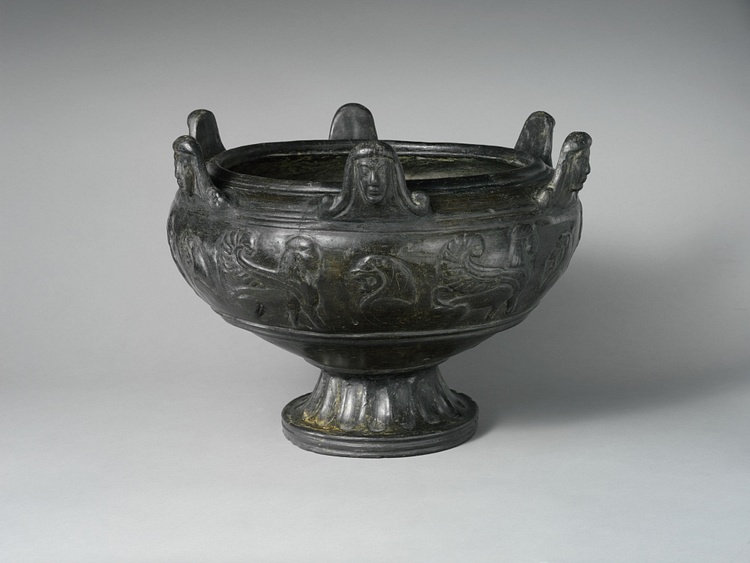 Bucchero Krater Metropolitan Museum of Art, N.Y: (Copyright) ](https://www.worldhistory.org/image/6279/bucchero-krater/ "Bucchero Krater")Another successful Etruscan export was [bucchero](https://www.worldhistory.org/Bucchero/), their own distinctive pottery with a near-black glossy finish. Examples of bucchero have been found along the coastal areas of southern France and northwestern Spain, at [Athens](https://www.worldhistory.org/Athens/), Sparta, and Corinth, on [Corfu](https://www.worldhistory.org/corcyra/) and [Cyprus](https://www.worldhistory.org/cyprus/), at [Carthage](https://www.worldhistory.org/carthage/), in Romania, [Syria](https://www.worldhistory.org/syria/), Libya, and Egypt. That other Etruscan manufactured goods (horse bits, helmets, and shields) were appreciated by foreign cultures is seen in their use as votive offerings at such important 'international' religious sites as [Olympia](https://www.worldhistory.org/Olympia/), [Delphi](https://www.worldhistory.org/delphi/), and [Dodona](https://www.worldhistory.org/Dodona/). In addition, Italian-made fibulae (buckles) have been excavated on [Aegina](https://www.worldhistory.org/Aegina/), [Rhodes](https://www.worldhistory.org/Rhodes/), and [Samos](https://www.worldhistory.org/samos/).
### Competition For Trade
Naturally, the Etruscans did not have everything their own way, and other trading cultures frequently sought to muscle in on their lucrative trade routes. Etruscan cities signed a treaty with Carthage to agree on exclusive areas of operation in 509 BCE, but the pair had to defend their interests against a Greek naval fleet. This they did with success at the [Battle](https://www.worldhistory.org/disambiguation/battle/) of Alalia (aka Battle of the Sardinian Sea) in 540 BCE. In the 5th century BCE, [Syracuse](https://www.worldhistory.org/syracuse/) was the dominant Mediterranean trading power, and the Sicilian [city](https://www.worldhistory.org/city/) combined with Cumae to inflict a naval defeat on the Etruscans at the battle at Cumae in 474 BCE. Worse was to come when the Syracusan tyrant Dionysius I decided to attack the Etruscan coast in 384 BCE and destroy many of the Etruscan ports. By the late 4th century BCE [Rome](https://www.worldhistory.org/Rome/) was beginning to flex its muscles in the region too, and these factors contributed significantly to the loss of trade and the consequent decline of many Etruscan cities seen from the 4th century BCE onwards.
#### Editorial Review
This human-authored article has been reviewed by our editorial team before publication to ensure accuracy, reliability and adherence to academic standards in accordance with our [editorial policy](https://www.worldhistory.org/static/editorial-policy/).
## Bibliography
- Bagnall, R.S. *The Encyclopedia of Ancient History.* Wiley-Blackwell, 2012
- [Haynes, S. *Etruscan Civilization.* J. Paul Getty Museum, 2005.](https://www.worldhistory.org/books/0892366001/)
- [Hornblower, S. *The Oxford Classical Dictionary.* Oxford University Press, 2012.](https://www.worldhistory.org/books/0199545561/)
- [Keller, W. *The Etruscans.* Random House Inc (T), 1974.](https://www.worldhistory.org/books/0394473019/)
- [Spivey, N. & Stoppardt. *Etruscan Italy.* B T Batsford Ltd, 1992.](https://www.worldhistory.org/books/0713465212/)
## About the Author
Mark is WHE’s Publishing Director and has an MA in Political Philosophy (University of York). He is a full-time researcher, writer, historian and editor. Special interests include art, architecture and discovering the ideas that all civilizations share.
## Cite This Work
### APA
Cartwright, M. (2017, February 09). Etruscan Trade. *World History Encyclopedia*.
### Chicago
Cartwright, Mark. "Etruscan Trade." *World History Encyclopedia*, February 09, 2017. .
### MLA
Cartwright, Mark. "Etruscan Trade." *World History Encyclopedia*, 09 Feb 2017, .
## License & Copyright
Submitted by [Mark Cartwright](https://www.worldhistory.org/user/markzcartwright/ "User Page: Mark Cartwright"), published on 09 February 2017. The copyright holder has published this content under the following license: [Creative Commons Attribution-NonCommercial-ShareAlike](https://creativecommons.org/licenses/by-nc-sa/4.0/deed.en). This license lets others remix, tweak, and build upon this content non-commercially, as long as they credit the author and license their new creations under the identical terms. When republishing on the web a hyperlink back to the original content source URL must be included. Please note that content linked from this page may have different licensing terms.