---
title: Etruscan Bronze Mirrors
author: Mark Cartwright
source: https://www.worldhistory.org/article/1009/etruscan-bronze-mirrors/
format: machine-readable-alternate
license: Creative Commons Attribution-NonCommercial-ShareAlike (https://creativecommons.org/licenses/by-nc-sa/4.0/)
updated: 1970-01-01
---
# Etruscan Bronze Mirrors
_Authored by [Mark Cartwright](https://www.worldhistory.org/user/markzcartwright/)_
The [Etruscan civilization](https://www.worldhistory.org/Etruscan_Civilization/) flourished in central [Italy](https://www.worldhistory.org/italy/) between the 8th and 3rd century BCE and produced distinctive art in the form of decorated [pottery](https://www.worldhistory.org/pottery/), figure [sculpture](https://www.worldhistory.org/disambiguation/Sculpture/), [wall](https://www.worldhistory.org/wall/) paintings, and the focus of this article, engraved [bronze](https://www.worldhistory.org/disambiguation/bronze/) mirrors. Perhaps rather unfairly, the [Etruscans](https://www.worldhistory.org/Etruscan_Civilization/) long-held a reputation for effeminacy and as lovers of luxury; a portrait not coincidentally perpetuated by their conquerors the Romans. The high number of [Etruscan](https://www.worldhistory.org/Etruscan_Civilization/)-made bronze mirrors found in their tombs and elsewhere only fuelled this reputation as the ancient [Mediterranean](https://www.worldhistory.org/disambiguation/mediterranean/)'s great narcissists.
[  Etruscan Bronze Mirror Showing Hercules The British Museum (Copyright) ](https://www.worldhistory.org/image/6287/etruscan-bronze-mirror-showing-hercules/ "Etruscan Bronze Mirror Showing Hercules")### Function
Mirrors, known to the Etruscans as *malena* or *malstria*, were first produced in quantity from the end of the 6th century BCE right through to the 2nd century BCE. They were locally made in such Etruscan towns as [Vulci](https://www.worldhistory.org/Vulci/), [Tarquinia](https://www.worldhistory.org/Tarquinia/), [Cerveteri](https://www.worldhistory.org/Cerveteri/) and [Chiusi](https://www.worldhistory.org/Chiusi/), as attested by the large number of finds in those places.
Besides being an object of practical daily use, mirrors were a status symbol for aristocratic Etruscan women and appear on Etruscan [tomb](https://www.worldhistory.org/tomb/) wall paintings often carried by a lady's maidservant. There is evidence, too, that they were used by some men if the fact that they were found in male-only tombs is an indicator. Mirrors were commonly given as part of a bride's dowry, and it is likely that these valuable objects, frequently decorated with great craftsmanship, also acquired a sentimental value. Mirrors have survived in such great numbers (over 3,000) because they were commonly laid with the deceased in Etruscan tombs, perhaps precisely because they were one of the objects the person had used daily throughout their lives. Curiously, many mirrors so placed in tombs have had their reflective surface made useless by the addition of an inscription: *suthina*, meaning 'of the [grave](https://www.worldhistory.org/burial/).'
### Design
Etruscan bronze mirrors, like [Greek](https://www.worldhistory.org/disambiguation/greek/) ones, were designed to be held in the hand using a single handle. The reflective side of mirrors was made by highly polishing or silvering the surface. From the 3rd century BCE more tin was used in the bronze alloy, which meant that the reflective surface gave a clearer image and was less prone to scratching and corrosion. Some mirrors from the 4th century BCE onwards were protected by a concave cover attached by a single hinge. The inside of the lid was often polished to reflect extra light onto the face of the user while the outside carried cut-out reliefs filled with a lead backing. A third type of mirror has the round reflective surface set into the lid of a wooden box.
[ 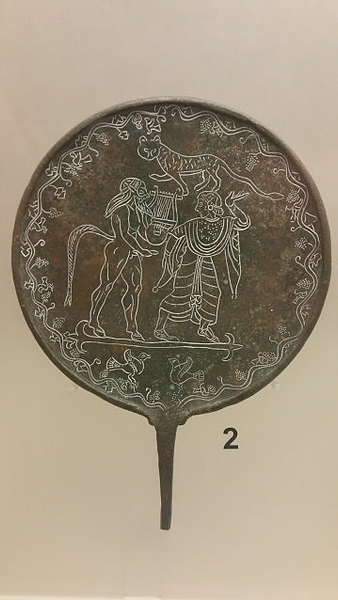 Etruscan Bronze Mirror with Nymph & Silenus Jan van der Crabben (CC BY-NC-SA) ](https://www.worldhistory.org/image/6285/etruscan-bronze-mirror-with-nymph--silenus/ "Etruscan Bronze Mirror with Nymph & Silenus")The flat reverse side of bronze mirrors, if not left plain (half the surviving examples are so), was an ideal canvas for engraved decoration, inscription, or even carved shallow relief. The latter decoration technique is even more rarely inlaid with [silver](https://www.worldhistory.org/Silver/), as in an example now in the British Museum, London.
Handles were formed by casting the mirror with a [tang](https://www.worldhistory.org/Tang_Dynasty/) at the bottom. This could then be inserted into a handle made from wood, bone, or ivory, but few such perishable pieces have survived intact. Some handles were painted or had carved relief scenes. Another type of mirror was produced from the 4th century BCE which had the handle cast along with the body. Many of this latter type have a bronze ram or hind's head decorating the end of the handle.
### Decoration
The main purpose of Etruscan mirror decoration would seem to be just that, decoration. However, these valuable objects might also have become symbolic transfers of wealth and family ties, for example, when the bride and groom were from different clans. In the latter case, the decoration may have represented, either directly or metaphorically, the union of the heritage of two families. Scenes and the people in them are often helpfully identified by accompanying inscriptions around the mirror edge, and these sometimes even describe the owner, for example, 'I am the mirror of Larthi Puruhena' (*Mi malena larthia puruhenas*) or even the giver, 'Tite Cale to his mother gave this mirror as a gift' (*tite cale:atial:turce malstria:cver*). Around 300 mirrors have names inscribed on them, most being female, and so they are an important indicator of literacy amongst Etruscan women.
[ 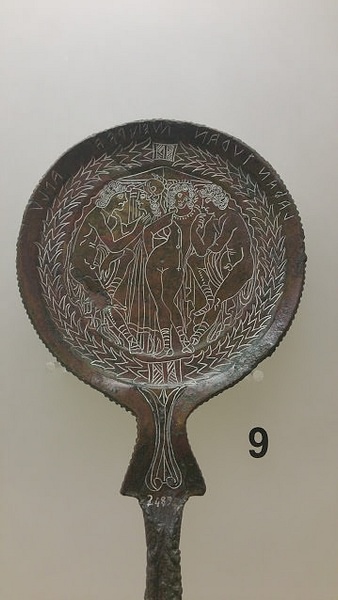 Etruscan Bronze Mirror Jan van der Crabben (CC BY-NC-SA) ](https://www.worldhistory.org/image/6286/etruscan-bronze-mirror/ "Etruscan Bronze Mirror")Some mirrors have scenes of wedding preparations, couples embracing or a lady in the process of dressing, but the most common subject for mirror decoration was [mythology](https://www.worldhistory.org/mythology/). Here mirrors illustrate the great influence of [Greek culture](https://www.worldhistory.org/disambiguation/Greek_Culture/) on the Etruscans as the myths are, invariably, of Greek origin, even if they are sometimes given an Etruscan twist. Scenes are often framed by a border of twisted ivy, vine, myrtle, or laurel leaves.
Perhaps not surprisingly, myths which involved a degree of vanity or gods renowned for their physical beauty are particularly popular subjects. Thus we see scenes of [Paris](https://www.worldhistory.org/disambiguation/paris/) deciding which of the three goddesses are the most beautiful and plumbing for [Aphrodite](https://www.worldhistory.org/Aphrodite/) (for the Etruscans: Turan) ahead of [Athena](https://www.worldhistory.org/athena/) and [Hera](https://www.worldhistory.org/Hera/). Aphrodite, the goddess of love and beauty being attended to and beautified by her entourage is another common subject. The impossibly handsome [Adonis](https://www.worldhistory.org/Adonis/) (Atune) and favourite of Aphrodite, [Zeus](https://www.worldhistory.org/zeus/) carrying off the attractive youth [Ganymede](https://www.worldhistory.org/Ganymede/) (Catamite), [Eos](https://www.worldhistory.org/Eos/) – the winged Dawn known for her love of handsome hunters, and that most famous earthly beauty of all – [Helen of Troy](https://www.worldhistory.org/Helen_of_Troy/), are all personas bound to inspire those who managed to pull themselves from the mirror's reflective side.
#### Editorial Review
This human-authored article has been reviewed by our editorial team before publication to ensure accuracy, reliability and adherence to academic standards in accordance with our [editorial policy](https://www.worldhistory.org/static/editorial-policy/).
## Bibliography
- [Haynes, S. *Etruscan Civilization.* J. Paul Getty Museum, 2005.](https://www.worldhistory.org/books/0892366001/)
- [Keller, W. *The Etruscans.* Random House Inc (T), 1974.](https://www.worldhistory.org/books/0394473019/)
- [Simon Hornblower. *The Oxford Classical Dictionary.* Oxford University Press, 2012.](https://www.worldhistory.org/books/0199545561/)
- [Simon, E. *The Religion of the Etruscans.* University of Texas Press, 2006.](https://www.worldhistory.org/books/0292721463/)
- [Spivey, N.J. *Etruscan Art.* Thames & Hudson, 1997.](https://www.worldhistory.org/books/0500203040/)
## About the Author
Mark is WHE’s Publishing Director and has an MA in Political Philosophy (University of York). He is a full-time researcher, writer, historian and editor. Special interests include art, architecture and discovering the ideas that all civilizations share.
## Cite This Work
### APA
Cartwright, M. (2017, January 24). Etruscan Bronze Mirrors. *World History Encyclopedia*.
### Chicago
Cartwright, Mark. "Etruscan Bronze Mirrors." *World History Encyclopedia*, January 24, 2017. .
### MLA
Cartwright, Mark. "Etruscan Bronze Mirrors." *World History Encyclopedia*, 24 Jan 2017, .
## License & Copyright
Submitted by [Mark Cartwright](https://www.worldhistory.org/user/markzcartwright/ "User Page: Mark Cartwright"), published on 24 January 2017. The copyright holder has published this content under the following license: [Creative Commons Attribution-NonCommercial-ShareAlike](https://creativecommons.org/licenses/by-nc-sa/4.0/deed.en). This license lets others remix, tweak, and build upon this content non-commercially, as long as they credit the author and license their new creations under the identical terms. When republishing on the web a hyperlink back to the original content source URL must be included. Please note that content linked from this page may have different licensing terms.