---
title: Ancient Armenia
author: Mark Cartwright
source: https://www.worldhistory.org/armenia/
format: machine-readable-alternate
license: Creative Commons Attribution-NonCommercial-ShareAlike (https://creativecommons.org/licenses/by-nc-sa/4.0/)
updated: 1970-01-01
---
# Ancient Armenia
_Authored by [Mark Cartwright](https://www.worldhistory.org/user/markzcartwright/)_
Ancient Armenia, located in the south Caucasus area of Eurasia, was settled in the [Neolithic](https://www.worldhistory.org/Neolithic/) era but its first recorded state proper was the kingdom of [Urartu](https://www.worldhistory.org/Urartu_Civilization/) from the 9th century BCE. Incorporated into the [Persian Empire](https://www.worldhistory.org/disambiguation/Persian_Empire/) of [Cyrus the Great](https://www.worldhistory.org/Cyrus_the_Great/) in the 6th century BCE, the [Orontid dynasty](https://www.worldhistory.org/Orontid_Dynasty/) ruled as Persian satraps, a function they performed for their next overlords the Macedonians and [Seleucid Empire](https://www.worldhistory.org/Seleucid_Empire/) into the 3rd century BCE. Under the Artaxiad and Arsacid dynasties the country flourished but was often caught between the ambitions of [Parthia](https://www.worldhistory.org/disambiguation/Parthia/) and [Rome](https://www.worldhistory.org/Rome/), and then the [Sasanian](https://www.worldhistory.org/Sasanian_Empire/) and [Byzantine](https://www.worldhistory.org/disambiguation/Byzantine/) Empires. The boundaries of the state varied considerably over the centuries but such common factors as [religion](https://www.worldhistory.org/religion/) and language were united by long-lasting dynastic clans, which gave Armenia its own unique identity throughout antiquity.
### [Hayasa-Azzi](https://www.worldhistory.org/Hayasa-Azzi/) (1500-1200 BCE)
The first identifiable [culture](https://www.worldhistory.org/disambiguation/culture/) in the region is the Hayasa-Azzi, an indigenous tribal confederation which flourished on the fertile plateau of ancient Armenia around [Mount Ararat](https://www.worldhistory.org/Mount_Ararat/) and parts of modern-day eastern [Turkey](https://www.worldhistory.org/Asia_Minor/) between c. 1500 and c. 1200 BCE. The Hayasa-Azzi are the eponym of the Hay people, the term Armenians use to describe themselves and their state, Hayastan. Over time, the Hayasa-Azzi mixed with other ethnic groups and local tribes such as the [Hurrians](https://www.worldhistory.org/Hurrians/), Arme-Shupria, and Nairi, probably motivated by the need for defence against more aggressive and powerful neighbours like the [Hittites](https://www.worldhistory.org/hittite/) and the Assyrians. They were probably infiltrated by the Thraco-Phrygians following the collapse of the [Hittite](https://www.worldhistory.org/hittite/) [Empire](https://www.worldhistory.org/empire/) c. 1200 BCE. Eventually, these various peoples and kingdoms would be fused into the region's first recognisable and recorded state, the kingdom of Urartu from the 9th century BCE.
### Urartu (9th century BCE - c. 590 BCE)
**Names**
Urartu, also known as the Kingdom of Van after the lake in the region of the same name, developed as a federation of older and smaller kingdoms across Armenia, eastern Turkey, and northwestern Iran. 'Urartu' comes from *urashtu*, the Assyrian word for the kingdom, and signifies “high place”, possibly referring to either the mountainous region or the culture's common practice of building fortifications on rock promontories. The Urartians called themselves the Biaina.
**Geography & Expansion**
Urartu prospered thanks to settlement on the extensive fertile plateau which was well-supplied by rivers. Viticulture was important, wine-making in the region perhaps being the earliest anywhere. [Animal husbandry](https://www.worldhistory.org/Animal_Husbandry/) prospered thanks to excellent mountain pastures, and horses, especially, were bred with success. Mineral deposits in the area included [gold](https://www.worldhistory.org/gold/), [silver](https://www.worldhistory.org/Silver/), [copper](https://www.worldhistory.org/copper/), lead, iron, and tin and were all used to produce highly skilled metalwork, especially [bronze](https://www.worldhistory.org/disambiguation/bronze/) cauldrons. The location on the [trade](https://www.worldhistory.org/disambiguation/trade/) routes between the ancient [Mediterranean](https://www.worldhistory.org/disambiguation/mediterranean/) and Asian and Anatolian cultures was another source of prosperity.
[  Urartu 714-715 BCE Sémhur (CC BY-SA) ](https://www.worldhistory.org/image/2744/urartu-714-715-bce/ "Urartu 714-715 BCE")The fortress capital was [Tushpa](https://www.worldhistory.org/Tushpa/) (later called Van), built on a limestone promontory on the eastern shores of Lake Van in the highlands. Regional governors represented the king and channelled taxes back to the capital. In 776 BCE, Argishti I (r. c. 785-760 BCE) founded a new [city](https://www.worldhistory.org/city/), Argishtihinili, on the Plain of Ararat, later to become the second city of the kingdom and renamed Armavir. Then, c. 685 BCE, king Rusa II (r. c. 685-645 BCE) founded the important northern city of [Teishebaini](https://www.worldhistory.org/Teishebaini/) (modern Yerevan), also on the Ararat plain. An important fortress site with substantial remains today is [Erebuni](https://www.worldhistory.org/Erebuni/) near today's capital of Armenia, Yerevan.
The [pantheon](https://www.worldhistory.org/Pantheon/) of the [Urartu religion](https://www.worldhistory.org/Urartu_Religion/) contains a mix of unique and Hurrian gods such as the [god](https://www.worldhistory.org/God/) of storms and thunder Teisheba, from the Hurrian Teshub. The mid-9th-century BCE king Ishpuini promoted Haldi (Khaldi) to the head of the gods, a deity of foreign origin and associated with [warfare](https://www.worldhistory.org/warfare/). So important was this god that the Urartians were sometimes called the Haldians or “children of Haldi”. The various gods were offered libations and animal sacrifices as well as dedications of weapons and precious goods.
Early Urartu [writing](https://www.worldhistory.org/writing/) used simple pictograms, but [cuneiform](https://www.worldhistory.org/cuneiform/) was adopted and adapted from neighbouring contemporary Mesopotamian cultures. Surviving cuneiform inscriptions from the kingdom show that the Urartian language was related to Hurrian.
[ 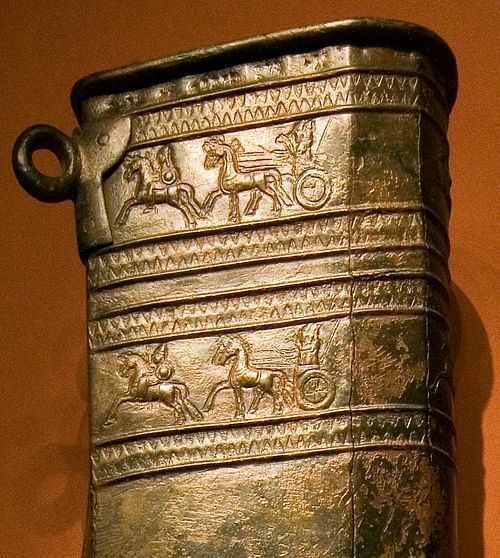 Urartu Decorated Quiver EvgenyGenkin (CC BY-SA) ](https://www.worldhistory.org/image/8076/urartu-decorated-quiver/ "Urartu Decorated Quiver")By the 7th century BCE, Urartu controlled a territory which stretched from the Caspian Sea to the Upper Euphrates (east to west) and the Caucasus mountains in the north to the Taurus Range in the south. The chief adversary of Urartu was the [Neo-Assyrian Empire](https://www.worldhistory.org/Neo-Assyrian_Empire/), although there is also evidence of trade relations between the two states. The Assyrian ruler [Tiglath-Pileser III](https://www.worldhistory.org/Tiglath_Pileser_III/) (r. 745-727 BCE) was especially aggressive, and he laid siege to Tushpa. Another significant conflict between the two states was during the campaign of [Sargon II](https://www.worldhistory.org/Sargon_II/) (722-705 BCE) in 714 BCE.
**Decline**
The Urartu kingdom came to a violent end when sometime between c. 640 and c. 590 BCE its [cities](https://www.worldhistory.org/city/) were destroyed. Weakened by decades of battles with the Assyrians, it may have been too overstretched to control its own empire. The perpetrators are not known, but the [Scythians](https://www.worldhistory.org/Scythians/) are one candidate, the Cimmerians another, and even possibly forces from within the territories administered by the Urartu kings. The kingdom was taken over by the [Medes](https://www.worldhistory.org/Medes/) from c. 585 BCE onwards and then incorporated into the [Achaemenian Empire](https://www.worldhistory.org/Achaemenid_Empire/) of [Cyrus](https://www.worldhistory.org/disambiguation/Cyrus/) the Great in the mid-6th century BCE.
### Orontid Dynasty (c. 570 - c. 200 BCE)
**Persian Satraps**
The Orontid dynasty succeeded the Kingdom of Urartu in ancient Armenia and ruled from the 6th to 3rd century BCE. The founder of the royal dynasty of the Orontids was Orontes (Yervand) Sakavakyats (c. 570-560 BCE, although reign dates for most of the Orontids are disputed). Initially, the Orontids ruled as Persian satraps as the Achaemenians divided their new territory into two parts, and it was in the eastern province that the Orontid dynasty, known locally as the Yervand (from the Iranian word *arvand*, meaning “mighty”), ruled as satraps on behalf of their Persian overlords. Thus, [Persian culture](https://www.worldhistory.org/disambiguation/Persian_Culture/), language and political practices were introduced into ancient Armenia which still maintained its own Urartian traditions, too.
The first known mention of the Persian client state of Armena or Armenia is recorded in a c. 520 BCE inscription of [Darius](https://www.worldhistory.org/disambiguation/darius/) I (r. 522-486 BCE) on a rock face in Behistun, [Persia](https://www.worldhistory.org/Persia/), which lists the king's royal possessions in Old Persian. The old Urartian capital of Van was also the first capital of the Orontids. An attempt to secede from the Persian Empire in 522 BCE was short-lived, Armenia being too valuable a source of soldiers and tribute, especially horses. Life under Persian rule seems to have been at least tolerable and Armenian culture left to largely follow its own path. By the mid-4th century BCE, the two divided regions under Persian control had been politically merged, their populations had mixed, and the language had become one: Armenian.
[ 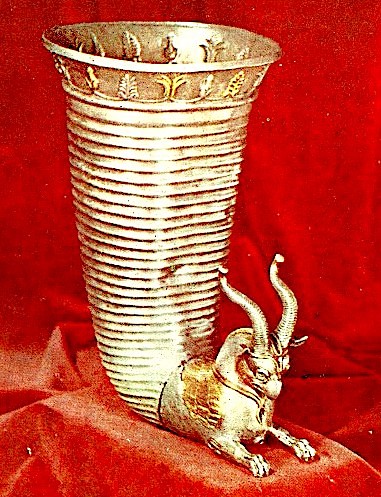 Silver Orontid Rhyton Aryamahasattva (CC BY-SA) ](https://www.worldhistory.org/image/8089/silver-orontid-rhyton/ "Silver Orontid Rhyton")**Macedonian Empire**
Following the rise of [Alexander the Great](https://www.worldhistory.org/Alexander_the_Great/), Armenia was formally annexed by [Macedon](https://www.worldhistory.org/macedon/), and in 330 BCE Armavir was made the capital (the former Urartian city of Argishtihinili). It seems likely that the political rule of Armenia remained much as under the Persians, though, with the Orontids ruling as semi-independent kings within the now vast Macedonian Empire. Indeed, even the Armenian rulers struggled to control the powerful local lords, known as *nakharars* and forming a hereditary nobility, such was the “feudal” nature of the region at this time.
**[Seleucid](https://www.worldhistory.org/Seleucid_Empire/) Empire**
From 321 BCE the Seleucids governed the Asian portion of [Alexander](https://www.worldhistory.org/disambiguation/Alexander/)'s empire after the young leader's [death](https://www.worldhistory.org/disambiguation/Death/), leading to a certain Hellenization, which created a rich cultural mix of Armenian, Persian, and Greek elements. Such was the size of the Seleucid Empire that the Orontid rulers were, again, largely left to enjoy a good deal of autonomy in what was now a region with three distinct areas: Lesser Armenia (to the northwest, near the Black Sea), Greater Armenia (the traditional heartland of the Armenian people) and Sophene (aka Dsopk, in the southwest). The Orontid kings' independence is illustrated by the minting of their own [coinage](https://www.worldhistory.org/coinage/).
**Antiochus III & Decline**
Around 260 BCE the newly unified kingdom of [Commagene](https://www.worldhistory.org/Commagene/) and Sophene arose in western Armenia, governed by Sames (aka [Samos](https://www.worldhistory.org/samos/)), a ruler of Orontid descent. It was Sames (r. c. 260-240 BCE) who founded the important city of Samosata (Shamshat). The period also saw the resurgence of the Persians and the growth of the [Parthian Empire](https://www.worldhistory.org/Parthia_(Empire)/) (247 BCE - 224 CE), who now claimed sovereignty over Armenia. However, the Seleucid king Antiochus III (r. 222-187 BCE) reasserted control over Armenia and notably extracted 300 talents of silver and 1,000 horses for his armies as they passed through the region on their way to suppress the Parthians.
The last of the Orontid dynasty to rule in eastern Armenia was King Orontes IV (aka Yervand the Last, r. c. 212-200 BCE). Yervand moved the capital from Armavir to the newly founded Yervandashat. His successor, following the king's murder, was the founder of the next dynasty to dominate Armenia in the coming centuries, King Artaxias I (Artashes) who was backed and made a direct [satrap](https://www.worldhistory.org/Persian_Governor/) by Antiochus III, probably in a move to reduce the trend of Armenian independence in recent decades.
### [Artaxiad Dynasty](https://www.worldhistory.org/Artaxiad_Dynasty/) (c. 200 BCE - 12 CE)
**Artaxias I**
Antiochus III did not just change the ruling house of Armenia, he created two satraps: Artaxias I (r. c. 200 - c. 160 BCE) in Armenia and Zariadris in the smaller kingdom of Sophene to the southwest. When Antiochus was defeated by the Romans at the [Battle](https://www.worldhistory.org/disambiguation/battle/) of Magnesia in 190 BCE, Artaxias declared himself king and set about expanding his kingdom, which he consolidated via an administrative centralisation and such innovations as boundary stelae to proclaim property rights and the authority of the crown. A new capital was founded at Artaxata ([Artashat](https://www.worldhistory.org/Artashat/)) in 176 BCE. [Hannibal](https://www.worldhistory.org/hannibal/), the great Carthaginian general, was said to have designed the city's fortifications when he served Artaxias following his defeat to the Romans.
When Artaxias I died, he was succeeded by his sons and the Artaxiad dynasty (aka Artashesian dynasty) was established. Armenia then enjoyed a sustained period of prosperity and regional importance but it would also be perpetually squeezed between the region's two superpowers: Parthia and Rome. Both would take turns in putting forward their own candidate to rule Armenia, which became a buffer zone between the two empires.
[  Empire of Tigranes the Great www.armenica.org (CC BY-SA) ](https://www.worldhistory.org/image/8167/empire-of-tigranes-the-great/ "Empire of Tigranes the Great")**[Tigranes the Great](https://www.worldhistory.org/Tigranes_the_Great/)**
One of the greatest of Artaxiad kings, or indeed any Armenian king, was [Tigranes II](https://www.worldhistory.org/Tigranes_the_Great/) (Tigran II) or Tigranes the Great (r. c. 95 - c. 56 BCE). He expanded the Armenian kingdom considerably; first, he annexed the kingdom of Sophene in 94 BCE. Then, with formidable siege engines and units of heavily-armoured cavalry, he conquered Cappadocia, Adiabene, Gordyene, [Phoenicia](https://www.worldhistory.org/phoenicia/), and parts of [Syria](https://www.worldhistory.org/syria/), including [Antioch](https://www.worldhistory.org/Antiochia/). The Armenian king even sacked Ecbatana, the Parthian royal summer residence, in 87 BCE while the Parthians were struggling to deal with invading northern nomads. At its peak, Tigranes the Great's Armenian Empire stretched from the Black Sea to the Mediterranean. Not before or since would Armenians control such a huge swathe of Asia.
Tigranes called himself the "king of kings" from 85 BCE, and he founded a new capital city in 83 BCE, [Tigranocerta](https://www.worldhistory.org/Tigranocerta/) (aka Tigranakert, and of uncertain location) which was famously [Hellenistic](https://www.worldhistory.org/Hellenic_World/) in its [architecture](https://www.worldhistory.org/disambiguation/architecture/). The Greek language was likely used, along with Persian and Aramaic, as the language of the nobility and administration while commoners spoke Armenian. Persian elements continued to be an important part of the Armenian cultural mix, too, especially in the area of religion.
**Roman-Parthian Wars & Decline**
Tigranes allied himself with [Mithridates VI](https://www.worldhistory.org/Mithridates_VI/), the king of Pontus (r. 120-63 BCE) whose daughter he married. The [Roman Republic](https://www.worldhistory.org/Roman_Republic/), seeing the danger of such an alliance between the two regional powers, responded by attacking Pontus, and when Mithridates fled to the court of Tigranes in 70 BCE, the Romans invaded Armenia. Tigranocerta was captured in 69 BCE, and the Armenian king was forced to abandon his conquests. Following another Roman attack c. 66 BCE, this time led by [Pompey](https://www.worldhistory.org/pompey/) the Great, Armenia was made into a Roman protectorate. The Artaxiads continued to rule but were obliged to involve themselves in the Roman-Parthian wars, providing troops for both [Marcus Licinius Crassus](https://www.worldhistory.org/Marcus_Licinius_Crassus/) in 53 BCE and [Mark Antony](https://www.worldhistory.org/Mark_Antony/) in 36 BCE. The latter general, dissatisfied with Armenian support, attacked the kingdom in 34 BCE and took the king, Artavasdes II (r. c. 56-34 BCE), to [Alexandria](https://www.worldhistory.org/alexandria/) where he would later be executed by Queen [Cleopatra](https://www.worldhistory.org/disambiguation/cleopatra/). A game of musical thrones then followed with first a Roman-backed king in Armenia, and then a Parthian-backed candidate until a new family took over the throne in 12 CE, the Arsacid (Arshakuni) dynasty.
### Arsacid Dynasty (12 CE - 428 CE)
**Tiridates I**
The founder of the Arsacid dynasty was Vonon (Vonones), but as he was succeeded by several short-ruling kings, some historians consider the founder proper of the dynasty to be [Tiridates I of Armenia](https://www.worldhistory.org/Tiridates_I_of_Armenia/) (r. 63 - 75 or 88 CE). He was the brother of the Parthian king Vologases I (r. c. 51-78 CE) who invaded Armenia in 52 CE for the specific purpose of setting Tiridates on the throne. The Romans were not content to let Parthia into their buffer zone, and in 54 CE, Emperor [Nero](https://www.worldhistory.org/Nero/) (r. 54-68 CE) sent an army under his best general Gnaeus Domitius Corbulo. A decade of intermittent warfare, which saw such important Armenian cites as Artaxata and Tigranocerta captured, ended in the 63 CE Treaty of Rhandia. It was now agreed that Parthia had the right to nominate Armenian kings but Rome the right to crown them. Nero was thus given the privilege of crowning Tiridates in Rome in a lavish spectacle.
[  Ruins of Roman Baths at Garni Temple James Blake Wiener (CC BY-NC-SA) ](https://www.worldhistory.org/image/7665/ruins-of-roman-baths-at-garni-temple/ "Ruins of Roman Baths at Garni Temple")**Roman Interventions**
[Vespasian](https://www.worldhistory.org/Vespasian/) (r. 69-79 CE) made sure that no more territories would fall to the Parthian ruling dynasty by annexing the neighbouring kingdoms of Commagene and Lesser Armenia in 72 CE. A period of peace then followed until Emperor [Trajan](https://www.worldhistory.org/trajan/) (r. 98-117 CE), using the excuse of not being consulted on a change in monarch, grabbed the moment and annexed Armenia for Rome. He then declared [war](https://www.worldhistory.org/disambiguation/War/) on Parthia in 114 CE. Ultimately, Armenia was made a province of the [Roman Empire](https://www.worldhistory.org/Roman_Empire/) and administered alongside Cappadocia.
Emperor [Hadrian](https://www.worldhistory.org/hadrian/) (r. 117-138 CE) was much less enthusiastic about keeping the bothersome province, and he allowed it to become independent. Various Parthian and Roman incursions occurred over the next century but Artaxata, at least, prospered after it was made one of the official trading points between the two empires.
**[Sasanian Empire](https://www.worldhistory.org/Sasanian_Empire/)**
Following the rise of the [Sasanid](https://www.worldhistory.org/Sasanian_Empire/) dynasty from 224 CE, there was a more aggressive Persian foreign policy towards Armenia which culminated in a full-scale invasion by the Sasanids in 252 CE. The Armenian Arsacid kings, with such close blood ties to the vanquished Arsacids in Persia, posed a threat of legitimacy to the new Sasanid order. The Sasanids won several major victories against Rome in this period, but the Romans were resurgent in the 4th century CE. When the dust finally settled again the kingdom of Armenia found itself divided up between Rome and Persia, with the Arsacids continuing to rule only western Armenia. In 298 CE, under the auspices of [Diocletian](https://www.worldhistory.org/Diocletian/) (r. 284-305 CE), Armenia was unified with Tiridates IV (Trdat III or IV) as king (r. c. 298 - c. 330 CE) - one of the great rulers of the Arsacid dynasty.
[ 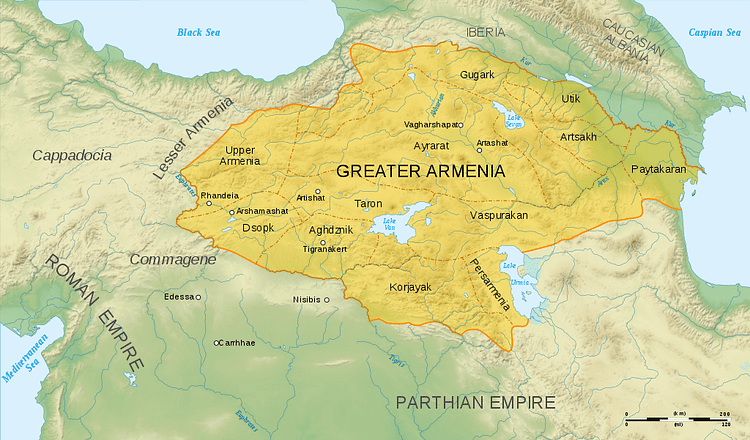 Arsacid Armenia Sémhur (CC BY-SA) ](https://www.worldhistory.org/image/8170/arsacid-armenia/ "Arsacid Armenia")**Tiridates the Great & [Christianity](https://www.worldhistory.org/christianity/)**
Tiridates the Great set about centralising his kingdom and reorganising the provinces and their governors. Land surveys were also carried out to better identify tax obligations; the king was determined to make Armenia great once again. By far the most lasting event of this period was Armenian's official adoption of Christianity c. 314 CE, if not earlier. Tradition records that Tiridates himself was converted in 301 CE by [Saint Gregory the Illuminator](https://www.worldhistory.org/Saint_Gregory_the_Illuminator/). One consequence of the move was that the persecution of the religion by Persia helped to create a more fiercely independent state. Saint Gregory, then known as Grigor Lusavorich, was made the first bishop of Armenia in 314 CE. Tiridates IV may also have adopted Christianity for internal political reasons - the end of the pagan religion was a fine excuse to confiscate the old [temple](https://www.worldhistory.org/temple/) treasuries and a monotheistic religion with the monarch as God's representative on earth might well instil greater loyalties from his nobles, the *nakharars*, and people in general.
**Division & Decline**
There was a greater threat from outside Armenia though, as the Sasanids again became more ambitious to rule directly over Armenia and made attacks on Armenian cities. It was then that emperor Theodosius I (r. 379-395 CE) and Shapur III (r. 383-388 CE) agreed to formally divide Armenia between the Eastern Roman (Byzantine) Empire and Sasanid Persia.
In 405 CE the Armenian [alphabet](https://www.worldhistory.org/alphabet/) was invented by [Mesrop Mashtots](https://www.worldhistory.org/Mesrop_Mashtots/) and the [Bible](https://www.worldhistory.org/bible/) translated into that language, helping to further spread and entrench Christianity in Armenia. Politically, though, it was time for a change. The last Arsacid ruler was Artashes IV (r. 422-428 CE) after the Armenian crown, unable to repress the pro-Persian and anti-Christian factions at court, was abolished by Persia and viceroy rulers, the *marzpans*, were installed.
### [Mamikonian Dynasty](https://www.worldhistory.org/Mamikonian_Dynasty/) (428-652 CE)
**The Mamikonains**
The last great dynasty to rule ancient Armenia was the Mamikonians who had been a powerful force in the Armenian military ever since the 1st century BCE. By the end of the 4th century CE the hereditary office of grand marshal (*sparapet*), who led the armed forces of Armenia, usually had a Mamikonian lord in the position. Amongst the other noble families the Mamikonians had been only second in importance to the Arsacid royal family itself, indeed two members had even served as regents: Mushegh and Manuel Mamikonian. Once the ruling house of Arsacid fell, the Mamikonians were left to dominate state affairs within the limitations imposed by their Persian overlords.
[  Armenia's Smbataberd Fortress James Blake Wiener (CC BY-NC-SA) ](https://www.worldhistory.org/image/7667/armenias-smbataberd-fortress/ "Armenia's Smbataberd Fortress")**Persia & Avarayr**
Persia installed *marzpan* rulers in their half of the country (Persarmenia) from 428 CE. Representing the Sasanian king, the *marzpans* had full civilian and military authority. There had been rumblings of discontent amongst the Armenian nobility and clergy following Persian cultural imperialism, but matters really came to a head with the succession of the Persian king Yazdgird (Yazdagerd) II in c. 439 CE. Sasanid rulers had long been suspicious that Armenian Christians were all simply spies of [Byzantium](https://www.worldhistory.org/Byzantium/), but Yazdgird was a zealous proponent of [Zoroastrianism](https://www.worldhistory.org/zoroastrianism/) and the double-edged sword of political and religious policy was about to cut Armenia down to size.
In May or June 451 CE at the Battle of Avarayr (Avarair) in modern Iran, the Armenians rebelled against oppression and faced a massive Persian army. The 6,000 or so Armenians were led by Vardan Mamikonian, but unfortunately for them, help from the Christian [Byzantine Empire](https://www.worldhistory.org/Byzantine_Empire/) was not forthcoming despite an embassy sent for that purpose. Perhaps not unexpectedly, the Persian-backed *marzpan*, Vasak Siuni, was nowhere to be seen in the battle either. The Persians, greatly outnumbering their opponents and fielding an elite corps of “Immortals” and a host of war elephants, won the battle easily enough and massacred their opponents; 'martyred' would be the term used by the Armenian Church, thereafter. Indeed, the battle became a symbol of resistance with Vardan, who died on the battlefield, even being made a saint.
Minor rebellions continued over the next few decades, and the Mamikonians continued a policy of careful resistance. The strategy paid off, for in 484 CE the Treaty of Nvarsak was signed between the two states, which granted Armenia a greater political autonomy and freedom of religious thought. In a full turnaround, Vahan, the nephew of Vardan, was made the *marzpan* in 485 CE. Peace brought prosperity and trade flourished as Artashat became an important trading point between the Byzantine and Persian Empires. Armenia was finding its feet as a unified nation, helped by language, the Christian faith, and such figures as [Movses Khorenatsi](https://www.worldhistory.org/Movses_Khorenatsi/) ([Moses](https://www.worldhistory.org/Moses/) of Khoren) who wrote his *History of the Armenians*, the first comprehensive history of the country in the late 5th century CE.
**The Arab Caliphates**
Armenia's geographical position would, yet again, cause its downfall. By the end of the 6th century CE, Persia and the Byzantine Empire created yet another division which saw Byzantium acquire two-thirds of Armenia. Worse was soon to come, though, following the dramatic rise of a new power in the region, the Arab Rashudin [Caliphate](https://www.worldhistory.org/Islamic_Caliphates/), which conquered the Sasanid capital [Ctesiphon](https://www.worldhistory.org/ctesiphon/) in 637 CE and Armenia between 640 to 650 CE. The country was formally annexed as a province of the [Umayyad Caliphate](https://www.worldhistory.org/Umayyad_Dynasty/) in 701 CE.
This article was made possible with generous support from the [National Association for Armenian Studies and Research](https://naasr.org/?utm_source=ancient.eu&utm_medium=link&utm_campaign=ancient.eu) and the Knights of Vartan Fund for Armenian Studies.
#### Editorial Review
This human-authored definition has been reviewed by our editorial team before publication to ensure accuracy, reliability and adherence to academic standards in accordance with our [editorial policy](https://www.worldhistory.org/static/editorial-policy/).
## About the Author
Mark is WHE’s Publishing Director and has an MA in Political Philosophy (University of York). He is a full-time researcher, writer, historian and editor. Special interests include art, architecture and discovering the ideas that all civilizations share.
## Timeline
- **3500 BCE - 2200 BCE**: Occupation of Shnagavit in ancient [Armenia](https://www.worldhistory.org/armenia/).
- **c. 3500 BCE - c. 1000 BCE**: The Hurrian [culture](https://www.worldhistory.org/disambiguation/culture/) flourishes in the [Near East](https://www.worldhistory.org/Near_East/).
- **c. 1500 BCE - c. 1200 BCE**: The [Hayasa-Azzi](https://www.worldhistory.org/Hayasa-Azzi/) confederation flourishes in ancient [Turkey](https://www.worldhistory.org/Asia_Minor/) and [Armenia](https://www.worldhistory.org/armenia/).
- **c. 1320 BCE**: The [Hittite](https://www.worldhistory.org/hittite/) king Musili II attacks the [Hayasa-Azzi](https://www.worldhistory.org/Hayasa-Azzi/) confederation.
- **c. 900 BCE - c. 590 BCE**: The [Urartu civilization](https://www.worldhistory.org/Urartu_Civilization/) flourishes in ancient [Armenia](https://www.worldhistory.org/armenia/), eastern [Turkey](https://www.worldhistory.org/Asia_Minor/) and western Iran.
- **c. 782 BCE**: The fortress of [Erebuni](https://www.worldhistory.org/Erebuni/) is constructed in ancient [Armenia](https://www.worldhistory.org/armenia/).
- **585 BCE**: The [Erebuni](https://www.worldhistory.org/Erebuni/) fortress in ancient [Armenia](https://www.worldhistory.org/armenia/) is occupied by the [Median Empire](https://www.worldhistory.org/Medes/).
- **c. 570 BCE - c. 560 BCE**: Orontes (Yervand) Sakavakyats reigns in [Armenia](https://www.worldhistory.org/armenia/), founder of the [Orontid dynasty](https://www.worldhistory.org/Orontid_Dynasty/).
- **c. 570 BCE - c. 200 BCE**: The [Orontid dynasty](https://www.worldhistory.org/Orontid_Dynasty/) rules in ancient [Armenia](https://www.worldhistory.org/armenia/).
- **522 BCE**: The Persian satrapy of [Armenia](https://www.worldhistory.org/armenia/) briefly cedes from the [Achaemenid Empire](https://www.worldhistory.org/Achaemenid_Empire/) but is brought under control by [Darius I](https://www.worldhistory.org/Darius_I/).
- **333 BCE**: The Armenian [Orontid dynasty](https://www.worldhistory.org/Orontid_Dynasty/) provides troops for the Persian cause at the [Battle of Issus](https://www.worldhistory.org/Battle_of_Issus/).
- **331 BCE**: The Armenian [Orontid dynasty](https://www.worldhistory.org/Orontid_Dynasty/) provides troops for the Persian cause at the [Battle of Gaugamela](https://www.worldhistory.org/Battle_of_Gaugamela/).
- **330 BCE**: Armavir is made the capital of [Armenia](https://www.worldhistory.org/armenia/), a state under control of the Macedonian [Empire](https://www.worldhistory.org/empire/).
- **c. 260 BCE**: The unified kingdom of [Commagene](https://www.worldhistory.org/Commagene/) and Sophene rises in western [Armenia](https://www.worldhistory.org/armenia/).
- **c. 212 BCE - c. 200 BCE**: Reign of king Orontes IV (aka Yervand IV), last ruler of the [Orontid dynasty](https://www.worldhistory.org/Orontid_Dynasty/).
- **c. 200 BCE - c. 160 BCE**: Reign of Artaxias I, founder of the [Artaxiad dynasty](https://www.worldhistory.org/Artaxiad_Dynasty/) in [Armenia](https://www.worldhistory.org/armenia/).
- **c. 200 BCE - c. 14 CE**: The [Artaxiad dynasty](https://www.worldhistory.org/Artaxiad_Dynasty/) rules in [Armenia](https://www.worldhistory.org/armenia/).
- **c. 188 BCE**: Artaxata replaces [Erebuni](https://www.worldhistory.org/Erebuni/) as the Armenian capital.
- **176 BCE**: [Artashat](https://www.worldhistory.org/Artashat/) (Artaxata) is made the new capital of [Armenia](https://www.worldhistory.org/armenia/) by Artaxias I.
- **c. 95 BCE - c. 56 BCE**: Reign of [Tigranes II](https://www.worldhistory.org/Tigranes_the_Great/), king of [Armenia](https://www.worldhistory.org/armenia/).
- **94 BCE**: [Armenia](https://www.worldhistory.org/armenia/) king [Tigranes II](https://www.worldhistory.org/Tigranes_the_Great/) annexes the kingdom of Sophene.
- **87 BCE**: Armenian king [Tigranes II](https://www.worldhistory.org/Tigranes_the_Great/) sacks Ecbatana, the Parthian royal summer residence.
- **83 BCE**: Armenian king [Tigranes II](https://www.worldhistory.org/Tigranes_the_Great/) founds a new capital at [Tigranocerta](https://www.worldhistory.org/Tigranocerta/) (aka Tigranakert).
- **69 BCE**: Licinius Lucullus leads a [Roman army](https://www.worldhistory.org/Roman_Army/) which defeats Armenian king [Tigranes II](https://www.worldhistory.org/Tigranes_the_Great/) and his capital [Tigranocerta](https://www.worldhistory.org/Tigranocerta/) is captured. [Artashat](https://www.worldhistory.org/Artashat/) becomes the capital again.
- **66 BCE**: [Pompey the Great](https://www.worldhistory.org/pompey/) rebuilds the Armenian [city](https://www.worldhistory.org/city/) of [Tigranocerta](https://www.worldhistory.org/Tigranocerta/).
- **66 BCE**: A [Roman army](https://www.worldhistory.org/Roman_Army/) led by [Pompey the Great](https://www.worldhistory.org/pompey/) besieges [Artashat](https://www.worldhistory.org/Artashat/) in [Armenia](https://www.worldhistory.org/armenia/).
- **c. 56 BCE - c. 34 BCE**: Reign of Armenian king Artavasdes II.
- **53 BCE**: [Roman](https://www.worldhistory.org/disambiguation/Roman/) general [Marcus Licinius Crassus](https://www.worldhistory.org/Marcus_Licinius_Crassus/) compels [Armenia](https://www.worldhistory.org/armenia/) to provide troops for his campaigns against [Parthia](https://www.worldhistory.org/disambiguation/Parthia/).
- **34 BCE**: [Roman](https://www.worldhistory.org/disambiguation/Roman/) general [Mark Antony](https://www.worldhistory.org/Mark_Antony/) attacks [Armenia](https://www.worldhistory.org/armenia/). The Armenian king Artavasdes II is taken captive to [Alexandria](https://www.worldhistory.org/alexandria/).
- **30 BCE**: Arteses (Artashes) II is made king of [Armenia](https://www.worldhistory.org/armenia/) by the Parthians.
- **20 BCE**: [Roman emperor](https://www.worldhistory.org/Roman_Emperor/) [Augustus](https://www.worldhistory.org/augustus/) makes Tigranes III king of [Armenia](https://www.worldhistory.org/armenia/).n
- **c. 6 CE - c. 12 CE**: Reign of Tigran V, last Artaxiad king of [Armenia](https://www.worldhistory.org/armenia/).
- **12 CE - 428 CE**: Reign of the Arsacid dynasty in [Armenia](https://www.worldhistory.org/armenia/).
- **52 CE**: Parthian king Vologases I invades [Armenia](https://www.worldhistory.org/armenia/).
- **54 CE - 60 CE**: [Roman](https://www.worldhistory.org/disambiguation/Roman/) general Corbulo successfully campaigns in [Armenia](https://www.worldhistory.org/armenia/).
- **58 CE**: The [Roman](https://www.worldhistory.org/disambiguation/Roman/) general Corbulo captures the Armenian capital [Artashat](https://www.worldhistory.org/Artashat/) without a fight.
- **63 CE**: The Treaty of Rhandia gives [Rome](https://www.worldhistory.org/Rome/) and [Parthia](https://www.worldhistory.org/disambiguation/Parthia/) equality over [Armenia](https://www.worldhistory.org/armenia/) rulers and government.
- **63 CE - c. 88 CE**: Reign of Tiridates I in [Armenia](https://www.worldhistory.org/armenia/).
- **72 CE**: [Roman emperor](https://www.worldhistory.org/Roman_Emperor/) [Vespasian](https://www.worldhistory.org/Vespasian/) annexes the kingdoms of [Commagene](https://www.worldhistory.org/Commagene/) and Lesser [Armenia](https://www.worldhistory.org/armenia/).
- **114 CE**: [Roman emperor](https://www.worldhistory.org/Roman_Emperor/) [Trajan](https://www.worldhistory.org/trajan/) annexes [Armenia](https://www.worldhistory.org/armenia/) and declares [war](https://www.worldhistory.org/disambiguation/War/) on [Parthia](https://www.worldhistory.org/disambiguation/Parthia/).
- **117 CE**: [Roman emperor](https://www.worldhistory.org/Roman_Emperor/) [Hadrian](https://www.worldhistory.org/hadrian/) grants independence to the Kingdom of [Armenia](https://www.worldhistory.org/armenia/).
- **166 CE**: A [Roman army](https://www.worldhistory.org/Roman_Army/) sacks the [Armenia](https://www.worldhistory.org/armenia/) capital of [Artashat](https://www.worldhistory.org/Artashat/).
- **c. 239 CE - c. 330 CE**: Life of [Saint Gregory the Illuminator](https://www.worldhistory.org/Saint_Gregory_the_Illuminator/) who is credited with bringing [Christianity](https://www.worldhistory.org/christianity/) to [Armenia](https://www.worldhistory.org/armenia/) (dates disputed).
- **252 CE**: The [Sasanid](https://www.worldhistory.org/Sasanian_Empire/) [Empire](https://www.worldhistory.org/empire/) invades the Kingdom of [Armenia](https://www.worldhistory.org/armenia/).
- **298 CE**: [Roman Emperor](https://www.worldhistory.org/Roman_Emperor/) [Diocletian](https://www.worldhistory.org/Diocletian/) reunifies the Kingdom of [Armenia](https://www.worldhistory.org/armenia/).
- **c. 298 CE - c. 330 CE**: Reign of Armenian king Tiridates the Great.
- **c. 303 CE**: Work is begun on [Etchmiadzin Cathedral](https://www.worldhistory.org/Etchmiadzin_Cathedral/), [Vagharshapat](https://www.worldhistory.org/Vagharshapat/), [Armenia](https://www.worldhistory.org/armenia/).
- **c. 314 CE**: [Armenia](https://www.worldhistory.org/armenia/) adopts [Christianity](https://www.worldhistory.org/christianity/) as the state [religion](https://www.worldhistory.org/religion/).
- **368 CE**: The [Sasanian](https://www.worldhistory.org/Sasanian_Empire/) ruler [Shapur II](https://www.worldhistory.org/Shapur_II/) sacks the Armenian [city](https://www.worldhistory.org/city/) of [Artashat](https://www.worldhistory.org/Artashat/).
- **368 CE - 369 CE**: The [Sasanid](https://www.worldhistory.org/Sasanian_Empire/) [Empire](https://www.worldhistory.org/empire/) destroys several [cities](https://www.worldhistory.org/city/) in the kingdom of [Armenia](https://www.worldhistory.org/armenia/).
- **387 CE**: Partition of [Armenia](https://www.worldhistory.org/armenia/) between the [Roman](https://www.worldhistory.org/disambiguation/Roman/) and [Sasanian](https://www.worldhistory.org/Sasanian_Empire/) Empires.
- **c. 387 CE**: [Roman emperor](https://www.worldhistory.org/Roman_Emperor/) Theodosius I and Shapur III of [Persia](https://www.worldhistory.org/Persia/) agree to formally divide [Armenia](https://www.worldhistory.org/armenia/) between the Eastern [Roman](https://www.worldhistory.org/disambiguation/Roman/) ([Byzantine](https://www.worldhistory.org/disambiguation/Byzantine/)) [Empire](https://www.worldhistory.org/empire/) and the [Sasanian Empire](https://www.worldhistory.org/Sasanian_Empire/).
- **387 CE**: [Tigranocerta](https://www.worldhistory.org/Tigranocerta/) in [Armenia](https://www.worldhistory.org/armenia/) is renamed Martyropolis.
- **405 CE**: The Armenian [alphabet](https://www.worldhistory.org/alphabet/) is invented by [Mesrop Mashtots](https://www.worldhistory.org/Mesrop_Mashtots/).
- **c. 410 CE - c. 490 CE**: Life of the Armenian historian [Movses Khorenatsi](https://www.worldhistory.org/Movses_Khorenatsi/).
- **422 CE - 428 CE**: Reign of [Armenia](https://www.worldhistory.org/armenia/) king Artashes IV, last ruler of the Arsacid dynasty.
- **c. 428 CE - 652 CE**: [Persia](https://www.worldhistory.org/Persia/) rules one half of [Armenia](https://www.worldhistory.org/armenia/) as the Marzpanate, that is with marzpan viceroys.
- **c. 439 CE**: Mamikonian prince Hamazasp marries Sahakanyush and so unifies the estates of the Mamikonians and descendants of [Saint Gregory the Illuminator](https://www.worldhistory.org/Saint_Gregory_the_Illuminator/).
- **451 CE**: [Battle](https://www.worldhistory.org/disambiguation/battle/) of Avarayr between Armenian forces and those of the [Sasanian Empire](https://www.worldhistory.org/Sasanian_Empire/).
- **483 CE**: [Etchmiadzin Cathedral](https://www.worldhistory.org/Etchmiadzin_Cathedral/), [Vagharshapat](https://www.worldhistory.org/Vagharshapat/), [Armenia](https://www.worldhistory.org/armenia/) is rebuilt by Vahan Mamikonian.
- **484 CE**: The Treaty of Nvarsak is signed between [Persia](https://www.worldhistory.org/Persia/) and [Armenia](https://www.worldhistory.org/armenia/) giving the latter a greater political autonomy and freedom of religious thought.
- **485 CE**: Vahan Mamikonian is made marzpan of [Armenia](https://www.worldhistory.org/armenia/).
- **506 CE**: First Council of [Dvin](https://www.worldhistory.org/Dvin/) establishes that the Armenian Church did not recognize the Fourth Ecumenical Council.
- **c. 554 CE**: The Council of [Dvin](https://www.worldhistory.org/Dvin/) declares the Armenian Church's adherence to the doctrine of monophysitism.
- **562 CE**: [Artashat](https://www.worldhistory.org/Artashat/) in [Armenia](https://www.worldhistory.org/armenia/) is confirmed as an official trading post between [Persia](https://www.worldhistory.org/Persia/) and the [Byzantine Empire](https://www.worldhistory.org/Byzantine_Empire/).
- **623 CE**: The [Byzantine emperor](https://www.worldhistory.org/Byzantine_Emperor/) [Heraclius](https://www.worldhistory.org/Heraclius/) attacks the Armenian capital of [Dvin](https://www.worldhistory.org/Dvin/).
- **640 CE - 650 CE**: The [Rashidun Caliphate](https://www.worldhistory.org/Rashidun_Caliphate/) conquers [Armenia](https://www.worldhistory.org/armenia/).
- **Oct 640 CE**: A Muslim Arab force attacks and captures the Armenian capital of [Dvin](https://www.worldhistory.org/Dvin/).
- **642 CE**: [Byzantine emperor](https://www.worldhistory.org/Byzantine_Emperor/) [Constans II](https://www.worldhistory.org/Constans_II/) attacks the Armenian capital of [Dvin](https://www.worldhistory.org/Dvin/).
- **651 CE**: Arab [Rashidun Caliphate](https://www.worldhistory.org/Rashidun_Caliphate/) conquers the [Sasanian Empire](https://www.worldhistory.org/Sasanian_Empire/).
- **701 CE**: [Armenia](https://www.worldhistory.org/armenia/) is formally annexed as a province of the [Umayyad Caliphate](https://www.worldhistory.org/Umayyad_Dynasty/).
- **746 CE - 752 CE**: [Byzantine emperor](https://www.worldhistory.org/Byzantine_Emperor/) [Constantine V](https://www.worldhistory.org/Constantine_V/) conducts successful campaigns in northern [Syria](https://www.worldhistory.org/syria/) and [Armenia](https://www.worldhistory.org/armenia/).
- **789 CE**: Partav replaces [Dvin](https://www.worldhistory.org/Dvin/) as the capital of [Armenia](https://www.worldhistory.org/armenia/).
- **862 CE**: Council of Sirakawan between the Armenian and [Byzantine](https://www.worldhistory.org/disambiguation/Byzantine/) Orthodox Churches discuss Christological issues in an effort to reunify, although ultimately unsuccessful.
- **892 CE**: A huge [earthquake](https://www.worldhistory.org/disambiguation/earthquake/) destroys much of [Dvin](https://www.worldhistory.org/Dvin/), the Armenian capital.
- **961 CE**: Ani is made the capital of [Armenia](https://www.worldhistory.org/armenia/).
- **1001 CE - 1006 CE**: The cathedral at Ani is completed by [Trdat the Architect](https://www.worldhistory.org/Trdat_the_Architect/).
- **1021 CE - 1022 CE**: [Byzantine emperor](https://www.worldhistory.org/Byzantine_Emperor/) [Basil II](https://www.worldhistory.org/Basil_II/) wins victories in [Armenia](https://www.worldhistory.org/armenia/) and Georgia.
- **16 Aug 1064 CE**: Seljuk Turks, under Alp Arslan, sack the former Armenian capital of Ani, then under [Byzantine](https://www.worldhistory.org/disambiguation/Byzantine/) control.
- **1124 CE**: Georgia captures the [city](https://www.worldhistory.org/city/) of Ani at the invitation of its Armenian population.
- **1137 CE**: [Byzantine emperor](https://www.worldhistory.org/Byzantine_Emperor/) [John II Komnenos](https://www.worldhistory.org/John_II_Komnenos/) conquers the Rubenids in [Armenia](https://www.worldhistory.org/armenia/) and occupies the capital at Anazarbos.
- **1206 CE**: Georgian forces under Tamar occupy the Armenian [cities](https://www.worldhistory.org/city/) Erzurum and Kars.
- **1209 CE**: The Sultan of Ardabil sacks the Georgian-held Armenian [city](https://www.worldhistory.org/city/) of Ani.
- **1236 CE**: [Dvin](https://www.worldhistory.org/Dvin/), the former capital of [Armenia](https://www.worldhistory.org/armenia/), is destroyed during the [Mongol](https://www.worldhistory.org/Mongol_Empire/) invasion and definitively abandoned.
## External Links
- [Armenian People Revealed by Inspirational Personal Stories](https://www.peopleareculture.com/armenian-people/)
## Cite This Work
### APA
Cartwright, M. (2018, March 06). Ancient Armenia. *World History Encyclopedia*.
### Chicago
Cartwright, Mark. "Ancient Armenia." *World History Encyclopedia*, March 06, 2018. .
### MLA
Cartwright, Mark. "Ancient Armenia." *World History Encyclopedia*, 06 Mar 2018, .
## License & Copyright
Submitted by [Mark Cartwright](https://www.worldhistory.org/user/markzcartwright/ "User Page: Mark Cartwright"), published on 06 March 2018. The copyright holder has published this content under the following license: [Creative Commons Attribution-NonCommercial-ShareAlike](https://creativecommons.org/licenses/by-nc-sa/4.0/deed.en). This license lets others remix, tweak, and build upon this content non-commercially, as long as they credit the author and license their new creations under the identical terms. When republishing on the web a hyperlink back to the original content source URL must be included. Please note that content linked from this page may have different licensing terms.