---
title: Ancient Argos
author: Mark Cartwright
source: https://www.worldhistory.org/argos/
format: machine-readable-alternate
license: Creative Commons Attribution-NonCommercial-ShareAlike (https://creativecommons.org/licenses/by-nc-sa/4.0/)
updated: 1970-01-01
---
# Ancient Argos
_Authored by [Mark Cartwright](https://www.worldhistory.org/user/markzcartwright/)_
Ancient Argos, located in the [Peloponnese](https://www.worldhistory.org/Peloponnese/) in [Greece](https://www.worldhistory.org/greece/), was a major [Mycenaean](https://www.worldhistory.org/Mycenaean_Civilization/) settlement in the Late [Bronze Age](https://www.worldhistory.org/disambiguation/Bronze_Age/) (1700-1100 BCE) and remained important throughout the [Greek](https://www.worldhistory.org/disambiguation/greek/), [Hellenistic](https://www.worldhistory.org/Hellenic_World/), and [Roman](https://www.worldhistory.org/disambiguation/Roman/) periods until its destruction by the [Visigoths](https://www.worldhistory.org/visigoth/) in 395 CE. The site's best-preserved example of ancient [architecture](https://www.worldhistory.org/disambiguation/architecture/) is the [theatre](https://www.worldhistory.org/disambiguation/theatre/), once the largest in Greece, and the remains of the 2nd-century CE [Roman baths](https://www.worldhistory.org/Roman_Baths/).
### [Bronze](https://www.worldhistory.org/disambiguation/bronze/) Age Period
Argos lies on the west side of the fertile Argolid plain in the eastern Peloponnese in Greece. The plain, which measures some 250 square kilometres (95 square miles), was well-watered thanks to rivers running down from the nearby western mountains. The Charadros river (today called the Xerias) ran past two sides of Argos. The site has been inhabited from prehistoric times (3000 BCE) up to the present day. Ancient Argos was built in the Late Bronze Age on two hills: Aspis and Larissa, 80 m (262 ft.) and 289 m (948 ft.) in height respectively. It prospered as a Mycenaean centre but was at that time smaller than its neighbours [Mycenae](https://www.worldhistory.org/mycenae/) and [Tiryns](https://www.worldhistory.org/tiryns/). A cemetery, which includes *tholos* chamber-tombs, dates to this period, and the [city](https://www.worldhistory.org/city/) seems to have been at its Bronze Age peak in the 14th and 13th century BCE.
### [Archaic Period](https://www.worldhistory.org/Archaic_Period/)
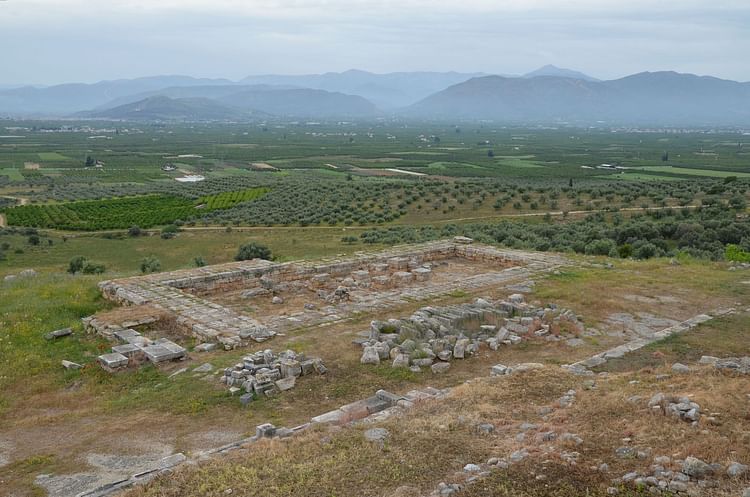
In ancient [Greek mythology](https://www.worldhistory.org/Greek_Mythology/), the city gained its name from Argos (aka Argus), the son of [Zeus](https://www.worldhistory.org/zeus/) and Niobe who reigned as the city's king and was famous for being covered in eyes or being 'all-seeing.' [Homer](https://www.worldhistory.org/homer/)'s *[Iliad](https://www.worldhistory.org/iliad/)* tells of Argos the city sending men to fight in the [Trojan War](https://www.worldhistory.org/Trojan_War/), as being ruled by [Diomedes](https://www.worldhistory.org/Diomedes/) who served as a vassal of King [Agamemnon](https://www.worldhistory.org/disambiguation/Agamemnon/) of Mycenae, and as a place celebrated for its horse rearing. The city is also described by Homer as being especially dear to the goddess [Hera](https://www.worldhistory.org/Hera/), and she did indeed end up with a protective sanctuary some 10 km (6 mi) distant from the city which hosted a major annual festival, the Panhellenic Heraia from the 7th century BCE onwards.
[ 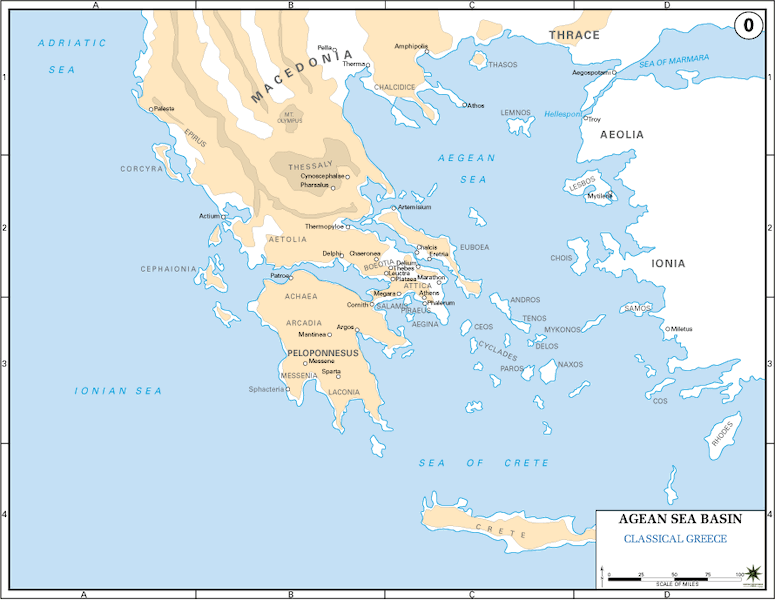 Map of Classical Greece US Military Academy (Public Domain) ](https://www.worldhistory.org/image/127/map-of-classical-greece/ "Map of Classical Greece")The city had declined after the fall of the [Mycenaean civilization](https://www.worldhistory.org/Mycenaean_Civilization/) c. 1100 BCE but was still settled on and around the Larissa hill throughout the so-called Dark Ages of the 10th to 8th century BCE. Argos then perhaps reached its greatest dominance in the 7th century BCE under King Pheidon of Argos, who is credited by some ancient writers with devising a standard system of measures and weights, introducing to mainland Greece such military innovations as [hoplite](https://www.worldhistory.org/hoplite/) tactics and double grip shields, and being the first ruler to mint [silver](https://www.worldhistory.org/Silver/) [coinage](https://www.worldhistory.org/coinage/) (although scholars believe this latter innovation to have been introduced only in the 6th century BCE). Pheidon is discredited by others, notably [Aristotle](https://www.worldhistory.org/aristotle/), for eventually turning himself into a tyrant, but Argos did become the most powerful city in Greece with Pheidon's defeat of [Sparta](https://www.worldhistory.org/sparta/), a position he celebrated by presiding over the [Olympic Games](https://www.worldhistory.org/Olympic_Games/). It is the city's contribution of hoplites to Greek armies - around 7,500, including knights - that hints at the city's population size in this period, perhaps some 12,500 adult male citizens. The government of the city would go through various stages over the next few centuries, at one time or other being a democracy, oligarchy, monarchy, and tyranny.
From the 7th to 5th century BCE, the *[polis](https://www.worldhistory.org/Polis/)* or [city-state](https://www.worldhistory.org/Polis/) dominated the surrounding valley and became a long-time rival to Sparta for dominance of the Argolid. Argos prospered largely thanks to [agriculture](https://www.worldhistory.org/disambiguation/Agriculture/) and stockbreeding. Another reason for the city's growth was a long-standing system of renting out land so that revenue could help pay for the city's defences and public buildings such as a [temple](https://www.worldhistory.org/temple/) to [Apollo](https://www.worldhistory.org/apollo/), the city's principal deity, and sanctuaries dedicated to Zeus and [Athena](https://www.worldhistory.org/athena/), amongst others. Nevertheless, Sparta usually had the upper hand in the region, acquiring Thyrea c. 545 BCE and winning a decisive victory at the [battle](https://www.worldhistory.org/disambiguation/battle/) of Sepeia c. 494 BCE.
[  Heraion of Argos, Greece Carole Raddato (CC BY-SA) ](https://www.worldhistory.org/image/2603/heraion-of-argos-greece/ "Heraion of Argos, Greece")### Classical Period
The role of Argos during the [Persian Wars](https://www.worldhistory.org/Persian_Wars/) of the 5th century BCE is ambiguous, the city refused an invitation to join the [Hellenic](https://www.worldhistory.org/greece/) League of Greek states in 481 BCE and, thereafter, either remained neutral or even displayed pro-Persian sentiment. Nevertheless, it was during this period, and perhaps because of the turmoil in Greece, that Argos began to assimilate smaller surrounding states such as Tiryns, Mycenae, and [Nemea](https://www.worldhistory.org/nemea/). In 451 BCE a peace treaty was signed between Argos and Sparta, which would endure for the next 30 years. Argos' more prominent position amongst the Greek city-states meant that it was an ideal candidate to take over as host of the biennial Panhellenic games, originally held at Nemea, firstly from c. 415 BCE to c. 330 BCE, and again definitively from 271 BCE.
A famous figure from Argos in the 5th century BCE was [Telesilla of Argos](https://www.worldhistory.org/Telesilla_of_Argos/), the poetess, considered one of the greatest of ancient Greece's lyric poets. The 2nd-century CE Greek historian [Pausanias](https://www.worldhistory.org/disambiguation/Pausanias/) even credits Telesilla with arming a group of [women](https://www.worldhistory.org/disambiguation/women/) and then leading them to face down a Spartan force attacking the city c. 494 BCE, but there is no evidence of this from more contemporary sources. Some of the poet's works did perhaps have a martial theme (only meagre fragments survive), and these may have inspired fellow Argives in battle rather than Telesilla involving herself personally.
### Roman Period
Argos remained neutral during the wars of [Philip II of Macedon](https://www.worldhistory.org/Philip_II_of_Macedon/) (r. 359-336 BCE), the city again taking advantage of the political upheaval to this time reclaim Thyrea. However, in 272 BCE the city fell under the rule of pro-Macedonian tyrants. Argos then abandoned its isolationist policy and became a member of the [Achaean League](https://www.worldhistory.org/Achaean_League/) (c. 281-146 BCE), a confederation of city-states in the north and central Peloponnese. The League allowed its members to use a common justice system, coinage, and band together in case of a military threat. This, however, did not prevent Philip V of [Macedon](https://www.worldhistory.org/macedon/) (r. 221-179 BCE) from handing over Argos to Nabis (r. 207-192 BCE), the Spartan tyrant during the Second Macedonian [War](https://www.worldhistory.org/disambiguation/War/) between Macedon and [Rome](https://www.worldhistory.org/Rome/). Fortunately, the Romans were victorious and insisted Sparta return Argos to its status as an independent member of the Achaean League in 196 BCE. Half a century later, this independence would end when Rome took control of Greece from 146 BCE. Argos came under the jurisdiction of the governor of Macedonia and eventually became a part of the Roman province of Achaea. At least, though, the city's mythical heritage meant that Argos enjoyed a certain prestige even in Roman times. The [Roman emperor](https://www.worldhistory.org/Roman_Emperor/) [Hadrian](https://www.worldhistory.org/hadrian/) (r. 117-138 CE), in particular, was generous to the city, building, amongst other things, an [aqueduct](https://www.worldhistory.org/aqueduct/) and baths.
[  Acropolis of Argos Mark Cartwright (CC BY-NC-SA) ](https://www.worldhistory.org/image/477/acropolis-of-argos/ "Acropolis of Argos")Argos was sacked by the Visigoths as they rampaged through the region in 395 CE, but it continued to be inhabited in Late Antiquity and right through the medieval period, with notable additions including a 10th-century CE castle and double fortification walls built on the Larissa hill above the town. The castle, which was first built by the [Franks](https://www.worldhistory.org/Franks/), was then added to by the Venetians and then the Ottoman Turks. The continuous inhabitation of Argos and the tendency to destroy and rebuild on the same spot has made archaeological excavations much more problematic than at other sites such as Mycenae and Tiryns which were abandoned.
### Archaeological Remains
Argos was excavated principally by the French School of [Archaeology](https://www.worldhistory.org/Archaeology/), and the archaeological remains visible today include Mycenaean, Greek and Roman structures. There are Mycenaean tombs (14th to 13th century BCE), an odeum for dramatic and musical performances (5th century BCE), the sanctuary of [Aphrodite](https://www.worldhistory.org/Aphrodite/) (430-420 BCE), the foundations and walls of the [agora](https://www.worldhistory.org/agora/) (5th century BCE) and a large stoa or collonaded enclosure. The impressive theatre dates to the 4th-3rd century BCE but includes 2nd-4th century CE modifications. Particularly well-preserved, it includes 81 rows of seats which would have given it a capacity of 20,000 spectators - the largest of any [Greek theatre](https://www.worldhistory.org/Greek_Theatre/). There are also ruins of the Roman baths or *thermae* (2nd century CE), and, around the city, parts of the ancient, Cyclopean citadel walls (incorporated into the medieval fortress fortifications on the Larissa hill).
[  Kouroi by Polymedes Mark Cartwright (CC BY-NC-SA) ](https://www.worldhistory.org/image/412/kouroi-by-polymedes/ "Kouroi by Polymedes")Various significant artefacts have been found at the site including terracotta figurines (13th century BCE), many superb examples of [pottery](https://www.worldhistory.org/pottery/) in the geometric style (9th-8th century BCE) found in graves, several marble figures of [Roman sculpture](https://www.worldhistory.org/Roman_Sculpture/), and two 4th-5th-century CE [mosaic](https://www.worldhistory.org/Mosaic/) floors depicting [Dionysos](https://www.worldhistory.org/Dionysos/) in one and the months of the year in the other. The latter mosaic has figures holding items to represent a particular month such as a lamb for April and wheat for June. One outstanding find was a bronze breastplate and crested helmet with cheek-plates discovered in a late 8th- or early 7th-century BCE [tomb](https://www.worldhistory.org/tomb/). Most of these artefacts now reside in the Archaeological Museum of Argos.
Examples of Argos' art output can be found across the [Mediterranean](https://www.worldhistory.org/disambiguation/mediterranean/). Argos was the home of one of ancient Greece's most famous sculptors, Polykleitos (Polyclitus), who was active in the second half of the 5th century BCE. Besides creating great bronze sculptures such as the Doryphoros (Spearbearer), which was much copied in Hellenistic and Roman times (at least 50 such copies survive today with perhaps the best being in Naples), he also wrote a treatise, the *Kanon*, on techniques of [sculpture](https://www.worldhistory.org/disambiguation/Sculpture/) where he emphasised the importance of correct proportion. Another famous sculptor from Argos was Polymedes who created the two life-size *kouroi* of Kleobis and Biton. Outstanding examples of [Archaic](https://www.worldhistory.org/disambiguation/Archaic/) [Greek sculpture](https://www.worldhistory.org/Greek_Sculpture/), they were created c. 580 BCE and then dedicated at [Delphi](https://www.worldhistory.org/delphi/), where they still reside in the site's archaeological museum.
#### Editorial Review
This human-authored definition has been reviewed by our editorial team before publication to ensure accuracy, reliability and adherence to academic standards in accordance with our [editorial policy](https://www.worldhistory.org/static/editorial-policy/).
## Bibliography
- Bagnall, R. (ed). *The Encyclopedia of Ancient History.* Wiley-Blackwell, 2012
- [Burn, A.R. *The Penguin History of Greece.* Penguin (Non-Classics), 1966.](https://www.worldhistory.org/books/0140137513/)
- [Homer. *The Iliad.* Penguin Classics, 1998.](https://www.worldhistory.org/books/0140275363/)
- [Hornblower, S. *The Oxford Classical Dictionary.* Oxford University Press, USA, 2012.](https://www.worldhistory.org/books/0199545561/)
- [Iakōvidēs, S.E. *Mycenae-Epidaurus, Argos-Tiryns-Nauplion.* Ekdotike Athenon, 1978.](https://www.worldhistory.org/books/B0007AOFPY/)
- Lane Fox, R. *The Classical World.* Penguin, London, 2006
- [Miller, S.G. *Nemea.* American School of Classical Studies, 1984.](https://www.worldhistory.org/books/B0007BLCCW/)
## About the Author
Mark is WHE’s Publishing Director and has an MA in Political Philosophy (University of York). He is a full-time researcher, writer, historian and editor. Special interests include art, architecture and discovering the ideas that all civilizations share.
## Timeline
- **1400 BCE - 1300 BCE**: [Mycenaean](https://www.worldhistory.org/Mycenaean_Civilization/) fortifications, palaces and tombs constructed at [Argos](https://www.worldhistory.org/argos/).
- **1200 BCE - 1100 BCE**: [Argos](https://www.worldhistory.org/argos/) takes over from [Mycenae](https://www.worldhistory.org/mycenae/) as most important regional power in the Argolid.
- **c. 700 BCE**: [Sparta](https://www.worldhistory.org/sparta/), [Argos](https://www.worldhistory.org/argos/) and [Paros](https://www.worldhistory.org/Paros/) hold the first documented musical competitions in [Greece](https://www.worldhistory.org/greece/).
- **700 BCE - 600 BCE**: King Phiedon leads [Argos](https://www.worldhistory.org/argos/) to its greatest expansion.
- **c. 660 BCE**: Pheidon is tyrant in [Argos](https://www.worldhistory.org/argos/).
- **c. 580 BCE**: The kouroi of [Argos](https://www.worldhistory.org/argos/), thought to represent Cleobis & Biton, are sculpted.
- **c. 545 BCE**: [Sparta](https://www.worldhistory.org/sparta/) takes control of Thyrea from [Argos](https://www.worldhistory.org/argos/).
- **494 BCE - 493 BCE**: Spartan forces under Cleomenes I attack the [city](https://www.worldhistory.org/city/) of [Argos](https://www.worldhistory.org/argos/).
- **494 BCE - 493 BCE**: [Telesilla of Argos](https://www.worldhistory.org/Telesilla_of_Argos/) defends her [city](https://www.worldhistory.org/city/) against the Spartan forces with an army of [women](https://www.worldhistory.org/disambiguation/women/).
- **c. 468 BCE**: [Tiryns](https://www.worldhistory.org/tiryns/) is destroyed by the Argeians.
- **451 BCE**: [Sparta](https://www.worldhistory.org/sparta/) and [Argos](https://www.worldhistory.org/argos/) sign a peace treaty which endures for the next 30 years.
- **c. 430 BCE - c. 420 BCE**: Sanctuary of [Aphrodite](https://www.worldhistory.org/Aphrodite/) constructed at [Argos](https://www.worldhistory.org/argos/).
- **418 BCE**: [Sparta](https://www.worldhistory.org/sparta/), led by Agis II, defeats [Argos](https://www.worldhistory.org/argos/) and her allies at the [battle](https://www.worldhistory.org/disambiguation/battle/) of Mantinaea.
- **415 BCE - 330 BCE**: Nemean Games relocated to [Argos](https://www.worldhistory.org/argos/).
- **c. 400 BCE**: The large [theatre](https://www.worldhistory.org/disambiguation/theatre/) is constructed at [Argos](https://www.worldhistory.org/argos/).
- **395 BCE - 386 BCE**: The Corinthian Wars between [Sparta](https://www.worldhistory.org/sparta/) and an alliance of [Athens](https://www.worldhistory.org/Athens/), [Corinth](https://www.worldhistory.org/corinth/), [Argos](https://www.worldhistory.org/argos/), Boeotia and [Thebes](https://www.worldhistory.org/disambiguation/Thebes/).
- **330 BCE**: Athletic Games return from [Argos](https://www.worldhistory.org/argos/) to [Nemea](https://www.worldhistory.org/nemea/).
- **272 BCE**: [Death](https://www.worldhistory.org/disambiguation/Death/) of [Pyrrhus](https://www.worldhistory.org/pyrrhus/) of Epirus in a street [battle](https://www.worldhistory.org/disambiguation/battle/) in [Argos](https://www.worldhistory.org/argos/).
- **269 BCE**: Nemean Games definitively moved to [Argos](https://www.worldhistory.org/argos/).
- **267 CE**: The [Goths](https://www.worldhistory.org/Goths/) sack [Athens](https://www.worldhistory.org/Athens/), [Corinth](https://www.worldhistory.org/corinth/), [Sparta](https://www.worldhistory.org/sparta/), and [Argos](https://www.worldhistory.org/argos/).
- **395 CE**: [Argos](https://www.worldhistory.org/argos/) is definitively destroyed by the [Visigoth](https://www.worldhistory.org/visigoth/) invasion.
## Cite This Work
### APA
Cartwright, M. (2019, October 28). Ancient Argos. *World History Encyclopedia*.
### Chicago
Cartwright, Mark. "Ancient Argos." *World History Encyclopedia*, October 28, 2019. .
### MLA
Cartwright, Mark. "Ancient Argos." *World History Encyclopedia*, 28 Oct 2019, .
## License & Copyright
Submitted by [Mark Cartwright](https://www.worldhistory.org/user/markzcartwright/ "User Page: Mark Cartwright"), published on 28 October 2019. The copyright holder has published this content under the following license: [Creative Commons Attribution-NonCommercial-ShareAlike](https://creativecommons.org/licenses/by-nc-sa/4.0/deed.en). This license lets others remix, tweak, and build upon this content non-commercially, as long as they credit the author and license their new creations under the identical terms. When republishing on the web a hyperlink back to the original content source URL must be included. Please note that content linked from this page may have different licensing terms.