---
title: Aquileia
author: Donald L. Wasson
source: https://www.worldhistory.org/aquileia/
format: machine-readable-alternate
license: Creative Commons Attribution-NonCommercial-ShareAlike (https://creativecommons.org/licenses/by-nc-sa/4.0/)
updated: 2023-08-18
---
# Aquileia
_Authored by [Donald L. Wasson](https://www.worldhistory.org/user/DWasson/)_
The ancient [city](https://www.worldhistory.org/city/) of Aquileia was situated near the head of the Adriatic Sea west of the [Roman](https://www.worldhistory.org/disambiguation/Roman/) province of Illyria. The strategic location of the city served a crucial role in the expansion of the [Roman Republic](https://www.worldhistory.org/Roman_Republic/) by serving as a buffer against possible invasions from the Germanic tribes to the north. As a colony with major harbor facilities, Aquileia allowed the Romans to exploit both the neighboring [gold](https://www.worldhistory.org/gold/) mines as well as the region's own rich [amber](https://www.worldhistory.org/Amber/).
To the north of the colony was the independent territory of Noricum. It would become a Roman province in 16 BCE under [Roman emperor](https://www.worldhistory.org/Roman_Emperor/) [Augustus](https://www.worldhistory.org/augustus/) (27 BCE to 14 CE). Although Noricum controlled a few minor routes over the Alps, its location south of the Danube and abundant iron and gold reserves were far more valuable to the Republic, allowing [trade](https://www.worldhistory.org/disambiguation/trade/) to emerge between Noricum and northeastern [Italy](https://www.worldhistory.org/italy/), namely Aquileia. As a buffer and center of trade, the city would eventually become one of the largest and wealthiest [cities](https://www.worldhistory.org/city/) of the [Roman Empire](https://www.worldhistory.org/Roman_Empire/), becoming the capital of Venetia et Istria.
### A Gallic Region
Lying to the north and northeast of the Italian peninsula far to the west of Aquileia lay Cisalpine and Transalpine [Gaul](https://www.worldhistory.org/gaul/). During the early and middle Roman Republic, the area was not considered part of Italia, which only extended to the foothills of the Apennines. Cisalpine Gaul comprised the area from the plains of the Po River to the Apennines, while Transalpine Gaul extended beyond the Alps northward. Although sources vary, Cisalpine Gaul was initially the home of the [Etruscans](https://www.worldhistory.org/Etruscan_Civilization/); however, [Celtic](https://www.worldhistory.org/celt/) tribes from north of the Alps – the Insubres and Senones among them – gradually moved into the area, and by the end of the 4th century BCE, the Etruscans had been completely forced out – thereby enabling the [Celts](https://www.worldhistory.org/celt/) (Gauls) to make the occasional raid into Italian territory.
Around 390 BCE, the Celts were bold enough to push further south and sack the city of [Rome](https://www.worldhistory.org/Rome/). Tom Holland in his *[Rubicon](https://www.worldhistory.org/disambiguation/Rubicon/)* wrote that "a barbarian horde had burst without warning across the Alps, sent a [Roman army](https://www.worldhistory.org/Roman_Army/) fleeing from it in panic, and swept into Rome" (234). Although sporadic raids continued into the 3rd century BCE, in 225 BCE, Rome was able to defeat the Gallic invaders at Telamon – a city located on the coast of [Etruria](https://www.worldhistory.org/Etruscan_Civilization/) between Rome and Pisa. Realizing the importance and potential of the region, the Romans went on a three-year campaign, capturing Mediolanum (Milan) in 223 BCE. Further attempts to move northward were foiled by the Carthaginian commander [Hannibal](https://www.worldhistory.org/hannibal/) in the [Second Punic War](https://www.worldhistory.org/Second_Punic_War/) (218-201 BCE) where many of the Celtic tribes sided with Hannibal. After his defeat, Rome continued their foray into the region, establishing colonies at Cremona and Placentia (Piacenza).
### Under Roman Rule
In 186 BCE, the region of Aquileia was still controlled by the Transalpine Gauls who regulated travel across the Julian Alps. When the Gauls were expelled in 181 BCE, the Romans established a colony there to protect and exploit the area's resources. Although often sacked by neighboring warring tribes, Aquileia's significance as a major crossroads was recognized by both [Julius Caesar](https://www.worldhistory.org/Julius_Caesar/) (100-44 BCE) and his successor Augustus. As a military stronghold, it is sometimes referred to as [Roma](https://www.worldhistory.org/disambiguation/Roma/) Secunda or the Second Rome, serving as a supply center for the Roman army. During [Caesar](https://www.worldhistory.org/disambiguation/caesar/)'s decade away from Rome conquering Gaul and leading a campaign into [Britain](https://www.worldhistory.org/disambiguation/Britain/), Aquileia served as a winter headquarters. In his *The [Conquest](https://www.worldhistory.org/warfare/) of Gaul*, he wrote of his preparation to fight the Helvetii. Besides the creation of two new legions, "the Roman commander \[Caesar\] by rapid stages hastened back to Italy; where … he summoned from their winter cantonments round Aquileia the three that formed his original establishment in these quarters" (7).
[  Caesar in Gaul The Creative Assembly / SEGA (Copyright) ](https://www.worldhistory.org/image/2171/caesar-in-gaul/ "Caesar in Gaul")From the days of Caesar through the [fall of the Western Roman Empire](https://www.worldhistory.org/article/835/fall-of-the-western-roman-empire/), Aquileia played an important but dubious role in history: it was besieged by fallen emperors, Germanic tribes, and lastly, the [Huns](https://www.worldhistory.org/Huns/). In 68 CE, Emperor [Nero](https://www.worldhistory.org/Nero/) (r. 54-68 CE), with some assistance, committed suicide, leaving four Roman commanders to compete for the throne and control of a vast [empire](https://www.worldhistory.org/empire/). The first of the four, [Galba](https://www.worldhistory.org/Galba/) (r. 68-69 CE), was killed by his own [Praetorian Guard](https://www.worldhistory.org/Praetorian_Guard/); his successor, [Otho](https://www.worldhistory.org/Otho/) (r. 69 CE), committed suicide as his army fell to his successor [Vitellius](https://www.worldhistory.org/Vitellius/) (r. 69 CE). Now, it was left for Vitellius to face [Vespasian](https://www.worldhistory.org/Vespasian/) (r. 69-79 CE), a popular and formidable commander. As Vespasian made his way to Rome, the Roman commander Marcus Primus threw his support to Vespasian, and with his Danubian legions marched into Italy, laying siege to Aquileia and routing Vitellius at Cremona. Vitellius would eventually be defeated, tortured, and killed in Rome.
Despite the bloody events of 69 CE, the [Year of the Four Emperors](https://www.worldhistory.org/Year_of_the_Four_Emperors/), the period between Augustus' and [Marcus Aurelius](https://www.worldhistory.org/Marcus_Aurelius/)' (r. 161-180 CE) rule was known as the *[Pax Romana](https://www.worldhistory.org/Pax_Romana/),* or Roman Peace, a time of relative peace and economic prosperity. It came to an end with the [death](https://www.worldhistory.org/disambiguation/Death/) of the emperor/philosopher Marcus Aurelius in 180 CE and the ascent of the much-maligned [Commodus](https://www.worldhistory.org/commodus/) (r. 180-192 CE). During this time, a [plague](https://www.worldhistory.org/disambiguation/plague/) was devastating the Empire and would claim the life of the co-emperor [Lucius Verus](https://www.worldhistory.org/Lucius_Verus/) (r. 161-169 CE). In 167 CE, Germanic tribes to the north, the Quadi, Iazyges, and Marcomanni, took advantage of the situation and drove through the lands south of the upper and middle Danube River burning Opitergium and besieging Aquileia. For the first time in almost three centuries, barbarians were in Italy. Aurelius armed gladiators and slaves, forming two legions, Italica II and Italica III, and moved northward. Although there is some debate, Aquileia served as the first base for each legion. For the next five years, the emperor battled the barbarians, returning to Rome in [triumph](https://www.worldhistory.org/Roman_Triumph/).
### [Crisis of the Third Century](https://www.worldhistory.org/Crisis_of_the_Third_Century/)
A little over four decades later, the legions II Parthica and I Adiutrix were in Pannonia under the leadership of Emperor [Maximinus Thrax](https://www.worldhistory.org/Maximinus_Thrax/) I (235-238 CE) battling the Germans and Sarmatians and preparing to go against the Gauls. Word arrived from Rome that the emperor had been dethroned and [Gordian I](https://www.worldhistory.org/Gordian_Emperors/) and his son [Gordian II](https://www.worldhistory.org/Gordian_Emperors/) in [Africa](https://www.worldhistory.org/disambiguation/africa/) had been named co-emperors; however, their short reign would soon end thanks to Legio III Augusta. Maximinus and his legion marched into Italy to reclaim his throne, but he found determined resistance at Aquileia and after an attempt to cross the river on a pontoon, he still failed to take the city. Heavy losses, a shortage of food, and disease led to a lowering of discipline and morale. Disgruntled soldiers of Legio II Parthica and men from his Praetorian Guard entered his tent and killed the fallen emperor and his son. Their bodies were mutilated and their heads were sent to Rome. Marcus Pupienus (r. 238) had been named co-emperor with Decimus Balbinus after the death of [Gordian](https://www.worldhistory.org/Gordian_Emperors/) II and his father. Pupienus' initial task was the repel Maximinus; however, when he heard of the emperor's death, he marched to Aquileia where the people opened up their gates to him. Maximinius' troops were sent home. Later, Pupienus and his co-emperor were murdered.
[ 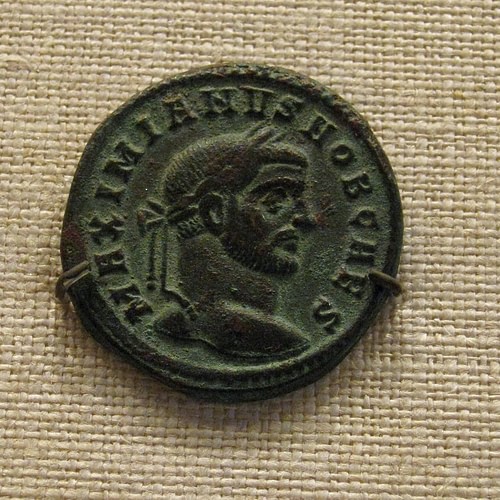 Galerius Peter Roan (CC BY-NC-SA) ](https://www.worldhistory.org/image/1069/galerius/ "Galerius")Although the Roman Empire had been split into two by Emperor [Diocletian](https://www.worldhistory.org/Diocletian/) (284-305 CE), it was reunited by [Constantine I](https://www.worldhistory.org/Constantine_I/) (306-337 CE). After his death, jealousy soon developed between his successors. In 341 CE, [Constantine](https://www.worldhistory.org/disambiguation/Constantine/) II (r. 337-340 CE) took advantage of Constans I's (r. 337-350 CE) absence and invaded Italy to face his brother's army, but Constans' remaining force ambushed and killed Constantine II at Aquileia. In 354 CE, Julian (r. 361-363 CE), a cousin, gained success in Gaul and Germany. Envious, Constantius ordered his little cousin to dispatch his army and send them east. Julian, of course, refused and marched to meet Constantius. After the city Aquileia was able to resist his attack, Julian was forced to continue to the east along the Danube, reaching the Balkans. However, he would never engage his cousin in [battle](https://www.worldhistory.org/disambiguation/battle/); Constantius died before they met.
### Destruction by the Huns
As the [Eastern Roman Empire](https://www.worldhistory.org/Byzantine_Empire/) was thriving, the West was inching toward its eventual fall. However, before it fell to the invasions c. 476 CE, it faced one more opponent: [Attila the Hun](https://www.worldhistory.org/Attila_the_Hun/), the scourge of [God](https://www.worldhistory.org/God/). After he ravaged the Balkans in 451 CE, [Attila](https://www.worldhistory.org/disambiguation/Attila/) crossed the Rhine and ransacked Gaul. Defeated at Chalons in the [Battle of the Catalaunian Fields](https://www.worldhistory.org/article/995/the-battle-of-the-catalaunian-fields/) (his only defeat), he lay siege to Aquileia and Milan. The people of Aquileia were forced to flee the city, establishing Venice as a refuge.
[  Army of Attila the Hun The Creative Assembly (Copyright) ](https://www.worldhistory.org/image/6196/army-of-attila-the-hun/ "Army of Attila the Hun")One story that almost appears to be mythical finds Attila and his army outside the city of Aquileia, debating whether to lay siege or leave. Attila noticed a mother stork and her young nesting in one of the city's towers. The stork gathered her young and flew away. To Attila it was a sign, a foretelling, indicating that some disaster was about to strike the city. Instead of leaving, Attila and his army continued their siege, and with the city's fall opened by the main routes into northeastern Italy. It would be some time before the city would be rebuilt.
#### Editorial Review
This human-authored definition has been reviewed by our editorial team before publication to ensure accuracy, reliability and adherence to academic standards in accordance with our [editorial policy](https://www.worldhistory.org/static/editorial-policy/).
## Bibliography
- [Caesar, Julius & Gardner, Jane & Handford, S. *The Conquest of Gaul .* Penguin, 1982.](https://www.worldhistory.org/books/B002RI9MTS/)
- [Dando-Collins, Stephen. *Legions of Rome.* Quercus, 2012.](https://www.worldhistory.org/books/B07V3JBG2Q/)
- [Grant, Michael. *The Roman Emperors.* Barnes & Noble Books, 1997.](https://www.worldhistory.org/books/0760700915/)
- [Heather, Peter. *The Fall of the Roman Empire.* Oxford University Press, 2005.](https://www.worldhistory.org/books/B000SEI0JQ/)
- [Hornblower, Simon & Spawforth, Antony & Eidinow, Esther. *The Oxford Classical Dictionary.* Oxford University Press, 2012.](https://www.worldhistory.org/books/0199545561/)
- [Nigel Rodgers & Dr. Hazel Dodge FSA. *The Illustrated Encyclopedia of the Roman Empire.* Hermes House, 2023.](https://www.worldhistory.org/books/1782143394/)
- [Pollard, Nigel & Berry, Joanne. *The Complete Roman Legions.* Thames & Hudson, 2012.](https://www.worldhistory.org/books/0500251835/)
- [Scarre, Chris. *Chronicle of the Roman Emperors.* Thames & Hudson, 2012.](https://www.worldhistory.org/books/0500289891/)
- [Strauss, Barry. *Ten Caesars.* Simon & Schuster, 2020.](https://www.worldhistory.org/books/1451668848/)
- [Tom Holland. *Rubicon.* Anchor, 2005.](https://www.worldhistory.org/books/1400078970/)
## About the Author
Donald has taught Ancient, Medieval and U.S. History at Lincoln College (Normal, Illinois)and has always been and will always be a student of history, ever since learning about Alexander the Great. He is eager to pass knowledge on to his students.
## Timeline
- **181 BCE**: A [Roman](https://www.worldhistory.org/disambiguation/Roman/) colony is founded at [Aquileia](https://www.worldhistory.org/aquileia/).
- **167 CE**: Marcomanni sack [Aquileia](https://www.worldhistory.org/aquileia/).
- **452 CE**: [Attila](https://www.worldhistory.org/disambiguation/Attila/)'s invasion of [Italy](https://www.worldhistory.org/italy/).
## Questions & Answers
### What is the history of Aquileia?
Aquileia came under Roman rule in 181 BCE when the Romans established a colony there to protect and exploit the area's resources. As a center of trade, the city would eventually become one of the largest and wealthiest cities of the Roman Empire. It was destroyed by Attila, the Hun in 452 CE, but would be rebuild and continue into the Middle Ages and beyond.
### When was Aquileia founded?
Aquileia was founded as a Roman colony in 181 BCE
## Cite This Work
### APA
Wasson, D. L. (2023, August 17). Aquileia. *World History Encyclopedia*.
### Chicago
Wasson, Donald L.. "Aquileia." *World History Encyclopedia*, August 17, 2023. .
### MLA
Wasson, Donald L.. "Aquileia." *World History Encyclopedia*, 17 Aug 2023, .
## License & Copyright
Submitted by [Donald L. Wasson](https://www.worldhistory.org/user/DWasson/ "User Page: Donald L. Wasson"), published on 17 August 2023. The copyright holder has published this content under the following license: [Creative Commons Attribution-NonCommercial-ShareAlike](https://creativecommons.org/licenses/by-nc-sa/4.0/deed.en). This license lets others remix, tweak, and build upon this content non-commercially, as long as they credit the author and license their new creations under the identical terms. When republishing on the web a hyperlink back to the original content source URL must be included. Please note that content linked from this page may have different licensing terms.