---
title: Apollo
author: Mark Cartwright
source: https://www.worldhistory.org/apollo/
format: machine-readable-alternate
license: Creative Commons Attribution-NonCommercial-ShareAlike (https://creativecommons.org/licenses/by-nc-sa/4.0/)
updated: 2025-02-04
---
# Apollo
_Authored by [Mark Cartwright](https://www.worldhistory.org/user/markzcartwright/)_
Apollo was a [Greek](https://www.worldhistory.org/disambiguation/greek/) [god](https://www.worldhistory.org/God/) associated with the bow, [music](https://www.worldhistory.org/disambiguation/Music/), and divination. The epitome of youth and beauty, source of life and healing, patron of the arts, and as bright and powerful as the sun itself, Apollo was perhaps the most loved of all the gods. He was worshipped at [Delphi](https://www.worldhistory.org/delphi/) and [Delos](https://www.worldhistory.org/delos/), amongst the most famous of all Greek religious sanctuaries.
Son of [Zeus](https://www.worldhistory.org/zeus/) and [Leto](https://www.worldhistory.org/Leto/), and the twin brother of [Artemis](https://www.worldhistory.org/artemis/), Apollo was born on the island of Delos (in [Hesiod](https://www.worldhistory.org/hesiod/)'s *[Theogony](https://www.worldhistory.org/Theogony/)* he is clutching a golden sword). His mother, fearful of revenge from Zeus' wife [Hera](https://www.worldhistory.org/Hera/), had chosen barren Delos as the safest retreat she could find. At his first taste of ambrosia, he was said to have immediately transformed from babe to man. Apollo was then given his bow, made by the master craftsman of Mount Olympus, [Hephaestus](https://www.worldhistory.org/Hephaistos/).
As with the other major divinities, Apollo had many children; perhaps the most famous are [Orpheus](https://www.worldhistory.org/Orpheus/) (who inherited his father's musical skills and became a virtuoso with the [lyre](https://www.worldhistory.org/Lyre/) or [kithara](https://www.worldhistory.org/Kithara/)), [Asclepius](https://www.worldhistory.org/Asclepius/) (to whom he gave his knowledge of healing and [medicine](https://www.worldhistory.org/disambiguation/medicine/)) and, according to the 5th-century BCE tragedian [Euripides](https://www.worldhistory.org/Euripides/), the hero Ion.
### In [Mythology](https://www.worldhistory.org/mythology/)
Apollo is a significant protagonist in [Homer](https://www.worldhistory.org/homer/)'s account of the [Trojan War](https://www.worldhistory.org/Trojan_War/) in the *[Iliad](https://www.worldhistory.org/iliad/)*. On the side of the Trojans, he gives particular assistance to the Trojan heroes Hector, [Aeneas](https://www.worldhistory.org/Aeneas/), and Glaukos, saving their lives on more than one occasion with his divine intervention. He brought [plague](https://www.worldhistory.org/disambiguation/plague/) to the Achaeans, led the entire Trojan army (holding Zeus' fearsome aegis) in an attack which destroyed the defensive walls of the Greek camps, and was also responsible for guiding [Paris](https://www.worldhistory.org/disambiguation/paris/)' arrow to the heel of [Achilles](https://www.worldhistory.org/achilles/), killing the seemingly invincible Greek hero. Apollo is most frequently described by Homer and Hesiod as the 'far-shooter', the 'far-worker', the 'rouser of armies', and 'Phoebus Apollo'.
[  Apollo Marble Relief Mark Cartwright (CC BY-NC-SA) ](https://www.worldhistory.org/image/3514/apollo-marble-relief/ "Apollo Marble Relief")Apollo generally played the dutiful son to Zeus, father of the gods, and never attempted to usurp his position (unlike Zeus who had overthrown his own father [Cronus](https://www.worldhistory.org/Cronus/)). The pair did have a serious falling out when Zeus killed Asclepius after he had used his marvellous medicinal skills to bring a mortal back to life. In revenge, Apollo then killed the Cyclopes, the one-eyed [giants](https://www.worldhistory.org/Giants/) who made Zeus' thunderbolts. As punishment, Apollo was obliged to spend a year in the humble service of Admetus of Therae, tending the king's sheep.
Apollo acquired his lyre from his mischievous half-brother Hermes, the messenger god. While still a baby, Hermes had stolen Apollo's sacred herd of cattle, cleverly reversing their hooves to make it difficult to follow their tracks. Hermes was permitted to keep his ill-gotten gains but only after he gave Apollo his lyre which he had invented using a tortoiseshell.
### Apollo's Darker Side
Apollo's darker side as the bringer of plague and divine retribution is seen most famously when he is, with his sister Artemis, the remorseless slayer of Niobe's six (or in some accounts seven) sons as punishment for her boasting that her childbearing capacity was greater than Leto's. Another hapless victim of Apollo's wrath was the [satyr](https://www.worldhistory.org/satyr/) [Marsyas](https://www.worldhistory.org/Marsyas/) who unwisely claimed he was musically more gifted than the god. The pair had a competition and the [Muses](https://www.worldhistory.org/muse/) ruled that Apollo was indeed the better musician. Apollo then had the mortal flayed alive for his presumption and nailed his skin to a pine tree. The tale is an interesting metaphor for the competition between (at least to Greek ears) the civilised and ordered music of Apollo's lyre and the wilder, more chaotic music of Marsyas' flute. Apollo won another musical competition, this time against the pastoral god [Pan](https://www.worldhistory.org/Pan/) and, judged the victor by King [Midas](https://www.worldhistory.org/midas/), Apollo thus became the undisputed master of music in the Greek world. The god's defeat of Marsyas and Pan may reflect the Greek [conquest](https://www.worldhistory.org/warfare/) of [Phrygia](https://www.worldhistory.org/phrygia/) and Arcadia respectively.
[ 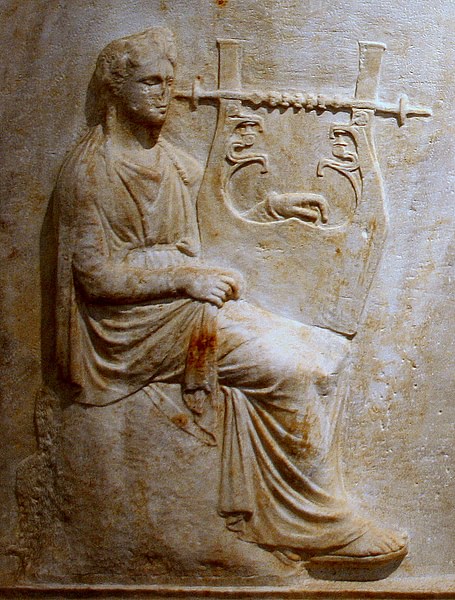 Apollo, detail from NAM, Athens, 215. James Lloyd (CC BY-NC-SA) ](https://www.worldhistory.org/image/2698/apollo-detail-from-nam-athens-215/ "Apollo, detail from NAM, Athens, 215.")### What is Apollo Associated With?
Objects traditionally associated with Apolllo include:
- **a [silver](https://www.worldhistory.org/Silver/) bow** - symbolic of his prowess as an archer.
- **a kithara (or lyre)** - made from the shell of a tortoise, this was symbolic of Apollo's ability in music and his leadership of the chorus of the nine Muses.
- **a laurel branch** - symbolic of the fate of Daphne who, after Apollo's amorous pursuit of her, led her father, the river god Phineus, to transform her into a laurel tree.
- **the omphalos** - symbol of Apollo's sanctuary at Delphi as the navel of the world.
- **a palm tree** - which Leto gripped when she gave birth to her son.
Apollo was a much-loved god, and this was most likely due to his association with many positive aspects of the human condition such as music, poetry, purification, healing, and medicine. The god was also associated with moderation in all things. His arrows, although they could bring destruction could also ward off harm to those he favoured. A strategy to keep away evil from Greek homes was to set up a pillar of Apollo Agyieus and, on a grander scale, Apollo Propylaios protected [city](https://www.worldhistory.org/city/) gates.
[  Omphalos of Delphi Mark Cartwright (CC BY-NC-SA) ](https://www.worldhistory.org/image/414/omphalos-of-delphi/ "Omphalos of Delphi")Apollo oversaw the initiation rites performed by young males (*ephebes*) as they entered the full civic community and became warriors. Rituals in this process involved cutting hair and offering it to the god, as well as athletic and martial challenges. The god is frequently associated with the sun (as Phoebus Apollo) and the sun god [Helios](https://www.worldhistory.org/Helios/), but modern scholars mostly agree that the link between Apollo and Helios does not go further back than the 5th century BCE. Apollo continued to inspire the Romans when he was principally considered a god of healing. [Octavian](https://www.worldhistory.org/augustus/), the future emperor [Augustus](https://www.worldhistory.org/augustus/) (r. 27 BCE - 14 CE), famously claimed the god as his patron and even dedicated a [temple](https://www.worldhistory.org/temple/) to Apollo at Actium. The god of moderation was a useful association and in direct contrast to the god of excess, [Dionysos](https://www.worldhistory.org/Dionysos/), championed by Octavian's no. 1 enemy, [Mark Antony](https://www.worldhistory.org/Mark_Antony/).
### Which Sites Were Sacred to Apollo?
Sanctuaries were built in honour of Apollo throughout the Greek world, notably at the islands of Delos and [Rhodes](https://www.worldhistory.org/Rhodes/) and at Ptoion and Claros. Sites which still possess some vestiges of once-great temples dedicated to Apollo include those at [Naxos](https://www.worldhistory.org/Naxos/) (6th century BCE), where the massive doorway still stands proud, at [Corinth](https://www.worldhistory.org/corinth/) (550-530 BCE), where seven Doric columns give an impression of a once impressive structure, at Didyma, [Turkey](https://www.worldhistory.org/Asia_Minor/) (4th century BCE), whose temple was the fourth largest in the Greek world, and at Side, also in Turkey (2nd century CE) where a corner of its elegant columned facade has been restored.
[  Temple of Apollo, Naxos Mark Cartwright (CC BY-NC-SA) ](https://www.worldhistory.org/image/1383/temple-of-apollo-naxos/ "Temple of Apollo, Naxos")Apollo's most direct presence amongst the Greeks, though, was manifested in his oracle at Delphi, which was consulted for its prophetic powers and which was the most important in the Greek world. According to legend, Apollo, wishing to reveal to humanity the intentions of his father Zeus, created the oracle on the site where he had killed the serpent (or dragon) Python. The Panhellenic Pythian games were begun at the site in order to commemorate the [death](https://www.worldhistory.org/disambiguation/Death/) of this divine creature. Tripods and laurel wreaths were given as prizes to the victors at these games. The 30 treasuries built at Delphi by various [cities](https://www.worldhistory.org/city/) indicate the popularity of the god and the sanctuary in the wider Greek world such as in [Asia Minor](https://www.worldhistory.org/Asia_Minor/).
The oracle of Delphi was already well-visited in the 8th century BCE - despite being difficult to get to and open only in summer - and the sometimes cryptic proclamations of its priestesses were not taken lightly, often deciding how laws would be applied or whether a foreign [war](https://www.worldhistory.org/disambiguation/War/) should be pursued. Sometimes the oracle's responses to questions were so obscure that priests at the site offered (for a fee) to give them greater clarity. As the historian B. Graziosi summarises,
> Pilgrims often continued to ponder Apollo's responses, and consult further experts, back home. After that long process of consultation and interpretation, Apollo's revelations usually crystallised into lines of hexameter poetry, and were always found to be true - even if the correct interpretation sometimes emerged only after the relevant events had come to pass. (21)
### How is Apollo Represented in Art?
Apollo appears frequently in all [media](https://www.worldhistory.org/disambiguation/media/) of ancient Greek art, most often as a beautiful, beardless youth. He is easily identified with either a kithara or a lyre, a [bronze](https://www.worldhistory.org/disambiguation/bronze/) tripod (signifying his oracle at Delphi), a deer (which he often fights over with [Hercules](https://www.worldhistory.org/hercules/)), and a bow and quiver. He is also, on occasion, portrayed riding a [chariot](https://www.worldhistory.org/chariot/) pulled by lions or swans.
[ 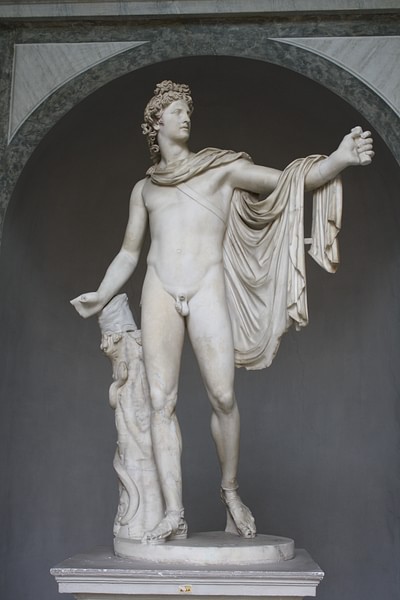 Belvedere Apollo Mark Cartwright (CC BY-NC-SA) ](https://www.worldhistory.org/image/1376/belvedere-apollo/ "Belvedere Apollo")Perhaps the most celebrated representation of Apollo in ancient Greek art is the statue which dominated the centre of the west pediment of the Temple of Zeus at [Olympia](https://www.worldhistory.org/Olympia/) (c. 460 BCE). Here, in a majestic pose, he brings order and reason to the [battle](https://www.worldhistory.org/disambiguation/battle/) between the Lapiths and the Centaurs at the wedding of Peirithoos. Another fine example of Apollo in his guise as a handsome youth, this time with long locks, is a 2nd-century CE marble relief from a funerary monument in [Piraeus](https://www.worldhistory.org/Piraeus/). The head of Apollo frequently appeared on Greek coins, notably on the silver tetradrachms of 5th-century BCE Catane (Catania) in [Sicily](https://www.worldhistory.org/sicily/) and the [gold](https://www.worldhistory.org/gold/) staters of [Philip II of Macedon](https://www.worldhistory.org/Philip_II_of_Macedon/) (r. 359-356 BCE).
[Roman](https://www.worldhistory.org/disambiguation/Roman/) sculptors were also fond of Apollo and a celebrated marble statue of the god, now in the Vatican Museums in [Rome](https://www.worldhistory.org/Rome/), is the Apollo Belvedere, a 2nd-century CE copy of a bronze statue of the 4th-century BCE by Leochares. Even the [Etruscans](https://www.worldhistory.org/Etruscan_Civilization/) were at it, perhaps one of their most famous sculptures in terracotta being the Apollo of [Veii](https://www.worldhistory.org/Veii/) (late 6th century BCE), a striding figure of the god, known to them as Aplu, which once stood on the roof of a temple.
#### Editorial Review
This human-authored definition has been reviewed by our editorial team before publication to ensure accuracy, reliability and adherence to academic standards in accordance with our [editorial policy](https://www.worldhistory.org/static/editorial-policy/).
## Bibliography
- Bagnall, R. (ed). *The Encyclopedia of Ancient History.* Wiley-Blackwell, 2012
- Carabatea, M. *Greek Mythology.* Peania, Pergamos, 2007
- [Carpenter, T.H. *Art and Myth in Ancient Greece.* Thames & Hudson, 2012.](https://www.worldhistory.org/books/B000EQ2DA0/)
- [Graves, R. *The Greek Myths.* Penguin Classics, 2012.](https://www.worldhistory.org/books/0143106716/)
- [Graziosi, B. *The Gods of Olympus.* Picador, 2015.](https://www.worldhistory.org/books/1250062349/)
- [Hesiod. *Hesiod.* Loeb Classical Library, 2007.](https://www.worldhistory.org/books/0674996224/)
- Hope Moncrieff, A.R. *Classical Mythology.* Senate, London, 1994
- [Hornblower, S. *The Oxford Classical Dictionary.* Oxford University Press, 2012.](https://www.worldhistory.org/books/0199545561/)
- [National Geographic. *National Geographic Essential Visual History of World Mythology.* National Geographic, 2008.](https://www.worldhistory.org/books/142620373X/)
## About the Author
Mark is WHE’s Publishing Director and has an MA in Political Philosophy (University of York). He is a full-time researcher, writer, historian and editor. Special interests include art, architecture and discovering the ideas that all civilizations share.
## Timeline
- **c. 800 BCE**: The site of [Delphi](https://www.worldhistory.org/delphi/) first acquires a religious significance.
- **c. 700 BCE**: [Greek](https://www.worldhistory.org/disambiguation/greek/) poet [Hesiod](https://www.worldhistory.org/hesiod/) writes his *[Theogony](https://www.worldhistory.org/Theogony/)* and *[Works and Days](https://www.worldhistory.org/Works_and_Days/)*.
- **c. 700 BCE**: The [temple](https://www.worldhistory.org/temple/) of [Apollo](https://www.worldhistory.org/apollo/) is built on the island of [Delos](https://www.worldhistory.org/delos/).
- **700 BCE - 600 BCE**: Temples are built in honour of [Apollo](https://www.worldhistory.org/apollo/), [Demeter](https://www.worldhistory.org/demeter/) and [Dionysos](https://www.worldhistory.org/Dionysos/) on the island of [Naxos](https://www.worldhistory.org/Naxos/).
- **c. 650 BCE**: The first [temple](https://www.worldhistory.org/temple/) in honour of [Apollo](https://www.worldhistory.org/apollo/) is built at [Delphi](https://www.worldhistory.org/delphi/).
- **c. 550 BCE**: The [temple](https://www.worldhistory.org/temple/) of [Apollo](https://www.worldhistory.org/apollo/) is constructed at [Corinth](https://www.worldhistory.org/corinth/).
- **c. 510 BCE**: The second [temple](https://www.worldhistory.org/temple/) to [Apollo](https://www.worldhistory.org/apollo/) is constructed at [Delphi](https://www.worldhistory.org/delphi/), replacing the first temple destroyed by fire.
- **c. 460 BCE - 457 BCE**: [Temple](https://www.worldhistory.org/temple/) of [Zeus](https://www.worldhistory.org/zeus/) is built at [Olympia](https://www.worldhistory.org/Olympia/) with a statue of [Apollo](https://www.worldhistory.org/apollo/) dominating the west pediment and containing the cult statue of Zeus by [Phidias](https://www.worldhistory.org/Phidias/).
- **c. 420 BCE - c. 400 BCE**: The [Temple](https://www.worldhistory.org/temple/) of [Apollo](https://www.worldhistory.org/apollo/) is built at [Bassae](https://www.worldhistory.org/Bassae/).
- **c. 330 BCE**: The third [temple](https://www.worldhistory.org/temple/) to [Apollo](https://www.worldhistory.org/apollo/) is constructed at [Delphi](https://www.worldhistory.org/delphi/), replacing the earlier temple damaged by [earthquake](https://www.worldhistory.org/disambiguation/earthquake/).
## Questions & Answers
### What is Apollo a god of?
Apollo is the Greek god of music, divination, healing, and the arts.
### Is Apollo a Greek or Roman god?
Apollo is a Greek god but he continued to be important in the Roman period.
### Why is Apollo so loved?
The god Apollo was so loved because he is young, beautiful and brings such positive aspects to the human condition as healing, music, and the arts in general.
## Cite This Work
### APA
Cartwright, M. (2019, July 25). Apollo. *World History Encyclopedia*.
### Chicago
Cartwright, Mark. "Apollo." *World History Encyclopedia*, July 25, 2019. .
### MLA
Cartwright, Mark. "Apollo." *World History Encyclopedia*, 25 Jul 2019, .
## License & Copyright
Submitted by [Mark Cartwright](https://www.worldhistory.org/user/markzcartwright/ "User Page: Mark Cartwright"), published on 25 July 2019. The copyright holder has published this content under the following license: [Creative Commons Attribution-NonCommercial-ShareAlike](https://creativecommons.org/licenses/by-nc-sa/4.0/deed.en). This license lets others remix, tweak, and build upon this content non-commercially, as long as they credit the author and license their new creations under the identical terms. When republishing on the web a hyperlink back to the original content source URL must be included. Please note that content linked from this page may have different licensing terms.