---
title: Alphabet
author: Jan van der Crabben
source: https://www.worldhistory.org/alphabet/
format: machine-readable-alternate
license: Creative Commons Attribution-NonCommercial-ShareAlike (https://creativecommons.org/licenses/by-nc-sa/4.0/)
updated: 2024-05-10
---
# Alphabet
_Authored by [Jan van der Crabben](https://www.worldhistory.org/user/jvdc/)_
The history of the alphabet started in ancient [Egypt](https://www.worldhistory.org/egypt/). By 2700 BCE [Egyptian writing](https://www.worldhistory.org/Egyptian_Writing/) had a set of some 22 hieroglyphs to represent syllables that begin with a single consonant of their language, plus a vowel (or no vowel) to be supplied by the native speaker. These glyphs were used as pronunciation guides for logograms, to write grammatical inflections, and, later, to transcribe loan words and foreign names.
However, although seemingly alphabetic in nature, the original [Egyptian](https://www.worldhistory.org/disambiguation/Egyptian/) uniliterals were not a system and were never used by themselves to encode Egyptian speech. In the Middle [Bronze Age](https://www.worldhistory.org/disambiguation/Bronze_Age/) an apparently "alphabetic" system known as the Proto-Sinaitic [script](https://www.worldhistory.org/script/) is thought by some to have been developed in central Egypt around 1700 BCE for or by Semitic workers, but only one of these early writings has been deciphered and their exact nature remains open to interpretation. Based on letter appearances and names, it is believed to be based on [Egyptian hieroglyphs](https://www.worldhistory.org/Egyptian_Hieroglyphs/).
This script eventually developed into the Proto-Canaanite alphabet, which in turn was refined into the Phoenician alphabet. It also developed into the South Arabian alphabet, from which the Ge'ez alphabet (an abugida) is descended. Note that the scripts mentioned above are not considered proper alphabets, as they all lack characters representing vowels. These early vowelless alphabets are called *abjads* and still exist in scripts such as Arabic, Hebrew, and Syriac.
Phoenician was the first major phonemic script. In contrast to two other widely used [writing](https://www.worldhistory.org/writing/) systems at the time, [cuneiform](https://www.worldhistory.org/cuneiform/) and Egyptian hieroglyphs, it contained only about two dozen distinct letters, making it a script simple enough for common traders to learn. Another advantage of Phoenician was that it could be used to write down many different languages since it recorded words phonemically.
[ 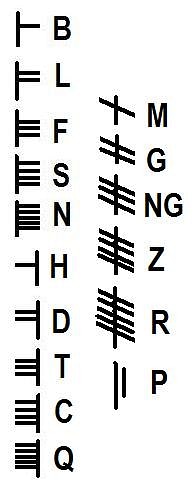 Ogham Script: Consonants Rico38 (CC BY-SA) ](https://www.worldhistory.org/image/654/ogham-script-consonants/ "Ogham Script: Consonants")
[Phoenician colonization](https://www.worldhistory.org/Phoenician_Colonization/) allowed the script to be spread across the [Mediterranean](https://www.worldhistory.org/disambiguation/mediterranean/). In [Greece](https://www.worldhistory.org/greece/), the script was modified to add the vowels, giving rise to the first true alphabet. The Greeks took letters which did not represent sounds that existed in [Greek](https://www.worldhistory.org/disambiguation/greek/) and changed them to represent the vowels. This marks the creation of a "true" alphabet, with both vowels and consonants as explicit symbols in a single script. In its early years, there were many variants of the [Greek alphabet](https://www.worldhistory.org/Greek_Alphabet/), a situation which caused many different alphabets to evolve from it.
The Cumae form of the Greek alphabet was carried over by Greek colonists from Euboea to the Italian peninsula, where it gave rise to a variety of alphabets used to inscribe the Italic languages. One of these became the Latin alphabet, which was spread across [Europe](https://www.worldhistory.org/europe/) as the Romans expanded their [empire](https://www.worldhistory.org/empire/). Even after the fall of the [Roman Empire](https://www.worldhistory.org/Roman_Empire/), the alphabet survived in intellectual and religious works. It eventually became used for the descendant languages of Latin (the Romance languages) and then for the other languages of Europe.
#### Editorial Review
This human-authored definition has been reviewed by our editorial team before publication to ensure accuracy, reliability and adherence to academic standards in accordance with our [editorial policy](https://www.worldhistory.org/static/editorial-policy/).
## About the Author
Jan is the Founder & Chairman of World History Encyclopedia and is the organisation's Director of Design & Technology. He holds an MA War Studies from King's College, and he has worked in the field of history-related digital media since 2006.
- [Linkedin Profile](https://www.linkedin.com/in/janvdc)
## Timeline
- **c. 3200 BCE**: Hieroglyphic [script](https://www.worldhistory.org/script/) developed in [Egypt](https://www.worldhistory.org/egypt/).
- **c. 2000 BCE - c. 1650 BCE**: Cretan Hieroglyphic [script](https://www.worldhistory.org/script/) is in use.
- **c. 1850 BCE - c. 1450 BCE**: The [Linear A script](https://www.worldhistory.org/Linear_A_Script/) of the [Minoan civilization](https://www.worldhistory.org/Minoan_Civilization/) is in use.
- **c. 1600 BCE**: Canaanite [alphabet](https://www.worldhistory.org/alphabet/).
- **c. 1400 BCE**: Ugaritic [alphabet](https://www.worldhistory.org/alphabet/) of 30 letters is invented.
- **1100 BCE**: Phoenician [alphabet](https://www.worldhistory.org/alphabet/).
- **c. 1000 BCE**: [Death](https://www.worldhistory.org/disambiguation/Death/) of Ahiram (or Ahirom) of [Byblos](https://www.worldhistory.org/Byblos/), whose sarcophagus bears the oldest inscription of the Phoenician [alphabet](https://www.worldhistory.org/alphabet/).
- **800 BCE**: Earliest examples of [Greek](https://www.worldhistory.org/disambiguation/greek/) alphabetic [script](https://www.worldhistory.org/script/).
- **c. 350 CE - c. 950 CE**: Estimated use of the [Ogham](https://www.worldhistory.org/Ogham/) in [Ireland](https://www.worldhistory.org/disambiguation/Ireland/) and southwestern [England](https://www.worldhistory.org/disambiguation/england/).
## External Links
- [Greek alphabet](http://en.wikipedia.org/wiki/Greek_alphabet)
- [Phoenician alphabet](http://en.wikipedia.org/wiki/Phoenician_alphabet)
- [Armenian Alphabet is Catalyst for Cultural Endurance](https://www.peopleareculture.com/armenian-alphabet/)
## Cite This Work
### APA
Crabben, J. v. d. (2011, April 28). Alphabet. *World History Encyclopedia*.
### Chicago
Crabben, Jan van der. "Alphabet." *World History Encyclopedia*, April 28, 2011. .
### MLA
Crabben, Jan van der. "Alphabet." *World History Encyclopedia*, 28 Apr 2011, .
## License & Copyright
Submitted by [Jan van der Crabben](https://www.worldhistory.org/user/jvdc/ "User Page: Jan van der Crabben"), published on 28 April 2011. The copyright holder has published this content under the following license: [Creative Commons Attribution-NonCommercial-ShareAlike](https://creativecommons.org/licenses/by-nc-sa/4.0/deed.en). This license lets others remix, tweak, and build upon this content non-commercially, as long as they credit the author and license their new creations under the identical terms. When republishing on the web a hyperlink back to the original content source URL must be included. Please note that content linked from this page may have different licensing terms.