---
title: Agrigento
author: Mark Cartwright
source: https://www.worldhistory.org/agrigento/
format: machine-readable-alternate
license: Creative Commons Attribution-NonCommercial-ShareAlike (https://creativecommons.org/licenses/by-nc-sa/4.0/)
updated: 1970-01-01
---
# Agrigento
_Authored by [Mark Cartwright](https://www.worldhistory.org/user/markzcartwright/)_
Agrigento ([Greek](https://www.worldhistory.org/disambiguation/greek/): Akragas, Latin: Agrigentum) was a Greek-founded [city-state](https://www.worldhistory.org/Polis/) located on the south coast of [Sicily](https://www.worldhistory.org/sicily/) near the river Akragas (now S. Biagio) just 5 km from the sea. At its peak, the [city](https://www.worldhistory.org/city/) may have had as many as 300,000 inhabitants, and it was enclosed by over 12 km of fortification walls which included nine gates. The prosperity of Agrigento is attested by the magnificent 5th-century BCE [architecture](https://www.worldhistory.org/disambiguation/architecture/) which survives today and which makes it one of the most impressive archaeological sites in the [Mediterranean](https://www.worldhistory.org/disambiguation/mediterranean/). Agrigento is listed by UNESCO as a World Heritage Site.
### Historical Overview
In [mythology](https://www.worldhistory.org/mythology/), Agrigento was founded by [Daedalus](https://www.worldhistory.org/Daedalus/) and his son Icarus following their flight from [Crete](https://www.worldhistory.org/crete/), but in the historical record, the city-state or *[polis](https://www.worldhistory.org/Polis/)* was founded c. 580 BCE by settlers from [Rhodes](https://www.worldhistory.org/Rhodes/) and Crete who had a century earlier founded the nearby city of [Gela](https://www.worldhistory.org/Gela/). The most notable early ruler was the tyrant Phalaris (c. 570-549 BCE) who expanded the city's influence in the surrounding territory and built the impressive fortification walls. The tyrant became famous in legend because of his innovative approach to executions. The condemned were put inside a huge [bronze](https://www.worldhistory.org/disambiguation/bronze/) bull which was then heated over a fire. Phalaris was tickled by the screams coming from inside the bull which made it seem like the animal was bellowing with rage.
A similar period of local dominance was enjoyed during the reign of another tyrant Theron (c. 489-473 BCE) who was noted as a just ruler and patron of the arts. Siding with [Syracuse](https://www.worldhistory.org/syracuse/) against [Carthage](https://www.worldhistory.org/carthage/), the city prospered following the [battle](https://www.worldhistory.org/disambiguation/battle/) of Himera in 480 BCE, although there was a significant battle with Hieron, the tyrant of Syracuse, in c. 472 BCE. From this period the city became known for its architectural splendour, especially its large Doric temples built using sandstone. So much so, that [Pindar](https://www.worldhistory.org/Pindar/), in [writing](https://www.worldhistory.org/writing/) an ode to an Olympic victor, wrote: "Akragas, the most beautiful city the mortals had ever built." Diodorus described the city as one of the richest in the Greek world and the noted philosopher and medical expert [Empedocles](https://www.worldhistory.org/Empedocles/) (c. 492-432 BCE), who came from Agrigento, famously said of the city's inhabitants and their easy living: "...they party as if they will die tomorrow, and build as if they will live for ever."
Agrigento was neutral in the [war](https://www.worldhistory.org/disambiguation/War/) between [Athens](https://www.worldhistory.org/Athens/) and Syracuse in 413 BCE but was attacked, besieged for seven months, and then destroyed by the Carthaginians in 406 BCE - emphatic revenge for their defeat at Himera in 480 BCE. The town did eventually recover and became an important [Hellenistic](https://www.worldhistory.org/Hellenic_World/) settlement, but Agrigento was again sacked in 262 BCE and 210 BCE, this time by the Romans. However, the new masters did ensure a new period of prosperity for Agrigento. The Hellenistic-[Roman](https://www.worldhistory.org/disambiguation/Roman/) area of the city survives in part today and was laid out in a regular grid pattern with six principal roads dividing the town into bands. Villas with surviving frescoes and mosaics attest to the wealth enjoyed by some of the city's residents. The town continued to prosper into the [Byzantine](https://www.worldhistory.org/disambiguation/Byzantine/) period and the distinctive semicircular tombs carved into the sandstone rocks can still be seen by the modern visitor.
[  Temple of Juno, Agrigento Mark Cartwright (CC BY-NC-SA) ](https://www.worldhistory.org/image/2625/temple-of-juno-agrigento/ "Temple of Juno, Agrigento")### Archaeological Remains
**The [Temple](https://www.worldhistory.org/temple/) of Concord**
Constructed between 450 and 430 BCE, it is one of the best-preserved Greek temples anywhere and is often described as the [Parthenon](https://www.worldhistory.org/parthenon/) of [Magna Graecia](https://www.worldhistory.org/Magna_Graecia/). Measuring 40 x 17 metres, the Doric temple was probably dedicated to [Castor and Pollux](https://www.worldhistory.org/Castor_and_Pollux/). The interior consists of a *pronaos*, *cella*, and *opistodomos*, where treasure, offerings, and public records were kept. There are six columns on each façade and 13 along the longer sides; each consists of four fluted drums. The frieze has alternating triglyphs and plain metopes. The temple is in such good condition largely because it was converted into a Christian basilica in 597 CE when the interior was converted into arcades with three naves.
**The Temple of the [Dioscuri](https://www.worldhistory.org/Castor_and_Pollux/) (Castor & Pollux)**
The name is a convention and the remains today were reconstructed in the 19th century CE. Originally, the 5th-century BCE temple measured around 34 x 16 metres and had a 6 x 13 arrangement of external columns. It was destroyed in the siege of 406 BCE. In front of the temple is a circular altar, once used to sacrifice animals and pour libations in religious ceremonies and an important part of the sanctuary to [Demeter](https://www.worldhistory.org/demeter/) and [Persephone](https://www.worldhistory.org/persephone/).
**The Temple of [Hercules](https://www.worldhistory.org/hercules/)**
The oldest temple at the site was built c. 510 BCE in honour of the Greek hero Hercules who was particularly revered at Agrigento. The temple base measures 73.9 x 27.7 metres and the full height would have been around 16 metres. Originally, there were 6 columns on each façade and 15 along the sides, but today only nine are still standing, re-erected in 1922 CE. Each [column](https://www.worldhistory.org/column/) was composed of four fluted drums and the pediment would have carried decorative [sculpture](https://www.worldhistory.org/disambiguation/Sculpture/). A bronze statue once stood in the interior.
**The Temple of [Juno](https://www.worldhistory.org/Juno/) ([Hera](https://www.worldhistory.org/Hera/) Lacinia)**
Constructed between 450 and 430 BCE, the Doric temple measured around 41 x 20 metres and 15.3 m in height. Originally, there were six columns on each façade and 13 along the long sides. Each column consists of four drums and 30 are still standing today. Interestingly, one can still see here and there the black stains of fire damage caused by the Carthaginian attack in 406 BCE. Within the temple stood a statue of the goddess, Hera (Roman name: Juno), revered for her role as protectress of marriages and wedding ceremonies, and rites would have once taken place outside the temple; the ruins of the massive altar can still be seen today.
[  Temple of Zeus Model, Agrigento Mark Cartwright (CC BY-NC-SA) ](https://www.worldhistory.org/image/2644/temple-of-zeus-model-agrigento/ "Temple of Zeus Model, Agrigento")**The Temple of [Zeus](https://www.worldhistory.org/zeus/)**
The massive temple of Zeus (or Olympieion) was built in the 480s BCE to commemorate the victory over Carthage at the battle of Himera. One of the largest temples built in antiquity, measuring around 113 x 56 metres and standing on a five-step base, it was 33 metres high and the size of a modern football [stadium](https://www.worldhistory.org/Stadium/). It was also unusual in that instead of the typical external free-standing columns, the unusually thick columns (7 on the façades x 14 on the long sides) were engaged in a half-[wall](https://www.worldhistory.org/wall/), and the upper interspaces between the columns were filled with huge atlantide figures (the male version of the [caryatid](https://www.worldhistory.org/Caryatid/), also known as *telemones*) seemingly holding up the roof with their bent arms. These 38 [god](https://www.worldhistory.org/God/)-like figures were 7.6 metres tall, but their exact positioning is still debated by scholars. The height of the temple columns alone was 16.88 metres, and their width at the base 4.22 metres. According to Diodorus, the pediments had sculptures representing a gigantomachy and scenes from the [Trojan War](https://www.worldhistory.org/Trojan_War/).
The temple is also an early and rare example in [Greek architecture](https://www.worldhistory.org/Greek_Architecture/) of the use of iron within the stone blocks. Slots were cut into the stones of the architrave into which were placed iron bars (31 x 10 cm) which provided structural support while the stones were assembled into position. They had no beneficial effect once the blocks were in place but provided tensile strength whilst construction was ongoing for the large architrave blocks which spanned the unusually large gap between columns. The temple was actually not quite finished when it was destroyed by the Carthaginians in 406 BCE.
**Theron's [Tomb](https://www.worldhistory.org/tomb/)**
Tradition ascribed this monument to Theron, considering it his tomb, but, in fact, the structure is a 1st-century BCE Roman monument probably commemorating the siege of 262 BCE. A combination of Doric and Ionic architectural elements, the monument is 9.3 m high and 5.2 m wide. A slender [pyramid](https://www.worldhistory.org/pyramid/), now lost, once stood atop the structure.
[ 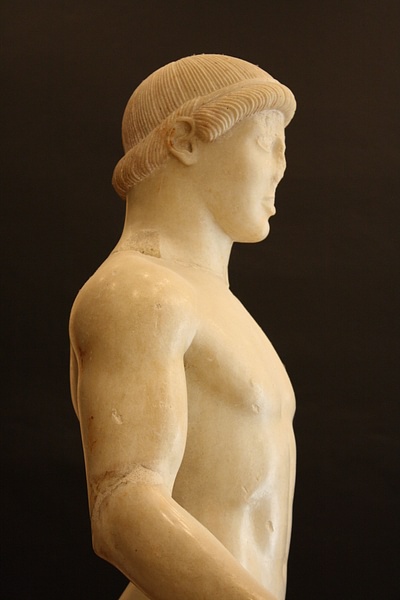 Kouros (The Agrigento Youth) Mark Cartwright (CC BY-NC-SA) ](https://www.worldhistory.org/image/2623/kouros-the-agrigento-youth/ "Kouros (The Agrigento Youth)")### Other Structures & Artefacts
Other structures of note are the temple of [Hephaistos](https://www.worldhistory.org/Hephaistos/), built c. 430 BCE, of which only two columns and a part of the base survive. There is also the temple of [Asclepius](https://www.worldhistory.org/Asclepius/), the centrepiece of a 10,000 square metre sanctuary to the god of healing constructed between 400 and 390 BCE. Finally, there is also a well-preserved 4th-century BCE Ekklesiasterion, once used for public assemblies.
Unsurprisingly for such an important settlement, the site is also a rich source of artefacts dating back to the [Neolithic period](https://www.worldhistory.org/Neolithic/). Star pieces include some of the huge atlantides from the temple of Zeus, a fine marble kouros, an expressive marble warrior torso, finely carved Roman sarcophagi, and an excellent selection of Greek red and [black-figure pottery](https://www.worldhistory.org/Black_Figure_Pottery/). These are all housed in the Archaeological Museum of Agrigento.
#### Editorial Review
This human-authored definition has been reviewed by our editorial team before publication to ensure accuracy, reliability and adherence to academic standards in accordance with our [editorial policy](https://www.worldhistory.org/static/editorial-policy/).
## Bibliography
- [Campbell, B. *The Oxford Handbook of Warfare in the Classical World.* Oxford University Press, 2013.](https://www.worldhistory.org/books/0195304659/)
- Di Giovanni, G. *Agrigento.* Siculgrafica, 1972
- Dragotta, S.M. *Sicily.* Polygraf, 1978
- [Durando, F. *Ancient Greece.* Stewart Tabori & Chang, 1997.](https://www.worldhistory.org/books/1556706014/)
- [Hornblower, S. *The Oxford Classical Dictionary.* Oxford University Press, 2012.](https://www.worldhistory.org/books/0199545561/)
- [Kinzl, K.H. *A Companion to the Classical Greek World.* Wiley-Blackwell, 2006.](https://www.worldhistory.org/books/0631230149/)
- [Oleson, J.P. *The Oxford Handbook of Engineering and Technology in the Classical World.* Oxford University Press, 2009.](https://www.worldhistory.org/books/0199734852/)
- [Strassler. *The Landmark Thucydides.* Free Press, 1998.](https://www.worldhistory.org/books/0684827905/)
- [Strassler. *The Landmark Xenophon's Hellenika.* Pantheon, 2009.](https://www.worldhistory.org/books/B0064X7OE2/)
## About the Author
Mark is WHE’s Publishing Director and has an MA in Political Philosophy (University of York). He is a full-time researcher, writer, historian and editor. Special interests include art, architecture and discovering the ideas that all civilizations share.
## Timeline
- **c. 580 BCE**: [Agrigento](https://www.worldhistory.org/agrigento/) in [Sicily](https://www.worldhistory.org/sicily/) is founded by colonists from [Gela](https://www.worldhistory.org/Gela/), [Crete](https://www.worldhistory.org/crete/) and [Rhodes](https://www.worldhistory.org/Rhodes/).
- **c. 570 BCE - c. 549 BCE**: The tyrant Phalaris rules [Agrigento](https://www.worldhistory.org/agrigento/), expanding its territory.
- **c. 510 BCE**: The [temple](https://www.worldhistory.org/temple/) of [Hercules](https://www.worldhistory.org/hercules/) is built at [Agrigento](https://www.worldhistory.org/agrigento/).
- **492 BCE - 432 BCE**: Life of the philosopher Empidocles of [Agrigento](https://www.worldhistory.org/agrigento/).
- **c. 489 BCE - c. 473 BCE**: The tyrant Theron rules [Agrigento](https://www.worldhistory.org/agrigento/).
- **480 BCE**: [Agrigento](https://www.worldhistory.org/agrigento/) defeats [Carthage](https://www.worldhistory.org/carthage/) at the [battle](https://www.worldhistory.org/disambiguation/battle/) of Himera.
- **c. 480 BCE**: The huge [temple](https://www.worldhistory.org/temple/) of [Zeus](https://www.worldhistory.org/zeus/) is built at [Agrigento](https://www.worldhistory.org/agrigento/).
- **450 BCE - 430 BCE**: The [Temple](https://www.worldhistory.org/temple/) of Concordia is built at [Agrigento](https://www.worldhistory.org/agrigento/).
- **c. 430 BCE**: The [temple](https://www.worldhistory.org/temple/) of [Hephaistos](https://www.worldhistory.org/Hephaistos/) is built at [Agrigento](https://www.worldhistory.org/agrigento/).
- **413 BCE**: [Agrigento](https://www.worldhistory.org/agrigento/) remains neutral in the [war](https://www.worldhistory.org/disambiguation/War/) between [Athens](https://www.worldhistory.org/Athens/) and [Syracuse](https://www.worldhistory.org/syracuse/).
- **406 BCE**: [Agrigento](https://www.worldhistory.org/agrigento/) is attacked and destroyed by [Carthage](https://www.worldhistory.org/carthage/).
- **400 BCE - 390 BCE**: A sanctuary to [Asclepius](https://www.worldhistory.org/Asclepius/) is built at [Agrigento](https://www.worldhistory.org/agrigento/).
- **282 BCE**: [Gela](https://www.worldhistory.org/Gela/), on [Sicily](https://www.worldhistory.org/sicily/), is destroyed by Phintias, the tyrant of [Agrigento](https://www.worldhistory.org/agrigento/).
- **262 BCE**: [Rome](https://www.worldhistory.org/Rome/) besieges and sacks [Agrigento](https://www.worldhistory.org/agrigento/) on [Sicily](https://www.worldhistory.org/sicily/) in one of the first actions of the [First Punic War](https://www.worldhistory.org/First_Punic_War/).
- **210 BCE**: [Rome](https://www.worldhistory.org/Rome/) attacks [Agrigento](https://www.worldhistory.org/agrigento/).
## Cite This Work
### APA
Cartwright, M. (2014, May 18). Agrigento. *World History Encyclopedia*.
### Chicago
Cartwright, Mark. "Agrigento." *World History Encyclopedia*, May 18, 2014. .
### MLA
Cartwright, Mark. "Agrigento." *World History Encyclopedia*, 18 May 2014, .
## License & Copyright
Submitted by [Mark Cartwright](https://www.worldhistory.org/user/markzcartwright/ "User Page: Mark Cartwright"), published on 18 May 2014. The copyright holder has published this content under the following license: [Creative Commons Attribution-NonCommercial-ShareAlike](https://creativecommons.org/licenses/by-nc-sa/4.0/deed.en). This license lets others remix, tweak, and build upon this content non-commercially, as long as they credit the author and license their new creations under the identical terms. When republishing on the web a hyperlink back to the original content source URL must be included. Please note that content linked from this page may have different licensing terms.