---
title: Zacchaeus
author: Rebecca Denova
source: https://www.worldhistory.org/Zacchaeus/
format: machine-readable-alternate
license: Creative Commons Attribution-NonCommercial-ShareAlike (https://creativecommons.org/licenses/by-nc-sa/4.0/)
updated: 2024-04-24
---
# Zacchaeus
_Authored by [Rebecca Denova](https://www.worldhistory.org/user/rdenova/)_
Zacchaeus was a tax collector in the [city](https://www.worldhistory.org/city/) of Jericho during the ministry of [Jesus of Nazareth](https://www.worldhistory.org/Jesus_Christ/) (20s-30s CE). 'Zacchaeus' means "pure" or "innocent" in [Greek](https://www.worldhistory.org/disambiguation/greek/). The story of Zacchaeus became a popular teaching lesson in [early Christianity](https://www.worldhistory.org/article/1205/early-christianity/). He exemplified the idea that a sinner (even a tax collector) could turn (repent) and change his life through the preaching of [Jesus](https://www.worldhistory.org/Jesus_Christ/).
He was elevated as one of the few who could be verified as being in heaven, along with the 'thief' on the cross next to Jesus. Later Christian legend claimed that he became the first Bishop of [Caesarea](https://www.worldhistory.org/disambiguation/Caesarea/) (Apostolic Constitutions, 7:46). He was elevated to sainthood by both the Eastern Orthodox and Western traditions.
### In [the Gospels](https://www.worldhistory.org/The_Gospels/)
Zacchaeus' story is told in the [gospels](https://www.worldhistory.org/The_Gospels/):
> Jesus entered Jericho and was passing through. A man was there by the name of Zacchaeus; he was a chief tax collector and was wealthy. He wanted to see who Jesus was, but because he was short he could not see over the crowd. So he ran ahead and climbed a sycamore-fig tree to see him, since Jesus was coming that way. When Jesus reached the spot, he looked up and said to him, "Zacchaeus, come down immediately. I must stay at your house today." So he came down at once and welcomed him gladly. All the people saw this and began to mutter, "He has gone to be the guest of a sinner." But Zacchaeus stood up and said to the Lord, "Look, Lord! Here and now I give half of my possessions to the poor, and if I have cheated anybody out of anything, I will pay back four times the amount." Jesus said to him, "Today salvation has come to this house, because this man, too, is a son of [Abraham](https://www.worldhistory.org/Abraham,_the_Patriarch/). For the Son of Man came to seek and to save the lost." (Luke 19:1-10).
This description of Zacchaeus as a son of Abraham is a reference to the early inclusion of Gentiles in the Christian movement. The name, Abraham, meant "father of the nations," in this case non-Jews as well. [Paul](https://www.worldhistory.org/disambiguation/Paul/) consistently used Abraham as a model to argue that [God](https://www.worldhistory.org/God/) had always intended to include Gentiles in salvation.
### Tax Collectors in the [Roman Empire](https://www.worldhistory.org/Roman_Empire/)
The [Roman](https://www.worldhistory.org/disambiguation/Roman/) method of collecting taxes in the [empire](https://www.worldhistory.org/empire/) was instituted by issuing public contracts through the *aediles* (magistrates) and the [Roman Senate](https://www.worldhistory.org/Roman_Senate/). Potential contractors submitted bids, demonstrating how much they could collect in regions of the provinces. The name of the contractors was rendered "publicans" in the King James [Bible](https://www.worldhistory.org/bible/). Then as now, tax collectors were unpopular. There was no government salary, so tax collectors were always perceived as skimming off the top to pay themselves first.
Jericho, where Zacchaeus' story takes place, was famous for producing balsam (sometimes rendered "spices"), which was a perfume resin that was applied in the coronation rituals of kings and oils used by priests (Exodus 25:6). In visiting King [Solomon](https://www.worldhistory.org/solomon/), it was reported that the [Queen of Sheba](https://www.worldhistory.org/Queen_of_Sheba/) brought him an abundance of the oils as a gift (1 Kings 10:10). The product and the area were mentioned by Strabo the geographer (63 BCE to 24 CE) and the naturalist, [Pliny the Elder](https://www.worldhistory.org/Pliny_the_Elder/) (24-79 CE). As clients of [Rome](https://www.worldhistory.org/Rome/), tax collectors were particularly hated in 1st-century Judea, in the decades leading up to the eventual [Great Jewish Revolt of 66 CE](https://www.worldhistory.org/article/823/the-great-jewish-revolt-of-66-ce/).
The average person in the 1st century CE could identify with the consistent negative views of tax collectors. According to Jesus in Matthew 18:17, "If they still refuse to listen, tell it to the church; and if they refuse to listen even to the church, treat them as you would a pagan or a tax collector." In Luke 3:12-13, in the crowds who came to [John the Baptist](https://www.worldhistory.org/John_the_Baptist/), "Even tax collectors came to be baptized. 'Teacher,' they asked, 'what should we do?' 'Don’t collect any more than you are required to,' he told them."
In relation to religious issues, scholars reconstruct the views of the [Pharisees](https://www.worldhistory.org/Pharisees/) who were noted for their more literal interpretations of Jewish [law](https://www.worldhistory.org/disambiguation/law/). As clients of Rome, tax collectors would meet socially for meals with their Roman overlords. Pharisees most likely assumed that the Jewish tax collectors would violate Jewish dietary laws. The tacit implication of the story of Zacchaeus is the shock that Jesus would elevate a sinner.
[  The Pharisees and the Sadducees Come to Tempt Jesus James Tissot (Public Domain) ](https://www.worldhistory.org/image/15196/the-pharisees-and-the-sadducees-come-to-tempt-jesu/ "The Pharisees and the Sadducees Come to Tempt Jesus")### The Call of Matthew
The writer of the gospel that became known as Matthew was a tax collector: "As Jesus went on from there, he saw a man named Matthew sitting at the tax collector's booth. 'Follow me,' he told him, and Matthew got up and followed him" (Matthew 9:9). However, problematically, both [Mark](https://www.worldhistory.org/disambiguation/Mark/) and Luke claim that his name was Levi (as the son of Alphaeus in Luke). The 2nd-century Church Fathers who eventually named the gospels took this as a sign that the author provided this note to his identity, and so it became the gospel according to Matthew.
In the 2nd century CE, the Christian philosopher, Clement of [Alexandria](https://www.worldhistory.org/alexandria/) (150-215 CE) associated Matthew the tax collector with the election of a man named Matthias who replaced Judas (Acts 2), but most [New Testament](https://www.worldhistory.org/New_Testament/) historians consider the latter individual as a different follower. Luke claimed that Matthias was with Jesus from the very beginning of the ministry.
### Tax Collectors & Sinners
In Mark, Matthew, and Luke, tax collectors are consistently paired with sinners. Their association was often in relation to meals:
> While Jesus was having dinner at Matthew's house, many tax collectors and sinners came and ate with him and his disciples. When the Pharisees saw this, they asked his disciples, "Why does your teacher eat with tax collectors and sinners?" On hearing this, Jesus said, "It is not the healthy who need a doctor, but the sick. But go and learn what this means: 'I desire mercy, not sacrifice.' \[paraphrasing [Hosea](https://www.worldhistory.org/Hosea/) 6:6\]. For I have not come to call the righteous, but sinners." (Matthew 9:10-13)
'Sinners' was a generic term for those who violated the morals and commandments of [Moses](https://www.worldhistory.org/Moses/). In the social context of meals in the ancient world, the claim that Jesus ate with these sinners meant sharing his dining couch. In one of Matthew's famous railings against the Pharisees, Jesus claimed that prostitutes will get into heaven before the Pharisees. So sinners in this charge, connected with tax collectors have always been understood to mean immoral [women](https://www.worldhistory.org/disambiguation/women/). [Prostitution in the ancient Mediterranean](https://www.worldhistory.org/article/1797/prostitution-in-the-ancient-mediterranean/) was common, and prostitutes in Judea were also known for their work with Gentile clients, including Romans. The allegation is drawn from the overall cultural image that any women present at a meal with men would either be slaves (whose morality was assumed to be deficient) or prostitutes.
[ 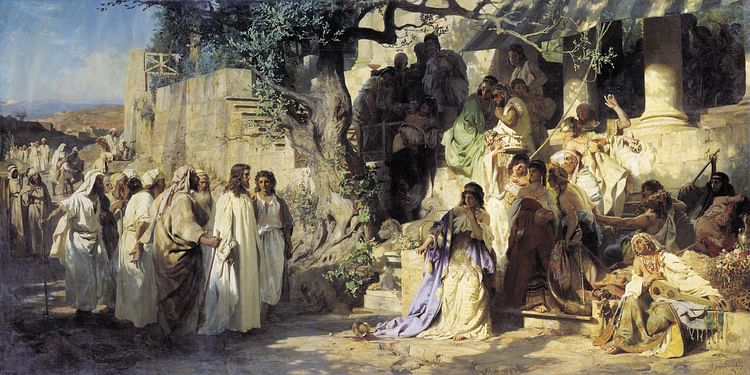 Christ and Sinner Henryk Siemiradzki (Public Domain) ](https://www.worldhistory.org/image/15319/christ-and-sinner/ "Christ and Sinner")Tax collectors were also the foil in the polemic against the Pharisees. We have Luke's parable of the Pharisee and the tax collector:
> To some who were confident of their own righteousness and looked down on everyone else, Jesus told this parable: "Two men went up to the [temple](https://www.worldhistory.org/temple/) to pray, one a Pharisee and the other a tax collector. The Pharisee stood by himself and prayed: 'God, I thank you that I am not like other people—robbers, evildoers, adulterers—or even like this tax collector. I fast twice a week and give a tenth of all I get.' But the tax collector stood at a distance. He would not even look up to heaven, but beat his breast and said, 'God, have mercy on me, a sinner.' I tell you that this man, rather than the other, went home justified before God. For all those who exalt themselves will be humbled, and those who humble themselves will be exalted." (Luke 18:9-14)
### Zacchaeus in the Eastern & Western Traditions
In the Eastern Orthodox traditions, the story of Zacchaeus is read on the last Sunday before Lent (known as Zacchaeus Sunday). It was selected because of Zacchaeus humbling himself by coming down from the tree, and his subsequent repentance for his sins.
[ 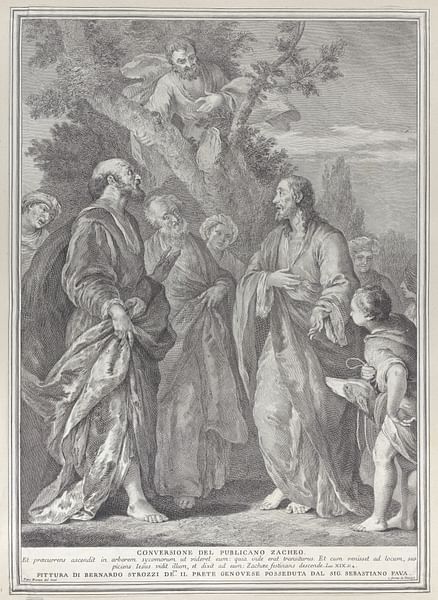 Conversion of Zacchaeus Bernardo Strozzi and Pietro Monaco (Copyright) ](https://www.worldhistory.org/image/15292/conversion-of-zacchaeus/ "Conversion of Zacchaeus")In Western Christian traditions, because of his name which meant "pure," he is often related to Matthew's [Sermon on the Mount](https://www.worldhistory.org/article/2547/sermon-on-the-mount/): "Blessed are the pure of heart, for they shall see God" (5:8). Zacchaeus is often contrasted with the story of the rich young man in Matthew 19:16-30, Mark 10:17-31, Luke 18:18-30: He asked of Jesus, "Good teacher, what must I do to inherit eternal life?" (Luke 18:18) After relating that he had always followed the Law of Moses, Jesus said: "You still lack one thing. Sell everything you have and give to the poor, and you will have treasure in heaven. Then come, follow me." (Luke 18:22) When he heard this, he became very sad, because he was very wealthy.
In 1166, an ancient [tomb](https://www.worldhistory.org/tomb/) containing a body was discovered in Rocamadour in the Dordogne region of France. The locals named him Amator ("lover" or "friend"), and he later became identified as Zacchaeus with the added detail that he was married to Saint Veronica, and both were persecuted and driven from [Palestine](https://www.worldhistory.org/palestine/). Seeking refuge in France, after the [death](https://www.worldhistory.org/disambiguation/Death/) of Veronica, Zacchaeus became a hermit and founded a chapel dedicated to Mary at Rocamadour.
#### Editorial Review
This human-authored definition has been reviewed by our editorial team before publication to ensure accuracy, reliability and adherence to academic standards in accordance with our [editorial policy](https://www.worldhistory.org/static/editorial-policy/).
## Bibliography
- [Abbott, Frank Frost & Johnson, Allan Chester. *Municipal Administration in the Roman Empire.* Quid Pro, LLC, 2012.](https://www.worldhistory.org/books/1610279174/)
- [Morris, Leon L. *Luke.* IVP Academic, 2008.](https://www.worldhistory.org/books/0830842330/)
## About the Author
Rebecca I. Denova, Ph.D. is Emeritus Professor of Early Christianity in the Department of Religious Studies, University of Pittsburgh. She has recently completed a textbook, "The Origins of Christianity and the New Testament" (Wiley-Blackwell)
## Cite This Work
### APA
Denova, R. (2022, March 03). Zacchaeus. *World History Encyclopedia*.
### Chicago
Denova, Rebecca. "Zacchaeus." *World History Encyclopedia*, March 03, 2022. .
### MLA
Denova, Rebecca. "Zacchaeus." *World History Encyclopedia*, 03 Mar 2022, .
## License & Copyright
Submitted by [Rebecca Denova](https://www.worldhistory.org/user/rdenova/ "User Page: Rebecca Denova"), published on 03 March 2022. The copyright holder has published this content under the following license: [Creative Commons Attribution-NonCommercial-ShareAlike](https://creativecommons.org/licenses/by-nc-sa/4.0/deed.en). This license lets others remix, tweak, and build upon this content non-commercially, as long as they credit the author and license their new creations under the identical terms. When republishing on the web a hyperlink back to the original content source URL must be included. Please note that content linked from this page may have different licensing terms.