---
title: Xanadu: Kublai Khan's Fabled Capital
author: Mark Cartwright
source: https://www.worldhistory.org/Xanadu/
format: machine-readable-alternate
license: Creative Commons Attribution-NonCommercial-ShareAlike (https://creativecommons.org/licenses/by-nc-sa/4.0/)
updated: 2025-11-27
---
# Xanadu: Kublai Khan's Fabled Capital
_Authored by [Mark Cartwright](https://www.worldhistory.org/user/markzcartwright/)_
Xanadu (aka Shangdu, Shang-tu, and Kaiping) located in Inner Mongolia, northern [China](https://www.worldhistory.org/china/), was first the capital (1263-73) and then the summer capital (1274-1364) of the [Mongol Empire](https://www.worldhistory.org/Mongol_Empire/). It came to prominence during the reign of [Kublai Khan](https://www.worldhistory.org/Kublai_Khan/) (r. 1260-1294) and was famous for its palaces, gardens and waterways.
Xanadu received lasting fame in the western world thanks to the Venetian explorer [Marco Polo](https://www.worldhistory.org/Marco_Polo/)'s description of it in his celebrated book *Travels* (c. 1298). The [city](https://www.worldhistory.org/city/) received another boost in the popular imagination when it was made the subject of a poem by [Samuel](https://www.worldhistory.org/samuel/) Taylor Coleridge (1772-1834). Distant and mysteriously lost Xanadu, thus, came to represent a place of mystery, splendid luxury and easy living. Although only ruins remain today of the city, it is listed by UNESCO as a World Heritage Site.
### The Summer Capital
In the 13th century, the [Mongol](https://www.worldhistory.org/Mongol_Empire/) [Empire](https://www.worldhistory.org/empire/) ruled most of Asia and their capital was moved from [Karakorum](https://www.worldhistory.org/Karakorum/) (Qaraqorum) in Mongolia to Xanadu in northeast China in 1263. Kublai Khan's first name for the new capital was Kaiping, but he then renamed it Xanadu/Shangdu, meaning 'Upper Capital' in 1273 when the capital was moved again, this time to Daidu (aka Khanbaliq), which is now Beijing, just 125 kilometres (78 miles) to the southeast. Daidu, construction of which had begun back in 1266-7, became a potent symbol of the Mongol takeover of China and the establishment of the Mongol [Yuan Dynasty](https://www.worldhistory.org/Yuan_Dynasty/) (1271-1368).
Xanadu was far from abandoned, though, and from 1274 Kublai Khan and his court moved back to Xanadu each summer because of its cooler climate. Xanadu functioned as the summer capital until the fall of the Yuan dynasty in 1364. The city's blend of Mongol and Chinese elements such as [architecture](https://www.worldhistory.org/disambiguation/architecture/) and [Buddhist](https://www.worldhistory.org/buddhism/) temples, its use as a place of hunting - which the [Mongols](https://www.worldhistory.org/Mongol_Empire/) had a great passion for, and its location on the edge of the grasslands of the steppe and China's agricultural plains, made it another symbol of the new regime; the future was to be a mix of traditional nomadic and farming cultures. This cultural mix did not appeal to everyone, and many Mongols considered that their rulers had abandoned their traditions to become soft-living Chinese. Conversely, Chinese officials noted with dismay the lack of formal imperial protocol at the summer capital. Xanadu survived the fall of the Yuan Dynasty, but after a period of neglect, it was definitively abandoned around 1430.
[  Map of Yuan Dynasty China Arab Hafez (Public Domain) ](https://www.worldhistory.org/image/11234/map-of-yuan-dynasty-china/ "Map of Yuan Dynasty China")### Layout & Buildings
The khan himself shunned his nomadic roots and, unlike his grandfather, the Mongol Empire's founder [Genghis Khan](https://www.worldhistory.org/Genghis_Khan/) (r. 1206-1227), he decided he had had enough of living in [yurt](https://www.worldhistory.org/Yurt/) tents and instead had a fine [palace](https://www.worldhistory.org/disambiguation/palace/) built. The city, designed by Kublai's Chinese advisor Liu Bingzhong (1216-1274), was also given earth circuit walls and towers, creating the classic Chinese square plan for the whole city. The outer walls were some 3.5 to 5.5 metres (12-18 ft) in height and access was provided by six gates - two on the east and west sides and one each on the others. Each side of the perimeter [wall](https://www.worldhistory.org/wall/) had six towers. The entire city covered 25,000 hectares and boasted a population of around 200,000 people at its peak. There was an ample supply of water thanks to the abundance of natural springs in the area. Buildings and streets were carefully laid out considering the principles of Feng Shui, especially in relation to the mountains in the north and river to the south. Indeed, the whole city was laid out on a north-south axis with three distinct areas: the Inner City and the Outer City, and an enclosed hunting preserve.
The Outer City, where most people lived, was packed with mud and board housing. The Inner City was separated from the Outer City by a brick wall some 3-5 metres (10-16 ft) in height and which had four towers. These walls created another square area within the outer square. Here Kublai Khan and his entourage resided in a palace which was built upon a raised platform made from earth reinforced with stones and wooden beams. The palace and other buildings at the site such as the major temples were built using a mix of wood, stone, marble, and glazed tiles. To the immediate northwest of the city was a hunting preserve which consisted of meadows, woods, and lakes and which was populated by semi-tamed animals such as deer. The hunting preserve was also used for falconry and keeping herds of white mares and special cows whose milk was reserved for the khans and those given that privilege. To keep the animals in and the uninvited out, the whole preserve was enclosed in an earth wall and moat.
#### Book Promotion
[  ](https://amzn.to/4isZ4B5 "The Forsaken 14th Century")### The Forsaken 14th Century
by World History Encyclopedia WHE's first book takes a truly global outlook and introduces readers to the different cultures that survived, thrived, and fell amid adversity in the 14th century. Filled with in-depth text written by WHE authors, many exclusive maps, and plenty of illustrations, The Forsaken 14th Century takes you on a global journey from the nomads of the Mongol Empire to the Black Death in Europe, the booming trade on the Swahili Coast to the Aztecs and the Māori settlements in New Zealand. [Learn More](https://amzn.to/4isZ4B5)
.sponsor.book img.key_art {
box-shadow: none !important;
}
.button_container {
margin-top: 1em;
}
.sponsor.book h3 {
text-transform: none;
margin-top: 0px;
margin-bottom: 15px;
font-family: "Libre Baskerville", "Palatino Linotype", "Book Antiqua", Palatino, serif;
}
.sponsor_message {
margin-left: 190px;
font-family: Karla, Arial, Helvetica, sans-serif;
line-height: 140%;
min-height: 200px;
}
.sponsor.book {
padding: 20px;
margin: 25px 0px;
background-color: #f3f3f3;
}
.sponsor.book .key_art {
margin-top: 0px;
margin-bottom: 10px;
float: left;
}
.sponsor h4 {
font-weight: bold;
text-transform: uppercase;
color: #000;
margin-bottom: 10px;
margin-top: 0px;
font-family: Karla,Arial,Helvetica,sans-serif;
font-size: 13px;
padding: 0;
}
.sponsor_book_author {
color: #999;
margin: -10px 0px 20px;
}
@media (max-width: 1199px) {
.sponsor.book .key_art {
float: none;
width: 100%;
}
.sponsor.book .sponsor_message {
margin-left: 0px;
}
.sponsor.book h3 {
margin-top: 20px;
margin-bottom: 10px;
}
}
@media (max-width: 767px) {
}
### A Host to Important Events
The city frequently hosted great feasts and hunting parties but was an important host in other areas, too. In 1260 it had hosted a meeting of the Mongol tribal chiefs, a *kurultai*, to officially proclaim Kublai the Great Khan or 'universal ruler' of the Mongol Empire. In 1275 the Great Khan called another *kurultai* at Xanadu, this time to decide how to proceed in the last stage of his campaign against the [Song Dynasty](https://www.worldhistory.org/Song_Dynasty/) of southern China (960-1279). The Chinese state would ultimately collapse just four years later. The city also played a role in a significant religious development in the region, as a great debate was held concerning the Buddhist and Taoist religions, which led to the spread of Tibetan [Buddhism](https://www.worldhistory.org/buddhism/) across northeast Asia. Finally, the city played host to many travellers eager to see the fabled splendour of Asian rulers, the most famous of these being Marco Polo.
[ 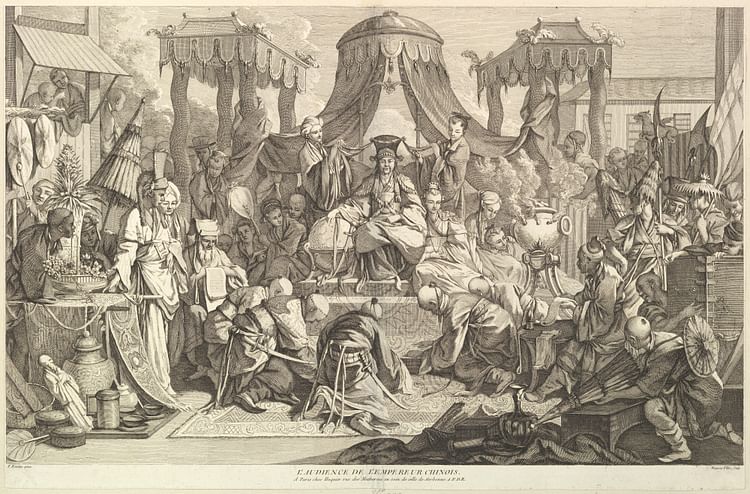 An Audience with a Chinese Emperor Jacques Gabriel Huquier (Copyright) ](https://www.worldhistory.org/image/11233/an-audience-with-a-chinese-emperor/ "An Audience with a Chinese Emperor")### Described by Marco Polo
The Venetian explorer Marco Polo (1254-1324) travelled across Asia and served at Kublai Khan's court between c. 1275 and 1292. On his return to [Europe](https://www.worldhistory.org/europe/), Marco wrote of his experiences in his book *The Travels of Marco Polo* or *Travels (Description of the World)*, first circulated c. 1298. In Book 1, chapter 57 of this extraordinary work, Marco describes Xanadu, which he calls Shandu. Below is an edited extract from that chapter:
> Departing from the city last mentioned \[Changanor\], and proceeding three days' journey in a north-easterly direction, you arrive at a city named Shandu, built by the grand khan Kublai, now reigning. In this he caused a palace to be erected, of marble and other handsome stone, admirable as well for the skill displayed in its execution. The halls and chambers are all gilt, and very handsome…Within the bounds of the royal park there are rich and beautiful meadows, watered by many rivulets, where a variety of animals of the deer and goat kind are pastured, to serve as food for the hawks, and other birds employed in the chase…In the centre of these grounds, where there is a beautiful grove of trees, he has built a royal pavilion, supported upon a colonnade of handsome pillars, gilt and varnished…This spot he has selected for his recreation on account of the mild temperature and salubrity of the air and he accordingly makes it his residence during three months of the year, namely June, July, and August.
### Samuel Taylor Coleridge
Perhaps the most famous work today of the English poet and philosopher Samuel Taylor Coleridge is the *Rime of the Ancient Mariner* (1798) but another of his critically acclaimed poems is *Kubla Khan* (written in 1797, published in 1816), in which he, too, describes Xanadu (although not from any personal experience). The poem is the origin of that now much-used phrase 'pleasure dome.' Below is the opening extract, the full poem may be read [here](https://www.poetryfoundation.org/poems/43991/kubla-khan).
> In Xanadu did Kubla Khan
> A stately pleasure dome decree:
> Where Alph, the sacred river, ran
> Through caverns measureless to man
> Down to a sunless sea.
> So twice five miles of fertile ground
> With walls and towers were girdled round;
> And there were gardens bright with sinuous rills,
> Where blossomed many an incense-bearing tree;
> And here were forests ancient as the hills,
> Enfolding sunny spots of greenery.
[ 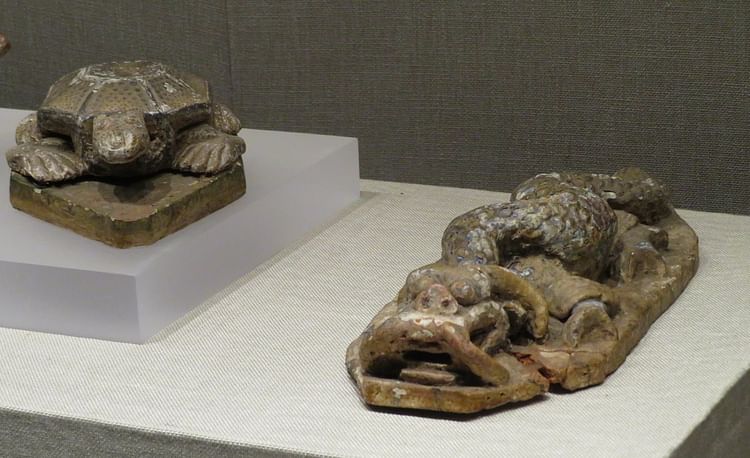 Cardinal Turtle & Dragon from Xanadu BabelStone (CC BY-SA) ](https://www.worldhistory.org/image/11235/cardinal-turtle--dragon-from-xanadu/ "Cardinal Turtle & Dragon from Xanadu")### Legacy
Today the site of Xanadu is listed by UNESCO as a World Heritage Site, and there are ruins and remains of the foundations of palaces, temples, walls, tombs, a canal, and waterways. Xanadu, though, really exists with far greater clarity in the imagination than it does in the reality of ruins. Both Polo and Coleridge's works contributed immeasurably to the mystique of the Far East in western eyes and, in particular, to the idea of a lavish city called Xanadu. That very name came to be associated with mystery, exotica, magnificent splendour, and easy leisure. Consequently, Xanadu has been used as a label to conjure up all of these associations in everything from the title character's mysterious mansion in the film *Citizen Kane* (1941) to a continent on [Titan](https://www.worldhistory.org/Titan/), the largest moon of [Saturn](https://www.worldhistory.org/Saturn/).
#### Editorial Review
This human-authored definition has been reviewed by our editorial team before publication to ensure accuracy, reliability and adherence to academic standards in accordance with our [editorial policy](https://www.worldhistory.org/static/editorial-policy/).
## Bibliography
- [Buell, P.D. *Historical Dictionary of the Mongol World Empire.* Rowman & Littlefield Publishers, 2018.](https://www.worldhistory.org/books/1538111365/)
- [Kubla Khan by Samuel Taylor Coleridge](https://www.poetryfoundation.org/poems/43991/kubla-khan "Kubla Khan by Samuel Taylor Coleridge"), accessed 19 Mar 2020.
- [Lane, G. *Daily Life in the Mongol Empire.* Hackett Publishing Company, Inc., 2009.](https://www.worldhistory.org/books/0872209687/)
- [May, T. *The Mongol Empire.* Edinburgh University Press, 2018.](https://www.worldhistory.org/books/0748642366/)
- [Morgan, D. *The Mongols.* Wiley-Blackwell, 2019.](https://www.worldhistory.org/books/B01FGL17HW/)
- [Polo, M. *The Travels of Marco Polo.* Penguin Classics, 1958.](https://www.worldhistory.org/books/0140440577/)
- [UNESCO Official Site: Xanadu](https://whc.unesco.org/en/list/1389 "UNESCO Official Site: Xanadu"), accessed 19 Mar 2020.
## About the Author
Mark is WHE’s Publishing Director and has an MA in Political Philosophy (University of York). He is a full-time researcher, writer, historian and editor. Special interests include art, architecture and discovering the ideas that all civilizations share.
## Timeline
- **1206 CE - 1368 CE**: The [Mongol Empire](https://www.worldhistory.org/Mongol_Empire/) rules in Central and East Asia.
- **1260 CE - 1294 CE**: Reign of [Kublai Khan](https://www.worldhistory.org/Kublai_Khan/), ruler of the [Mongol Empire](https://www.worldhistory.org/Mongol_Empire/).
- **1263 CE - 1273 CE**: [Xanadu](https://www.worldhistory.org/Xanadu/) is the capital of the [Mongol Empire](https://www.worldhistory.org/Mongol_Empire/).
- **1274 CE - 1364 CE**: [Xanadu](https://www.worldhistory.org/Xanadu/) is the summer capital of the [Mongol Empire](https://www.worldhistory.org/Mongol_Empire/).
- **c. 1275 CE - 1292 CE**: [Marco Polo](https://www.worldhistory.org/Marco_Polo/) serves [Kublai Khan](https://www.worldhistory.org/Kublai_Khan/) in [Mongol](https://www.worldhistory.org/Mongol_Empire/) [Yuan Dynasty](https://www.worldhistory.org/Yuan_Dynasty/) [China](https://www.worldhistory.org/china/).
- **1430 CE**: The [city](https://www.worldhistory.org/city/) of [Xanadu](https://www.worldhistory.org/Xanadu/), once the capital of the [Mongol Empire](https://www.worldhistory.org/Mongol_Empire/), is definitively abandoned.
## Cite This Work
### APA
Cartwright, M. (2019, September 18). Xanadu: Kublai Khan's Fabled Capital. *World History Encyclopedia*.
### Chicago
Cartwright, Mark. "Xanadu: Kublai Khan's Fabled Capital." *World History Encyclopedia*, September 18, 2019. .
### MLA
Cartwright, Mark. "Xanadu: Kublai Khan's Fabled Capital." *World History Encyclopedia*, 18 Sep 2019, .
## License & Copyright
Submitted by [Mark Cartwright](https://www.worldhistory.org/user/markzcartwright/ "User Page: Mark Cartwright"), published on 18 September 2019. The copyright holder has published this content under the following license: [Creative Commons Attribution-NonCommercial-ShareAlike](https://creativecommons.org/licenses/by-nc-sa/4.0/deed.en). This license lets others remix, tweak, and build upon this content non-commercially, as long as they credit the author and license their new creations under the identical terms. When republishing on the web a hyperlink back to the original content source URL must be included. Please note that content linked from this page may have different licensing terms.