---
title: William Tecumseh Sherman: The First Modern General
author: Joshua J. Mark
source: https://www.worldhistory.org/William_Tecumseh_Sherman/
format: machine-readable-alternate
license: Creative Commons Attribution-NonCommercial-ShareAlike (https://creativecommons.org/licenses/by-nc-sa/4.0/)
updated: 2026-11-17
---
# William Tecumseh Sherman: The First Modern General
_Authored by [Joshua J. Mark](https://www.worldhistory.org/user/JPryst/)_
William Tecumseh Sherman (1820-1891) was a Union general in the [American Civil War](https://www.worldhistory.org/American_Civil_War/), best known for his aggressive military campaign, [Sherman's March to the Sea](https://www.worldhistory.org/Sherman's_March_to_the_Sea/), that cut a swath of destruction through Georgia to cripple the Confederacy's will to fight.
Sherman led 62,000 men through Georgia between 15 November and 21 December 1864, living off the land with no supply line, and then continued up through the Carolinas between January and April 1865. His campaign contributed significantly to ending the [war](https://www.worldhistory.org/disambiguation/War/) as the civilian population of the Southern States understood their government could no longer protect them and Sherman was willing to target any site, military or civilian, that could support the war; a tactic used in [warfare](https://www.worldhistory.org/warfare/) ever since, earning him the epithet "The First Modern General."
After the war, Sherman became a target for writers advocating the "Lost Cause" myth – the claim that the Civil War was never about slavery but states' rights and had only been lost because of the North's superior military and industrial strength – who claimed he was a butcher and criminal.
Sherman never targeted the civilian population, however; only sites and industry that could support the war effort. Still, his reputation suffered throughout most of the 20th century. In the past 50 years, scholars have re-evaluated Sherman, and he is now considered one of the greatest generals in US history.
### Early Life & West Point
William Tecumseh Sherman was born on 8 February 1820 in Lancaster, Ohio, to Charles Robert Sherman and Mary Hoyt Sherman, the sixth of eleven children. Charles admired the Shawnee warrior Tecumseh and named his boy after the great [Native American](https://www.worldhistory.org/Native_Peoples_of_North_America/) leader. According to one story, he was given the name *William* as an infant at his Presbyterian baptism; according to another, he received the name when he was nine or ten at a Catholic baptism arranged by his foster mother. Sherman himself insisted his father had named him William Tecumseh.
He was known as "Cump" because his younger siblings could not pronounce Tecumseh (the nickname would follow him through life), and when he was nine years old, his father died of typhoid fever, leaving Mary with eleven children and no means of support. Friends and family rallied to help her.
"Cump" was welcomed into the family of Thomas Ewing, a wealthy attorney who had been a close friend and neighbor of the Shermans. Ewing became the US senator for Ohio and arranged an appointment for Sherman to the US Military Academy at West Point in 1836 when the boy was 16. At West Point, he would become friends with future generals [George H. Thomas](https://www.worldhistory.org/George_H._Thomas/), William Rosecrans, [Braxton Bragg](https://www.worldhistory.org/Braxton_Bragg/), and [P. G. T. Beauregard](https://www.worldhistory.org/P._G._T._Beauregard/).
Sherman did well at West Point academically but found the rules tedious and was punished with roughly 150 demerits each year. He graduated sixth in his class in 1840, was commissioned a second lieutenant, and was then sent to Florida, arriving after the Second Seminole War had ended.
After the mop-up operations in Florida were concluded, he was transferred to a post in Alabama, then Georgia, Louisiana, and South Carolina. During this time, he moved easily in genteel Southern high society and, if he had any objections to slavery during this time, he did not give them any voice. He traveled a great deal during this time, as noted by scholar Martin Dugard:
> Sherman traveled through chunks of the South on horseback, studying the lay of the land, memorizing the topography, and making a mental map of its roads and of the paths of its streams and rivers. In time, he could travel just as knowledgeably though the swales and mountains of Georgia as through his native Ohio. Sherman never forgot those lessons.
> (147)
In 1847, he was transferred to California during the [Mexican-American War](https://www.worldhistory.org/Mexican-American_War/), embarking from New York [City](https://www.worldhistory.org/city/) along with future generals Henry Halleck and Edward Ord, sailing around Cape Horn, and arriving in Monterey on 28 January 1847.
### Mexican-American War & Between Wars
Sherman served in an administrative post toward the tail end of the Mexican-American War, never seeing action. Dugard notes how, unlike many of the other [Civil War generals in the Mexican-American War](https://www.worldhistory.org/article/2867/civil-war-generals-in-the-mexican-american-war/), "Sherman never got the chance to prove himself in [battle](https://www.worldhistory.org/disambiguation/battle/)" (147). He did, however, inadvertently launch the California Gold Rush of 1848 by writing the official documents confirming gold had been found there.
That same year, Sherman laid out the street grid for the city of Sacramento and, the next, opened a profitable general store. In 1850, he traveled to Washington, D.C., where he married Ellen Boyle Ewing, his foster sister, with whom he had always been close. The couple would eventually have eight children. The couple settled in St. Louis, Missouri, in 1851 because some of his wife's family lived there.
[  General William Tecumseh Sherman George Peter Alexander Healy (CC BY-NC-SA) ](https://www.worldhistory.org/image/22350/general-william-tecumseh-sherman/ "General William Tecumseh Sherman")Sherman struggled to make a living on army pay and resigned his commission in 1853, accepting a position as manager of the Bank of Lucas, Turner & Co. After the Panic of 1857, when the bank closed, he moved to Leavenworth, Kansas, and worked at the Ewing brothers' [law](https://www.worldhistory.org/disambiguation/law/) firm as their office manager, but Leavenworth steadily proved a financial disappointment.
In 1859, after P. G. T. Beauregard had passed on the position, Sherman was selected as the first superintendent of the Louisiana State Seminary of Learning (later Louisiana State University). Tensions were escalating in the South as the issue of slavery became increasingly central to political friction with the North, and then came [John Brown's raid on Harpers Ferry](https://www.worldhistory.org/article/2772/john-browns-raid-on-harpers-ferry/) (16-18 October 1859), which inflamed the situation.
As talk of secession increased, Sherman became more and more concerned, not only for his position at the school, but for the fate of the nation. In January 1861, the Louisiana State Militia seized the US arsenal at Baton Rouge, which Sherman regarded as an act of war. The weapons seized from the arsenal were sent to the school for storage, and so, in his estimation, he had "been made the receiver of stolen goods" (McDonough, 235). He resigned from his position and left Louisiana.
### American Civil War
After the war began with the [Battle of Fort Sumter](https://www.worldhistory.org/Battle_of_Fort_Sumter/) (April 12-13 1861), President [Abraham Lincoln](https://www.worldhistory.org/Abraham_Lincoln/) called for 75,000 volunteers to put down the rebellion. Sherman did not think much of Lincoln, first, because he believed the Republican Party was forcing its abolitionist platform on the South and, second, because he did not believe Lincoln understood how serious the situation was or how long the war would last.
[ 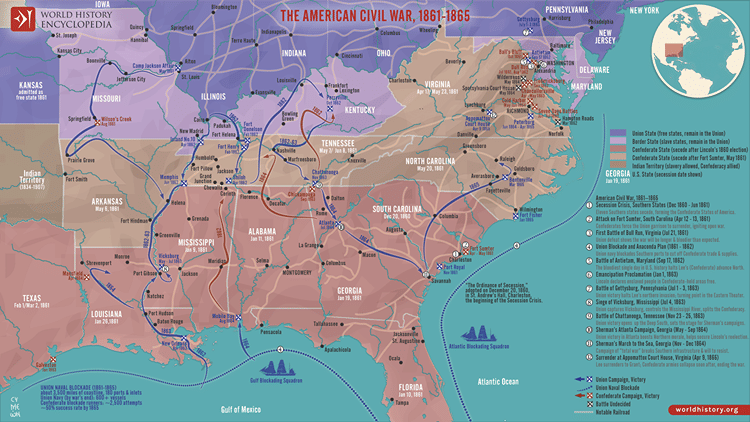 Map of the American Civil War, 1861-1865 Simeon Netchev (CC BY-NC-ND) ](https://www.worldhistory.org/image/21119/map-of-the-american-civil-war-1861-1865/ "Map of the American Civil War, 1861-1865")**[First Battle of Bull Run (First Manassas)](https://www.worldhistory.org/First_Battle_of_Bull_Run_(First_Manassas)/)**
He returned to the army and was commissioned a colonel, commanding a brigade of infantry under General Daniel Tyler at the Battle of Blackburn's Ford (18 July 1861) and at the First Battle of Bull Run (First Manassas) on 21 July 1861. During the Union retreat (see [Panic at Bull Run](https://www.worldhistory.org/article/2959/panic-at-bull-run/)), Sherman was one of the officers who tried to stop the rout and reform the troops, but there was nothing to be done; the battle had been a complete Union defeat. Scholar James Lee McDonough writes:
> Sherman's Bull Run experience…left him more keenly aware than ever of the alarming vulnerability of the United States, as well as the distinct possibility of Confederate success.
> (267)
Sherman would later become famous for coining the phrase "War is Hell" (which he never said). At a graduation speech at the Michigan Military Academy in 1879, he would say, "There is many a boy here today who looks on war as all glory, but boys, it is all hell" (McDonough, 692). Bull Run first introduced him to that concept, and the rest of the Civil War would only prove his early impression correct.
[ 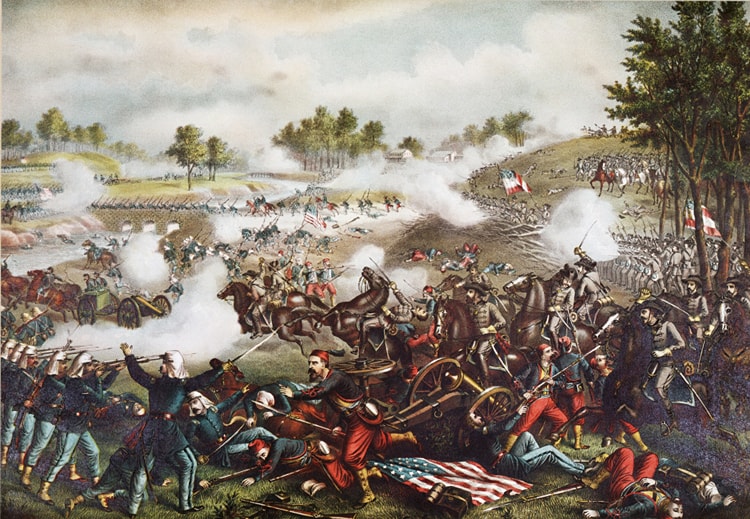 First Battle of Bull Run (First Manassas), 21 July 1861 Kurz & Allison (Public Domain) ](https://www.worldhistory.org/image/21982/first-battle-of-bull-run-first-manassas-21-july-18/ "First Battle of Bull Run (First Manassas), 21 July 1861")**Breakdown in Kentucky**
Sherman's actions on the field impressed Lincoln, however, who promoted him to brigadier general and sent him to Louisville, Kentucky, to serve in the Department of the Cumberland under Robert Anderson. When Anderson was relieved, Sherman took his place and assumed responsibility for keeping the border state in the Union despite encroachments from Confederate forces.
Sherman had always had an energetic, nervous disposition which, after Bull Run and news of other Confederate victories in Missouri, encouraged a downward spiral into depression. He appeared unhinged to reporters at press conferences, and in October 1861, he asked to be relieved of command.
**[Ulysses S. Grant](https://www.worldhistory.org/Ulysses_S._Grant/)**
He had recovered by December and returned to service under his old friend Henry Halleck. Sherman was put in charge of logistical support at Paducah, Kentucky, sending supplies to General Ulysses S. Grant and Flag Officer Andrew H. Foote for their joint campaign in the [Battle of Fort Henry](https://www.worldhistory.org/Battle_of_Fort_Henry/) (6 February 1862) and the [Battle of Fort Donelson](https://www.worldhistory.org/Battle_of_Fort_Donelson/) (11-16 February 1862), both Union victories which opened the Cumberland and Tennessee rivers to Union traffic and led to the capture of Nashville. McDonough notes:
> For William Tecumseh Sherman, the campaign was the proverbial godsend. It put him back in the war in a big way.
> (308)
Sherman finally had hope that the Union might win the war, and that hope was embodied in Grant. Although Sherman outranked Grant at this time, he sought service under Grant's command. Grant had been sidelined by Halleck after Fort Donelson, however, on trumped-up charges, and his command was given to General Charles F. Smith. After Smith died following an accident, Grant was reinstated and went to meet Sherman in Tennessee at Pittsburg Landing near a house of worship called Shiloh.
[ 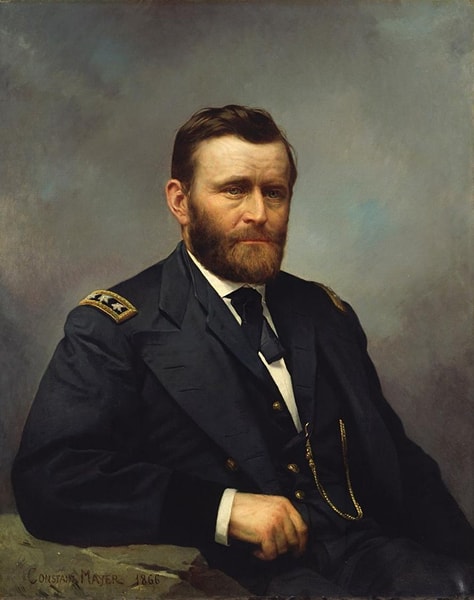 General Ulysses S. Grant Constant Mayer (CC BY-NC-SA) ](https://www.worldhistory.org/image/21462/general-ulysses-s-grant/ "General Ulysses S. Grant")**[Battle of Shiloh](https://www.worldhistory.org/Battle_of_Shiloh/) (6-7 April 1862)**
The Union Army was gathering at Shiloh for a massive assault on the city of [Corinth](https://www.worldhistory.org/corinth/), Mississippi, where the Confederate Army under [Albert Sidney Johnston](https://www.worldhistory.org/Albert_Sidney_Johnston/) and P. G. T. Beauregard was based. Sherman was so certain that the Confederates were holding their position at Corinth that he placed no pickets, sent out no patrols, and, when Sergeant C. J. Eagler reported Confederate troop movements on 5 April, Sherman "ordered Eagler placed under arrest for spreading a false alarm" (Cunningham, 134).
The Confederates struck the morning of the 6th, and the Union forces under Grant and Sherman would have been taken completely by surprise if Colonel Everett Peabody, ignoring orders, had not sent out a reconnaissance patrol before dawn. Their engagement with Confederate skirmishers alerted the camp and allowed time for mobilization.
Sherman's division bore the brunt of Johnston's attack, but he mounted a strong defense. He was wounded twice (in the hand and shoulder) and had three horses shot out from under him, but still rallied his troops and held the Union right flank, retreating in order back to Pittsburg Landing.
[  Battle of Shiloh Thure de Thulstrup (Public Domain) ](https://www.worldhistory.org/image/20815/battle-of-shiloh/ "Battle of Shiloh")Johnston was mortally wounded on the 6th, bled to [death](https://www.worldhistory.org/disambiguation/Death/), and command fell to Beauregard, who confidently sent word to Confederate President [Jefferson Davis](https://www.worldhistory.org/Jefferson_Davis/) that he had won and would finish off the enemy the next day. That night, however, General Don Carlos Buell's forces reinforced Grant and Sherman. The next morning, they attacked at dawn, driving Beauregard back to Corinth.
The battle transformed Sherman, as McDonough notes:
> Wonderfully buoyed up by the experience, Sherman henceforth exhibited both confidence and total, all-consuming, physical and emotional commitment to the war, even if he never expected to survive it.
> (19)
Halleck, arriving to take command, again sidelined Grant and promoted George H. Thomas to his position. Grant, discouraged, decided to go home and leave the army, but Sherman convinced him to stay. McDonough writes:
> In urging Grant to stay, Sherman had rendered a major service to his country. His action also strengthened the growing friendship between the two; a respectful and trusting friendship that became invaluable in the future prosecution of the war.
> (326-327)
**Corinth to Meridian**
Halleck led the overly cautious advance on Corinth, allowing Beauregard time to escape, and was called back east; Grant was restored to the field. Sherman was given command of the military district of [Memphis](https://www.worldhistory.org/Memphis_(Ancient_Egypt)/), Tennessee, where he successfully, and brutally, suppressed Confederate guerrilla attacks on passing steamships by burning the village of Randolph.
After Memphis, Sherman realized the war would not be won by defeating the opposing army on battlefields; it would be won by making the war so terrible the South would lose the will to fight. This was a view shared by Grant, but Sherman seems to have come to it independently, and he certainly implemented the concept of 'hard war' fully.
During the Vicksburg Campaign (December 1862 to July 1863), Sherman commanded half of Grant's army, leading an attack at [Chickasaw](https://www.worldhistory.org/disambiguation/Chickasaw/) Bayou in December of 1862 and capturing Fort Hindman in January 1863. During the Siege of Vicksburg, Sherman supervised the shelling of the city and, after its surrender on 4 July 1862, struck Confederate General [Joseph E. Johnston](https://www.worldhistory.org/Joseph_E._Johnston/) at Jackson, Mississippi, taking the city on 25 July.
In the Chattanooga Campaign (September to November 1863), Sherman, now a brigadier general, reinforced Grant's army, taking the northern end of Missionary Ridge. His next advance was driven back by General [Patrick Cleburne](https://www.worldhistory.org/Patrick_Cleburne/), but his persistence in attacks kept Braxton Bragg engaged, weakening the Confederate center and allowing George H. Thomas to take Missionary Ridge and win the Battles of Chattanooga on 25 November 1863.
During the Vicksburg Campaign, Grant had directed his army to leave its supply train and live off the land, a policy Sherman had at first objected to. He had seen how it worked, however, and, after Chattanooga, planned an attack on Meridian, Mississippi, that would rely on speed and foraging, leaving supply lines behind.
[  William Tecumseh Sherman on Horseback George N. Barnard (CC BY-NC-SA) ](https://www.worldhistory.org/image/22351/william-tecumseh-sherman-on-horseback/ "William Tecumseh Sherman on Horseback")No civilians at Meridian were injured during Sherman's attack – which destroyed bridges, [railroad](https://www.worldhistory.org/disambiguation/Railroad/) tracks, engines, railroad cars, and mills – but afterward Sherman remarked that Meridian no longer existed. This would be the 'dress rehearsal' for his March to the Sea.
**[Atlanta Campaign](https://www.worldhistory.org/Atlanta_Campaign/)**
Lincoln promoted Grant to lieutenant general in early 1864 and transferred him east, appointing him general-in-chief of the army. Grant appointed Sherman to lead the Military Division of the Mississippi, and Sherman led his troops into Georgia. Joseph E. Johnston mobilized his forces to defend but was too cautious against Sherman's maneuvers.
Johnston was replaced by [John Bell Hood](https://www.worldhistory.org/John_Bell_Hood/), a far more aggressive commander, but even he could not stop Sherman's advance. Atlanta was captured on 2 September 1864, and Sherman gave orders that all government buildings and any structure that could be used to support the military be burned.
Railroad tracks were pulled up, heated, and twisted into shapes that came to be known as "Sherman's Neckties." This victory blunted the momentum of the Northern Peace Party that was running [George B. McClellan](https://www.worldhistory.org/George_B._McClellan/) as presidential candidate against Lincoln, handing Lincoln the win in the 1864 election.
[  Sherman's Troops Destroy a Railroad George N. Barnard (Public Domain) ](https://www.worldhistory.org/image/21165/shermans-troops-destroy-a-railroad/ "Sherman's Troops Destroy a Railroad")As Sherman marched, formerly enslaved people left their homes to follow, seeing him as their liberator. This trust was betrayed at Ebenezer Creek in Georgia when, after the army crossed on a pontoon bridge, Union General Jefferson C. Davis, believing the refugees were slowing Sherman's advance, ordered the bridge cut loose, stranding the former slaves on the other side to be killed or re-enslaved by Confederate forces.
The public outrage over this event would lead to Sherman issuing Special Field Order No. 15 in January 1865, supported by the Lincoln administration, ordering land redistribution for formerly enslaved African Americans; a promise popularly known as "forty acres and a mule," which was later broken by President [Andrew Johnson](https://www.worldhistory.org/Andrew_Johnson/).
**March to the Sea & Carolinas**
Grant ordered Sherman to come to Virginia to support his campaigns against [Robert E. Lee](https://www.worldhistory.org/Robert_E._Lee/), but Sherman proposed another plan: he would continue without supply lines to Savannah, destroying anything of military value along the way. Grant approved, and Sherman began his march on 15 November, causing over $100 million in property damage ($1.5 billion today) by the time he took Savannah on 21 December and sent word of the victory to Lincoln as a Christmas present.
[  Sherman's March to the Sea Felix Octavius Carr Darley & Alexander Hay Ritchie (Public Domain) ](https://www.worldhistory.org/image/21164/shermans-march-to-the-sea/ "Sherman's March to the Sea")Sherman then launched the Carolinas Campaign, continuing his destruction of property and, increasingly, followed by more formerly enslaved people seeking safety with his army. The decisive engagement of the campaign was the [Battle of Bentonville](https://www.worldhistory.org/article/2819/battle-of-bentonville/) (19-21 March 1865), where Sherman defeated Joseph E. Johnston.
After Lee surrendered to Grant on 9 April 1865 at Appomattox Court House, Sherman accepted Johnston's surrender on 26 April at Bennett Place, Durham, North Carolina. Although fighting would continue into May, Grant and Sherman had effectively brought the war to a close.
### Conclusion
Throughout the 20th century, Sherman would be regarded as a controversial figure for his 'scorched earth' tactics, even without the attacks by "Lost Cause" writers, but has become more so – like his contemporary [George Armstrong Custer](https://www.worldhistory.org/George_Armstrong_Custer/) – for his genocidal policies toward the [Plains Indians](https://www.worldhistory.org/Plains_Indians/), especially the [Sioux](https://www.worldhistory.org/Sioux/).
He fully supported westward expansion and considered the railroad system vital in accomplishing that. Whatever interfered with this progress, therefore, would have to be eliminated. Sherman, along with General Philip Sheridan, would be responsible for policies leading to the deaths of thousands of [Native Americans](https://www.worldhistory.org/Native_Peoples_of_North_America/), waging the same sort of 'hard war' they had when fighting Confederate forces.
Sherman is chiefly remembered today, however, for his service during the Civil War and, in time, was hailed as the 'first modern general' for his tactics during the war. He died of pneumonia in New York City on 14 February 1891, six days after his 71st birthday, having outlived his wife, Grant, Sheridan, and many other friends and former enemies. He is buried in Calvary Cemetery, St. Louis, Missouri, alongside his wife and children.
#### Editorial Review
This human-authored definition has been reviewed by our editorial team before publication to ensure accuracy, reliability and adherence to academic standards in accordance with our [editorial policy](https://www.worldhistory.org/static/editorial-policy/).
## Bibliography
- [Cunningham, O. E. *Shiloh and the Western Campaign of 1862.* Savas Beatie, 2009.](https://www.worldhistory.org/books/B0047T7JUO/)
- [Dugard, M. *The Training Ground: Grant, Lee, Sherman, and Davis in the Mexican War, 1846-1848.* University of Nebraska Press, 2008.](https://www.worldhistory.org/books/B01FKSHZQI/)
- [Gott, K. D. *Where the South Lost the War: An Analysis of the Fort Henry-Fort Donelson Campaign, February 1862.* Stackpole Books, 2023.](https://www.worldhistory.org/books/B00AVZSQ78/)
- [McDonough, J. L. *William Tecumseh Sherman: In The Service of My Country, A Life.* W. W. Norton & Company, 2017.](https://www.worldhistory.org/books/0393354202/)
- [Miller, D. L. *Vicksburg: Grant's Campaign That Broke the Confederacy.* Simon & Schuster, 2020.](https://www.worldhistory.org/books/1451641397/)
- [Taylor, A. *American Civil Wars: A Continental History, 1850-1873.* W. W. Norton & Company, 2024.](https://www.worldhistory.org/books/1324035285/)
## About the Author
Joshua J. Mark is World History Encyclopedia's co-founder and Content Director. He was previously a professor at Marist College (NY) where he taught history, philosophy, literature, and writing. He has traveled extensively and lived in Greece and Germany.
- [Linkedin Profile](https://www.linkedin.com/pub/joshua-j-mark/38/614/339)
## Timeline
- **1820 CE - 1891 CE**: Life of [American Civil War](https://www.worldhistory.org/American_Civil_War/) General [William Tecumseh Sherman](https://www.worldhistory.org/William_Tecumseh_Sherman/).
- **1836 CE - 1840 CE**: [William Tecumseh Sherman](https://www.worldhistory.org/William_Tecumseh_Sherman/) attends West Point Military Academy.
- **1847 CE - 1850 CE**: [William Tecumseh Sherman](https://www.worldhistory.org/William_Tecumseh_Sherman/) is posted to California during and after the [Mexican-American War](https://www.worldhistory.org/Mexican-American_War/).
- **21 Jul 1861 CE**: [William Tecumseh Sherman](https://www.worldhistory.org/William_Tecumseh_Sherman/) sees action at the [First Battle of Bull Run (First Manassas)](https://www.worldhistory.org/First_Battle_of_Bull_Run_(First_Manassas)/) during the [American Civil War](https://www.worldhistory.org/American_Civil_War/).
- **6 Apr 1862 CE - 7 Apr 1862 CE**: [William Tecumseh Sherman](https://www.worldhistory.org/William_Tecumseh_Sherman/) leads a division at the [Battle of Shiloh](https://www.worldhistory.org/Battle_of_Shiloh/) during the [American Civil War](https://www.worldhistory.org/American_Civil_War/).
- **7 May 1864 CE**: [William Tecumseh Sherman](https://www.worldhistory.org/William_Tecumseh_Sherman/) begins his [Atlanta Campaign](https://www.worldhistory.org/Atlanta_Campaign/).
- **18 Jul 1864 CE**: Sherman begins to lay siege to Atlanta, Georgia.
- **15 Nov 1864 CE - 21 Dec 1864 CE**: William Tecumseh [Sherman's March to the Sea](https://www.worldhistory.org/Sherman's_March_to_the_Sea/) during the [American Civil War](https://www.worldhistory.org/American_Civil_War/).
- **21 Mar 1865 CE**: [William Tecumseh Sherman](https://www.worldhistory.org/William_Tecumseh_Sherman/) defeats [Joseph E. Johnston](https://www.worldhistory.org/Joseph_E._Johnston/) at the [Battle of Bentonville](https://www.worldhistory.org/article/2819/battle-of-bentonville/) toward the end of the [American Civil War](https://www.worldhistory.org/American_Civil_War/).
## Questions & Answers
### Who was William Tecumseh Sherman?
William Tecumseh Sherman was a Union Civil War general during the American Civil War, best known for his March to the Sea in the fall of 1864, which broke the Confederacy and hastened an end to hostilities. After the war, he became notorious among Native Americans for his harsh policies, especially toward the Plains Indians.
### Why was Sherman named after Tecumseh?
Sherman's father was a great admirer of the Shawnee leader and so named his son Tecumseh. "William" was given to the boy later at his baptism.
### Why is Sherman known as the first modern general?
Sherman is known as the first modern general because of his policy of waging a 'hard war' against both military and civilian sites to destroy the means of supporting an army and break the will of the enemy to keep fighting. These tactics have since been used in other wars throughout the modern era.
### How did William Tecumseh Sherman die?
William Tecumseh Sherman died of pneumonia at age 71 in New York City on 14 February 1891.
## External Links
- [New Georgia Encyclopedia/Sherman's March to the Sea](https://www.georgiaencyclopedia.org/articles/history-archaeology/shermans-march-to-the-sea/)
- [US Army War College/War Room/William T. Sherman: The First "Modern" General](https://warroom.armywarcollege.edu/podcasts/william-t-sherman/)
- [American Battlefield Trust/William T. Sherman](https://www.battlefields.org/learn/biographies/william-t-sherman)
- [US National Park Service/Andersonville National Historic Site/Sherman's March to the Sea and the Andersonville Myth](https://www.nps.gov/ande/learn/historyculture/shermanandersonville.htm?fullweb=1)
## Cite This Work
### APA
Mark, J. J. (2026, November 17). William Tecumseh Sherman: The First Modern General. *World History Encyclopedia*.
### Chicago
Mark, Joshua J.. "William Tecumseh Sherman: The First Modern General." *World History Encyclopedia*, November 17, 2026. .
### MLA
Mark, Joshua J.. "William Tecumseh Sherman: The First Modern General." *World History Encyclopedia*, 17 Nov 2026, .
## License & Copyright
Submitted by [Joshua J. Mark](https://www.worldhistory.org/user/JPryst/ "User Page: Joshua J. Mark"), published on 17 November 2026. The copyright holder has published this content under the following license: [Creative Commons Attribution-NonCommercial-ShareAlike](https://creativecommons.org/licenses/by-nc-sa/4.0/deed.en). This license lets others remix, tweak, and build upon this content non-commercially, as long as they credit the author and license their new creations under the identical terms. When republishing on the web a hyperlink back to the original content source URL must be included. Please note that content linked from this page may have different licensing terms.