---
title: Vulcan
author: Donald L. Wasson
source: https://www.worldhistory.org/Vulcan/
format: machine-readable-alternate
license: Creative Commons Attribution-NonCommercial-ShareAlike (https://creativecommons.org/licenses/by-nc-sa/4.0/)
updated: 2023-04-19
---
# Vulcan
_Authored by [Donald L. Wasson](https://www.worldhistory.org/user/DWasson/)_
Vulcan or Volcanus was the [Roman](https://www.worldhistory.org/disambiguation/Roman/) [god](https://www.worldhistory.org/God/) of fire and forge, the equivalent of [Hephaestus](https://www.worldhistory.org/Hephaistos/) from [Greek mythology](https://www.worldhistory.org/Greek_Mythology/). The son of [Jupiter](https://www.worldhistory.org/jupiter/) and [Juno](https://www.worldhistory.org/Juno/), he was the special patron of blacksmiths and artisans. As the god of the forge and the devastating fire of both the environment and nature (volcanoes), Vulcan was probably among the most dreaded of all the gods.
Like the other gods, Vulcan had a festival, the Vulcanalia (the Hephaestia) celebrated on 23 August, and a [temple](https://www.worldhistory.org/temple/) located outside [Rome](https://www.worldhistory.org/Rome/) on the Campus Martius. For fear of fire (and for safety), most of his temples were located outside a [city](https://www.worldhistory.org/city/).
### Birth & Family
Although she did not return his affections, Vulcan was, in the beginning, extremely fond of his mother, Juno. He often consoled her after one of their frequent arguments with Jupiter. In one story found in both [Greek](https://www.worldhistory.org/disambiguation/greek/) and Roman mythologies, Juno confronted Jupiter in another fit of jealousy. In anger, Jupiter dangled her out of [the clouds](https://www.worldhistory.org/The_Clouds/) by a golden chain. Vulcan attempted unsuccessfully to rescue her. Angry with his son's interference, Jupiter threw him out of heaven. Vulcan fell to earth for one full day and night, landing on the summit of Mount Mosychulus on the island of Lemnos. The severity of the fall left him lame and deformed, but his mother never inquired about his well-being. According to the Roman account, Vulcan withdrew to Mount Aetna where he established a great forge and partnered with the Cyclopes Bronte, Steropes, and Pyraemon.
A variation of this fall comes from Greek [mythology](https://www.worldhistory.org/mythology/). [Hera](https://www.worldhistory.org/Hera/) was well aware of [Zeus](https://www.worldhistory.org/zeus/)' wandering eye and wanted to give him a child of great strength and power, but at Hephaestus' birth, Hera found him small, swarthy, and ugly. Disgusted, she hurled him down the mountainside, disappearing into the sea. He was rescued by sea nymphs (one of them being the mother of [Achilles](https://www.worldhistory.org/achilles/), [Thetis](https://www.worldhistory.org/Thetis/)), who raised him in a cave where he learned to forge [metal](https://www.worldhistory.org/disambiguation/metal/). In [Hesiod](https://www.worldhistory.org/hesiod/)'s *[Theogony](https://www.worldhistory.org/Theogony/)*, "…Hera, angry, quarreled with her mate and bore, without the act of love, a son [Hephaistos](https://www.worldhistory.org/Hephaistos/), famous for his workmanship…" (53)
Vulcan's ugliness and deformity prevented him from finding happiness in marriage. First, he was rejected (as were many others) by [Minerva](https://www.worldhistory.org/Minerva/) ([Athena](https://www.worldhistory.org/athena/)) who vowed never to marry. Next, as a punishment to [Venus](https://www.worldhistory.org/venus/) for her pride and rejection of all suitors, Jupiter married the goddess of beauty to the 'ill-favored' Vulcan, forcing her and her attendants – the [Graces](https://www.worldhistory.org/Graces/) – to live with him in his cave in Mount Aetna. Of course, the marriage did not last, and she left him for the affection of others – one of them being his brother [Mars](https://www.worldhistory.org/Mars/). Lastly, Vulcan married one of the Graces, but, like the others, she deserted him. He did, however, have children (all of whom were considered monsters): among them were Cacus (slain by [Hercules](https://www.worldhistory.org/hercules/)), Periphetes (killed by [Theseus](https://www.worldhistory.org/Theseus/)), and the wrestler Cercyon (possibly also killed by Theseus). Supposedly, he may have been the father of Servius Tullius, the sixth king of Rome.
### The Golden Throne
Many of the stories and myths surrounding Vulcan can be found in the tales concerning Hephaestus. It is often difficult to differentiate between the two. One such story is of the golden throne. Partially in retaliation for how he was treated, Vulcan fashioned a beautiful golden throne for Juno, but it contained a number of hidden springs. If unoccupied, it appeared innocent, quite ordinary. However, if anyone sat on it, the chair closed up, and all attempts to escape its clutches would be fruitless. Juno was delighted with its beauty and delicate workmanship, but when she sat down, she found herself a prisoner. All attempts by the gods to free her failed. Finally, Mercury visited Vulcan in his cave and pleaded with him to return to Olympus and free his mother. Vulcan had vowed never to return to Olympus and flatly refused. Finally, [Bacchus](https://www.worldhistory.org/Bacchus/) ([Dionysus](https://www.worldhistory.org/Dionysos/)), the god of wine and revelry, appealed to Vulcan's better nature with a flask of wine. Vulcan consented and freed his mother. Afterwards, he returned to his forge and built magnificent palaces for each of the gods.
[  Vulcan's Forge Cornelis Schut (Public Domain) ](https://www.worldhistory.org/image/17309/vulcans-forge/ "Vulcan's Forge")### Birth of Minerva
In another Roman myth, Vulcan is associated with the birth of Minerva. Jupiter was in serious pain with a severe headache. All of the gods' attempts to help failed; even [Apollo](https://www.worldhistory.org/apollo/), the god of [medicine](https://www.worldhistory.org/disambiguation/medicine/), was unable to ease the pain. Finally, Jupiter appealed to Vulcan to open up his head with an axe. Vulcan quickly complied, and Minerva sprang forth, fully grown and clad in her armor. She would become known as the goddess of peace, defensive [war](https://www.worldhistory.org/disambiguation/War/), and wisdom. In the Greek version of the myth, it was [Prometheus](https://www.worldhistory.org/Prometheus/)' idea for Hephaestus to use the axe. Reluctantly, the god of the sky knelt, and the fire god with one swift swing struck the center of the skull. Athena (Minerva) appeared. Her mother was said to be Metis. [Homer](https://www.worldhistory.org/homer/) wrote of her birth in *The Homeric Hymns* (No. 28):
> It was Craft-filled Zeus himself who gave birth from his sacred head to her already in armor of war, all-gleaming; every immortal was gripped in awe at the sight. But quickly she leaped from his deathless head to stand.
> (*Homeric Hymns*, 88)
[  The Birth of Minerva René-Antoine Houasse (Public Domain) ](https://www.worldhistory.org/image/17310/the-birth-of-minerva/ "The Birth of Minerva")### [Ovid](https://www.worldhistory.org/ovid/)'s *Metamorphoses*
Vulcan, not Hephaestus, appears in both Ovid's *Metamorphoses* and [Virgil](https://www.worldhistory.org/virgil/)'s *[Aeneid](https://www.worldhistory.org/The_Aeneid/)*. Ovid's (43 BCE to 17 CE) epic poem relates the history of Rome from its ancient beginnings to the [death](https://www.worldhistory.org/disambiguation/Death/) of [Julius Caesar](https://www.worldhistory.org/Julius_Caesar/) (100-44 BCE). It describes not only humanity's interaction with the gods but also heroes and heroines. In Book IV of the poem, Ovid writes about the celebration of a Bacchic festival when all [women](https://www.worldhistory.org/disambiguation/women/) were excused from work. However, the daughters of Minyas decided not to attend the festival; they chose instead, to remain at their looms and exchange stories. Ovid writes:
> ... the Theban women cry; and perform the sacred rites as the priest bids them. Only the daughters of Minyas stay within, marring the festival, and out of due time ply their household tasks, spinning wool, thumbing the turning threads or keep close to the loom. (65)
After a while one of the daughters says,"…let us take turns in telling stories, while all the others listen" (65). The first daughter tells of the fated lovers Pyramus and Thisbe. Next comes Leuconoe who tells a tale of Mars and the faithless wife of Vulcan, Venus: "The Sun, with his central light guides all of the stars ... was the first to see the shame of Venus and Mars" (68). He relates what he had seen to Vulcan. "...Vulcan's mind reeled and the work upon which he was engaged fell from his hands." (68) The god of the forge fashioned a very thin net of fine links of [bronze](https://www.worldhistory.org/disambiguation/bronze/) and spread it over a couch. "Now when the goddess and her paramour had come to this place, by the husband's art and by the net so cunningly prepared, they were both caught and held fast in each other's arms." (68) Vulcan opened the doors widely, displaying the two entwined lovers to the laughter of the gods.
[  Vulcan Surprising Venus and Mars in Bed Johann Heiss (Public Domain) ](https://www.worldhistory.org/image/17311/vulcan-surprising-venus-and-mars-in-bed/ "Vulcan Surprising Venus and Mars in Bed")### Virgil's *Aeneid*
Although Virgil (70-19 BCE) was not pleased with his epic, [Roman emperor](https://www.worldhistory.org/Roman_Emperor/) [Augustus](https://www.worldhistory.org/augustus/) (r. 27 BCE to 14 CE), who claimed to be a descendant of [Aeneas](https://www.worldhistory.org/Aeneas/), was ecstatic. The emperor believed that the poem demonstrated a final fulfillment of Rome's destiny. Virgil's *Aeneid* tells the story of the Trojan warrior Aeneas who escaped [Troy](https://www.worldhistory.org/troy/) in the final [hours](https://www.worldhistory.org/Horae/) of the [Trojan War](https://www.worldhistory.org/Trojan_War/). He eventually made his way to [Italy](https://www.worldhistory.org/italy/) where his descendants [Romulus and Remus](https://www.worldhistory.org/Romulus_and_Remus/) would one day build the city of Rome. In Book VIII of the poem, Aeneas and his fellow Trojans reach the Tiber River and the kingdom of Latium. Juno, still angry with Aeneas, arouses the ire of the Latium king and forces the Trojans into a war they did not want. Venus is concerned for her son Aeneas' safety and appeals to her husband Vulcan to make him weapons and armor.
> "Venus, her mother's heart alarmed ... spoke to her husband, Vulcan, as they lay in their [gold](https://www.worldhistory.org/gold/) bedchamber. Breathing into the words all her divine allurement ... I ask no help of you for my unhappy people, make no demands on your skill and resource as a forger of weapons." (190)
She tells him how she owes a great deal to the sons of Priam. "Yet it is now that I'm asking a deity whom I reverence for arms, appealing to you on my son's behalf." (190) After he slept, Vulcan returned to his forge where the Cyclopes were working on Jupiter's thunderbolts and Mars' [chariot](https://www.worldhistory.org/chariot/). Vulcan told them:
> Put aside all that work aside, pack up the jobs you're engaged on ... and turn your attention to this — the making of arms for a hot-blooded hero! Now there is need for your strength, your speediest work and your master-craftsmanship. (192)
They quickly went to work, and "They fashioned a shield of heroic size, to withstand by itself every missile the Latins can use" (193). Aeneas eyed every piece:
> The formidable helmet with plumes like fountains of fire, the sword that would deal out doom, the breastplate of hard bronze … and the spear, and the shield's miraculous workmanship. (198)
However, on Aeneas' shield (being prophetic) he portrayed future events of Roman history. One such depiction is his portrayal of the [Battle of Actium](https://www.worldhistory.org/Battle_of_Actium/) (31 BCE) where he showed [Cleopatra](https://www.worldhistory.org/disambiguation/cleopatra/): "The Fire-god had rendered her, pale with the shadow of her own death" (201).
[ 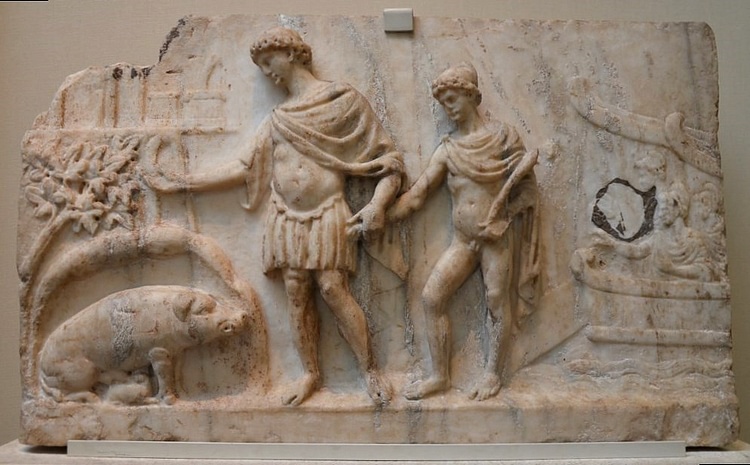 Aeneas' Arrival in Latium Carole Raddato (CC BY-NC-SA) ](https://www.worldhistory.org/image/13528/aeneas-arrival-in-latium/ "Aeneas' Arrival in Latium")### Conclusion
[Roman mythology](https://www.worldhistory.org/Roman_Mythology/) gets lost within [Greek literature](https://www.worldhistory.org/Greek_Literature/). However, unlike the Greeks, Roman myths were written in prose, providing a sense of history and a foundation of all that was Roman. Some conciliation comes to the Romans in that the planets of our solar system bear the name of the Roman, not the Greek, gods – even the much-maligned [Pluto](https://www.worldhistory.org/Pluto/). Unfortunately, Vulcan has no planet named for him, only the process of hardening rubber: vulcanization.
#### Editorial Review
This human-authored definition has been reviewed by our editorial team before publication to ensure accuracy, reliability and adherence to academic standards in accordance with our [editorial policy](https://www.worldhistory.org/static/editorial-policy/).
## Bibliography
- [Berens, E.M. *Mythology.* Crestline, 2020.](https://www.worldhistory.org/books/0785838414/)
- [Fry, Stephen. *Mythos.* Chronicle Books, 2019.](https://www.worldhistory.org/books/1452178917/)
- [Guerber, H.A. *Classical Mythology.* Fall River Press.](https://www.worldhistory.org/books/B0BBPMVP3P/)
- [Hesiod & West, M. L. *Theogony and Works and Days .* Oxford University Press, 2009.](https://www.worldhistory.org/books/019953831X/)
- [Homer & Richardson, Nicholas & Cashford, Jules & Richardson, Nicholas. *Homeric Hymns .* Penguin Classics, 2003.](https://www.worldhistory.org/books/0140437827/)
- [Ovid & Raeburn, David & Feeney, Denis. *Metamorphoses .* Penguin Classics, 2004.](https://www.worldhistory.org/books/014044789X/)
- [Price, Simon & Kearns, Emily. *The Oxford Dictionary of Classical Myth and Religion.* Oxford University Press, 2003.](https://www.worldhistory.org/books/0192802887/)
- [Virgil & West, David & West, David & West, David. *The Aeneid .* Penguin Classics, 2003.](https://www.worldhistory.org/books/0140449329/)
## About the Author
Donald has taught Ancient, Medieval and U.S. History at Lincoln College (Normal, Illinois)and has always been and will always be a student of history, ever since learning about Alexander the Great. He is eager to pass knowledge on to his students.
## Questions & Answers
### What is Vulcan the god of?
Vulcan is of the god fire and forge in Roman mythology.
### Who is the Greek equivalent of Vulcan?
The Greek equivalent of Vulcan is Hephaestus.
### Is there a planet named Vulcan?
No, there is no planet named after Vulcan.
## Cite This Work
### APA
Wasson, D. L. (2023, April 19). Vulcan. *World History Encyclopedia*.
### Chicago
Wasson, Donald L.. "Vulcan." *World History Encyclopedia*, April 19, 2023. .
### MLA
Wasson, Donald L.. "Vulcan." *World History Encyclopedia*, 19 Apr 2023, .
## License & Copyright
Submitted by [Donald L. Wasson](https://www.worldhistory.org/user/DWasson/ "User Page: Donald L. Wasson"), published on 19 April 2023. The copyright holder has published this content under the following license: [Creative Commons Attribution-NonCommercial-ShareAlike](https://creativecommons.org/licenses/by-nc-sa/4.0/deed.en). This license lets others remix, tweak, and build upon this content non-commercially, as long as they credit the author and license their new creations under the identical terms. When republishing on the web a hyperlink back to the original content source URL must be included. Please note that content linked from this page may have different licensing terms.