---
title: Ancient Volterra
author: Mark Cartwright
source: https://www.worldhistory.org/Volterra/
format: machine-readable-alternate
license: Creative Commons Attribution-NonCommercial-ShareAlike (https://creativecommons.org/licenses/by-nc-sa/4.0/)
updated: 1970-01-01
---
# Ancient Volterra
_Authored by [Mark Cartwright](https://www.worldhistory.org/user/markzcartwright/)_
Volterra ([Etruscan](https://www.worldhistory.org/Etruscan_Civilization/) name: Velathri, [Roman](https://www.worldhistory.org/disambiguation/Roman/): Volaterrae), located in the northern part of Tuscany, [Italy](https://www.worldhistory.org/italy/), was an important Etruscan settlement between the 7th and 2nd century BCE. After its destruction by the Romans in the 1st century BCE it became a modest town with the prosperity of its ruling elite into the early imperial period attested by the prodigious number of finely carved alabaster funerary urns in its many rock-cut tombs.
### Early Settlement
Settlement on the high sandstone plateau of Volterra began from at least the 10th century BCE. [Iron Age](https://www.worldhistory.org/disambiguation/Iron_Age/) peoples of the [Villanovan culture](https://www.worldhistory.org/Villanovan_Culture/), a precursor to the [Etruscans](https://www.worldhistory.org/Etruscan_Civilization/), no doubt selected the site for its ease of defence. The site prospered due to the fertile agricultural lands in its territory across the Cecina valley and its rich mineral deposits. Although finds are not as impressive as the coastal Villanovan sites, evidence of a wider [trade](https://www.worldhistory.org/disambiguation/trade/) is found in such foreign imports as Sardinian [bronze](https://www.worldhistory.org/disambiguation/bronze/) goods.
### A Thriving Etruscan [City](https://www.worldhistory.org/city/)
From the mid-8th century BCE, when the Villanovan had matured into the [Etruscan culture](https://www.worldhistory.org/Etruscan_Civilization/) proper, Volterra became one of the major towns in [Etruria](https://www.worldhistory.org/Etruscan_Civilization/), probably controlling a large surrounding area given the distance between it and neighbouring centres. Faesulae (Fiesole) was just one satellite centre founded by Volterra. Funeral inscriptions reveal that many [women](https://www.worldhistory.org/disambiguation/women/) from aristocratic families of Volterra married men from outlying villages such as Barberino, Castiglioncello, and Monteriggioni, thus consolidating the town's control over the region.
It is likely that Volterra was one of the Etruscan [cities](https://www.worldhistory.org/city/) that formed colonies in the Po Valley to the north. Volterra was also one of the 12 to 15 members of the Etruscan League. Other members of this loose association included [Cerveteri](https://www.worldhistory.org/Cerveteri/), [Chiusi](https://www.worldhistory.org/Chiusi/), [Populonia](https://www.worldhistory.org/Populonia/), [Tarquinia](https://www.worldhistory.org/Tarquinia/), [Veii](https://www.worldhistory.org/Veii/), and [Vulci](https://www.worldhistory.org/Vulci/). Very little is known of this league except that its members had common religious ties and that leaders met annually at the Fanum Voltumnae sanctuary near [Orvieto](https://www.worldhistory.org/volsinii/) (exact location as yet unknown).
Volterra was noted for its production of bronze figurines, often used as votive offerings at [temple](https://www.worldhistory.org/temple/) sites and in tombs, which are extremely tall and slim human figures curiously reminiscent of modern art sculpture, perhaps a relic of much earlier figures cut from sheet bronze. Other locally made products include large and highly decorative alabaster funerary urns; [red-figure pottery](https://www.worldhistory.org/Red-Figure_Pottery/) wares, including the distinctive [column](https://www.worldhistory.org/column/)-kraters with two 'portrait' heads painted on the upper portion; and the unique Etruscan black [pottery](https://www.worldhistory.org/pottery/) known as [bucchero](https://www.worldhistory.org/Bucchero/). Located as it was at the head of several river routes leading to coastal areas, Volterra was able to export these goods to other Etruscan cities and to inland sites in the Umbria region which were more isolated from the trade activities of the wider [Mediterranean](https://www.worldhistory.org/disambiguation/mediterranean/). Another local product, this time not for export, is the large stone [grave](https://www.worldhistory.org/burial/) markers produced from the 6th century BCE onwards. These stelae, standing well over 1.5 metres in some cases, were carved from the local *nenfro* stone and represented in relief prominent deceased members of the community in their guise as either warriors or priests.
[ 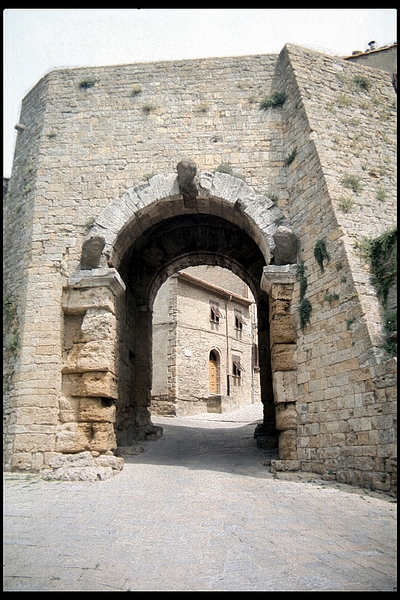 Porta all' Arco, Volterra Katherine McDonnell (CC BY) ](https://www.worldhistory.org/image/6344/porta-all-arco-volterra/ "Porta all' Arco, Volterra")### The Challenge of [Rome](https://www.worldhistory.org/Rome/)
Evidence of the town's prosperity and geographical spread, but at the same time also a concern for defence, takes the form of an enlarged circuit [wall](https://www.worldhistory.org/wall/) built in the 4th and 3rd century BCE. These fortifications totalled 7.28 km in length and were punctuated by arched gates, including the Porta all'Arco with its three sculpted heads decoration. The heads were probably representations of gods but are now badly weather-worn. A rebuilding of several temples at the site, the minting of cast-bronze coins inscribed *Velathri*, and the large number of rock-cut tombs with their fine alabaster funerary urns with relief carvings further attest to Volterra's continued success which now covered around 116 hectares.
However, from the 3rd century BCE, the town was faced with the threat of the territorially ambitious Romans. The Etruscans lost a [battle](https://www.worldhistory.org/disambiguation/battle/) with Rome in 298 BCE, and Volterra's status thereafter is unclear beyond that it contributed, as did many other Etruscan cities, to the campaigns of [Scipio Africanus](https://www.worldhistory.org/disambiguation/Scipio_Africanus/) against [Carthage](https://www.worldhistory.org/carthage/) during the [Second Punic War](https://www.worldhistory.org/Second_Punic_War/) (218-201 BCE). According to the Roman writer [Livy](https://www.worldhistory.org/livy/), it gave grain and timber for shipbuilding. Volterra then made the fatal error of backing the losing side in Rome's civil [war](https://www.worldhistory.org/disambiguation/War/), and as a consequence, the victor [Sulla](https://www.worldhistory.org/sulla/) sacked the city in 80 BCE after a two-year siege. The Roman general then resettled many of his veterans in Volterran territory; the Romans were here to stay.
### Later History
In the long-term, life under Roman rule was made more bearable due to the favourable influence the local Caecinae family enjoyed with various Roman rulers, including [Julius Caesar](https://www.worldhistory.org/Julius_Caesar/) and [Octavian](https://www.worldhistory.org/augustus/). Several members of the Caecinae clan served as consuls, and this perhaps explains the towns elevated status as a *colonia Augusta*. One prominent member of the family, Aulus Caecina, who, besides being an important writer and good pal of [Cicero](https://www.worldhistory.org/Cicero/), is recorded as having raced his four-horse chariots at Rome's [Circus Maximus](https://www.worldhistory.org/Circus_Maximus/).
[ 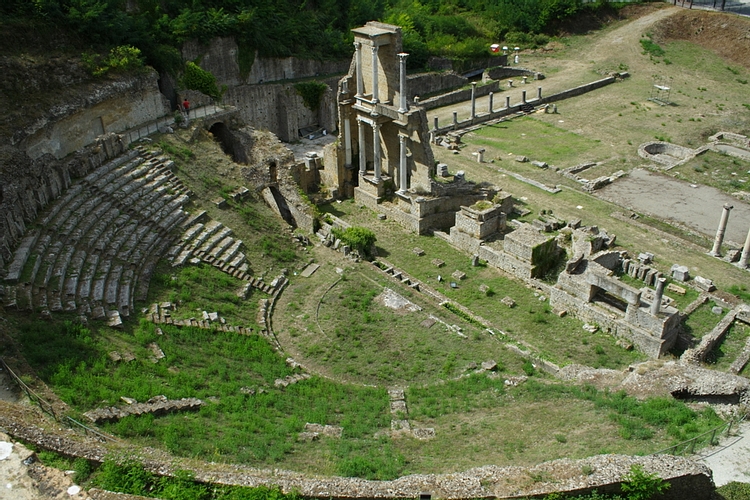 Roman Theatre, Volterra Matt Browne (CC BY-ND) ](https://www.worldhistory.org/image/6343/roman-theatre-volterra/ "Roman Theatre, Volterra")Another indicator of Volterra's growing stature was the construction of a [theatre](https://www.worldhistory.org/disambiguation/theatre/) in the 1st century CE and then a [Roman baths](https://www.worldhistory.org/Roman_Baths/) complex. Volterra's alabaster funerary urns become even more extravagant in this period and portray the deceased in often very life-like and uncompromising portrait sculpture on the lid. The sides of these large square or rectangular boxes carry impressive relief scenes from [mythology](https://www.worldhistory.org/mythology/). One 1st-century CE rock-carved [tomb](https://www.worldhistory.org/tomb/), the Inghirami Tomb, contained 53 such urns. Another claim to fame in the early imperial years was that Pope Linus (d. 76 CE), second bishop of Rome, came from the town.
By the 3rd century CE, some areas of the town were no longer inhabited, but Volterra soldiered on as a small Roman town for the next two centuries, overcoming the destruction of the Gothic invasion and then continuing as a [Byzantine](https://www.worldhistory.org/disambiguation/Byzantine/) town with its own bishop. After a period of rule under the [Lombards](https://www.worldhistory.org/Lombards/), Volterra was an important regional town in the medieval period from which much of its present-day [architecture](https://www.worldhistory.org/disambiguation/architecture/) dates.
#### Editorial Review
This human-authored definition has been reviewed by our editorial team before publication to ensure accuracy, reliability and adherence to academic standards in accordance with our [editorial policy](https://www.worldhistory.org/static/editorial-policy/).
## Bibliography
- Bagnall, R.S. *The Encyclopedia of Ancient History.* Wiley-Blackwell, 2012
- [Brendel, O.J. *Etruscan Art.* Yale University Press, 1995.](https://www.worldhistory.org/books/0300064462/)
- [Haynes, S. *Etruscan Civilization.* J. Paul Getty Museum, 2005.](https://www.worldhistory.org/books/0892366001/)
- [Heurgon, J. *Daily Life of the Etruscans.* Phoenix, 2002.](https://www.worldhistory.org/books/1842125923/)
- [Hornblower, S. *The Oxford Classical Dictionary.* Oxford University Press, 2012.](https://www.worldhistory.org/books/0199545561/)
- [Keller, W. *The Etruscans - A Journey Into History And Archaeology In Search of A Great Lost Civilization..* Book Club Associates, 1975.](https://www.worldhistory.org/books/B0044NGF80/)
- [Spivey, N. *Etruscan Italy.* B T Batsford Ltd, 1992.](https://www.worldhistory.org/books/0713465212/)
- [Spivey, N.J. *Etruscan Art.* Thames & Hudson, 1997.](https://www.worldhistory.org/books/0500203040/)
## About the Author
Mark is WHE’s Publishing Director and has an MA in Political Philosophy (University of York). He is a full-time researcher, writer, historian and editor. Special interests include art, architecture and discovering the ideas that all civilizations share.
## Timeline
- **c. 750 BCE - 80 BCE**: [Volterra](https://www.worldhistory.org/Volterra/) flourishes as an [Etruscan](https://www.worldhistory.org/Etruscan_Civilization/) town.
- **298 BCE**: An [Etruscan](https://www.worldhistory.org/Etruscan_Civilization/) army including forces from [Volterra](https://www.worldhistory.org/Volterra/) is defeated by the Romans.
- **82 BCE - 80 BCE**: [Volterra](https://www.worldhistory.org/Volterra/) is besieged and sacked by [Roman](https://www.worldhistory.org/disambiguation/Roman/) general [Sulla](https://www.worldhistory.org/sulla/).
## Cite This Work
### APA
Cartwright, M. (2017, February 10). Ancient Volterra. *World History Encyclopedia*.
### Chicago
Cartwright, Mark. "Ancient Volterra." *World History Encyclopedia*, February 10, 2017. .
### MLA
Cartwright, Mark. "Ancient Volterra." *World History Encyclopedia*, 10 Feb 2017, .
## License & Copyright
Submitted by [Mark Cartwright](https://www.worldhistory.org/user/markzcartwright/ "User Page: Mark Cartwright"), published on 10 February 2017. The copyright holder has published this content under the following license: [Creative Commons Attribution-NonCommercial-ShareAlike](https://creativecommons.org/licenses/by-nc-sa/4.0/deed.en). This license lets others remix, tweak, and build upon this content non-commercially, as long as they credit the author and license their new creations under the identical terms. When republishing on the web a hyperlink back to the original content source URL must be included. Please note that content linked from this page may have different licensing terms.