---
title: Vikings
author: Joshua J. Mark
source: https://www.worldhistory.org/Vikings/
format: machine-readable-alternate
license: Creative Commons Attribution-NonCommercial-ShareAlike (https://creativecommons.org/licenses/by-nc-sa/4.0/)
updated: 1970-01-01
---
# Vikings
_Authored by [Joshua J. Mark](https://www.worldhistory.org/user/JPryst/)_
The Vikings were originally diverse Scandinavian seafarers from Norway, Sweden, and Denmark (though other nationalities were later involved) whose raids and subsequent settlements significantly impacted the cultures of [Europe](https://www.worldhistory.org/europe/) and were felt as far as the [Mediterranean](https://www.worldhistory.org/disambiguation/mediterranean/) regions c. 790 - c. 1100 CE. The Vikings were all Scandinavian but not all Scandinavians were Vikings.
The term *Viking* applied only to those who took to the sea for the purpose of acquiring wealth by raiding in other lands, and the word was primarily used by the English writers, not inclusively by other cultures. Most Scandinavians were not Vikings, and those who traded with other cultures were known as Northmen, Norsemen, or other terms designating their origin.
Beginning in 793 CE and continuing on for the next 300 years, the Vikings raided coastal and inland regions in Europe and conducted [trade](https://www.worldhistory.org/disambiguation/trade/) as far as the [Byzantine Empire](https://www.worldhistory.org/Byzantine_Empire/) in the east, even serving as the elite [Varangian Guard](https://www.worldhistory.org/Varangian_Guard/) for the [Byzantine Emperor](https://www.worldhistory.org/Byzantine_Emperor/). Their influence on the cultures they interacted with was substantial in virtually every aspect of life, most notably in the regions of [Scotland](https://www.worldhistory.org/disambiguation/Scotland/), [Britain](https://www.worldhistory.org/disambiguation/Britain/), France, and [Ireland](https://www.worldhistory.org/disambiguation/Ireland/). They founded Dublin, colonized Normandy (land of the Northmen) in France, established the area of the Danelaw in Britain, and settled in numerous communities throughout Scotland.
Their settlements in Iceland and Greenland spread Scandinavian culture further across the North Atlantic and placed them in an ideal position for further exploration and [colonization](https://www.worldhistory.org/disambiguation/colonization/). The Vikings were the first Europeans to visit North America and establish communities. The Newfoundland site of L'Anse Aux Meadows has been positively identified as an early Viking settlement while debate continues on other sites from Maine to Rhode Island – and even further south – as evidence of early Viking habitation or at least visitation in North America.
Although popularly imagined as warriors wearing horned helmets, this is inaccurate. Horned helmets would have been impractical in [battle](https://www.worldhistory.org/disambiguation/battle/) and were most likely only worn for ceremonial purposes. Further, although the Vikings were great warriors and their name in the present day is almost synonymous with [warfare](https://www.worldhistory.org/warfare/), slaughter, and destruction – an association encouraged by popular [media](https://www.worldhistory.org/disambiguation/media/) representations – but the Scandinavian culture was actually highly developed and the Viking raids on other nations were only one aspect of the civilization.
### Name
The origin of the word 'Viking' is still debated by scholars. Professor Kenneth W. Harl represents the traditional view that Viking “comes from the Norse *vik*, meaning a cove or small fjord, a place where pirates could lurk and prey on merchant ships” (3). The philologist Henry Sweet claims the word derives from the Old Norse for “pirate” (Whitelock, 222). Professor Peter Sawyer argues that the word must come from the region of Viken, which flanked the Oslo Fjord, [writing](https://www.worldhistory.org/writing/):
> This district was of great value for it was there that the Danes could obtain the iron that was produced in Norway. If, as seems likely, the word Viking originally referred to the inhabitants of Viken, it could explain why the English, and only they, called Scandinavian pirates Vikings, for [England](https://www.worldhistory.org/disambiguation/england/) was the natural objective for men from Viken who chose exile as raiders. (8)
Sawyer points out that other cultures all referred to these same people by different names – but none called them Vikings. The Irish records call them pagans or simply foreigners, the French called them Northmen, the [Slavs](https://www.worldhistory.org/Slavs/) called them the *Rus* (which gave Russia its name), and the Germans knew them as Ashmen in reference to their use of ash wood for their boats.
[ 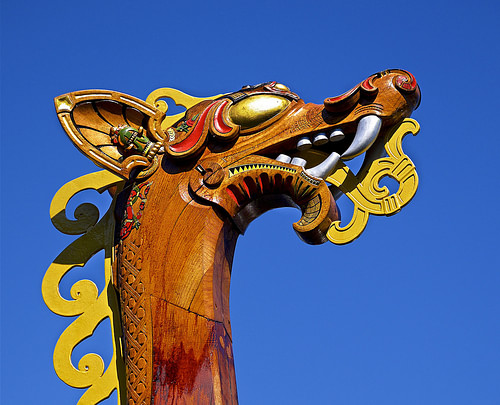 Viking Boat Figurehead Jamie McCaffrey (CC BY-NC-SA) ](https://www.worldhistory.org/image/6557/viking-boat-figurehead/ "Viking Boat Figurehead")The Vikings used the word themselves to refer to the activity of armed raids on other lands for the purpose of plunder. The Old Norse phrase *fara i viking* (“to go on expedition”) had a distinctly different meaning than going on a sea voyage for the purposes of legitimate trade. When one decided to “go Viking” one was announcing one's intention to join in raiding profitable targets in other lands.
### Culture
The Viking culture was Scandinavian, with society divided into three classes, the Jarls (aristocracy), Karls (lower class), and Thralls (slaves). Upward mobility was possible for Karls but not Thralls. Slavery was widely practiced throughout Scandinavia and is considered one of the prime motivators for the Viking raids on other lands.
[Women](https://www.worldhistory.org/disambiguation/women/) had greater freedoms in Scandinavian/Viking culture than in many others. Women could inherit property, choose where and how to live if unmarried, represent themselves in legal cases, and own their own businesses (such as breweries, taverns, shops, and farms). Women were the prophetesses of either the goddess [Freyja](https://www.worldhistory.org/Freyja/) or the [god](https://www.worldhistory.org/God/) [Odin](https://www.worldhistory.org/odin/) – there were no male religious leaders – and interpreted the gods' messages for the people.
Marriages were arranged by the men of the clan, and a woman could not choose her own mate - but neither could a man. Women's dress and jewelry were similar to men of their social class, and neither sex wore earrings which were thought to be affectations of lesser races. Women were responsible for raising children and keeping the house but both men and women prepared meals for the family.
Most Scandinavians were farmers, but there were also blacksmiths, armorers, brewers, merchants, weavers, luthiers (those who made stringed instruments), drum-makers, poets, musicians, craftsmen, carpenters, jewelers, and many other occupations. A significant source of income was trading [amber](https://www.worldhistory.org/Amber/), the fossilized resin of the pine tree, which they had in abundance. Amber frequently washed up on the shores around Scandinavia and was worked into jewelry or sold in semi-processed form, especially to the [Roman](https://www.worldhistory.org/disambiguation/Roman/) and [Byzantine](https://www.worldhistory.org/disambiguation/Byzantine/) empires.
Scandinavians enjoyed leisure time as much as any other culture and played sports, board games, and organized festivals. Sports included mock-combat, wrestling, mountain climbing, swimming, javelin-throwing, hunting, a spectacle known as horse-fighting whose details are unclear, and a field game known as *Knattleik* which was similar to hockey. Their board games included dice, games of strategy along the lines of chess, and chess itself.
[ 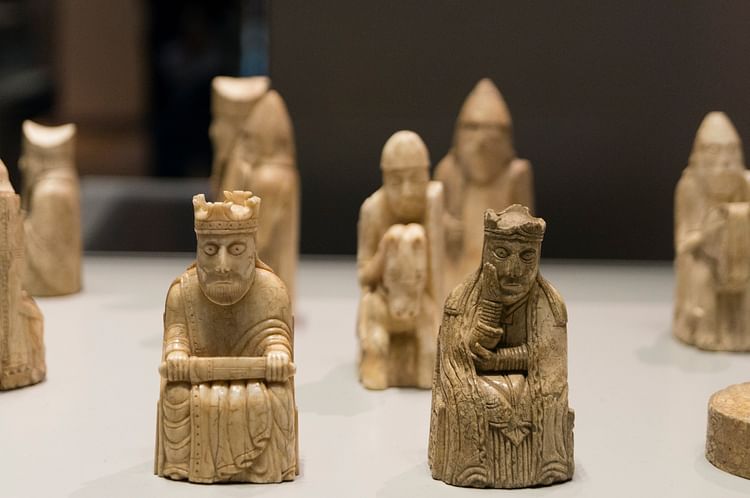 Lewis Chessmen Jagoba Barron (CC BY-SA) ](https://www.worldhistory.org/image/8029/lewis-chessmen/ "Lewis Chessmen")Contrary to the popular image of the Vikings as filthy and savage, they were actually quite refined and paid a great deal of attention to hygiene and appearance. Once trade was established with the east, Viking Jarls often wore [silk](https://www.worldhistory.org/Silk/) and expensive jewelry. They braided their hair, were well groomed, and wore fine cloaks and intricately-crafted jewelry in the form of necklaces and arm- and wristbands.
Cleanliness was not only a sign of wealth and status but also had religious significance. Vikings made sure to always keep their finger and toenails short because of their belief in [Ragnarok](https://www.worldhistory.org/Ragnarok/), the twilight of the gods and the end of the world, at which the ship Naglfar would appear floating on the waters unleashed by the great serpent Jormungand. Naglfar was built from the nails of the dead and so anyone who died with nails unpared provided ship-building material and hastened the inevitable end.
### Norse [Religion](https://www.worldhistory.org/religion/)
The end of the world was predestined but one could still struggle against it. The gods of the Norse provided the people with the breath of life, and it was then up to each individual to prove worthy of the gift. The Norse gods came to Scandinavia with the Germanic migrations sometime around the beginning of the [Bronze Age](https://www.worldhistory.org/disambiguation/Bronze_Age/) (c. 2300 - c.1200 BCE). These were fierce gods who understood their time was limited and lived fully to make the most of it; their followers were encouraged to do the same.
The main sources for the Norse religious beliefs are the *Poetic [Edda](https://www.worldhistory.org/Edda/)*, dated to oral traditions of the 9th and 10th centuries CE, and the *Prose Edda* (c. 1220 CE), a collection of tales based on older stories. In the Norse creation story, before the world was created there was only ice and a [giant](https://www.worldhistory.org/Giants/) named [Ymir](https://www.worldhistory.org/Ymir/) who lived by the grace of the great cow Audhumla. Audhumla fed Ymir milk which ran continuously from her four udders while, at the same time, licking the ice for her own sustenance. Her licking freed the trapped god Buri who then produced a son, Borr.
[  Codex Regius of the Poetic Edda Unknown (Public Domain) ](https://www.worldhistory.org/image/6411/codex-regius-of-the-poetic-edda/ "Codex Regius of the Poetic Edda")Borr married Bestla, daughter of Bolthorn the frost giant, and she gave birth to the gods Odin, Vili, and Vé. These gods united, killed Ymir, and used his body to create the world. The first human beings were Ask and Embla, who had no spirit or form until life was breathed into them by Odin, while other gods gave them reason and passion.
The world created by the gods was understood as an enormous tree, known as Yggdrasil, and included nine planes of existence. The most famous of these are [Midgard](https://www.worldhistory.org/Midgard/) (home for mortals), Asgard (home of the gods), and Alfheim (home of the elves) and another realm, Niflheim, located beneath Midgard where those who died poorly went. Heroic women, especially those who died in childbirth, went to the Hall of [Frigg](https://www.worldhistory.org/Frigg/) in Asgard where they spent eternity in the company Odin's wife while men who died heroically in battle went to Odin's hall of [Valhalla](https://www.worldhistory.org/Valhalla/).
The entire universe was established on the principles of order by Odin and the other gods after they had defeated the frost [giants](https://www.worldhistory.org/Giants/). The frost giants lived in their own realm, Jotunheim, but were a constant threat to both Asgard and Midgard. At some point in the future, a great day of destruction would come and chaos would be unleashed; this day was known as Ragnarök, the twilight of the gods.
[  Valhalla Emil Doepler (Public Domain) ](https://www.worldhistory.org/image/7527/valhalla/ "Valhalla")When Ragnarök came, the sun would be swallowed by the wolf Skoll and the moon by his brother Hati, plunging the world into darkness while, at the same time, the great wolf [Fenrir](https://www.worldhistory.org/Fenrir/) would ravage through all the planes of Yggdrasil. The god [Heimdall](https://www.worldhistory.org/heimdall/) would sound his great horn, calling the gods to battle, and Odin would call up all the heroes from Valhalla's halls to join with the gods in defending creation. The gods fight valiantly but, in the end, they fall in battle as the entire universe is consumed in flame and sinks into the primordial waters. Although this is the end of the world, it is not the end of existence; once this present world is destroyed, a new one is created and rises from the waters and the entire cycle repeats itself.
The Norse gods were honored through the actions of the people who believed in them. No evidence of a religious hierarchy has been found in Scandinavia prior to the coming of [Christianity](https://www.worldhistory.org/christianity/). Women who were touched by the gods were known as *Volva* and could hear the divine words and translate them for other mortals. Although there were some temples erected to the gods, most worship seems to have taken place in natural settings which had some connection to a certain deity. The stories of the gods, creation, and Ragnarök were transmitted orally and were only written down much later, in Iceland by the historian/poet Snorri Sturluson (l. 1179-1241 CE).
### Shipbuilding & The Viking Raids
The [Norse mythology](https://www.worldhistory.org/Norse_Mythology/) would influence the Viking culture and encourage their raids because the Viking life emulated that of the gods. Brave warriors went abroad to do battle against forces they saw as chaotic and dangerous. The Mediterranean and European religious belief in a single god and his savior son who needed priests, churches, nuns, books, and rules to be worshipped would have seemed absurd and threatening to the Vikings. There was nothing in the Christian teaching which resonated with Norse ideology. Once the Scandinavians had fully mastered shipbuilding and began to “go Viking,” they showed no mercy to the Christian communities they encountered, but early Scandinavian settlers in foreign lands frequently adopted the new faith.
Carvings from Scandinavia dated to c. 4000-2300 BCE show that the people already knew how to build boats at this time. These small ships were driven by paddles, had no keel, and would have made long-distance trips perilous; still, there is ample evidence that such journeys were made. Shipbuilding developed past this stage of small ferry boats only around c. 300-200 BCE and would not develop further until interactions with Roman traders and [Celtic](https://www.worldhistory.org/celt/) and Germanic merchants using Roman technology between c. 200-400 CE. The first ship able to navigate the sea easily is known as the Nydam ship, from Denmark, built c. 350-400 CE, though this ship had no sail.
[  Nydam Ship Erik Christensen (CC BY-SA) ](https://www.worldhistory.org/image/8030/nydam-ship/ "Nydam Ship")Long before the development of keel or sail, however, a number of Scandinavian traders established permanent communities in Europe and assimilated with the Christian culture, forgetting the stories of the Norse gods and their old religious practices. Professor Harl notes that by 625 CE,
> The West Germanic kinsmen of the Scandinavians had converted to Christianity and had begun to forget their own stories. Between 650 and 700 CE, new Christian cultures emerged in England, in the Frankish world, and in Frisia, which led to a parting of the ways between the Scandinavian heartland and the new states in the former [Roman Empire](https://www.worldhistory.org/Roman_Empire/). (25)
This “parting of the ways” was largely due to differences in religious understanding and behavior. The Christian god was supposed to be omnipotent, omniscient, and omnipresent and this was a significant departure from the Norse gods who, like other pagan religions, each had their own area of expertise, their own lives and concerns, and whose actions explained the observable world in a way the Christian god did not. For the Vikings, the universe was full of gods and spirits and supernatural energies which infused a challenging world of adventure while, to the Christians, it was ruled by one deity who presided over a fallen world of sin; this difference in world views influenced how the Vikings dealt with the Christians they encountered on their raids.
[  Lindisfarne Damian Entwistle (CC BY-NC-SA) ](https://www.worldhistory.org/image/6547/lindisfarne/ "Lindisfarne")It would have been considered dishonorable for a Norse warrior to kill unarmed civilians and take their possessions, but this is precisely what the Vikings did between c. 793-1100 CE. They were able to do so because those they plundered were not Norse, were not bound by the same belief, and so the rules which maintained Viking society did not apply to them.
When the Vikings first came to Britain and sacked the priory of Lindisfarne in 793 CE, they murdered every monk they found and carried off everything of value; this would have been considered a serious crime if the slain had been Norse, but as it was, the monks were simply obstacles to the acquisition of wealth and, further, it was abundantly clear that the Christian god had no power to defend his people if they could so easily be killed within the walls of their own place of worship.
### Expansion & Legacy
The Viking raids on Christian communities, like those of the [Huns](https://www.worldhistory.org/Huns/) on the Roman [Empire](https://www.worldhistory.org/empire/) centuries earlier, were interpreted by European Christians as God's wrath on his people for their sins. In Britain, [Alfred the Great](https://www.worldhistory.org/Alfred_the_Great/) (871-899 CE) would institute his reforms in education to better his people and appease his God. He also made baptism into the Christian faith a stipulation of treaties with the Vikings. When Alfred defeated the Viking army under Guthrum at the Battle of Eddington in 878 CE, Guthrum and 30 of his chieftains had to submit to baptism and conversion.
[Charlemagne](https://www.worldhistory.org/Charlemagne/) in France (800-814 CE) pursued a much more active course in attempting to forcefully Christianize the Scandinavians through military campaigns which destroyed sites sacred to Norse belief and established Christianity as an enemy faith of a hostile people. Charlemagne's efforts have been cited by a number of historians as the primary motivation for the savagery of the Viking raids, but this claim does not take into account the raids on Britain and Ireland between 793-800 CE. There is little doubt, however, that Charlemagne's evangelical holy wars did little to encourage Scandinavian acceptance of Christianity and only led to animosity and greater division.
In the early years of the [Viking Age](https://www.worldhistory.org/collection/29/the-viking-age/) in Europe, the sea-raiders began as little more than pirates, but they would eventually arrive as great armies under charismatic and skilled military leaders, would [conquer](https://www.worldhistory.org/warfare/) large territories and establish communities, and finally would assimilate with the local population.
The Viking Age is known for legendary Norse leaders such as Halfdan Ragnarsson (also known as Halfdane, c. 865-877 CE), his brother [Ivar the Boneless](https://www.worldhistory.org/Ivar_the_Boneless/) (c. 870 CE), Guthrum (c. 890 CE), Harold Bluetooth (c. 985 CE), his son Sven Forkbeard (986-1014 CE), [Cnut the Great](https://www.worldhistory.org/Cnut_the_Great/) (1016-1035 CE) and Harald Hardrada (1046-1066). Other notable Norse explorers of the time were Eric the Red (died 1003 CE) and [Leif Erikson](https://www.worldhistory.org/Leif_Erikson/) (died c. 1020 CE) who explored and settled Greenland and North America.[  Map of Viking Exploration, 8th-11th Century Simeon Netchev (CC BY-NC-ND) ](https://www.worldhistory.org/image/14067/map-of-viking-exploration-8th-11th-century/ "Map of Viking Exploration, 8th-11th Century")The Vikings were never defeated *en masse* in battle and no single engagement ended the Viking Age. The date agreed on by most scholars as the end of the Viking Age is 1066 CE when Harald Hardrada was killed at the [Battle of Stamford Bridge](https://www.worldhistory.org/article/1306/battle-of-stamford-bridge/), but Viking raids continued after this date. There were many factors which contributed to the end of the Viking Age but the Christianization of Scandinavia throughout the 10th and 11th centuries CE was certainly among the most significant. The Norse religion was the last of the great pagan belief systems to fall to Christianity, and once it did, there was no inspiration in the new faith for one to "go Viking" anymore.
The Vikings influenced the culture of every nation they came in contact with and in every conceivable way from [architecture](https://www.worldhistory.org/disambiguation/architecture/) to language, infrastructure to poetry and place names, military reforms to food and clothing, and certainly in the areas of warfare and shipbuilding. Regularly depicted by medieval writers as marauding bands of murderous heathens, the Vikings would be re-imagined as noble savages by the early 20th century CE, and this is often how they are still portrayed in the present day. The Vikings were actually neither of these, however; they were a cultured and sophisticated warrior class who understood, based on their religious belief, that in raiding other lands for personal gain they had everything to win and nothing to lose.
#### Editorial Review
This human-authored definition has been reviewed by our editorial team before publication to ensure accuracy, reliability and adherence to academic standards in accordance with our [editorial policy](https://www.worldhistory.org/static/editorial-policy/).
## Bibliography
- [Arman, J. *The Warrior Queen: The Life and Legend of Aethelflaed, Daughter of Alfred the Great.* Amberley Publishing, 2017.](https://www.worldhistory.org/books/1445662043/)
- [Carlson, R. *Norse Mythology.* CreateSpace Independent Publishing Platform, 2016.](https://www.worldhistory.org/books/B01MQH12IR/)
- [Dersin, D. *Vikings: Raiders from the North.* Time Life Education, 1993.](https://www.worldhistory.org/books/0809498952/)
- [Ferguson, R. *The Vikings: A History.* Penguin Books, 2010.](https://www.worldhistory.org/books/0143118013/)
- [Harl, K. W. *The Great Courses: The Vikings.* The Great Courses, 2016.](https://www.worldhistory.org/books/B01K3HOJFG/)
- [Hollander, L. M. *The Poetic Edda.* Oxford University Press, 2014.](https://www.worldhistory.org/books/0199675341/)
- [Keynes, S. & Lapidge, M. *Alfred the Great & Other Contemporary Sources.* Penguin Classics, 1984.](https://www.worldhistory.org/books/0140444092/)
- [Lindow, J. *Norse Mythology: A Guide to Gods, Heroes, Rituals, and Beliefs.* Oxford University Press, 2002.](https://www.worldhistory.org/books/0195153820/)
- [Oliver, N. *The Vikings: A New History.* Pegasus Books, 2014.](https://www.worldhistory.org/books/1605986399/)
- [Sawyer, P. *The Oxford Illustrated History of the Vikings.* Oxford University Press, 2001.](https://www.worldhistory.org/books/0192854348/)
- [Snorri Sturluson. *The Prose Edda.* University of California Press, 2012.](https://www.worldhistory.org/books/0520273052/)
- [Somerville, A. A. & McDonald, R. A. *The Viking Age: A Reader.* University of Toronto Press, Higher Education Division, 2014.](https://www.worldhistory.org/books/1442608676/)
## About the Author
Joshua J. Mark is World History Encyclopedia's co-founder and Content Director. He was previously a professor at Marist College (NY) where he taught history, philosophy, literature, and writing. He has traveled extensively and lived in Greece and Germany.
- [Linkedin Profile](https://www.linkedin.com/pub/joshua-j-mark/38/614/339)
## Timeline
- **c. 4000 BCE - c. 2300 BCE**: Depictions of ships in stone (in [burial](https://www.worldhistory.org/burial/) settings) and [metal](https://www.worldhistory.org/disambiguation/metal/) found in Scandinavia.
- **c. 350 BCE**: Hjortspring boat - the earliest known plank-built Scandinavian vessel.
- **c. 200 CE - c. 400 CE**: [Roman](https://www.worldhistory.org/disambiguation/Roman/) technology used by [Vikings](https://www.worldhistory.org/Vikings/) in shipbuilding.
- **c. 350 CE - c. 400 CE**: The Nydam Ship built, first able to easily travel long distance overseas.
- **c. 750 CE - c. 800 CE**: The presumed founding of the important [Viking](https://www.worldhistory.org/Vikings/) trading center of [Birka](https://www.worldhistory.org/Birka/) in Sweden.
- **780 CE - 950 CE**: The commercial [Viking](https://www.worldhistory.org/Vikings/) centre at [Kaupang](https://www.worldhistory.org/Kaupang/) thrives.
- **c. 790 CE - c. 880 CE**: Style E (also 'Oseberg' or 'Broa' style) of the Scandinavian animal ornamentation styles flourished between the late 8th- and late 9th century CE.
- **c. 790 CE - c. 1100 CE**: The [Viking Age](https://www.worldhistory.org/collection/29/the-viking-age/).
- **793 CE**: First [Viking](https://www.worldhistory.org/Vikings/) raid in [Britain](https://www.worldhistory.org/disambiguation/Britain/) at Lindisfarne Abbey.
- **c. 800 CE - c. 1050 CE**: Approximate timespan of the [Viking Age](https://www.worldhistory.org/collection/29/the-viking-age/).
- **c. 829 CE - c. 831 CE**: The Frankish missionary St. Ansgar (801-865 CE) first introduces the Swedes to [Christianity](https://www.worldhistory.org/christianity/) in the [Viking](https://www.worldhistory.org/Vikings/) trading town of [Birka](https://www.worldhistory.org/Birka/).
- **845 CE**: [Viking](https://www.worldhistory.org/Vikings/) chief [Ragnar Lothbrok](https://www.worldhistory.org/Ragnar_Lothbrok/) raids [Paris](https://www.worldhistory.org/disambiguation/paris/).
- **c. 850 CE - c. 990 CE**: The Borre Style of the [Viking Age](https://www.worldhistory.org/collection/29/the-viking-age/) animal ornamentation styles flourished between c. 850 and the late 10th century CE.
- **854 CE - 858 CE**: [Viking](https://www.worldhistory.org/Vikings/) raids on West Francia allegedly led by [Bjorn Ironside](https://www.worldhistory.org/Bjorn_Ironside/) and Hastein (although this attribution is more likely legendary rather than historical).
- **876 CE**: [Viking](https://www.worldhistory.org/Vikings/) raids involving Rollo.
- **885 CE - 886 CE**: [Viking](https://www.worldhistory.org/Vikings/) siege of [Paris](https://www.worldhistory.org/disambiguation/paris/). [Odo of West Francia](https://www.worldhistory.org/Odo_of_West_Francia/) successfully defends the [city](https://www.worldhistory.org/city/).
- **c. 890 CE - c. 990 CE**: The Jelling Style, a [Viking Age](https://www.worldhistory.org/collection/29/the-viking-age/) animal ornamentation style, cropped up just before 900 CE and was in vogue until the end of the 10th century CE.
- **c. 900 CE**: [Viking](https://www.worldhistory.org/Vikings/) [Hedeby](https://www.worldhistory.org/Hedeby/) is at its height. It encompasses an area of around 24 hectares and has a population of approximately 1,500 people.
- **c. 950 CE**: The [Viking](https://www.worldhistory.org/Vikings/) trading center of [Birka](https://www.worldhistory.org/Birka/) in present-day Sweden goes into abrupt decline around the mid-10th century CE.
- **c. 950 CE - c. 1000 CE**: The Mammen Style, a Scandinavian animal ornamentation style, flourished in this period.
- **c. 990 CE - c. 1050 CE**: The Ringerike Style, a Scandinavian animal ornamentation style, flourished in this period.
- **c. 1000 CE**: [Vikings](https://www.worldhistory.org/Vikings/) first land in North America, in Newfoundland and other parts of eastern Canada.
- **c. 1040 CE - c. 1100 CE**: The Urnes style, the last of the [Viking Age](https://www.worldhistory.org/collection/29/the-viking-age/) animal ornamentation styles, flourished in this period and even extended into the 12th century CE in certain locations.
- **1066 CE**: [Viking](https://www.worldhistory.org/Vikings/) [Hedeby](https://www.worldhistory.org/Hedeby/) is sacked by Polabian [Slavs](https://www.worldhistory.org/Slavs/), after already having been sacked by Harald Hardrada of Norway a few years before. Residents relocate to Schleswig, and Hedeby's role as mercantile center ceases.
- **c. 1066 CE**: Harald Hardrada of the [Vikings](https://www.worldhistory.org/Vikings/) killed at the [Battle of Stamford Bridge](https://www.worldhistory.org/article/1306/battle-of-stamford-bridge/); accepted date of the end of the [Viking Age](https://www.worldhistory.org/collection/29/the-viking-age/).
- **25 Sep 1066 CE**: [Battle of Stamford Bridge](https://www.worldhistory.org/article/1306/battle-of-stamford-bridge/) in which [Harold Godwinson](https://www.worldhistory.org/Harold_Godwinson/) (Harold II) defeats an invading army led by Harald Hardrada, king of Norway.
- **21 Sep 1069 CE**: A [Viking](https://www.worldhistory.org/Vikings/) force led by King Sweyn II of Denmark's brother Asbjorn sacks York.
- **May 1070 CE**: King Sweyn II of Denmark joins forces with Anglo-[Saxon](https://www.worldhistory.org/Saxons/) rebels led by Hereward the Wake to threaten East Anglia in [England](https://www.worldhistory.org/disambiguation/england/).
- **c. 1220 CE**: The Prose [Edda](https://www.worldhistory.org/Edda/) by Snorri Sturluson is written.
- **c. 1270 CE**: The Poetic [Edda](https://www.worldhistory.org/Edda/) is written. It contains poetry that dates further back, though.
- **2018 CE**: The [Viking](https://www.worldhistory.org/Vikings/) trading center of [Hedeby](https://www.worldhistory.org/Hedeby/) is made a UNESCO World Heritage Site in 2018: the "Archaeological Border complex of Hedeby and the Danevirke".
## External Links
- [Vikings - KS2 History - BBC Bitesize](https://www.bbc.com/bitesize/topics/ztyr9j6)
- [32 Viking Facts That Uncover One Of History's Most Misunderstood Civilizations](https://allthatsinteresting.com/viking-facts-history-information)
- [The History of Vikings Podcast by Noah Tetzner](http://thehistoryofvikings.com/)
- [Norse World](https://www.uu.se/en/research/infrastructure/norseworld/)
- [Cross-curricular science ideas web: the Vikings- Learn Chemistry](http://www.rsc.org/learn-chemistry/resource/res00002195/science-ideas-web-the-vikings)
- [Experiment with the Vikings- Learn Chemistry](http://www.rsc.org/learn-chemistry/resource/res00001940/experiment-with-the-vikings?cmpid=CMP00006331)
- [The History of Vikings Podcast](https://thehistoryofvikings.com/)
- [What was so special about Viking ships? - Jan Bill](https://ed.ted.com/lessons/what-was-so-special-about-viking-ships-jan-bill)
- [The Viking Blót Sacrifices](https://en.natmus.dk/historical-knowledge/denmark/prehistoric-period-until-1050-ad/the-viking-age/religion-magic-death-and-rituals/the-viking-blot-sacrifices/)
- [The Vikings (780–1100) | Essay | The Metropolitan Museum of Art | Heilbrunn Timeline of Art History](https://www.metmuseum.org/toah/hd/vikg/hd_vikg.htm)
## Cite This Work
### APA
Mark, J. J. (2018, January 29). Vikings. *World History Encyclopedia*.
### Chicago
Mark, Joshua J.. "Vikings." *World History Encyclopedia*, January 29, 2018. .
### MLA
Mark, Joshua J.. "Vikings." *World History Encyclopedia*, 29 Jan 2018, .
## License & Copyright
Submitted by [Joshua J. Mark](https://www.worldhistory.org/user/JPryst/ "User Page: Joshua J. Mark"), published on 29 January 2018. The copyright holder has published this content under the following license: [Creative Commons Attribution-NonCommercial-ShareAlike](https://creativecommons.org/licenses/by-nc-sa/4.0/deed.en). This license lets others remix, tweak, and build upon this content non-commercially, as long as they credit the author and license their new creations under the identical terms. When republishing on the web a hyperlink back to the original content source URL must be included. Please note that content linked from this page may have different licensing terms.