---
title: Roman Verona
author: Mark Cartwright
source: https://www.worldhistory.org/Verona/
format: machine-readable-alternate
license: Creative Commons Attribution-NonCommercial-ShareAlike (https://creativecommons.org/licenses/by-nc-sa/4.0/)
updated: 1970-01-01
---
# Roman Verona
_Authored by [Mark Cartwright](https://www.worldhistory.org/user/markzcartwright/)_
Verona, situated on the river Adige in northern [Italy](https://www.worldhistory.org/italy/), was a [Roman](https://www.worldhistory.org/disambiguation/Roman/) town probably founded some time in the 2nd century BCE. It was a *colonia* by 69 CE and the impressive monuments which survive to this day attest to the [city](https://www.worldhistory.org/city/)'s importance. In late antiquity, the emperors [Constantine I](https://www.worldhistory.org/Constantine_I/) and Theodoric spent time in Verona, the latter building a [palace](https://www.worldhistory.org/disambiguation/palace/), and today it is most famous for its magnificent [amphitheatre](https://www.worldhistory.org/amphitheatre/), which was the third largest in the Roman world and which continues to hold important cultural events. Verona is listed by UNESCO as a World Heritage Site.
### Overview
The oldest inscription found at Verona is from a milestone on the Via Postumia and dates to 148 BCE. The history of the town before that time is unclear but, according to both Pliny and [Livy](https://www.worldhistory.org/livy/), the settlement may have been occupied by the Cenomani Gauls. Both Strabo and Martial describe Roman Verona as a large city, and prominent amongst its citizens were the powerful Gavia family who were also generous patrons of the city. In the mid-1st century CE Verona's citizens received [Roman citizenship](https://www.worldhistory.org/article/859/roman-citizenship/).
The general plan of the town, laid out in a regular grid pattern, may have been designed by [Vitruvius](https://www.worldhistory.org/Vitruvius/). There were impressive circuit walls constructed by Emperor [Gallienus](https://www.worldhistory.org/Gallienus/) (r. 253-268 CE), and notable architectural highlights include the large 1st century CE amphitheatre, several monumental gates, and a [theatre](https://www.worldhistory.org/disambiguation/theatre/). [Catullus](https://www.worldhistory.org/Catullus/), the 1st century CE poet, is one of the town's famous sons. The town continued to be occupied through the Middle Ages but never regained the importance it had enjoyed in Roman times. The town did achieve literary fame, though, when Shakespeare chose it as a location for three of his plays, including *[Romeo and Juliet](https://www.worldhistory.org/Romeo_and_Juliet/)*. Testimony to Verona's rich architectural legacy is its status as a UNESCO World Heritage Site.
### Principal Roman Monuments
**Amphitheatre**
The 1st century CE amphitheatre, known simply as the Arena, is Verona's best preserved Roman monument. Originally there were three tiers of arches reaching a height of 30 metres, but today only two tiers survive except in one small portion where four arches survive of the top tier. The Arena floor is also now 2 metres below ground-level. The external dimensions of the elliptic structure are 152 x 123 metres, which made it the third largest Roman amphitheatre (after the [Colosseum](https://www.worldhistory.org/Colosseum/) and Capua). The building was constructed using a cement and rubble mix known as *opus coementicum*, brick, and stone blocks from Valpolicella set in square pillars to create an external façade of 72 arches, each spanning 2 metres. These led directly to an interior corridor 4.4 metres wide which runs around the Arena. From this corridor, steps lead upwards at regular intervals and on four different levels to form *vomitoria,* which give access to the interior cavea. Inside, the seats were arranged in four elliptic rings giving a total of 44 rows of seats. There is also an extensive and still functioning drainage system which has contributed to the excellent preservation of the monument. The Arena was originally used to host [gladiator](https://www.worldhistory.org/gladiator/), [circus](https://www.worldhistory.org/disambiguation/Circus/), and equestrian events and, even today, it continues to host concerts and, most famously, an opera season every summer where 20,000 spectators, as in antiquity, enjoy the unique atmosphere of an open-air spectacle.
**Theatre**
The Roman theatre nestling into the hill on the left bank of the Adige was first built in the 1st century BCE during the reign of [Augustus](https://www.worldhistory.org/augustus/) with conversion to stone probably coming later. It has been partially built over on the right side but originally measured 123 x 152 metres. The semicircular cavea and stage background [wall](https://www.worldhistory.org/wall/) are a typical mix of Roman and [Greek architecture](https://www.worldhistory.org/Greek_Architecture/). Once again, quality building materials and good drainage systems have allowed for a reasonable preservation and the theatre continues to be used for public performances today.
[ 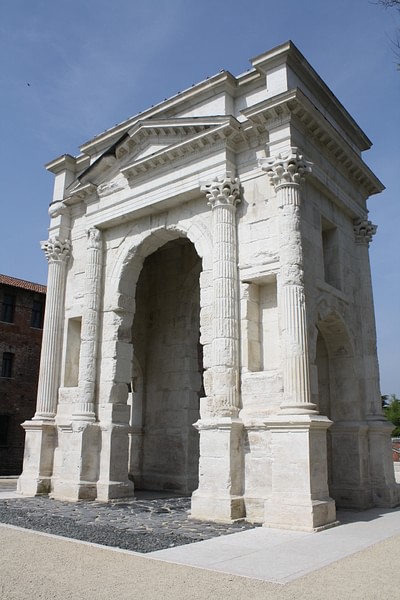 Arch of Gavi, Verona Mark Cartwright (CC BY-NC-SA) ](https://www.worldhistory.org/image/2480/arch-of-gavi-verona/ "Arch of Gavi, Verona")**Arch of Gavi**
The arch also known as the Arco dei Gavi was built in the 1st century CE to glorify and commemorate the powerful Gavi family. Typically, triumphal arches commemorated military triumphs and statesmen, but this is a rare example of such a structure commemorating a private family. Situated to [mark](https://www.worldhistory.org/disambiguation/Mark/) the beginning of the Via Sacra, the arch once had family statues in its niches, the inscriptions of which still remain. There is also an inscription: 'Lucius Vitruvius Libertus Architectus' which indicates the architect who constructed it. Beneath the arch is a well-preserved stretch of Roman road with typical polygonal slabs which show the tell-tale parallel grooves of wheeled traffic. The arch was entirely dismantled in 1805 CE when [Napoleon](https://www.worldhistory.org/disambiguation/Napoleon/) considered that it blocked military traffic, but the arch was restored in 1932 CE.
**Borsari Gate**
The Borsari Gate or Porta dei Borsari was built in the 1st century CE. The gate is built from white Valpolicella stone and was the city's main entrance gate in Roman times. Two arches are flanked by engaged Corinthian columns and topped by an architrave and tympanum. Above are two tiers of smaller arches, six on each level, again with engaged columns and pediments. The inscription relates to the city walls built in 265 CE by Gallienus.
[ 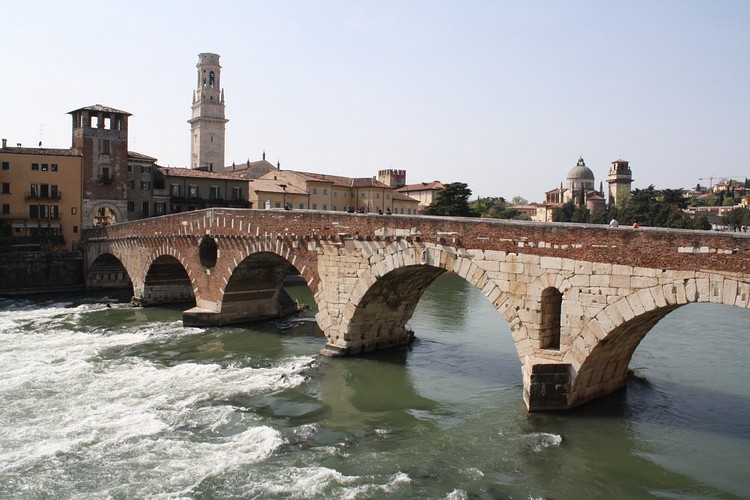 Ponte Pietra, Verona Mark Cartwright (CC BY-NC-SA) ](https://www.worldhistory.org/image/2545/ponte-pietra-verona/ "Ponte Pietra, Verona")**Ponte Pietra**
The bridge known today as the 'Stone Bridge' was built in the 1st century BCE and was one of only two Roman bridges that crossed the Adige. Its original name was the Pons Marmoreus. Floods, [warfare](https://www.worldhistory.org/warfare/), and time have taken their toll on the structure but the two arches nearest the left bank (in white) are original.
#### Editorial Review
This human-authored definition has been reviewed by our editorial team before publication to ensure accuracy, reliability and adherence to academic standards in accordance with our [editorial policy](https://www.worldhistory.org/static/editorial-policy/).
## Bibliography
- Fabbri, P. *Art & History Verona.* Bonechi, Florence
- [Henig, M. *A Handbook of Roman Art.* Phaidon Press Ltd, 1983.](https://www.worldhistory.org/books/0714822140/)
- [Hornblower, S. *The Oxford Classical Dictionary.* Oxford University Press, USA, 2012.](https://www.worldhistory.org/books/0199545561/)
- [Wheeler, M. *Roman Art and Architecture.* Thames & Hudson, 1985.](https://www.worldhistory.org/books/0500200211/)
## About the Author
Mark is WHE’s Publishing Director and has an MA in Political Philosophy (University of York). He is a full-time researcher, writer, historian and editor. Special interests include art, architecture and discovering the ideas that all civilizations share.
## Timeline
- **148 BCE**: The oldest [Roman](https://www.worldhistory.org/disambiguation/Roman/) inscription from [Verona](https://www.worldhistory.org/Verona/) is upon a milestone.
- **69 CE**: [Verona](https://www.worldhistory.org/Verona/) is made a [Roman](https://www.worldhistory.org/disambiguation/Roman/) colonia.
- **265 CE**: [Gallienus](https://www.worldhistory.org/Gallienus/) builds walls around [Verona](https://www.worldhistory.org/Verona/).
## Cite This Work
### APA
Cartwright, M. (2014, April 10). Roman Verona. *World History Encyclopedia*.
### Chicago
Cartwright, Mark. "Roman Verona." *World History Encyclopedia*, April 10, 2014. .
### MLA
Cartwright, Mark. "Roman Verona." *World History Encyclopedia*, 10 Apr 2014, .
## License & Copyright
Submitted by [Mark Cartwright](https://www.worldhistory.org/user/markzcartwright/ "User Page: Mark Cartwright"), published on 10 April 2014. The copyright holder has published this content under the following license: [Creative Commons Attribution-NonCommercial-ShareAlike](https://creativecommons.org/licenses/by-nc-sa/4.0/deed.en). This license lets others remix, tweak, and build upon this content non-commercially, as long as they credit the author and license their new creations under the identical terms. When republishing on the web a hyperlink back to the original content source URL must be included. Please note that content linked from this page may have different licensing terms.