---
title: Vejovis
author: Tyler Holman
source: https://www.worldhistory.org/Vejovis/
format: machine-readable-alternate
license: Creative Commons Attribution-NonCommercial-ShareAlike (https://creativecommons.org/licenses/by-nc-sa/4.0/)
updated: 1970-01-01
---
# Vejovis
_Authored by [Tyler Holman](https://www.worldhistory.org/user/tyler_holman95/)_
Vejovis (sometimes spelt Vediovis) was an obscure [Roman](https://www.worldhistory.org/disambiguation/Roman/) deity. He is poorly attested in both written sources and [archaeology](https://www.worldhistory.org/Archaeology/), and his nature is debated by scholars. His name is related to Jove ([Jupiter](https://www.worldhistory.org/jupiter/)), and some authors described him as either a 'little Jupiter' or 'anti-Jupiter.' Others have implied an association with the underworld. He was celebrated with festivals on 1 January, 7 March, and 21 May, but the nature of these festivals, as with the rest of the [god](https://www.worldhistory.org/God/)'s cult, is unknown.
His worship dated to the very earliest period of Roman history, when his cult was introduced to [Rome](https://www.worldhistory.org/Rome/) by the Sabine king [Titus](https://www.worldhistory.org/disambiguation/Titus/) Tatius. Other scholars suggest a relation to the [Etruscan](https://www.worldhistory.org/Etruscan_Civilization/) deity Veive, which is supported by references to Vejovis in an Etruscan divination formula, preserved by Martianus Capella, which places him among gods of thunder and lightning.
Vejovis had already fallen into obscurity by the 1st century BCE, and Roman authors offered several explanations for the meaning of his name and the nature of his powers. [Ovid](https://www.worldhistory.org/ovid/) describes him as being depicted as a young Jupiter carrying no thunderbolts, accompanied by a female goat. The 2nd century CE Latin author Gellius, on the other hand, depicts him as a negative force, the reverse of Jupiter, who was worshipped to pacify his wrath, rather than to seek his aid. He describes Vejovis as being depicted holding a bundle of arrows, which he used to inflict harm, and was propitiated with the sacrifice of a female goat '*ritu humano*,' on behalf of or in place of a human. Gellius also notes that some equated Vejovis with [Apollo](https://www.worldhistory.org/apollo/) on account of their similar appearance.
> …the statue of the god Vediovis… holds arrows, which, clearly, are meant to inflict harm.
> (Gellius, *Noctes Attica*, Book V, 12.11-12)
Vejovis was often invoked during times of [war](https://www.worldhistory.org/disambiguation/War/). One such invocation is preserved in Macrobius' 5th century CE *[Saturnalia](https://www.worldhistory.org/Saturnalia/)* which was used by dictators or generals to devote enemy [cities](https://www.worldhistory.org/city/) and armies to destruction. This invocation clearly draws upon Vejovis' destructive aspects:
> Father Dis, Veiovis, Manes, or by whatever other name it is right to call you: may you all fill that [city](https://www.worldhistory.org/city/) of [Carthage](https://www.worldhistory.org/carthage/), and that army of which it is my intention to speak, and those who will bear arms and missiles against our legions and armies, with the urge to flee, with dread, with panic; and may you lead away that army, that enemy… deprive them of heaven's light… may you consider \[their\] cities and fields and the people's lives and lifetimes cursed…
> (Macrobius, *Saturnalia*, Book 3, 9.10-12)
Elsewhere, [Livy](https://www.worldhistory.org/livy/) noted that L. Furius Purpureo had called upon Vejovis, apparently successfully, to route the Gauls at the [Battle](https://www.worldhistory.org/disambiguation/battle/) of Cremona in 200 BCE.
[ 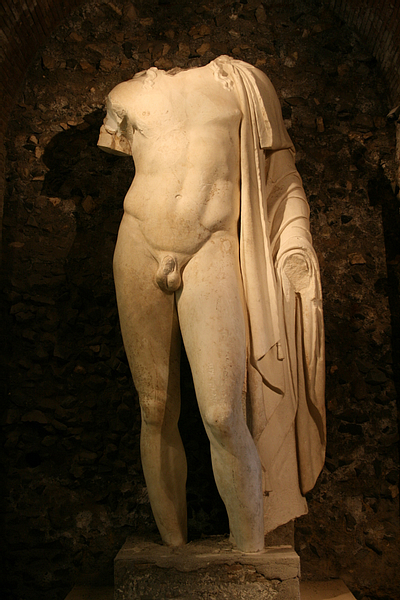 Statue of Vejovis Jean-Pol Grandmont (CC BY-SA) ](https://www.worldhistory.org/image/9511/statue-of-vejovis/ "Statue of Vejovis")In terms of depictions of Vejovis, [Pliny the Elder](https://www.worldhistory.org/Pliny_the_Elder/) described the preservation of a wooden statue of Vejovis which had been consecrated along with the [temple](https://www.worldhistory.org/temple/) in 192 BCE. The remains of a marble statue depicting a youthful body with long, flowing hair, but missing the head, was recovered from the Temple of Vejovis on Rome's Capitoline Hill. Additionally, some scholars interpret a series of first century BCE denarii coins as representing Vejovis, while others reject this identification, instead identifying the deity depicted as Apollo.
There were two temples dedicated to Vejovis in Rome: one between the two summits of the Capitoline Hill (the one referenced by Pliny), and another on Tiber Island. The construction of the temple of Tiber Island was vowed by the [praetor](https://www.worldhistory.org/praetor/) L. Furius Purpureo as noted above, and the second temple was vowed by him during his later consulship. The work done to the Capitoline temple may have been a restoration of an earlier structure, as Ovid implies it had existed since the time of [Romulus](https://www.worldhistory.org/Romulus_and_Remus/), and was a place of refuge. The consecration of that temple was celebrated on the Nones of March (March 7).
The Capitoline temple was restored by Emperor [Domitian](https://www.worldhistory.org/domitian/) in the late 1st century CE, and excavated in 1939 CE. It was unique in its construction, oriented horizontally (left to right) so as to fit into the limited space available in the area. An inscribed altar dedicated to Vejovis by the gens Iulia, the family of [Julius Caesar](https://www.worldhistory.org/Julius_Caesar/) and Emperor [Augustus](https://www.worldhistory.org/augustus/), was found at Bovillae, dedicated according to the 'Alban [law](https://www.worldhistory.org/disambiguation/law/),' yet another term of obscure meaning.
#### Editorial Review
This human-authored definition has been reviewed by our editorial team before publication to ensure accuracy, reliability and adherence to academic standards in accordance with our [editorial policy](https://www.worldhistory.org/static/editorial-policy/).
## Bibliography
- [The Temple of Veiovis](http://www.museicapitolini.org/en/sede/campidoglio_antico/tempio_di_veiove "The Temple of Veiovis"), accessed 22 Nov 2018.
- [Adkins, L. *Dictionary of Roman Religion.* Oxford University Press, 2001.](https://www.worldhistory.org/books/0195142330/)
- Anonymous. "Vejovis and Divus Augustus." *The Numismatic Chronicle and Journal of the Royal Numismatic Society*, Vol. 13 No. 51 1933, pp. 232-233.
- Bagnall, R. *The Encyclopedia of Ancient History.* Wiley-Blackwell, 2012
- [Gaius Plinius Secundus (Pliny the Elder). *Natural History.* Penguin Classics, 1991, Book 19, 98.](https://www.worldhistory.org/books/0140444130/)
- [Gellius. *Aulus Gellius.* Harvard University Press, 1927, Book V, XII.](https://www.worldhistory.org/books/0674992156/)
- [Livy. *Livy.* Harvard University Press, 1919.](https://www.worldhistory.org/books/0674991265/)
- Luce, T.J. "Political Propaganda on roman Republican Coins: Circa 92-82 B.C." *American Journal of Archaeology*, Vol. 72 No. 1 (January, 1968), pp. 25-39.
- [Macrobius. *Macrobius.* Harvard University Press, 2011.](https://www.worldhistory.org/books/0674996496/)
- Marcus Terrentius Varro. *De Lingua Latina.* , Book V, 74.
- [Ovid. *Fasti.* Oxford University Press, 2013, Book III, 430.](https://www.worldhistory.org/books/0192824112/)
- Stephen Hinds. ""Arma" in Ovid's "Fasti" Part 1: Genre and Mannerism." *Arethusa*, Issue 1 Volume 25 (Winter 1992).
## About the Author
Tyler Holman is a student majoring in history. He is fascinated by the ancient world, and enjoys researching overlooked and lesser known figures and events of the period.
## Timeline
- **192 BCE**: A [temple](https://www.worldhistory.org/temple/) dedicated to [Vejovis](https://www.worldhistory.org/Vejovis/) is built in [Rome](https://www.worldhistory.org/Rome/).
## Cite This Work
### APA
Holman, T. (2018, November 23). Vejovis. *World History Encyclopedia*.
### Chicago
Holman, Tyler. "Vejovis." *World History Encyclopedia*, November 23, 2018. .
### MLA
Holman, Tyler. "Vejovis." *World History Encyclopedia*, 23 Nov 2018, .
## License & Copyright
Submitted by [Tyler Holman](https://www.worldhistory.org/user/tyler_holman95/ "User Page: Tyler Holman"), published on 23 November 2018. The copyright holder has published this content under the following license: [Creative Commons Attribution-NonCommercial-ShareAlike](https://creativecommons.org/licenses/by-nc-sa/4.0/deed.en). This license lets others remix, tweak, and build upon this content non-commercially, as long as they credit the author and license their new creations under the identical terms. When republishing on the web a hyperlink back to the original content source URL must be included. Please note that content linked from this page may have different licensing terms.