---
title: Veii
author: Mark Cartwright
source: https://www.worldhistory.org/Veii/
format: machine-readable-alternate
license: Creative Commons Attribution-NonCommercial-ShareAlike (https://creativecommons.org/licenses/by-nc-sa/4.0/)
updated: 1970-01-01
---
# Veii
_Authored by [Mark Cartwright](https://www.worldhistory.org/user/markzcartwright/)_
Veii (modern name: Isola Farnese, in [Etruscan](https://www.worldhistory.org/Etruscan_Civilization/): Vei), was an important Etruscan town located near the west coast of central [Italy](https://www.worldhistory.org/italy/). Lying just 16 km north of [Rome](https://www.worldhistory.org/Rome/), it was the most southerly of the major Etrurian settlements. The prosperity of Veii in the 6th and 5th century BCE is attested by the construction of a sizeable Etruscan [temple](https://www.worldhistory.org/temple/), the Portonaccio Temple, which was decorated with large terracotta figure sculptures, one of which, a confidently striding [Apollo](https://www.worldhistory.org/apollo/), is celebrated as a masterpiece of [Etruscan art](https://www.worldhistory.org/Etruscan_Art/). Veii was a long-time rival of nearby Rome and suffered a legendary 10-year siege from 406 BCE. When it finally fell, the [city](https://www.worldhistory.org/city/) was destroyed but not obliterated as it had a second, more modest life as a small [Roman](https://www.worldhistory.org/disambiguation/Roman/) town well into Late Antiquity.
### EARLY SETTLEMENT
Evidence of habitation at the site dates back to the [Bronze Age](https://www.worldhistory.org/disambiguation/Bronze_Age/) and indicates that Veii was an important settlement of the [Villanovan culture](https://www.worldhistory.org/Villanovan_Culture/) (1000-750 BCE), a precursor to the Etruscan. Archaeological evidence shows that these people lived in wooden circular huts built over a shallow trench and with thatched roofs. There were, as yet, no specialised manufacturing centres, but each household would have produced their own textiles from wool, as attested by frequent finds of such paraphernalia as spools and loom weights. Large cemeteries from this period have rock-cut pits within which was placed a funerary urn and other votive offerings. Some later tombs have trenches or benches where a body was laid to rest. The tombs were rich in [pottery](https://www.worldhistory.org/pottery/) finds, including the locally produced geometric wares and large numbers of [Greek](https://www.worldhistory.org/disambiguation/greek/) vessels, perhaps from [Greece](https://www.worldhistory.org/greece/) itself or colonies in [Magna Graecia](https://www.worldhistory.org/Magna_Graecia/).
### A THRIVING ETRUSCAN CITY
Vast numbers of Greek vases attest to Veii's contact with the wider world and its role, as with other Etruscan centres, as a significant trading city. The earliest Greek vessels come from the Fontalini cemetery and date to the 8th century BCE. These show that first contact was with the Euboeans of Greece. There are also examples of Phoenician pottery. Veii had its own thriving workshops producing figure [sculpture](https://www.worldhistory.org/disambiguation/Sculpture/), [bronze](https://www.worldhistory.org/disambiguation/bronze/) work (e.g. horse bits, braziers, weapons, and rectangular fans), and pottery such as the distinctive Etruscan [bucchero](https://www.worldhistory.org/Bucchero/) wares with their shiny black finish. Local artists achieved some renown, a notable figure being one named Vulca, who was commissioned to provide sculptures for Rome's Temple of [Jupiter](https://www.worldhistory.org/jupiter/).
7th and 6th century BCE tombs are constructed of steps leading down to an open area surrounded by niches. The design, known as *area scoperta*, is unique to Veii. Finds within the tombs of this period are more modest than those from contemporary coastal Etruscan sites, perhaps indicating the latter were more prosperous due to their better [trade](https://www.worldhistory.org/disambiguation/trade/) connections. Veii does have some of the earliest Etruscan [wall](https://www.worldhistory.org/wall/) paintings, though, including the *Tomba delle Anatre* named after the five ducks painted on one wall. The [tomb](https://www.worldhistory.org/tomb/) dates to between 680 and 660 BCE and is painted, as other early tombs at Etruscan sites, to resemble the inside of a tent, an earlier funerary practice of this [culture](https://www.worldhistory.org/disambiguation/culture/).
[  Etruscan Civilization NormanEinstein (GNU FDL) ](https://www.worldhistory.org/image/119/etruscan-civilization/ "Etruscan Civilization")By the late 6th century BCE Veii begins to establish itself as an important regional town as indicated by an increase in overall size, larger buildings with terracotta decoration, and a greater concern for town planning. Two notable temples were dedicated to Vei/[Ceres](https://www.worldhistory.org/Ceres/) and to [Juno](https://www.worldhistory.org/Juno/) Regina, Veii's patron goddess. A wide central avenue dominated a regular layout of secondary streets. Water supply was regulated via canals and tunnels (*cuniculi*), the largest of which is the 70 m long Ponte Sodo. The town's prosperity came from the production of salt from the pans at the mouth of the River Tiber, agriculture, and its control of shipping travelling upriver to the interior of [Etruria](https://www.worldhistory.org/Etruscan_Civilization/).
Veii was a member of the Etruscan League, a loose confederacy of 12 (or perhaps 15) Etruscan towns. They included [Cerveteri](https://www.worldhistory.org/Cerveteri/) (Cisra or Caere), [Chiusi](https://www.worldhistory.org/Chiusi/), [Populonia](https://www.worldhistory.org/Populonia/), [Tarquinia](https://www.worldhistory.org/Tarquinia/) (Tarchuna), [Vulci](https://www.worldhistory.org/Vulci/) (Velch) and [Volterra](https://www.worldhistory.org/Volterra/). Very little is known of this league except that its members had common religious ties and that leaders met annually at the Fanum Voltumnae sanctuary near [Orvieto](https://www.worldhistory.org/volsinii/) (exact location as yet unknown).
### The Portonaccio Temple
Just outside the city stood the sanctuary of Portonaccio with its large temple, subsidiary treasury buildings, free-standing altar, stone tubular drain for the pouring of libations, and a sacred rectangular pool lined with clay. These all date to c. 510 BCE. Perhaps dedicated to Menrva (the Etruscan version of [Athena](https://www.worldhistory.org/athena/)/[Minerva](https://www.worldhistory.org/Minerva/)), the temple was of Etruscan design with the typical side entrance as well as front steps. It was built on an almost square base of volcanic tufa blocks measuring 18.5 m along the sides. The facade had columns which created a veranda in front of the temple building. The ends of the roof carried terracotta antefixes depicting gorgons, maenads, and river gods, while large terracotta statues stood on saddle-like tiles along the roof's central ridge. These included [Leto](https://www.worldhistory.org/Leto/) carrying her young son Apollo, [Hermes](https://www.worldhistory.org/Hermes/), and [Hercules](https://www.worldhistory.org/hercules/) wrestling the Hind of Keryneia.
[  Etruscan Temple Diagram Steven Zucker (CC BY-NC-SA) ](https://www.worldhistory.org/image/6282/etruscan-temple-diagram/ "Etruscan Temple Diagram")One of the temple's roof statues, a fine life-size standing figure of Apollo wearing a flowing robe and striding forth purposely, can today be seen in the National Etruscan Museum of Villa Giulia in Rome. The interior of the temple was decorated with painted terracotta relief panels showing scenes from [mythology](https://www.worldhistory.org/mythology/). Inscribed votive offerings at the site indicate that the sanctuary was visited by pilgrims from across central Italy who sought to consult the oracle there.
### DECLINE & ROMAN [CONQUEST](https://www.worldhistory.org/warfare/)
A period of decline set in for Veii from the mid-5th century BCE as control of the lucrative local trade routes fell into the hands of [Sicily](https://www.worldhistory.org/sicily/)'s rising power [Syracuse](https://www.worldhistory.org/syracuse/). Even worse was to come, however, when the Etruscan's southern neighbours started to show more territorial ambition too: the Romans were coming, and Veii was to be their first victim. It was at this time, too, that the city constructed fortification walls punctuated with several gates, roads to which connected Veii with other Etruscan towns.
[ 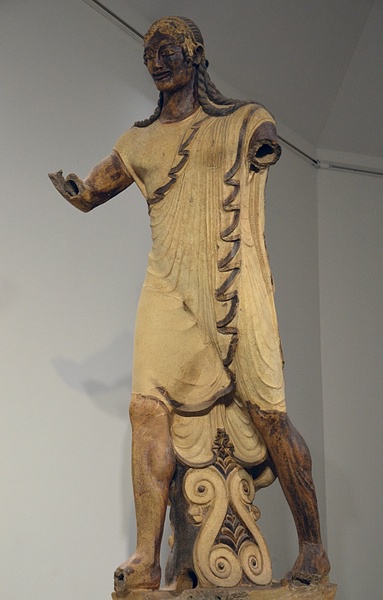 Apollo of Veii Carole Raddato (CC BY-NC-SA) ](https://www.worldhistory.org/image/5528/apollo-of-veii/ "Apollo of Veii")The Romans would exploit the lack of political and military unity between the Etruscan League members and eventually take over all of the Etruscan [cities](https://www.worldhistory.org/city/). Veii, being especially close, was the first to feel the brunt of Rome's might as the Eternal City set off on the road to conquering the [Mediterranean](https://www.worldhistory.org/disambiguation/mediterranean/). No fewer than 14 wars are recorded between the two cities, and relations soured further around 437 BCE when Lars Tolumnius, the king of Veii, murdered four Roman ambassadors. Veii called for assistance from the League, but perhaps because the city was still a monarchy while most other Etruscan cities were now run by an aristocracy, the more powerful members declined to send aid to fight the Romans. The subsequent Veientine [War](https://www.worldhistory.org/disambiguation/War/) (437-435 BCE) saw Lars killed in single combat by the [consul](https://www.worldhistory.org/Consul/) Aulus Cornelius Cossus.
Finally, in 406 BCE, Veii was besieged (incredibly for 10 years), then sacked when the Romans tunnelled into the city, and incorporated into Roman lands in 396 BCE. The statue of Juno Regina was whisked away from her temple by the general M. Furius [Camillus](https://www.worldhistory.org/Camillus/) and set up in a new home in Rome. The Romans had immediately doubled their territory and the [Etruscans](https://www.worldhistory.org/Etruscan_Civilization/) would rue the day they had not stood together to face this common and ruthless enemy. Meanwhile, the remnants of Veii, those who escaped the dreadful fate of being sold into slavery, were permitted to form a small town which eventually became a modest Roman *municipium* in 2 BCE with the title of *municipium Augustum Veiens*. Although never regaining its former glory, Veii continued to function as a town of reasonably well-off Roman residents into the 3rd century CE and beyond.
#### Editorial Review
This human-authored definition has been reviewed by our editorial team before publication to ensure accuracy, reliability and adherence to academic standards in accordance with our [editorial policy](https://www.worldhistory.org/static/editorial-policy/).
## Bibliography
- Bagnall, R.S. *The Encyclopedia of Ancient History.* Wiley-Blackwell, 2012
- [Haynes, S. *Etruscan Civilization.* J. Paul Getty Museum, 2005.](https://www.worldhistory.org/books/0892366001/)
- [Heurgon, J. *Daily Life of the Etruscans.* Phoenix, 2002.](https://www.worldhistory.org/books/1842125923/)
- [Hornblower, S. *The Oxford Classical Dictionary.* Oxford University Press, 2012.](https://www.worldhistory.org/books/0199545561/)
- [Keller, W. *The Etruscans.* Random House Inc (T), 1974.](https://www.worldhistory.org/books/0394473019/)
- [Spivey, N.J. *Etruscan Art.* Thames & Hudson, 1997.](https://www.worldhistory.org/books/0500203040/)
- [Thomson de Grummons, N. *The Religion of the Etruscans.* University of Texas Press, 2006.](https://www.worldhistory.org/books/0292721463/)
## About the Author
Mark is WHE’s Publishing Director and has an MA in Political Philosophy (University of York). He is a full-time researcher, writer, historian and editor. Special interests include art, architecture and discovering the ideas that all civilizations share.
## Timeline
- **700 BCE - 450 BCE**: The [Etruscan](https://www.worldhistory.org/Etruscan_Civilization/) town of [Veii](https://www.worldhistory.org/Veii/) flourishes.
- **c. 510 BCE**: The [Etruscan](https://www.worldhistory.org/Etruscan_Civilization/) Portonaccio [Temple](https://www.worldhistory.org/temple/) is constructed at [Veii](https://www.worldhistory.org/Veii/).
- **437 BCE - 435 BCE**: [Rome](https://www.worldhistory.org/Rome/) defeats [Etruscan](https://www.worldhistory.org/Etruscan_Civilization/) [Veii](https://www.worldhistory.org/Veii/) in the Veientine [War](https://www.worldhistory.org/disambiguation/War/); the Etruscan king Lars Tolumnius is killed.
- **396 BCE**: [Rome](https://www.worldhistory.org/Rome/) sacks the [Etruscan](https://www.worldhistory.org/Etruscan_Civilization/) town of [Veii](https://www.worldhistory.org/Veii/) after a ten-year siege.
- **2 BCE**: [Veii](https://www.worldhistory.org/Veii/) is made a [Roman](https://www.worldhistory.org/disambiguation/Roman/) municipium.
## Cite This Work
### APA
Cartwright, M. (2017, January 23). Veii. *World History Encyclopedia*.
### Chicago
Cartwright, Mark. "Veii." *World History Encyclopedia*, January 23, 2017. .
### MLA
Cartwright, Mark. "Veii." *World History Encyclopedia*, 23 Jan 2017, .
## License & Copyright
Submitted by [Mark Cartwright](https://www.worldhistory.org/user/markzcartwright/ "User Page: Mark Cartwright"), published on 23 January 2017. The copyright holder has published this content under the following license: [Creative Commons Attribution-NonCommercial-ShareAlike](https://creativecommons.org/licenses/by-nc-sa/4.0/deed.en). This license lets others remix, tweak, and build upon this content non-commercially, as long as they credit the author and license their new creations under the identical terms. When republishing on the web a hyperlink back to the original content source URL must be included. Please note that content linked from this page may have different licensing terms.