---
title: Vagharshapat
author: Mark Cartwright
source: https://www.worldhistory.org/Vagharshapat/
format: machine-readable-alternate
license: Creative Commons Attribution-NonCommercial-ShareAlike (https://creativecommons.org/licenses/by-nc-sa/4.0/)
updated: 1970-01-01
---
# Vagharshapat
_Authored by [Mark Cartwright](https://www.worldhistory.org/user/markzcartwright/)_
Vagharshapat (Valarsapat), located some 20 km west of modern Yerevan, was an ancient [city](https://www.worldhistory.org/city/) in [Armenia](https://www.worldhistory.org/armenia/) founded in the 2nd century CE. Serving as the capital, the city prospered and, under the new name of Echmiadzin, became the spiritual capital of Christian Armenia from the 4th century CE. Still an important pilgrimage site today, the building of the cathedral at Vagharshapat is attributed to [Saint Gregory the Illuminator](https://www.worldhistory.org/Saint_Gregory_the_Illuminator/) who was, in a vision, instructed by Christ to build it there after he descended and struck the ground at the very spot. The site is listed by UNESCO as a World Heritage Site.
### The Royal Residence
Vagharshapat was founded during the reign of the Arsacid king Vagharsh I (r. 117-140 CE), who gave his name to the new city, a common practice of the period. [Artashat](https://www.worldhistory.org/Artashat/) (Artaxata) remained the capital but Vagharshapat became the royal residence. The city was not entirely built from scratch but expanded upon the existing settlement of Vardgesavan. The city was protected by a new and encircling fortification [wall](https://www.worldhistory.org/wall/).
In 166 CE Vagharshapat became the first city in Armenia following the sack of Artashat by a [Roman army](https://www.worldhistory.org/Roman_Army/) led by Statius Priscus. The [Roman](https://www.worldhistory.org/disambiguation/Roman/) and Persian Empires had been constantly bickering over control of Armenia for its vital strategic value in the region. Priscus established a Roman garrison at Vagharshapat, and the city, known to them by its [Greek](https://www.worldhistory.org/disambiguation/greek/) name, Kaine [Polis](https://www.worldhistory.org/Polis/) or New City, was made the new administrative capital, a position it kept even after Artashat was rebuilt a few years later. Vagharshapat was attacked and destroyed during the [Sasanid](https://www.worldhistory.org/Sasanian_Empire/) invasions of 368 and 369 CE. The city was then replaced as the political capital by [Dvin](https://www.worldhistory.org/Dvin/) sometime in the 4th century CE.
The move of the political capital to Dvin was designed to disassociate the new regime from that of the former Armenian ruling dynasty the Arsacid dynasty (12 CE - 428 CE) and increase loyalty to [Persia](https://www.worldhistory.org/Persia/), which now controlled that part of Armenia. A Persian viceroy or *marzpan* had his [palace](https://www.worldhistory.org/disambiguation/palace/) at Dvin but Vagharshapat was not about to be consigned to obscurity for it became the religious capital of Armenia under the new name of Echmiadzin (aka Etchmiadzin or Edjmiadsin).
### A Religious Capital: Echmiadzin
During the reign of Tiridates the Great (r. c. 298 - 330 CE) [Christianity](https://www.worldhistory.org/christianity/) was formally adopted as the state [religion](https://www.worldhistory.org/religion/) of Armenia, and the king himself was said to have been converted in 301 CE by Saint Gregory the Illuminator in the royal palace at Vagharshapat. Some of the earliest churches in the country were built in the city. In the latter half of the 4th century CE the seat of the first bishop of Armenia, the *katholikos*, was moved from Artashat to Vagharshapat (it would later be moved again, this time to Dvin). This is traditionally seen as the work of the *katholikos* Sahak (r. 387-428 CE). The city became a focal point from which the tentacles of the Armenian Apostolic Church spread out to convert the entire country. The famed clergyman and scholar [Mesrop Mashtots](https://www.worldhistory.org/Mesrop_Mashtots/) (360/370 - c. 440 CE), who invented the Armenian [alphabet](https://www.worldhistory.org/alphabet/), resided here.
[ 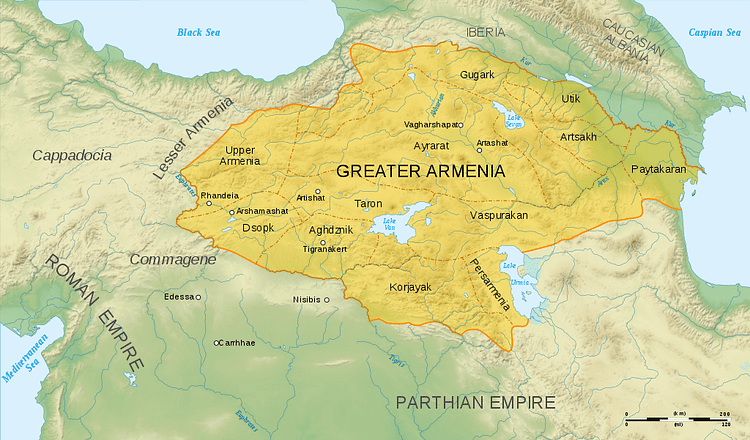 Arsacid Armenia Sémhur (CC BY-SA) ](https://www.worldhistory.org/image/8170/arsacid-armenia/ "Arsacid Armenia")One of the most tangible and long-lasting manifestations of Vagharshapat's roles as the spiritual centre of Armenia was, and is, the great cathedral dedicated to the Mother of [God](https://www.worldhistory.org/God/). Said to have been built by Saint Gregory following a vision in which Christ descended to earth and indicated the very spot, the cathedral thus explains the city's new name of Echmiadzin, meaning “The Only-Begotten-One Descended”. Archaeological evidence suggests that the cathedral was built, no doubt intentionally, on the site of a pagan fire altar, as revealed by archaeological excavations in 1957 CE. The version of the cathedral which stands at the site today dates to 483 CE after the then ruler Vahan Mamikonian commissioned an upgrade on Saint Gregory's first structure. The cathedral was a compensation, perhaps, for the moving of the church's headquarters to Dvin in 485 CE.
### A Pilgrimage Site
Another 5th-century CE addition to the city's Christian [architecture](https://www.worldhistory.org/disambiguation/architecture/) was a monastery with its first prior being the famous scholar and historian Ghazar Parpetsi. In time, the monastery accumulated an impressive manuscript library. Over the following two centuries, successive bishops ensured the building programme continued. In the 7th century CE, under the guidance of the bishop Komitas of Aghdzk (r. 615-628 CE), Echmiadzin began to pull in even more pilgrims following the construction of the particularly splendid church of Saint Hripsime which was named after the virgin who had been martyred by Tiridates the Great prior to his conversion to Christianity. Indeed, the church was said to have been built on the very spot of Hripsime's [death](https://www.worldhistory.org/disambiguation/Death/). The church of Saint Gayane was added around 616 CE and, in the 650s CE, the completion of the impressive [Zvartnots cathedral](https://www.worldhistory.org/Zvartnots_Cathedral/) nearby only added to the attractions which ensured Echmiadzin became one of the most important pilgrimage sites in Armenia.
[  Saint Hripsime Church Façade James Blake Wiener (CC BY-NC-SA) ](https://www.worldhistory.org/image/7411/saint-hripsime-church-facade/ "Saint Hripsime Church Façade")### Later History
Following the invasion and occupation of Armenia by the Rashidun and then [Umayyad Caliphate](https://www.worldhistory.org/Umayyad_Dynasty/) from 640 CE, the position of Echmiadzin as a major religious centre became precarious. Dvin and then Ani were the political and religious capitals, and Echmiadzin slowly fell into decline. A major [earthquake](https://www.worldhistory.org/disambiguation/earthquake/) struck the region in the 10th century CE which caused the collapse of the church of Zvartnots, amongst other buildings. By the late 13th century CE the site was so dilapidated that the celebrated poet Stepanos Orbelian (d. 1304 CE) felt compelled to compose his *Lamentations on the Holy Cathedral of Vagharshapat*.
Echmiadzin's fortunes revived when the Armenian church decided to restore the catholicosate to the site in the mid-15th century CE. The country and its Christians endured troubled times under Turkish rule but Echmiadzin's monastery was given certain economic privileges which at least ensured the site could maintain itself until better days arrived. These days did come but not until the late 18th century CE. It was then that the bishop Simon of Yerevan (r. 1763-1780 CE) embarked on an ambitious plan to make the site a great centre of learning, aided by generous donations from Armenians abroad, especially in [India](https://www.worldhistory.org/india/). The process began with the installation of Armenia's first printing press and a paper mill to keep it well-supplied with raw material, a new archive was established for the Armenian church's records, and a general rebuilding programme was initiated which included a new cupola and three new belfries for the cathedral. After surviving the anti-religious Soviet regime of the 20th century CE, present-day Echmiadzin has once more become a major pilgrimage centre and tourist attraction for its excellent surviving examples of Armenian medieval architecture.
#### Editorial Review
This human-authored definition has been reviewed by our editorial team before publication to ensure accuracy, reliability and adherence to academic standards in accordance with our [editorial policy](https://www.worldhistory.org/static/editorial-policy/).
## Bibliography
- [Adalian, R.P. *Historical Dictionary of Armenia.* Scarecrow Press, 2010.](https://www.worldhistory.org/books/0810860961/)
- [Chahin, M. *The Kingdom of Armenia.* Routledge, 2018.](https://www.worldhistory.org/books/B01FIZNMY2/)
- [Hovannisian, R.G. *The Armenian People from Ancient to Modern Times.* Palgrave Macmillan, 2004.](https://www.worldhistory.org/books/1403964211/)
- [Kurkjian, V.M. *A History of Armenia.* IndoEuropeanPublishing.com, 2014.](https://www.worldhistory.org/books/1604447710/)
- [Panossian, R. *The Armenians.* Columbia University Press, 2006.](https://www.worldhistory.org/books/0231139268/)
- [Payaslian, S. *The History of Armenia.* Palgrave Macmillan, 2008.](https://www.worldhistory.org/books/1403974675/)
## About the Author
Mark is WHE’s Publishing Director and has an MA in Political Philosophy (University of York). He is a full-time researcher, writer, historian and editor. Special interests include art, architecture and discovering the ideas that all civilizations share.
## Timeline
- **c. 303 CE**: Work is begun on [Etchmiadzin Cathedral](https://www.worldhistory.org/Etchmiadzin_Cathedral/), [Vagharshapat](https://www.worldhistory.org/Vagharshapat/), [Armenia](https://www.worldhistory.org/armenia/).
- **483 CE**: [Etchmiadzin Cathedral](https://www.worldhistory.org/Etchmiadzin_Cathedral/), [Vagharshapat](https://www.worldhistory.org/Vagharshapat/), [Armenia](https://www.worldhistory.org/armenia/) is rebuilt by Vahan Mamikonian.
## Cite This Work
### APA
Cartwright, M. (2018, March 26). Vagharshapat. *World History Encyclopedia*.
### Chicago
Cartwright, Mark. "Vagharshapat." *World History Encyclopedia*, March 26, 2018. .
### MLA
Cartwright, Mark. "Vagharshapat." *World History Encyclopedia*, 26 Mar 2018, .
## License & Copyright
Submitted by [Mark Cartwright](https://www.worldhistory.org/user/markzcartwright/ "User Page: Mark Cartwright"), published on 26 March 2018. The copyright holder has published this content under the following license: [Creative Commons Attribution-NonCommercial-ShareAlike](https://creativecommons.org/licenses/by-nc-sa/4.0/deed.en). This license lets others remix, tweak, and build upon this content non-commercially, as long as they credit the author and license their new creations under the identical terms. When republishing on the web a hyperlink back to the original content source URL must be included. Please note that content linked from this page may have different licensing terms.