---
title: Utica
author: Mark Cartwright
source: https://www.worldhistory.org/Utica/
format: machine-readable-alternate
license: Creative Commons Attribution-NonCommercial-ShareAlike (https://creativecommons.org/licenses/by-nc-sa/4.0/)
updated: 1970-01-01
---
# Utica
_Authored by [Mark Cartwright](https://www.worldhistory.org/user/markzcartwright/)_
Utica (also Utique), 33km north of Tunis, was the first Phoenician colony on the North African coast. The strategically important port was an ally to [Carthage](https://www.worldhistory.org/carthage/) in the [First Punic War](https://www.worldhistory.org/First_Punic_War/), but the [city](https://www.worldhistory.org/city/) switched sides in the Second and Third [Punic Wars](https://www.worldhistory.org/Punic_Wars/) so that it later thrived as capital of the [Roman](https://www.worldhistory.org/disambiguation/Roman/) province of [Africa](https://www.worldhistory.org/disambiguation/africa/).
### Early Settlement
Ancient writers traditionally set the founding of Utica as 1101 BCE, but archaeological evidence points to a much more recent date. The earliest burials date to the 8th century BCE and pre-date those of Carthage. Ancient authors disagree as to whether the city was founded by [Tyre](https://www.worldhistory.org/Tyre/) or [Sidon](https://www.worldhistory.org/sidon/). Utica was selected as a site for settlement in order to provide a useful stopping point for Phoenician ships trading across the [Mediterranean](https://www.worldhistory.org/disambiguation/mediterranean/). In the typical Phoenician practice, Utica was first settled on a small island separated from the mainland peninsula by a small creek and then spread to the mainland. It became a thriving coastal city and port dominating the mouth of the river Bagradas (Mejerda) and its fertile alluvial plain. Due to silting, which began in antiquity, the site is today 12 km inland.
### Carthage: Friend & Foe
Utica was probably under the control of Carthage (40 km to the south-east) with some municipal autonomy for much of its earlier history and this perhaps explains its complete absence from the historical record prior to the mid-6th century BCE. The historian Sabatino Moscati describes the political relationship with Carthage as follows:
> There was probably a certain hierarchy amongst the colonies: Utica, and maybe [Cadiz](https://www.worldhistory.org/Gades/), remained official allies, but the same title was certainly not conferred on all the colonies. On the other hand, it seems certain that Carthage did impose restrictions on the autonomy: she cannot have authorised confederations between the colonies; she must have dealt with all foreign policy and forbidden local armies except for immediate requirements, otherwise supplying garrisons and organising the defence of the colonies herself. She may – although this is not certain – have had inspectors of revenue in the various [cities](https://www.worldhistory.org/city/), and she controlled all [trade](https://www.worldhistory.org/disambiguation/trade/). (134)
However, after that period Utica often acted independently, even joining the side of Carthage's enemies several times. The city also suffered when it remained loyal to Carthage as the port proved an irresistible point of entry to North Africa for many commanders seeking a platform from which to attack the better fortified Carthage. When [Agathocles of Syracuse](https://www.worldhistory.org/Agathocles_of_Syracuse/) went to [war](https://www.worldhistory.org/disambiguation/War/) with Carthage, he invaded North Africa with an army of 14,000 men and seized Utica in 308 BCE.
[ 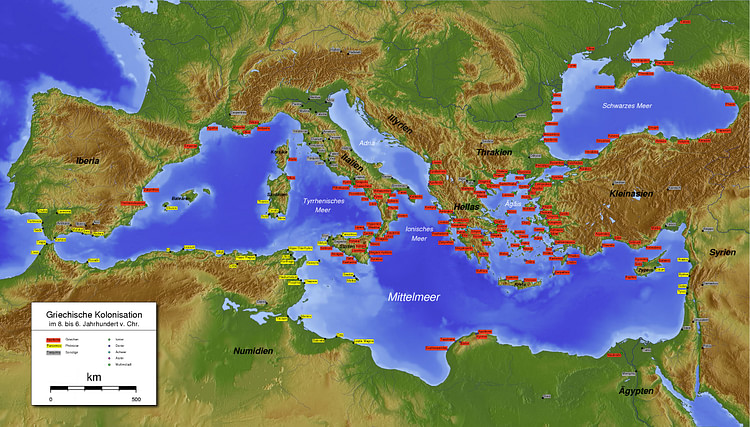 Greek & Phoenician Colonies Benowar et al. (GNU FDL) ](https://www.worldhistory.org/image/108/greek--phoenician-colonies/ "Greek & Phoenician Colonies")Between the First (264-241 BCE) and Second (218-201 BCE) [Punic](https://www.worldhistory.org/carthage/) Wars Carthage had to deal with a mixed rebellion by Utica and other cities, unpaid mercenaries, and disgruntled Libyans. This so-called Truceless War (also [Mercenary War](https://www.worldhistory.org/Mercenary_War/)), between 241 and 237 BCE, was eventually quashed by [Hamilcar Barca](https://www.worldhistory.org/Hamilcar_Barca/) and Hanno the Great who reasserted Carthage's authority and brought Utica back into line.
The city was once again a strategic pawn in regional politics when [Scipio Africanus](https://www.worldhistory.org/disambiguation/Scipio_Africanus/) besieged it 204-203 BCE during the latter stages of the [Second Punic War](https://www.worldhistory.org/Second_Punic_War/) between Carthage and [Rome](https://www.worldhistory.org/Rome/). In the [Third Punic War](https://www.worldhistory.org/Third_Punic_War/) (149-146 BCE) Utica sided with Carthage's enemy Masinissa of Numidia and provided a base for [Scipio](https://www.worldhistory.org/disambiguation/Scipio/) Africanus the Younger. When Rome destroyed Carthage at the end of the war, Utica was given portions of the defeated city's territory, made the capital of the new Roman province of Africa, and given the status of a free city (*civitas libera*) which made it exempt from taxes.
### Roman Utica
Utica prospered under Roman rule, and it became, yet again, an important military rallying point in the 1st century BCE when [Pompey](https://www.worldhistory.org/pompey/) established a base there for his successful campaigns against the Marians. When Pompey battled with [Julius Caesar](https://www.worldhistory.org/Julius_Caesar/) for control of the [Roman Republic](https://www.worldhistory.org/Roman_Republic/) Utica remained loyal to the former. This time, the city had backed the wrong side, though, and Marcus Porcius Cato ([Cato the Younger](https://www.worldhistory.org/Cato_the_Younger/)), who had governed Utica as an ally of the Pompeian loyalists during the war, committed suicide there in 46 BCE rather than accept [Caesar](https://www.worldhistory.org/disambiguation/caesar/)'s pardon. Victorious Caesar fined Utica for its part in the war, and Carthage was favoured for redevelopment. Nevertheless, the city continued to flourish and was made a *municipium* by [Augustus](https://www.worldhistory.org/augustus/) and then a *colonia* by [Hadrian](https://www.worldhistory.org/hadrian/).
Under [Septimius Severus](https://www.worldhistory.org/Septimius_Severus/) (himself of North African origin) Rome gave Utica the status of *ius Italicum* which meant the city's land was given a legal status equal to land in [Italy](https://www.worldhistory.org/italy/) itself. This was the highest privilege granted to foreign territory and meant that the land could be fully owned by private individuals who were also exempt from tax. Utica became an important centre for [early Christianity](https://www.worldhistory.org/article/1205/early-christianity/), sending a bishop to the 3rd century CE council at Carthage, and continued as such into the [Byzantine](https://www.worldhistory.org/disambiguation/Byzantine/) period.
[  Roman Hunt Mosaic Carole Raddato (CC BY-SA) ](https://www.worldhistory.org/image/5186/roman-hunt-mosaic/ "Roman Hunt Mosaic")### Archaeological Remains
Two 7th-5th century BCE Punic cemeteries have been excavated at Utica, known as Ile and La Berge. They both include monumental tombs typical of the [Phoenician architecture](https://www.worldhistory.org/Phoenician_Architecture/) of the homeland. This fact and the lack of a *[tophet](https://www.worldhistory.org/Tophet/)* (a sacred precinct and [burial](https://www.worldhistory.org/burial/) site) indicate that Utica was closer in [culture](https://www.worldhistory.org/disambiguation/culture/) to the Phoenician colonies of southern Spain than it was to Carthage despite its geographical proximity to the latter. [Pottery](https://www.worldhistory.org/pottery/) finds at Utica confirm the city was an active member of the trade network which included [Phoenicia](https://www.worldhistory.org/phoenicia/), [Egypt](https://www.worldhistory.org/egypt/), and [Greece](https://www.worldhistory.org/greece/).
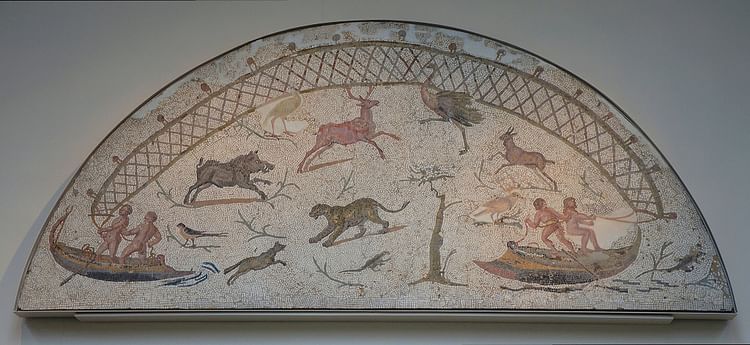
The archaeological remains from Roman Utica include an unusually large forum, [theatre](https://www.worldhistory.org/disambiguation/theatre/), [amphitheatre](https://www.worldhistory.org/amphitheatre/), extensive [Roman baths](https://www.worldhistory.org/Roman_Baths/), what may have been a [circus](https://www.worldhistory.org/disambiguation/Circus/), and 20 private buildings, many with fine [mosaic](https://www.worldhistory.org/Mosaic/) or *opus sectile* floors. From the 1st century CE the town was planned in a grid pattern with wide streets.
#### Editorial Review
This human-authored definition has been reviewed by our editorial team before publication to ensure accuracy, reliability and adherence to academic standards in accordance with our [editorial policy](https://www.worldhistory.org/static/editorial-policy/).
## Bibliography
- [Aubet, M.E. *The Phoenicians and the West.* Cambridge University Press, 2001.](https://www.worldhistory.org/books/0521795435/)
- Bagnall, R. et al. *The Encyclopedia of Ancient History.* Wiley-Blackwell, 2012
- [Hornblower, S. *The Oxford Classical Dictionary.* Oxford University Press, 2012.](https://www.worldhistory.org/books/0199545561/)
- [Hoyos, D. *The Carthaginians.* Routledge, 2010.](https://www.worldhistory.org/books/0415436451/)
- [Moscati, S. *The World of the Phoenicians Paperback.* Weidenfeld & Nicolson History, 2016.](https://www.worldhistory.org/books/B011SL6MCE/)
- [Warmington, B.H. *Carthage.* Penguin Books, 1964.](https://www.worldhistory.org/books/B0007KDLJK/)
## About the Author
Mark is WHE’s Publishing Director and has an MA in Political Philosophy (University of York). He is a full-time researcher, writer, historian and editor. Special interests include art, architecture and discovering the ideas that all civilizations share.
## Timeline
- **c. 1101 BCE**: Traditional founding date for the Phoenician colony of [Utica](https://www.worldhistory.org/Utica/) by [Sidon](https://www.worldhistory.org/sidon/) (or [Tyre](https://www.worldhistory.org/Tyre/)).
- **309 BCE - 308 BCE**: [Agathocles of Syracuse](https://www.worldhistory.org/Agathocles_of_Syracuse/) successfuly campaigns in North [Africa](https://www.worldhistory.org/disambiguation/africa/) defeating Carthaginian armies and taking [Utica](https://www.worldhistory.org/Utica/) and Hippacra.
- **264 BCE - 241 BCE**: [First Punic War](https://www.worldhistory.org/First_Punic_War/). [Carthage](https://www.worldhistory.org/carthage/) cedes [Sicily](https://www.worldhistory.org/sicily/) to [Rome](https://www.worldhistory.org/Rome/).
- **218 BCE - 201 BCE**: [Second Punic War](https://www.worldhistory.org/Second_Punic_War/).
- **204 BCE - 203 BCE**: [Scipio Africanus](https://www.worldhistory.org/disambiguation/Scipio_Africanus/) wins two battles and besieges [Utica](https://www.worldhistory.org/Utica/) in North [Africa](https://www.worldhistory.org/disambiguation/africa/).
- **149 BCE - 146 BCE**: [Third Punic War](https://www.worldhistory.org/Third_Punic_War/).
- **146 BCE**: [Utica](https://www.worldhistory.org/Utica/) is made the capital of the [Roman](https://www.worldhistory.org/disambiguation/Roman/) province of [Africa](https://www.worldhistory.org/disambiguation/africa/).
## Cite This Work
### APA
Cartwright, M. (2016, June 06). Utica. *World History Encyclopedia*.
### Chicago
Cartwright, Mark. "Utica." *World History Encyclopedia*, June 06, 2016. .
### MLA
Cartwright, Mark. "Utica." *World History Encyclopedia*, 06 Jun 2016, .
## License & Copyright
Submitted by [Mark Cartwright](https://www.worldhistory.org/user/markzcartwright/ "User Page: Mark Cartwright"), published on 06 June 2016. The copyright holder has published this content under the following license: [Creative Commons Attribution-NonCommercial-ShareAlike](https://creativecommons.org/licenses/by-nc-sa/4.0/deed.en). This license lets others remix, tweak, and build upon this content non-commercially, as long as they credit the author and license their new creations under the identical terms. When republishing on the web a hyperlink back to the original content source URL must be included. Please note that content linked from this page may have different licensing terms.