---
title: Uranus
author: Liana Miate
source: https://www.worldhistory.org/Uranus/
format: machine-readable-alternate
license: Creative Commons Attribution-NonCommercial-ShareAlike (https://creativecommons.org/licenses/by-nc-sa/4.0/)
updated: 2023-04-09
---
# Uranus
_Authored by [Liana Miate](https://www.worldhistory.org/user/lianamiate/)_
Uranus (also spelt Ouranos) is the personification of heaven and the sky in [Greek mythology](https://www.worldhistory.org/Greek_Mythology/). His [Roman](https://www.worldhistory.org/disambiguation/Roman/) counterpart is Caelus. [Gaia](https://www.worldhistory.org/Gaia/) (Earth) gave birth to Uranus and chose him to be her equal. She lay with him, resulting in the birth of the twelve Titans, the three Cyclopes and the three Hecatoncheires.
Uranus hated his children and hid them beneath the earth, causing Gaia and his son [Cronus](https://www.worldhistory.org/Cronus/) to devise a plan to destroy him. Cronus castrated his father with a sickle, and the blood that fell impregnated Gaia, who gave birth to the Erinyes, the [Giants](https://www.worldhistory.org/Giants/), and the Meliae (tree nymphs). Uranus lost power to Cronus but warned him that he, too, would face being overthrown by his son. With this warning, Uranus helped set off a chain of events that would eventually lead to [Zeus](https://www.worldhistory.org/zeus/) and the Olympian gods overpowering the Titans and seizing power.
### Birth & Family
In his *[Theogony](https://www.worldhistory.org/Theogony/)*, [Hesiod](https://www.worldhistory.org/hesiod/) (700 BCE) writes that Gaia, the personification of Earth, gave birth to Uranus (Heaven), along with Pontus (the Sea) and Ourea (the Mountains).
> And Earth bore starry Heaven, first, to be
> An equal to herself, to cover her
> All over, and to be a resting-place,
> Always secure, for all the blessed gods.
> (Hesiod, *Theogony*, 128-132)
Uranus became equal to Gaia, and they lay together and bore the twelve Titans ([Oceanus](https://www.worldhistory.org/Oceanus/), Coeus, Crius, Hyperion, Iapetus, Theia, [Rhea](https://www.worldhistory.org/Rhea/), [Themis](https://www.worldhistory.org/Themis/), Mnemosyne, Phoebe, Tethys, and Cronus), the three one-eyed Cyclopes (Brontes, Arges, and Steropes) and the hundred-handed and fifty-headed Hecatoncheires (Kottos, Gyes, and Briareus).
### The Creation of the World According to Orphism
Orphism was a religious movement that rose to prominence during the 6th century BCE. It based its beliefs on the legendary [Greek](https://www.worldhistory.org/disambiguation/greek/) hero [Orpheus](https://www.worldhistory.org/Orpheus/) and the valuable lessons he learnt during his time in the underworld. The story of creation in Orphism differs slightly from Hesiod's version. In Orphism, the world began with Chronos (Time). From Chronos came Aether (Radiance), Chaos, and Erebus (Darkness). Chronos then formed an egg inside Aether. From the egg hatched Phanes (the creator of all existence). Phanes gave birth to [Nyx](https://www.worldhistory.org/Nyx/) (Night), then Nyx bore Gaia and Uranus with Phanes.
### Eastern Creation Myths
During the 20th-century excavations in the village of Boĝazköy ([Turkey](https://www.worldhistory.org/Asia_Minor/)), a set of tablets were discovered that recounted the [Hittite](https://www.worldhistory.org/hittite/) story of the storm [god](https://www.worldhistory.org/God/) Teššub's rise to power and the attempts to overthrow him. The myth closely follows the Uranus-Cronus-Zeus succession myth found in Hesiod's *Theogony*. [Anu](https://www.worldhistory.org/Anu/), the king of Heaven, can clearly be identified as Uranus. He ruled in Heaven for nine years but was deposed by his cupbearer Kumarbi. Anu flees, but he is captured by Kumarbi, who bites off Anu's genitals and becomes pregnant with Anu's children, including the storm god Teššub and the Tigris River.
What is considered a Phoenician version of the succession myth is recorded by Herennius Philo (aka Philo of [Byblos](https://www.worldhistory.org/Byblos/), l. 1st or 2nd century CE). This version of the tale originated from Sanchuniathon, a researcher and polymath who lived around the time of the [Trojan War](https://www.worldhistory.org/Trojan_War/). The myth begins with Elioun ('high one') and his companion Berouth. Together they have a son named Epigeios, who would later be named Uranus, and a daughter called Ge (Gaia). After his father's [death](https://www.worldhistory.org/disambiguation/Death/), Epigeios (Uranus) replaced him as king and married his sister, Ge. Epigeios and Ge had four children, El, Baitylos, Dagon, and [Atlas](https://www.worldhistory.org/Atlas/). El (Cronus) turned against his father, Uranus, and avenged his mother after Uranus sexually abused her and tried to kill her children. Cronus and his allies went to war against Uranus and overthrew him, taking the throne for himself. Uranus tried to reclaim his throne by force and trickery but was unsuccessful in his attempts. During the 32nd year of his reign, Cronus emasculated Uranus.
[  Uranus & Gaia Bibi Saint-Pol (Public Domain) ](https://www.worldhistory.org/image/6249/uranus--gaia/ "Uranus & Gaia")### The Sky & Heavens
According to the *Theogony*, there is an equal distance between [Tartarus](https://www.worldhistory.org/Tartarus/) (the infernal regions), Earth (Gaia), and the heavens (Uranus). Therefore, an anvil falling from Uranus would take nine days and nights to reach Gaia and another nine days and nights to reach Tartarus.
Tartarus is surrounded by a [wall](https://www.worldhistory.org/wall/) of [bronze](https://www.worldhistory.org/disambiguation/bronze/), while up above, in the misty dark, are the Titans, hidden away by a wall. Outside this wall are the springs of Tartarus, the sea and starry heaven – a dark, gloomy place that even the gods hate.
### Uranus & the Succession Problem
Uranus hated his and Gaia's children and hid them deep beneath the earth so that they would stay out of his sight. He also feared the power of the Cyclopes and the Hecatoncheires and imprisoned them in Tartarus. Gaia was saddened by how her children were being treated by their father and devised a plan to stop him. Gaia told her children that she had a plan to destroy their father, but only their youngest son, Cronus, was willing to take part and help his mother. Gaia made a sickle out of grey adamant, gave it to Cronus, and hid him in her bed chamber.
Uranus entered the room, lustful and ready to lie with Gaia. Cronus took his chance and struck out with the sickle, castrating Uranus' genitals. As the blood fell, it impregnated Gaia, who gave birth to the Erinyes (the [Furies](https://www.worldhistory.org/Furies/)), the Giants and the Meliae (tree nymphs). Uranus' genitals were thrown into the sea and carried on the waves. White foam surrounded it, and from it, the goddess [Aphrodite](https://www.worldhistory.org/Aphrodite/) was born in Cythera (Kythira).
[ 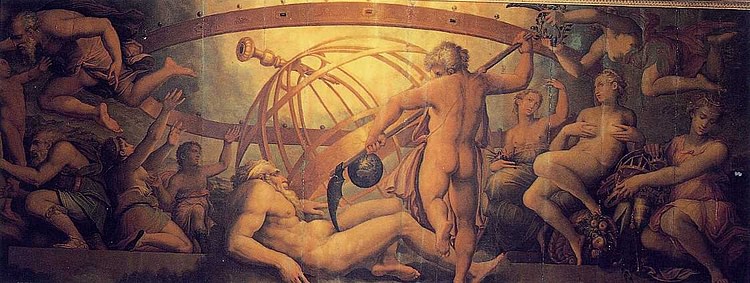 The Mutilation of Uranus by Saturn (Cronus) Giorgio Vasari (Public Domain) ](https://www.worldhistory.org/image/16552/the-mutilation-of-uranus-by-saturn-cronus/ "The Mutilation of Uranus by Saturn (Cronus)")Uranus reproached his children and called them Titans, warning them that they would be punished for their actions. Sure enough, history would repeat itself after Cronus and Rhea got married. Uranus and Gaia warned Cronus that he would be overthrown by his children, causing Cronus to swallow each child as they were born. A desperate Rhea approached Uranus and Gaia for help, and they helped her run away to [Crete](https://www.worldhistory.org/crete/), where Zeus was born. Once Zeus was older, he made his father throw up each of his siblings. This led to the ten-year [battle](https://www.worldhistory.org/disambiguation/battle/) (Titanomachy) between Cronus and the Titans and Zeus and his siblings (Olympian gods). During the Titanomachy, the sea went wild, the earth quaked, and the heavens shook as the immortal gods fought with all their might.
After Zeus married his first wife, Metis, Uranus and Gaia informed him that Metis would have a daughter who was strong and wise like her father and a son who would overthrow his father to become king of the gods and men. Zeus immediately swallowed Metis to prevent this prophecy from coming true. However, Metis was already pregnant with their daughter, and before too long, the goddess [Athena](https://www.worldhistory.org/athena/) emerged from Zeus' head.
### Witness to the Oaths of the Gods
Uranus, along with Gaia and Styx, was often the witness to the oaths of the gods. In [Homer](https://www.worldhistory.org/homer/)'s (750 BCE) *[Iliad](https://www.worldhistory.org/iliad/)*, [Hera](https://www.worldhistory.org/Hera/) swore to Gaia, Uranus, and the waters of the Styx that she did not do anything to jeopardise Hector and his army during the Trojan War after Zeus accused her of making [Poseidon](https://www.worldhistory.org/poseidon/) and the Greeks wreak havoc among the Trojans. In the *Homeric Hymn to Delian [Apollo](https://www.worldhistory.org/apollo/)*, the goddess [Leto](https://www.worldhistory.org/Leto/) swore the great oath of the gods to the island of [Delos](https://www.worldhistory.org/delos/) that her son Apollo would honour Delos above all others.
> Now Earth be my witness
> and vast Heaven above
> and Styx with your water cascading down.
> (*Hymn to Delian Apollo*, 3. 83-85).
The great oath was said to be the strongest and most terrible oath that the gods could make. In the epic poem *Argonautica* by Apollonius of [Rhodes](https://www.worldhistory.org/Rhodes/) (c. 295 BCE), the sorceress [Medea](https://www.worldhistory.org/Medea/) made the great oath of the Colchians in front of her sister, Chalciope, promising that she would do whatever she could to save her sister's sons from their father, King Aeëtes of Colchis.
[  Hera SquinchPix.com (Copyright) ](https://www.worldhistory.org/image/874/hera/ "Hera")### Orphic Hymn to the Sky
Although there is barely any surviving evidence of worship to Uranus, he does have an Orphic hymn dedicated to him.
> Sky, father of all,
> eternal cosmic element,
> primeval beginning of all,
> end of all,
> lord of the universe,
> moving about the Earth like a sphere.
> You are home of the blessed gods,
> your motion is a roaring whirl,
> you envelop all,
> celestial and terrestrial guard.
> Physis' invincible drive
> lies in your breast.
> Dark-blue, indomitable,
> Shimmering, variform,
> all-seeing father of Kronos,
> blessed and most sublime divinity,
> Hearken, bring a life of holiness
> to the new initiates.
> (*Hymn to Sky*, 4. 1-9).
### Legacy
When people hear the name 'Uranus', the first thing they most likely think of is the planet. As a personification of the sky and heavens, it is only befitting that a planet should be named after Uranus.
[  The Planet Uranus NASA/JPL-Caltech (Public Domain) ](https://www.worldhistory.org/image/17205/the-planet-uranus/ "The Planet Uranus")Uranus is the seventh planet from the Sun and the third largest of the planets. It was discovered in 1781 by the British-German astronomer William Herschel (1738-1822), and it took two years to be officially accepted as a new planet. While Herschel wanted to name it Georgium Sidus for King George III of [England](https://www.worldhistory.org/disambiguation/england/), it was fellow astronomer Johann Elert Bode (1747-1826) who suggested that it be called Uranus in honour of the primordial deity – a decision that was enthusiastically accepted by the scientific community. Uranus holds the distinction of being the first planet discovered with the help of a telescope.
#### Editorial Review
This human-authored definition has been reviewed by our editorial team before publication to ensure accuracy, reliability and adherence to academic standards in accordance with our [editorial policy](https://www.worldhistory.org/static/editorial-policy/).
## Bibliography
- [Apollodorus & Hard, Robin. *The Library of Greek Mythology.* Oxford University Press, 2008.](https://www.worldhistory.org/books/0199536325/)
- [Apollonius of Rhodes & Hunter, Richard. *Jason and the Golden Fleece.* Oxford University Press, 2009.](https://www.worldhistory.org/books/0199538727/)
- [Athanassakis, Apostolos N. & Wolkow, Benjamin M. *The Orphic Hymns.* Johns Hopkins University Press, 2013.](https://www.worldhistory.org/books/1421408821/)
- [Graves, Robert. *The Greek Myths\[May 15, 2018\] Graves, Robert.* Viking, 2018.](https://www.worldhistory.org/books/0241982359/)
- [Hesiod & Theognis & Wender, Dorothea & Wender, Dorothea. *Hesiod and Theognis.* Penguin Classics, 1976.](https://www.worldhistory.org/books/0140442839/)
- [Homer & Richardson, Nicholas & Cashford, Jules & Richardson, Nicholas. *Homeric Hymns.* Penguin Classics, 2003.](https://www.worldhistory.org/books/0140437827/)
- [Homer & Robert Fagles & Bernard Knox. *The Iliad.* Penguin Classics, 1998.](https://www.worldhistory.org/books/0140275363/)
- [Overview | Uranus – NASA Solar System Exploration](https://solarsystem.nasa.gov/planets/uranus/overview/#:~:text=Uranus%20is%20the%20seventh%20planet,a%20comet%20or%20a%20star. "Overview | Uranus – NASA Solar System Exploration"), accessed 17 Mar 2023.
- [Woodard, Roger D. *The Cambridge Companion to Greek Mythology.* Cambridge University Press, 2008.](https://www.worldhistory.org/books/0521607264/)
## About the Author
Liana is the Social Media Editor for Ancient History Encyclopedia. She holds a Bachelor of Arts Degree with a major in ancient Greece, Rome & Late Antiquity. She is particularly passionate about Rome and Greece, and anything to do with mythology or wo
- [Linkedin Profile](https://www.linkedin.com/in/lian)
## Questions & Answers
### Who is Uranus?
Uranus is the personification of the sky and heavens in Greek mythology.
### How was Uranus defeated in Greek mythology?
Uranus hated his children, so his wife, Gaia, devised a plan to destroy him. His son, Cronus, sliced off Uranus' genitals and overthrew his father.
### Is Uranus a Titan or god?
Neither. Uranus is a primordial deity (older than both the Titans and the Olympian gods). He is, however, the father of the 12 Titans and the grandfather of the Olympian gods.
### Is Uranus the most powerful god?
As one of the oldest deities and the personification of the sky and heavens, Uranus was considered extremely powerful. However, he was overthrown by his son Cronus and eventually the Titans, and then the Olympian gods became more powerful than him.
## Cite This Work
### APA
Miate, L. (2023, March 24). Uranus. *World History Encyclopedia*.
### Chicago
Miate, Liana. "Uranus." *World History Encyclopedia*, March 24, 2023. .
### MLA
Miate, Liana. "Uranus." *World History Encyclopedia*, 24 Mar 2023, .
## License & Copyright
Submitted by [Liana Miate](https://www.worldhistory.org/user/lianamiate/ "User Page: Liana Miate"), published on 24 March 2023. The copyright holder has published this content under the following license: [Creative Commons Attribution-NonCommercial-ShareAlike](https://creativecommons.org/licenses/by-nc-sa/4.0/deed.en). This license lets others remix, tweak, and build upon this content non-commercially, as long as they credit the author and license their new creations under the identical terms. When republishing on the web a hyperlink back to the original content source URL must be included. Please note that content linked from this page may have different licensing terms.