---
title: Typhon
author: Liana Miate
source: https://www.worldhistory.org/Typhon/
format: machine-readable-alternate
license: Creative Commons Attribution-NonCommercial-ShareAlike (https://creativecommons.org/licenses/by-nc-sa/4.0/)
updated: 2023-08-09
---
# Typhon
_Authored by [Liana Miate](https://www.worldhistory.org/user/lianamiate/)_
Typhon (also Typheus) is the largest and most dreadful monster in [Greek mythology](https://www.worldhistory.org/Greek_Mythology/). He was tall, with a brutish face, and had wings, countless snakeheads in place of hands, and a lower body made up of coiled [serpents](https://www.worldhistory.org/disambiguation/Serpents/). His eyes flashed fire, and fiery rocks fell from his mouth.
Typhon was the son of [Gaia](https://www.worldhistory.org/Gaia/) (the Earth) and [Tartarus](https://www.worldhistory.org/Tartarus/) (the Infernal Regions), although he is also mentioned as being the son of [Hera](https://www.worldhistory.org/Hera/) in the *Homeric Hymn to [Apollo](https://www.worldhistory.org/apollo/)*. He joined in love with Echidna, a half-woman, half-snake creature, and together they had many fierce children. The most famous myth associated with Typhon is his [battle](https://www.worldhistory.org/disambiguation/battle/) with [Zeus](https://www.worldhistory.org/zeus/) and the Olympian gods, as he sought to rule over gods and mortals. Typhon is also associated with Set from ancient [Egyptian mythology](https://www.worldhistory.org/Egyptian_Mythology/) and other Near Eastern myths.
### Birth & Family
In revenge for the destruction of her children (the [Giants](https://www.worldhistory.org/Giants/)), Gaia lay with Tartarus and gave birth to Typhon, the biggest monster in Greek mythology, in a cave in [Cilicia](https://www.worldhistory.org/Cilicia/). In the *Homeric Hymn to Apollo*, the birth of Typhon is very different. He was the son of Hera, who was angry that Zeus had given birth to [Athena](https://www.worldhistory.org/athena/) without any involvement from her. Hera begged that Gaia, [Uranus](https://www.worldhistory.org/Uranus/), and the Titans would give her a son who was mightier than Zeus. She became pregnant after she beat the Earth with her hand. She stayed in her temples and accepted offerings to her. After many months had passed, she gave birth to the cruel and dreaded Typhon. Hera gave Typhon to the dragon Python to be brought up, and they both wreaked havoc among the mortals.
Typhon fell in love with Echidna, a half-woman, half-snake creature, who was both beautiful and terrible to look at, and together they had some of the most fearsome monsters in Greek mythology.
> First, Orthos the dog of Geryon, and next,
> Unspeakable [Cerberus](https://www.worldhistory.org/Cerberus/), who eats raw flesh,
> The [bronze](https://www.worldhistory.org/disambiguation/bronze/)-voiced hound of [Hades](https://www.worldhistory.org/Hades/), shameless, strong
> With fifty heads. And then again she bore
> The Lernaean Hydra, skilled in wrong, the one
> The goddess white-armed Hera raised, who was
> Immensely angry with great Heracles.
> ([Hesiod](https://www.worldhistory.org/hesiod/), *[Theogony](https://www.worldhistory.org/Theogony/)*, 311-318).
[  The Lernaean Hydra & Hercules Carole Raddato (CC BY-SA) ](https://www.worldhistory.org/image/3359/the-lernaean-hydra--hercules/ "The Lernaean Hydra & Hercules")### Description & Characteristics
In his *Theogony*, Hesiod (c. 700 BCE) calls Typhon "proud" and "terrible." He was violent, powerful and possessed immense strength. Ancient writers describe Typhon in similar ways, with Apollodorus (c. 180 BCE) stating that:
> Down to his thighs he was human in form, but of such
> Immense size that he rose higher than all the mountains
> and often even scraped the stars with his head.
> With arms outstretched, he could reach the west on one side
> and the east on the other; and from his arms there sprang
> a hundred dragons' heads. Below his thighs, he had
> massive coils of vipers, which, when they were fully
> extended, reached right up to his head and emitted violent hisses.
> He had wings all over his body, and filthy hair springing from his
> head and cheeks floated around him in the wind,
> and fire flashed from his eyes.
> (Apollodorus, *The Library of Greek Mythology*, 1.6.4-14).
According to the [Greek tragedy](https://www.worldhistory.org/Greek_Tragedy/) playwright [Aeschylus](https://www.worldhistory.org/Aeschylus/) (c. 525 to c. 456 BCE), Typhon had a hundred heads, and his eyes burned in a fiery glare. He was able to withstand the power of the gods. In his *Dionysiaca*, the Greek poet Nonnus (c. 5th century CE), describes Typhon as a tangled mass of snakes with snake feet and hair. From his hair and mouth spat out poison. Nonnus also gives Typhon 200 hands and mentions that the heads of Typhon were made up of all different animals, including wolves, lions, boars and bears.
[ 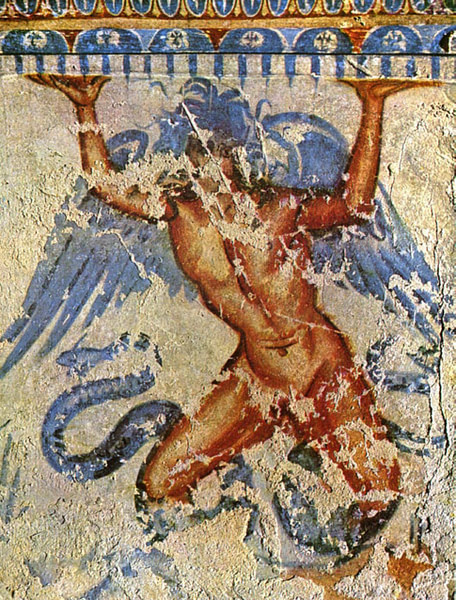 Typhon, Tarquinia Unknown Artist (Public Domain) ](https://www.worldhistory.org/image/6340/typhon-tarquinia/ "Typhon, Tarquinia")### Typhon's Revolt
The last battle in the Olympians' fight for superiority was Typhon's revolt against them (referred to as the Typhonomachy). Like the Titans and Giants before him, Typhon wanted to rule the heavens. He threw rocks that were on fire up to heaven while hissing and screaming his battle cry. Fire emerged from his mouth like a flowing river. He was such a menacing sight that the Olympian gods immediately fled to [Egypt](https://www.worldhistory.org/egypt/) in terror. Typhon pursued them, causing the gods to transform into animals to try and lose him for good. Zeus was said to have transformed into a ram, Apollo into a crow, [Dionysos](https://www.worldhistory.org/Dionysos/) into a goat, [Artemis](https://www.worldhistory.org/artemis/) transformed into a cat, Hera into a white cow, [Aphrodite](https://www.worldhistory.org/Aphrodite/) into a fish, and [Hermes](https://www.worldhistory.org/Hermes/) into an ibis (although the animals sometimes differ depending on the source).
Zeus threw thunderbolts at him from a distance, and as Typhon got closer, he stabbed him with an adamantine sickle and chased him. Zeus pursued him to Mount Casion (a mountain range near [Syria](https://www.worldhistory.org/syria/)), where he saw that Typhon was seriously injured. Typhon and Zeus engaged in hand-to-hand combat, with Zeus believing that he could easily kill a weakened Typhon. However, Zeus underestimated Typhon's strength, and before he knew it, Typhon had trapped Zeus in his coils, snatched the sickle from him and slashed the tendons in his hands and feet. Typhon carried Zeus through the sea to the Corycian Cave (near [Delphi](https://www.worldhistory.org/delphi/)). Zeus' tendons were hidden in a bear's fur, and Typhon made the she-dragon Delphyne (half-woman, half-monster) guard them. Hermes and Aigipan (rustic spirit) stole the tendons under the nose of Delphyne and put them back into Zeus without being caught. After Zeus had regained his strength, he left the heavens on a [chariot](https://www.worldhistory.org/chariot/) with his thunderbolts and continued chasing after Typhon. He found him on Mount Nysa, where Typhon had met the [Fates](https://www.worldhistory.org/Fates/) and been tricked by them. They offered him a taste of the ephemeral fruits, promising they would give Typhon extra strength if he consumed them.
[  Zeus Aiming His Lighting Bolt at Typhon Bibi Saint-Pol (Public Domain) ](https://www.worldhistory.org/image/13230/zeus-aiming-his-lighting-bolt-at-typhon/ "Zeus Aiming His Lighting Bolt at Typhon")Once he realised that Zeus was in pursuit of him again, Typhon escaped to Thrace and battled Zeus near Mount Haimos. He lifted up mountains and hurled them at Zeus. Zeus responded by striking him with thunderbolts. Blood began streaming from Typhon's body and was absorbed by the mountain.
### Imprisonment
As Typhon prepared to retreat across the Sicilian Sea, Zeus threw Mount Etna at him and trapped Typhon underneath, ending the battle. To this day, every time Mount Etna erupts, it is said to be caused by the fire in Typhon's eyes or the fiery rocks that flow from his mouth.
> But at him came the unsleeping bolt of Zeus,
> the sky-dropped thunderclap all wreathed in flame,
> and knocked him down from his high-hearted boasts.
> The blow went deep into his heart and mind;
> his strength was lightning-seared, reduced to ash;
> and now he lies, a useless, sprawling mass,
> crushed beneath the base of mighty Aetna,
> beside the straits of the Messinian sea.
> [Hephaestus](https://www.worldhistory.org/Hephaistos/) sits there, on the highest ridges,
> and smites hot iron. Streams of fire will burst forth,
> devouring with the jaws of savage beasts
> the spreading fields of [Sicily](https://www.worldhistory.org/sicily/) fair in fruit-
> such is the bile that Typho will set boiling,
> with hot blasts of a deadly fire-storm-
> Despite the bolts of Zeus that cindered him.
> (Aeschylus, *Prometheusus Bound*, 360-375).
Most ancient authors believed that Typhon was trapped in Tartarus, however, according to Hesiod and [Homer](https://www.worldhistory.org/homer/) (c. 750 BCE), instead of Tartarus, Typhon was imprisoned underneath the land of the Arimoi (a mythical tribe of people). His lover, Echidna, was also trapped there with him.
[  Typhon and the Harpies Wenceslas Hollar (Public Domain) ](https://www.worldhistory.org/image/17715/typhon-and-the-harpies/ "Typhon and the Harpies")### Typhon & the [Near East](https://www.worldhistory.org/Near_East/)
As early as the days of Hecataeus of Miletus (c. 550 to c. 476 BCE), some ancient writers, notably the Greek historian [Herodotus](https://www.worldhistory.org/herodotus/) (c. 484 to 425/413 BCE), believed that there was a link between Typhon and the ancient [Egyptian](https://www.worldhistory.org/disambiguation/Egyptian/) [god](https://www.worldhistory.org/God/) [Seth](https://www.worldhistory.org/Set_(Egyptian_God)/) (Set in ancient Egyptian mythology). In his *Histories*, Herodotus states that ancient Egypt was once ruled by gods who lived alongside humankind on Earth. The last of the great gods was [Horus](https://www.worldhistory.org/Horus/), who was Apollo's equivalent. Horus was the one who had banished Typhon (Seth).
He also speaks of an island called Chemmis, which floats. According to Herodotus, the Egyptians believed it floats because [Leto](https://www.worldhistory.org/Leto/), one of the oldest deities, welcomed Apollo (Horus) and saved him from Typhon, who had gone searching for the gods in Egypt. She hid Apollo in the island, which made it float. Herodotus mentions a Lake Serbonis (Serbonian Marsh), which he says is where Typhon is hidden and which the Egyptians call "Typhon's breathing hole."
[  Statue of Set Tutincommon (CC BY-NC) ](https://www.worldhistory.org/image/12670/statue-of-set/ "Statue of Set")There were even some similarities between the myth of Typhon and the Mesopotamian god [Ninurta](https://www.worldhistory.org/Ninurta/) which can be found in the ancient [Sumerian](https://www.worldhistory.org/Sumerians/) poem *Lugal-e (*(also known as *The Exploits of Ninurta*) where Azag-Labbu, the hissing sea-monster challenges the throne of Ninurta, who fights back with floods and fierce winds. There are also similarities between the story of Typhon and the [Akkadian](https://www.worldhistory.org/disambiguation/akkadian/) epic [Enuma Elish](https://www.worldhistory.org/article/225/enuma-elish—the-babylonian-epic-of-creation—fu/), in which [Marduk](https://www.worldhistory.org/Marduk/), the patron god of [Babylon](https://www.worldhistory.org/babylon/), uses strong winds to fight against the sea goddess [Tiamat](https://www.worldhistory.org/Tiamat/).
### In the Ancient World
In the ancient world, the story of Typhon was believed to have explained the actual event of the volcanic eruption on the island of Santorini in [Greece](https://www.worldhistory.org/greece/); after the volcano erupted, people fled from the island, just as the gods ran away from Typhon. Some writers, such as Strabo (c. 63 BCE to 24 CE), believed that the volcanic activity in [Italy](https://www.worldhistory.org/italy/) could be explained by the presence of Typhon being trapped underneath the Earth.
In his *Description of Greece*, [Pausanias](https://www.worldhistory.org/disambiguation/Pausanias/) (115 to c. 180 CE) says that in Laconia, there were sculptures of Typhon and Echidna near the throne of the Laconian king.
#### Editorial Review
This human-authored definition has been reviewed by our editorial team before publication to ensure accuracy, reliability and adherence to academic standards in accordance with our [editorial policy](https://www.worldhistory.org/static/editorial-policy/).
## Bibliography
- [Apollodorus & Hard, Robin. *The Library of Greek Mythology .* Oxford University Press, 2008.](https://www.worldhistory.org/books/0199536325/)
- [Chrystal, Paul. *War in Greek Mythology.* Pen & Sword Military, 2020.](https://www.worldhistory.org/books/B08JH88N9W/)
- [Graves, Robert. *The Greek Myths\[May 15, 2018\] Graves, Robert.* Viking, 2018.](https://www.worldhistory.org/books/0241982359/)
- [Herodotus & Marincola, John M. & Marincola, John M. & de Sélincourt, Aubrey & Marincola, John M. & Radice, Betty. *The Histories.* Penguin Classics, 2003.](https://www.worldhistory.org/books/0140449086/)
- [Hesiod & Theognis & Wender, Dorothea & Wender, Dorothea. *Hesiod and Theognis .* Penguin Classics, 1976.](https://www.worldhistory.org/books/0140442839/)
- [Homer & Robert Fagles & Bernard Knox. *The Iliad.* Penguin Classics, 1998.](https://www.worldhistory.org/books/0140275363/)
- [Ogden, Daniel. *Drakon.* Oxford University Press, 2013.](https://www.worldhistory.org/books/0199557322/)
- [Ovid & Raeburn, David & Feeney, Denis. *Metamorphoses .* Penguin Classics, 2004.](https://www.worldhistory.org/books/014044789X/)
- [Pausanias & Newberry, John & Levi, Peter & Levi, Peter. *Guide to Greece, Vol. 2.* Penguin Classics, 1984.](https://www.worldhistory.org/books/014044226X/)
- [Sophocles & Aeschylus & Euripides & Lefkowitz, Mary & Romm, James. *The Greek Plays.* Modern Library, 2017.](https://www.worldhistory.org/books/0812983092/)
- [Syropoulos, Spyros. *A Bestiary of Monsters in Greek Mythology.* Archaeopress Archaeology, 2018.](https://www.worldhistory.org/books/1784919500/)
- [Watterson, Barbara. *Gods of Ancient Egypt.* Sutton Publishing Ltd, 1996.](https://www.worldhistory.org/books/0750932627/)
## About the Author
Liana is the Social Media Editor for Ancient History Encyclopedia. She holds a Bachelor of Arts Degree with a major in ancient Greece, Rome & Late Antiquity. She is particularly passionate about Rome and Greece, and anything to do with mythology or wo
- [Linkedin Profile](https://www.linkedin.com/in/lian)
## Questions & Answers
### What was Typhon the god of?
As a child of Gaia and Tartarus, Typhon was a god, but he was more notorious for being the largest and fiercest monster in Greek mythology.
### Which deity killed Typhon?
Zeus threw Mount Etna at Typhon, trapping him underneath and defeating him.
### What creature is Typhon?
Typhon is a giant creature, with his lower body consisting of snake coils, and snakes for feet. He had hundreds of hands, and his eyes burned with fire, while fiery rocks poured from his mouth.
## Cite This Work
### APA
Miate, L. (2023, August 09). Typhon. *World History Encyclopedia*.
### Chicago
Miate, Liana. "Typhon." *World History Encyclopedia*, August 09, 2023. .
### MLA
Miate, Liana. "Typhon." *World History Encyclopedia*, 09 Aug 2023, .
## License & Copyright
Submitted by [Liana Miate](https://www.worldhistory.org/user/lianamiate/ "User Page: Liana Miate"), published on 09 August 2023. The copyright holder has published this content under the following license: [Creative Commons Attribution-NonCommercial-ShareAlike](https://creativecommons.org/licenses/by-nc-sa/4.0/deed.en). This license lets others remix, tweak, and build upon this content non-commercially, as long as they credit the author and license their new creations under the identical terms. When republishing on the web a hyperlink back to the original content source URL must be included. Please note that content linked from this page may have different licensing terms.