---
title: Tympanon
author: Nathalie Choubineh
source: https://www.worldhistory.org/Tympanon/
format: machine-readable-alternate
license: Creative Commons Attribution-NonCommercial-ShareAlike (https://creativecommons.org/licenses/by-nc-sa/4.0/)
updated: 1970-01-01
---
# Tympanon
_Authored by [Nathalie Choubineh](https://www.worldhistory.org/user/nathalie.choubineh/)_
The tympanon (*tympanum* in Latin) was the most popular frame-drum in ancient [Greek music](https://www.worldhistory.org/Greek_Music/), producing a loud rumbling sound not far from the sound of the orchestral timpani drums today. This percussion instrument was played mainly by [women](https://www.worldhistory.org/disambiguation/women/) on various spiritual and festive occasions and often accompanied [Greek dance](https://www.worldhistory.org/Greek_Dance/) in public processions. The [Greek comedy](https://www.worldhistory.org/Greek_Comedy/) playwright [Aristophanes](https://www.worldhistory.org/Aristophanes/) (c. 460 - c. 380 BCE) opens his *[Lysistrata](https://www.worldhistory.org/Lysistrata/)* with the heroine’s quibble about women’s overt enthusiasm for festive gatherings when the torrent of their tympana would block the roads. Women across the [Greek](https://www.worldhistory.org/disambiguation/greek/) world used to play the tympanon to worship various deities of [Greek mythology](https://www.worldhistory.org/Greek_Mythology/), particularly the major goddesses like [Rhea](https://www.worldhistory.org/Rhea/), [Demeter](https://www.worldhistory.org/demeter/), [Artemis](https://www.worldhistory.org/artemis/), or [Cybele](https://www.worldhistory.org/Cybele/) who presided over fertility, marriage, and motherhood. From around the 7th century BCE onwards, the Great Mother’s rituals and mysteries were interlaced with the rites of [Dionysos](https://www.worldhistory.org/Dionysos/), the [god](https://www.worldhistory.org/God/) of wine and the source of its reviving powers, and the tympanon began to represent both divinities in Greek art and [culture](https://www.worldhistory.org/disambiguation/culture/).
Since the tympanon was made of perishable materials such as wood and animal hide, its archaeological remains are unlikely to be found. That said, the significance and popularity of the tympanon and its non-Greek variations in celebration of earthly occasions, religious festivals, divination, and healing practices are abundantly attested by verbal and visual evidence. Hand-drums, mostly round-shaped but sometimes also triangular or rectangular, decorated or plain, with or without little rings or cymbals attached, have been in use for thousands of years by people in many different regions of the world, from West [Africa](https://www.worldhistory.org/disambiguation/africa/) and [Egypt](https://www.worldhistory.org/egypt/) to [Mediterranean](https://www.worldhistory.org/disambiguation/mediterranean/) [Europe](https://www.worldhistory.org/europe/) and Asia, [Near East](https://www.worldhistory.org/Near_East/), [Mesopotamia](https://www.worldhistory.org/Mesopotamia/), and [Indus Valley](https://www.worldhistory.org/Indus_Valley_Civilization/), up to this day.
### Features & Technique
The ancient Greek tympanon consisted of a round wooden frame wide enough to sit comfortably in the palm of the player’s hand. One side of this frame was covered with oxhide, and sometimes colourful patterns were painted on its surface. Many tympana had several equally spaced ringlets installed around the inner side of their frames to underline their rumble with some metallic rustles when shaken. The number of the ringlets overall could be anything between 4 and 7, mostly depending on the peripheral size of the frame. Painted [pottery](https://www.worldhistory.org/pottery/) and high- and low-relief carvings on stone, gems, and metalwares demonstrate that the tympanon could be made in different sizes, from small tambourines sometimes confused with hand-mirrors or libation bowls to huge shield-like discs held by Cybele, Rhea, or Demeter, associating these goddesses with moon divinities such as Artemis and [Selene](https://www.worldhistory.org/Selene/).
The primary method of playing the tympanon, as understood from ancient sculptures and paintings, was to hold it upright by the left hand and stroke its surface by the palm and fingers of the right hand. The beats and rhythmic patterns thus produced could be punctuated by jingling shakes given to the instrument. The shakes looked even more spectacular when waving ribbons were flowing down the frame, and some tympana also had carrying handles made of ribbons or fine rope.
[ 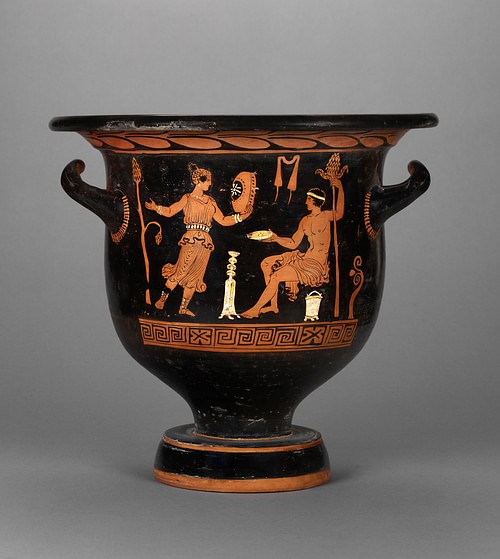 Krater with Dionysus & Maenad British Museum (CC BY-NC-SA) ](https://www.worldhistory.org/image/13619/krater-with-dionysus--maenad/ "Krater with Dionysus & Maenad")Ancient writers describe dancing with the tympanon as whirling, and there are many images showing women dancers in a twist and turn whilst holding up and/or shaking their tympana. On the other hand, a series of painted vases found in [Italy](https://www.worldhistory.org/italy/) shows the tympanon in various positions and angles, implying the inclusion of some advanced techniques in tympanon-playing such as turning the instrument fully or partly and/or tossing it up and down during the performance.
### Sources
The [Greek tragedy](https://www.worldhistory.org/Greek_Tragedy/) playwright [Euripides](https://www.worldhistory.org/Euripides/) (c. 484-407 BCE) begins his *[Bacchae](https://www.worldhistory.org/Bacchae/)*, the most frequently quoted [writing](https://www.worldhistory.org/writing/) about Dionysos and his cult, with an elaborate description of the tympanon, its creation, and its significance in the widespread worship of this god:
> **[Dionysus](https://www.worldhistory.org/Dionysos/)**
> I, the son of [Zeus](https://www.worldhistory.org/zeus/), have come to this land of the Thebans—\[…\] I have left the wealthy lands of the Lydians and Phrygians, the sun-parched plains of the Persians, and the Bactrian walls, and have passed over the wintry land of the [Medes](https://www.worldhistory.org/Medes/), and blessed [Arabia](https://www.worldhistory.org/Arabia/), and all of Asia which lies along the coast of the salt sea with its beautifully-towered [cities](https://www.worldhistory.org/city/) full of Hellenes and barbarians mingled together; and I have come to this Hellene [city](https://www.worldhistory.org/city/) first, having already set those other lands to dance and established my mysteries there, so that I might be a deity manifest among men.\[…\]
> But, you women who have left Tmolus, the bulwark of [Lydia](https://www.worldhistory.org/lydia/), my sacred band, whom I have brought from among the barbarians as assistants and companions to me, take your drums (tympana), native instruments of the city of the Phrygians, the invention of mother Rhea and myself, and going about this [palace](https://www.worldhistory.org/disambiguation/palace/) of Pentheus beat them, so that Kadmos' city may see. I myself will go to the folds of Kithairon, where the Bacchae are, to share in their dances. (lines 1-64)
Euripides’s indication of the widespread popularity of Dionysiac dancing and tympanon-playing is convincingly supported by the archaeological finds. His emphasis on women as the main tympanon-players positively reflects the rituals he may have witnessed in the 5th century BCE in [Athens](https://www.worldhistory.org/Athens/) and elsewhere, perhaps mingled with his own experience as a young dancer and torch-bearer in the Apollonian rites.
The earliest known writings about hand-drums identical to the tympanon date back to c. 1700 BCE, when Miriam, [Moses](https://www.worldhistory.org/Moses/)’s sister, took her *tof* (the Hebrew hand-drum) to lead the thankful singing and dancing of Israelite women after their safe passage through the Red Sea (Exodus 15: 20-21). Also, from the 2nd millennium BCE, we have the [Egyptian](https://www.worldhistory.org/disambiguation/Egyptian/) Tekh festival of revelry, dancing, singing, and playing drums in celebration of the redemption from Sekhmet’s fatal mission of destroying the human race and her rebirth as the benevolent [Hathor](https://www.worldhistory.org/Hathor/). Like most drum-loving goddesses, Hathor was the queen of the sky and the patroness of femininity, fertility, and love. She was primarily connected to the [sistrum](https://www.worldhistory.org/Sistrum/) but plays a hand-drum in some of her reliefs on the walls of her [temple](https://www.worldhistory.org/temple/) in Dendera and her husband’s, [Horus](https://www.worldhistory.org/Horus/), in Edfu.
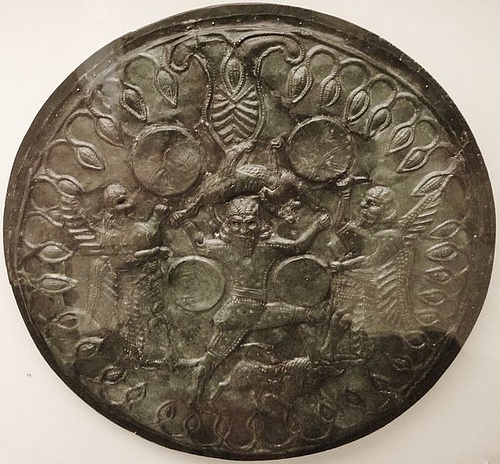
Our earliest picture of a Greek tympanon, from the 8th century BCE, appears on a tympanon/shield found in a cave high up Mount Ida in Crete. The Greek myths indicate this cave as the hiding place of baby Zeus, carried away by his mother, Rhea, from his baby-eating father, Kronos. Here, Zeus’s guardians, the daimons *kouretes*, would clash their tympanon-like shields and swords to cover the baby’s crying, while dancing a [war](https://www.worldhistory.org/disambiguation/War/)-dance to the rhythm thus created.
[  Minoan Bronze Shield Archaeological Museum of Heraklion (Public Domain) ](https://www.worldhistory.org/image/13483/minoan-bronze-shield/ "Minoan Bronze Shield")### Sound & Functions
In the short surviving fragment of the *Edonians* by [Aeschylus](https://www.worldhistory.org/Aeschylus/) (c. 525 - c. 456 BCE), this ancient people of Thrace use the thundering sound of the tympanon to imitate the bull-god (Dionysos) in the nocturnal mysteries of the moon goddess Kotys. This cultic use of the tympanon resembled, as the Greek historian Strabo (c. 64 BCE - c. 24 CE) tells us, the sacred rites of Rhea and Dionysos in Crete and mainland [Greece](https://www.worldhistory.org/greece/). [Pindar](https://www.worldhistory.org/Pindar/) (c. 518 - c. 448/7 BCE) describes how the beating of the drums cheers up the Great Mother (Demeter) out of her grief for her daughter’s abduction by [Hades](https://www.worldhistory.org/Hades/).
In classical Athens, the tympanon accompanied women’s calling upon Dionysos as the god of revival and resurrection in both matrimonial and funerary contexts. On her marble gravestone from 4th-century BCE Athens, Nikomache is leaning on her large drum, shaking hand (*deixiosis*) with her husband to bid farewell and/or to maintain their union in the afterlife. The tombstone of Chairestrate, the “all-bearing mother”, also shows her with her tympanon held by her granddaughter. Both slabs are found in [Piraeus](https://www.worldhistory.org/Piraeus/), a harbour city near Athens with a central shrine dedicated to the Mother Goddess-Cybele, who was worshipped there together with Dionysos.
[  Cybele with Patera, Lion & Tympanon Nathalie Choubineh (CC BY) ](https://www.worldhistory.org/image/13515/cybele-with-patera-lion--tympanon/ "Cybele with Patera, Lion & Tympanon")The tympanon appears in many vase-paintings of the Dionysian festival of Lenaia and is played by his circle of followers (*thiasos*) in the scenes of revelry and ritual ecstasy. By the end of the 5th century BCE, satyrs and other male Dionysian characters join in tympanon-playing, but the visual evidence of their increasing contribution disappears with the decline of painted pottery a [hundred years](https://www.worldhistory.org/disambiguation/Hundred_Years/) later.
### Later Transmissions
In [Roman](https://www.worldhistory.org/disambiguation/Roman/) culture, tympanon is often depicted without its ringlets. Still, the Latin tympanum maintained its connection to women, dancing, and [Bacchus](https://www.worldhistory.org/Bacchus/), whose ecstatic rites together with his supervision on the spirit and its revival were largely accepted. The tympanum is held high by many women in Roman mural paintings and sculptures, including tympanum-playing maenads dancing in the sculpted scenes of Dionysiac revelry on the sarcophagus of Maconiana Severiana from c. 210-220 CE, and in the painted [Triumph](https://www.worldhistory.org/Roman_Triumph/) of Bacchus on a Roman [mosaic](https://www.worldhistory.org/Mosaic/) from the 3rd century CE.
In modern Greece, the ancient form of the tympanon has lost its popularity, and the word τυμπανον in modern Greek can literally denote a drum of any kind. In practice, however, the modern Greek tympanon is a rather large snare-drum hung in front of the body and played with the sticks. The original form of ancient Greek tympanon, a big hand-drum with a roaring sound, lives on in religious, mystic, and festive contexts in the countries accommodating Arabic, Turkish, and Persian musical traditions.
#### Editorial Review
This human-authored definition has been reviewed by our editorial team before publication to ensure accuracy, reliability and adherence to academic standards in accordance with our [editorial policy](https://www.worldhistory.org/static/editorial-policy/).
## Bibliography
- [AESCHYLUS, The Edonians, Attributed Fragments, Loeb Classical Library](https://www.loebclassics.com/view/aeschylus-attributed_fragments/2009/pb_LCL505.61.xml "AESCHYLUS, The Edonians, Attributed Fragments, Loeb Classical Library"), accessed 7 Mar 2021.
- [Aristophanes. *Lysistrata and Other Plays .* Addison Wesley, 2003.](https://www.worldhistory.org/books/0140448144/)
- [Carpenter, Thomas H. *Dionysian Imagery in Fifth Century Athens .* Clarendon Press, 1997.](https://www.worldhistory.org/books/0198150385/)
- [Dillon, Matthew. *Girls and Women in Classical Greek Religion.* Routledge, 2003.](https://www.worldhistory.org/books/0415319161/)
- [Euripides & Dodds, E. R. *Bacchae .* Clarendon Press, 1987.](https://www.worldhistory.org/books/0198721250/)
- [Mathiesen, Thomas J. *Apollo's Lyre.* ACLS Humanities E-Book, 2010.](https://www.worldhistory.org/books/1597407968/)
- [Strabo, unknown & Lauren, Giles & Sterrett, Robert Sitlington & Jones, Horace Leonard. *Strabo The Geography in Two Volumes.* Sophron Editor, 2018.](https://www.worldhistory.org/books/0999140167/)
## About the Author
Nathalie is a translator and independent researcher of dance in the ancient world with a focus on Ancient Greece and the Near East. She has published works in ancient dance, ethnomusicology, and literature. She loves learning and sharing knowledge.
- [Facebook Profile](https://www.facebook.com/nathalie.choubineh/)
- [Linkedin Profile](https://www.linkedin.com/in/nathalie-choubineh-035a8451/)
## Timeline
- **c. 1700 BCE**: The earliest written hint to a hand-drum: the Jewish tof played by [Moses](https://www.worldhistory.org/Moses/)’s sister, Miriam, in Exodus.
- **c. 750 BCE**: The earliest depiction of the [tympanon](https://www.worldhistory.org/Tympanon/) on a [bronze](https://www.worldhistory.org/disambiguation/bronze/) disc found in the Idaean Cave in [Crete](https://www.worldhistory.org/crete/).
- **c. 575 BCE**: [Scythian](https://www.worldhistory.org/Scythians/) Philosopher Anacharsis plays the [tympanon](https://www.worldhistory.org/Tympanon/) in his celebration of the Eleusinian Mysteries, as accounted by [Herodotus](https://www.worldhistory.org/herodotus/).
- **c. 525 BCE**: The [tympanon](https://www.worldhistory.org/Tympanon/) first appears on [Greek pottery](https://www.worldhistory.org/Greek_Pottery/).
- **c. 499 BCE - c. 456 BCE**: [Aeschylus](https://www.worldhistory.org/Aeschylus/) in The Edonians tells of the bull-roaring sound of the [tympanon](https://www.worldhistory.org/Tympanon/) in the rites of the moon goddess, Kotys.
- **c. 405 BCE**: [Euripides](https://www.worldhistory.org/Euripides/) in The Bacchai has [Dionysos](https://www.worldhistory.org/Dionysos/) tell us how the [tympanon](https://www.worldhistory.org/Tympanon/) was invented by him and his Mother Goddess, [Rhea](https://www.worldhistory.org/Rhea/).
- **c. 205 BCE**: The [tympanon](https://www.worldhistory.org/Tympanon/) is adopted by the Romans together with the cult of Magna Mater.
## Cite This Work
### APA
Choubineh, N. (2021, March 16). Tympanon. *World History Encyclopedia*.
### Chicago
Choubineh, Nathalie. "Tympanon." *World History Encyclopedia*, March 16, 2021. .
### MLA
Choubineh, Nathalie. "Tympanon." *World History Encyclopedia*, 16 Mar 2021, .
## License & Copyright
Submitted by [Nathalie Choubineh](https://www.worldhistory.org/user/nathalie.choubineh/ "User Page: Nathalie Choubineh"), published on 16 March 2021. The copyright holder has published this content under the following license: [Creative Commons Attribution-NonCommercial-ShareAlike](https://creativecommons.org/licenses/by-nc-sa/4.0/deed.en). This license lets others remix, tweak, and build upon this content non-commercially, as long as they credit the author and license their new creations under the identical terms. When republishing on the web a hyperlink back to the original content source URL must be included. Please note that content linked from this page may have different licensing terms.