---
title: Tyche
author: Liana Miate
source: https://www.worldhistory.org/Tyche/
format: machine-readable-alternate
license: Creative Commons Attribution-NonCommercial-ShareAlike (https://creativecommons.org/licenses/by-nc-sa/4.0/)
updated: 2022-11-22
---
# Tyche
_Authored by [Liana Miate](https://www.worldhistory.org/user/lianamiate/)_
In [Greek mythology](https://www.worldhistory.org/Greek_Mythology/), Tyche is the goddess and personification of good luck, chance, and fortune. Tyche's popularity grew after the Classical period when many [cities](https://www.worldhistory.org/city/) and officials across the [Greek](https://www.worldhistory.org/disambiguation/greek/) world and the [Mediterranean](https://www.worldhistory.org/disambiguation/mediterranean/) adopted her as their patron deity and sacrifices were made at her shrines. Her popularity endured for hundreds of years.
Tyche was represented in many forms of art and was instantly recognisable by her mural crown and the rudder and cornucopia she held. Various writers describe her as 'all-powerful' and 'wise'. Her [Roman](https://www.worldhistory.org/disambiguation/Roman/) counterpart is the goddess, Fortuna.
### Birth & Family
According to [Hesiod](https://www.worldhistory.org/hesiod/) (c. 700 BCE) in his *[Theogony](https://www.worldhistory.org/Theogony/),* Tyche was one of the many daughters of the Titans [Oceanus](https://www.worldhistory.org/Oceanus/) and Tethys and a sister to many, including the Oceanids [Electra](https://www.worldhistory.org/disambiguation/electra/), Ourania, Metis, Styx (goddess of the underworld), and Calypso. As a daughter of Oceanus, Tyche was said to have a connection with the water, which is evident in the rudder she holds in artistic representations of her. Other sources claimed that she was the daughter of [Zeus](https://www.worldhistory.org/zeus/), even though she is mentioned as his cousin in the *Theogony.*
### The Goddess of Fortune, Luck, & Chance
Although Tyche was recognised early on, she became a fully developed goddess during the [Hellenistic period](https://www.worldhistory.org/Hellenistic_Period/) (323-30 BCE). Tyche's rise in popularity showed that the ancient Greeks believed that chance and luck governed their lives. Her popularity was seen in the widespread practice of dedicating cities to her during the [Hellenistic](https://www.worldhistory.org/Hellenic_World/) and Roman periods (with the only exception being [Athens](https://www.worldhistory.org/Athens/) which already had its patron deity in [Athena](https://www.worldhistory.org/athena/)). Tyche was the default explanation for anything unrelated to the Olympian deities.
The Greeks believed that every place, [city](https://www.worldhistory.org/city/), and state had its own Tyche closely connected with the welfare of a particular city. She was the constant force that regulated their lives, and people either invoked her for her help or disparaged her, depending on their personal circumstances. The gods were even said to have accepted her commands. She was usually depicted as a benevolent goddess who caused feelings of well-being and happiness in the people who worshipped her.
Tyche gained even more political importance after the [death of Alexander the Great](https://www.worldhistory.org/article/2366/death-of-alexander-the-great/) (356-323 BCE) and the upheaval that followed it with the establishment of new Hellenistic cities being established across [Egypt](https://www.worldhistory.org/egypt/) and [Asia Minor](https://www.worldhistory.org/Asia_Minor/) (modern-day [Turkey](https://www.worldhistory.org/Asia_Minor/)).
[ 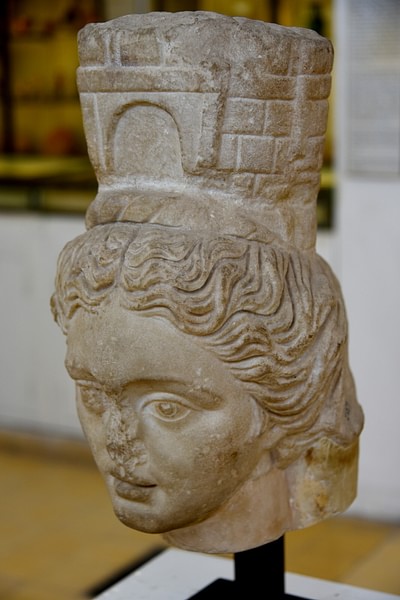 Head of the Goddess Tyche Osama Shukir Muhammed Amin (Copyright) ](https://www.worldhistory.org/image/8516/head-of-the-goddess-tyche/ "Head of the Goddess Tyche")### Tyche in Written Sources
Some writers referred to Tyche as a goddess but most depicted her as an impersonal Tyche – a quality rather than a real identity. Tyche was often used to describe historical events, and she personified events like pirate attacks, shipwrecks, slavery, and chance occurrences. One of the earliest mentions of Tyche can be found in [Pindar](https://www.worldhistory.org/Pindar/)'s (c. 518 to c. 438 BCE) *Olympian Odes*, where she is implored to help Ergoteles of Himera as she competed in the long race:
> I beseech you, daughter of Zeus the Deliverer,
> watch over Himera and extend her strength, O saviour Fortune!
> For you are she by whom swift ships at sea
> are guided, and on land both sudden turns of [war](https://www.worldhistory.org/disambiguation/War/)
> and policies in council. So men's hopes and fears,
> tossing now up, now down,
> cleaving through vain illusions, ride and roll.
> (Pindar, *Olympian Odes*, 12.1-6a)
In the Homeric *Hymn to [Demeter](https://www.worldhistory.org/demeter/)*, Tyche is portrayed as a nereid (sea [nymph](https://www.worldhistory.org/nymph/)). The hymn mentions how Tyche and her sisters were playing with [Persephone](https://www.worldhistory.org/persephone/) in a meadow before her violent abduction by [Hades](https://www.worldhistory.org/Hades/). The ancient historian [Polybius](https://www.worldhistory.org/Polybius/) (c. 208-125 BCE) reflects on the influence of Tyche, who had the power to inflict bad fortune and anger on questionable leaders, just like divine providence could.
In [Pausanias](https://www.worldhistory.org/disambiguation/Pausanias/)' (115-180 CE) *Description of [Greece](https://www.worldhistory.org/greece/)*, he takes a great interest in Tyche, visiting many of her sanctuaries across Greece. He lamented the decay of Megalopolis and admitted that all things were being changed by Tyche according to her whims. He stated that [Alexandria](https://www.worldhistory.org/alexandria/) and other cities, on the other hand, had reached great prosperity, despite being new cities, because Tyche favoured them.
[  Tyche Furniture Ornaments Osama Shukir Muhammed Amin (Copyright) ](https://www.worldhistory.org/image/5748/tyche-furniture-ornaments/ "Tyche Furniture Ornaments")In ancient [Greek theatre](https://www.worldhistory.org/Greek_Theatre/), Tyche was often the cause of unexpected outcomes – a sudden disaster or a welcome last-minute reprieve. She was addressed in a polite and indirect manner to encourage her to bring good luck. Menander (342-291 BCE), the Greek dramatist, used Tyche as a narrator for the prologue in his play *The Shield*, where she announces that there will be a surprise ending. He referred to her as a blind goddess. However, it seems to be more indicative of her unpredictable and indiscriminate nature rather than any physical disability.
In [Euripides](https://www.worldhistory.org/Euripides/)' (c. 484-407 BCE) play *[Cyclops](https://www.worldhistory.org/disambiguation/Cyclops/)*, he used Tyche as a personification after [Odysseus](https://www.worldhistory.org/odysseus/) invoked [Hephaestus](https://www.worldhistory.org/Hephaistos/) and Sleep (Hypnos) to help him bind the cyclops successfully. He stated that if the gods failed to answer his call for help, he would regard Tyche as a divinity and as someone who was more powerful than the gods.
### Tyche & [Greek Philosophy](https://www.worldhistory.org/Greek_Philosophy/)
Greek philosopher [Plato](https://www.worldhistory.org/plato/) (428/427-348/347 BCE) believed that Tyche was the spontaneous cause of all divine actions. Likewise, Plato's student [Aristotle](https://www.worldhistory.org/aristotle/) (384-322 BCE) viewed her as the very epitome of spontaneity. Stoics defined Tyche as somebody or something which was a mystery to humans and could only be adequately understood by a higher intelligence. The Epicureans made sense of the universe by viewing it in a physical and scientific way. They believed that there was no such thing as chance and that every random event or occurrence could be explained by the movement of matter.
### Tyche in Art
Tyche is represented in many art forms, including coins, sculptures, amulets, mosaics, tombstones and goblets. Each city portrayed her differently since she was the embodiment of each community. She would often be depicted with unique symbols that represented each place, including geographical or cultural characteristics like a river or warships in Phoenician cities. Rulers and city officials used the signs of Tyche to convey patriotic or ideological messages.
However, her basic appearance had a similar theme; she was always shown with a mural crown on her head and often carrying a rudder in one hand and/or a cornucopia in the other one. The mural crown (crown of city walls) symbolised her link to the different cities whose fate she oversaw. The cornucopia represented the prosperity she brought. The rudder was a symbol of her guidance and her parentage. She also wears a long tunic or dress with a *palla* over the top, secured with a fibula, and sometimes wears a [gold](https://www.worldhistory.org/gold/) torc around her neck.
In the 4th century BCE, Praxiteles of Athens (395-330 BCE) created two sculptures of Tyche, while early in the 3rd century BCE, the sculptor, Eutychides, created the famous [Greek sculpture](https://www.worldhistory.org/Greek_Sculpture/) Tyche of [Antioch](https://www.worldhistory.org/Antiochia/) – a replica can currently be found in the Vatican Museums. The statue depicts Tyche sitting on a rock with the personification of the River Orontes at her feet. She holds a sheaf of wheat in her hand, which symbolises prosperity. Pausanias talks about another [sculpture](https://www.worldhistory.org/disambiguation/Sculpture/) that he saw in the sanctuary of Tyche, where Tyche is holding a young Ploutos, the Greek [god](https://www.worldhistory.org/God/) of wealth and agricultural bounty.
[  Tyche On a Golden Double Shekel RomanDeckert (CC BY-SA) ](https://www.worldhistory.org/image/16673/tyche-on-a-golden-double-shekel/ "Tyche On a Golden Double Shekel")###
Tyche & [Byzantium](https://www.worldhistory.org/Byzantium/)
Tyche plays an essential role in the founding myth of Byzantium. Byzas, the legendary founder of Byzantium, dedicated [Rhea](https://www.worldhistory.org/Rhea/) as the Tyche of the city, combining them both into one goddess known as Tyche Poliade and 'queen of the city'. Rhea and Tyche are the most important deities in the city of Byzantium. [Roman emperor](https://www.worldhistory.org/Roman_Emperor/) [Constantine I](https://www.worldhistory.org/Constantine_I/) (r. 306-337 CE) maintained the worship of the two goddesses even after establishing [Constantinople](https://www.worldhistory.org/Constantinople/), as evidenced by dedication ceremonies and statuary. He installed two statues of Tyche Constantinopolis and Rhea in niches in the *tetrastoon* (a porch surrounding a courtyard). The cults of Tyche and Rhea were slowly integrated with other goddesses. Tyche's cult was mixed with Athena, Demeter, and [Hecate](https://www.worldhistory.org/Hecate/).
### Worship as Tyche of the *[Polis](https://www.worldhistory.org/Polis/)*
Tyche was widely worshipped in many cities across the ancient Mediterranean. The cult of Tyche was established in ancient Greece in the 5th or 6th century BCE and appeared across the rest of the Mediterranean during the 4th century BCE. In his *Description of Greece*, Pausanias mentioned seeing temples dedicated to Tyche in the Greek cities of Elis, [Megara](https://www.worldhistory.org/disambiguation/Megara/), Sicyon, and [Tegea](https://www.worldhistory.org/Tegea/). In addition, her sanctuary in Alexandria was supposedly so beautiful that no other [temple](https://www.worldhistory.org/temple/) in the [Hellenistic world](https://www.worldhistory.org/Hellenistic_Period/) could surpass it. Tyche also had temples in [Caesarea](https://www.worldhistory.org/disambiguation/Caesarea/) (modern-day [Israel](https://www.worldhistory.org/disambiguation/Israel/)), Antioch (modern day-Turkey), Constantinople (modern-day Turkey), and Palmyra (modern-day [Syria](https://www.worldhistory.org/syria/)).
In Selge (modern-day Turkey), the high priest of the Tyche cult held office for life. In Mytilene ([Lesbos](https://www.worldhistory.org/lesbos/), Greece), Tyche was known as the 'Great Tyche of Mytilene'. In Trapezopolis (a city in Caria), she was known as the 'great goddess in defence of the city'.
[  Tyche & Plutus Giovanni Dall'Orto (CC BY-NC-SA) ](https://www.worldhistory.org/image/16674/tyche--plutus/ "Tyche & Plutus")Archaeological evidence shows that Tyche/Fortuna was one of the most important deities in Israel, Syria, and [Jordan](https://www.worldhistory.org/Jordan/) during the Roman period. Tyche's popularity endured for many years. Evidence shows that Emperor [Alexander Severus](https://www.worldhistory.org/Alexander_Severus/) (r. 222-235 CE) was the first person to use the figure of Tyche on coins produced in Caesarea during his reign. Emperor Julian (r. 361-363 CE) made a sacrifice to Tyche in Antioch in 361 or 362 CE.
#### Editorial Review
This human-authored definition has been reviewed by our editorial team before publication to ensure accuracy, reliability and adherence to academic standards in accordance with our [editorial policy](https://www.worldhistory.org/static/editorial-policy/).
## Bibliography
- [Athanassakis, Apostolos N. & Wolkow, Benjamin M. *The Orphic Hymns.* Johns Hopkins University Press, 2013.](https://www.worldhistory.org/books/1421408821/)
- Brian Kinsey. *Gods and Goddesses of Greece and Rome.* Marshall Cavendish Reference, 2011
- [Dirven, Lucinda. *The Palmyrenes of Dura-Europos.* Brill Academic Pub, 1999.](https://www.worldhistory.org/books/9004115897/)
- [Ferguson, John. *The Religions of the Roman Empire .* Cornell University Press, 1985.](https://www.worldhistory.org/books/0801493110/)
- [Gagarin, Michael. *The Oxford Encyclopedia of Ancient Greece and Rome.* Oxford University Press, 2009.](https://www.worldhistory.org/books/0195170725/)
- [Hedreen, Guy. *The Image of the Artist in Archaic and Classical Greece.* Cambridge University Press, 2015.](https://www.worldhistory.org/books/1107118255/)
- [Hesiod & Theognis & Wender, Dorothea & Wender, Dorothea. *Hesiod and Theognis .* Penguin Classics, 1976.](https://www.worldhistory.org/books/0140442839/)
- [Jordan, Michael. *Dictionary Of Gods And Goddesses.* Facts on File, 2022.](https://www.worldhistory.org/books/0816059233/)
- [Limberis, Vasiliki. *Divine Heiress.* Routledge, 2012.](https://www.worldhistory.org/books/0415642965/)
- Michael Gagarin. *Ancient Mediterranean Religions Myth, Ritual and Religious Experience.* Cambridge Scholars Publishing, 2009
- [Pindar & Miller, Andrew M. *The Odes.* University of California Press, 2019.](https://www.worldhistory.org/books/0520300009/)
- [Rodan, Simona. *Maritime-Related Cults in the Coastal Cities of Philistia during the Roman Period..* Archaeopress Archaeology, 2019.](https://www.worldhistory.org/books/1789692563/)
- [Steinberg, Aliza. *Weaving in Stones.* Archaeopress Archaeology, 2020.](https://www.worldhistory.org/books/1789693217/)
## About the Author
Liana is the Social Media Editor for Ancient History Encyclopedia. She holds a Bachelor of Arts Degree with a major in ancient Greece, Rome & Late Antiquity. She is particularly passionate about Rome and Greece, and anything to do with mythology or wo
- [Linkedin Profile](https://www.linkedin.com/in/lian)
## Questions & Answers
### What was Tyche known for?
Tyche was known for being the Greek goddess of good luck, fortune, and chance. She was the patron deity of many ancient cities and towns throughout the Mediterranean world.
### What are Tyche's powers?
Tyche has control over luck and fate.
### What myth features Tyche?
Tyche is not featured in a particular myth but is mentioned in ancient literature and various plays.
### How do you pronounce Tyche in Greek?
In ancient Greek, Tyche is pronounced as tý.kʰɛ, while in modern Greek, it is pronounced as ti.çi.
## Cite This Work
### APA
Miate, L. (2022, November 20). Tyche. *World History Encyclopedia*.
### Chicago
Miate, Liana. "Tyche." *World History Encyclopedia*, November 20, 2022. .
### MLA
Miate, Liana. "Tyche." *World History Encyclopedia*, 20 Nov 2022, .
## License & Copyright
Submitted by [Liana Miate](https://www.worldhistory.org/user/lianamiate/ "User Page: Liana Miate"), published on 20 November 2022. The copyright holder has published this content under the following license: [Creative Commons Attribution-NonCommercial-ShareAlike](https://creativecommons.org/licenses/by-nc-sa/4.0/deed.en). This license lets others remix, tweak, and build upon this content non-commercially, as long as they credit the author and license their new creations under the identical terms. When republishing on the web a hyperlink back to the original content source URL must be included. Please note that content linked from this page may have different licensing terms.