---
title: Tulum
author: Mark Cartwright
source: https://www.worldhistory.org/Tulum/
format: machine-readable-alternate
license: Creative Commons Attribution-NonCommercial-ShareAlike (https://creativecommons.org/licenses/by-nc-sa/4.0/)
updated: 1970-01-01
---
# Tulum
_Authored by [Mark Cartwright](https://www.worldhistory.org/user/markzcartwright/)_
Tulum, on the east coast of the Yucatan peninsula in southern Mexico, was an important Mesoamerican centre which displayed both [Maya](https://www.worldhistory.org/disambiguation/Maya/) and [Toltec](https://www.worldhistory.org/Toltec_Civilization/) influence. Tulum was a major trading and religious centre between the 11th and 16th centuries CE and, dramatically situated near the sea, it is one of the most evocative ancient sites in Mexico.
First settled in the 6th century CE, Tulum prospered, especially so under Mayapán influence from c. 1200 CE, and was an important centre trading in such typical barter goods of the period as cotton, foodstuffs, [copper](https://www.worldhistory.org/copper/) bells, axes, and cacao beans. Protected by the jungle of Quintana Roo, the site survived the general Maya collapse and was largely left untouched by the Spanish.
The ceremonial complex of Tulum, built on a 12 metre high limestone cliff, was surrounded on three sides by fortification walls, while the fourth side faces the Caribbean Sea. Indeed, the very name Tulum is a colonial one and means '[wall](https://www.worldhistory.org/wall/)'. The original local name may have been Zama meaning 'dawn' in reference to the site's position facing east across the sea.
Residential buildings were built outside the sacred walled area which was reserved for the rulers of Tulum. The largest structure is the Castillo (Castle) which is in fact a temple pyramid displaying architectural influences from the Toltec [civilization](https://www.worldhistory.org/civilization/), such as over-door niches and serpent-columns. In addition, the stucco [sculpture](https://www.worldhistory.org/disambiguation/Sculpture/) which decorates the building recalls those at Mayapán. The halls of the Castillo, and also Structure 25, are also notable for their well-preserved examples of beam-and-mortar roofs.
The Temple of the Frescoes is a squat square building which has undergone several modifications over the centuries. In the Classic period there seems only to have been a vaulted shrine, but this was later surrounded by a larger structure which had a four-[column](https://www.worldhistory.org/column/) facade. Later still, the second storey was added. Stucco faces on the exterior suggest the building was dedicated to the [god](https://www.worldhistory.org/God/) Itzamnaaj.
[ 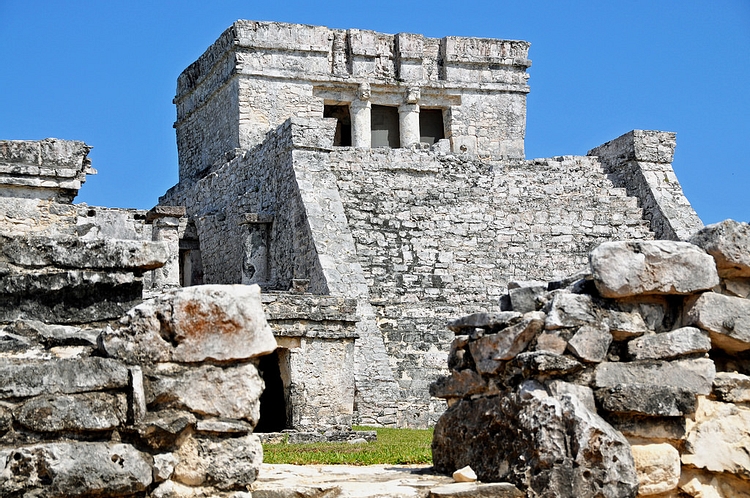 Castillo, Tulum Dennis Jarvis (CC BY-SA) ](https://www.worldhistory.org/image/3572/castillo-tulum/ "Castillo, Tulum")The earliest wall paintings, which give the building its name, date to the 11th or 12th centuries CE, but some are certainly later, perhaps post [conquest](https://www.worldhistory.org/warfare/). They depict figures performing various actions such as a woman grinding corn on a stone (*metate)*, the goddess Chak Chel carrying two images of the god Chahk, and the [Aztec](https://www.worldhistory.org/Aztec_Civilization/) god [Tezcatlipoca](https://www.worldhistory.org/Tezcatlipoca/) with his black eye band and turquoise mask. The latter strongly suggests contact with central Mexican centres. Most figures are strikingly painted in blue on a black background, and panels are divided by twisted snake-like borders, perhaps representing umbilical cords and therefore a genealogical connection between the figures. Frescoes appear on both the outer and inner walls of several other buildings at Tulum but always using only three colours – red, blue, and yellow – with outlines painted in black and accompanied by Maya glyphs. Other structures at Tulum include the dramatically sited Temple of the Winds which was built in honour of the wind god and helped guide sailors through the reef, a [palace](https://www.worldhistory.org/disambiguation/palace/) building in a poor state of preservation, various platforms, and the Temple of the Descending God. This latter building and the presence on several other structures of stucco figures of winged gods descending suggest the site was specifically in honour of this strange deity also known as the 'diving god' and perhaps connected to the planet [Venus](https://www.worldhistory.org/venus/) and the associated Maya god Xux Ek.
#### Editorial Review
This human-authored definition has been reviewed by our editorial team before publication to ensure accuracy, reliability and adherence to academic standards in accordance with our [editorial policy](https://www.worldhistory.org/static/editorial-policy/).
## Bibliography
- [Coe, M.D. *The Maya.* Thames & Hudson, 2011.](https://www.worldhistory.org/books/0500289026/)
- [Kubler, G. *The Art and Architecture of Ancient America, Third Edition.* Yale University Press, 1984.](https://www.worldhistory.org/books/0300053258/)
- [Miller, M.E. *The Art of Mesoamerica.* Thames & Hudson, 2012.](https://www.worldhistory.org/books/0500204144/)
## About the Author
Mark is WHE’s Publishing Director and has an MA in Political Philosophy (University of York). He is a full-time researcher, writer, historian and editor. Special interests include art, architecture and discovering the ideas that all civilizations share.
## Timeline
- **c. 1200 CE**: [Tulum](https://www.worldhistory.org/Tulum/) prospers as a trading centre under the influence of Mayapan.
## Cite This Work
### APA
Cartwright, M. (2015, February 03). Tulum. *World History Encyclopedia*.
### Chicago
Cartwright, Mark. "Tulum." *World History Encyclopedia*, February 03, 2015. .
### MLA
Cartwright, Mark. "Tulum." *World History Encyclopedia*, 03 Feb 2015, .
## License & Copyright
Submitted by [Mark Cartwright](https://www.worldhistory.org/user/markzcartwright/ "User Page: Mark Cartwright"), published on 03 February 2015. The copyright holder has published this content under the following license: [Creative Commons Attribution-NonCommercial-ShareAlike](https://creativecommons.org/licenses/by-nc-sa/4.0/deed.en). This license lets others remix, tweak, and build upon this content non-commercially, as long as they credit the author and license their new creations under the identical terms. When republishing on the web a hyperlink back to the original content source URL must be included. Please note that content linked from this page may have different licensing terms.