---
title: Tonatiuh
author: Mark Cartwright
source: https://www.worldhistory.org/Tonatiuh/
format: machine-readable-alternate
license: Creative Commons Attribution-NonCommercial-ShareAlike (https://creativecommons.org/licenses/by-nc-sa/4.0/)
updated: 1970-01-01
---
# Tonatiuh
_Authored by [Mark Cartwright](https://www.worldhistory.org/user/markzcartwright/)_
Tonatiuh, 'Turquoise Lord,' was the 5th and present sun in the [Aztec](https://www.worldhistory.org/Aztec_Civilization/) view of the cosmos and the fierce sun [god](https://www.worldhistory.org/God/) of several other Postclassic Mesoamerican cultures, including the Toltecs. It was thought that only the regular offering of hearts from sacrificial victims would nourish Tonatiuh so that he had the strength to reign supreme in the skies and [battle](https://www.worldhistory.org/disambiguation/battle/) each night the forces of darkness. For many, the sun god is the central figure on the [Sun Stone](https://www.worldhistory.org/Sun_Stone/), perhaps the most famous of all [Aztec art](https://www.worldhistory.org/Aztec_Art/) pieces, where his tongue appears as a sacrificial blade thirsty for blood.
### Names & Associations
The idea in Mesoamerica of a sun god with martial qualities goes back to the Classic [Maya](https://www.worldhistory.org/disambiguation/Maya/) figure of K'inich Ajaw. For the [Zapotec civilization](https://www.worldhistory.org/Zapotec_Civilization/) (500 BCE - 900 CE) in the southern highlands of central Mexico in the Valley of Oaxaca, Tonatiuh was Copijcha (aka Cocicho). The [Toltec civilization](https://www.worldhistory.org/Toltec_Civilization/), which flourished in central Mexico between the 10th and mid-12th century CE, closely associated Tonatiuh with [Quetzalcoatl](https://www.worldhistory.org/Quetzalcoatl/), the feathered serpent god, and his manifestation as the [morning star](https://www.worldhistory.org/Morning_Star/) aspect of the planet [Venus](https://www.worldhistory.org/venus/).
To the Aztecs of ancient Mexico (c. 1345-1521 CE) Tonatiuh was also known as *Cuauhtlehuanitl* ('Ascending eagle') and *Cuauhtemoc* ('Descending eagle'). His calendar name was *Nahui ollin*, 4 Motion, he was patron god of the 19th day *Quiahuitl* (rain), and 4th of the 13 Aztec Lords of the Day with an associated 'bird' sign of the quail. The sun was associated with [gold](https://www.worldhistory.org/gold/) and, for the Mixtec, made of turquoise, hence Tonatiuh is sometimes known as 'Turquoise Lord' (as, confusingly, is [Xiuhtecuhtli](https://www.worldhistory.org/Xiuhtecuhtli/), the Aztec god of Fire). Tonatiuh was a fierce and warlike god and it is suggestive that the Aztecs called the cruel and ruthless [conquistador](https://www.worldhistory.org/Conquistador/) [Pedro de Alvarado](https://www.worldhistory.org/Pedro_de_Alvarado/) none other than Tonatiuh.
### The Aztec Creation Myth
The Aztecs believed that the cosmos had already gone through four stages, each with its own sun and beings. The present era for the Aztecs was that of the 5th and final sun, Tonatiuh. The god had been born from the sacrifice of Nanahuatzin who threw himself into a fire at [Teotihuacan](https://www.worldhistory.org/Teotihuacan/) and thus became the new sun. There was an immediate problem that Tonatiuh could or would not set himself in motion across the sky without a blood sacrifice. Now stepped in [Tlahuizcalpantecuhtli](https://www.worldhistory.org/Tlahuizcalpantecuhtli/), for the Aztecs the planet Venus as the menacing morning star. He angrily threw his *atl-atl dart at Tonatiuh in order to set him on his orbit, but the sun retaliated by throwing a dart right back. This missile hit Tlahuizcalpantecuhtli right in the forehead, instantly transforming him into stone and the god Itztlacoliuhqui, a deity associated with ice and cold. The rest of the gods realised that only a sacrifice would set the sun in motion and so Quetzalcoatl removed their hearts for that purpose. The offering worked and Tonatiuh was on his way.
[ 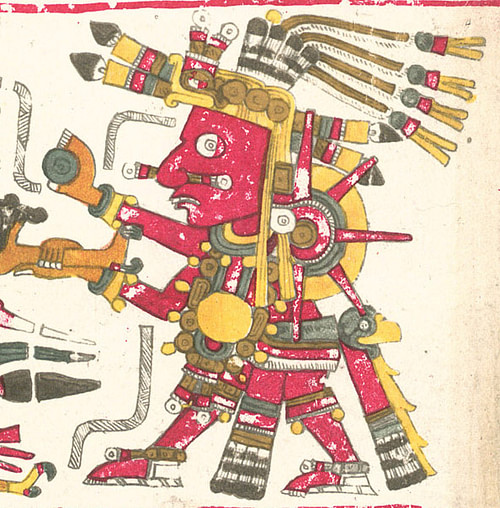 Tonatiuh, Codex Borgia Unknown Artist (Public Domain) ](https://www.worldhistory.org/image/6453/tonatiuh-codex-borgia/ "Tonatiuh, Codex Borgia")Tlahuizcalpantecuhtli had not left the scene permanently, though, and every 584 days he rises from the eastern sea to do battle with Tonatiuh once again. For this reason, Tonatiuh had to be strengthened via the sacrifice of humans so that he could feast on their hearts, just as he had first been nourished by the hearts of the gods. It was imagined that the sun was swallowed each night by the earth-fertility goddess, [Tlaltecuhtli](https://www.worldhistory.org/Tlaltecuhtli/), and then regurgitated by the toad-like monster the following morning. Sacrifices ensured his successful return and victory each night against her and the forces of darkness.
Warriors were closely associated with Tonatiuh because it was their duty to ensure a steady supply of sacrificial victims for him. The spirits of dead warriors, too, were conducted to the next life by Tonatiuh. In addition, given the sun's vital role in ensuring the well-being of the cosmos and the Aztec ruler's position as chief warrior, Tonatiuh had his own sacrificial altar during coronation ceremonies. In times of great strife such as famine, droughts, and [war](https://www.worldhistory.org/disambiguation/War/), Tonatiuh could receive the huge number of bloody sacrifices that the Aztecs have become infamous forever since.
### Representation in Art
In art, Tonatiuh is most often represented as a symbolic sun disk which was carved onto monuments and large-scale [sculpture](https://www.worldhistory.org/disambiguation/Sculpture/). An impersonator of the god wore such a disk on his back during sacrificial ceremonies held in his honour, and sometimes the god himself is portrayed in sculpture as a squatting man with a large disk on his back. An example of this latter type is currently on display in the Museum fur Volkerkunde, Basel, Switzerland. On the disk is the symbol for earthquakes (*ollin*) which the Aztecs believed would be the source of the destruction of the 5th cosmos.
The earliest depictions of Tonatiuh come from the art of the [Toltec](https://www.worldhistory.org/Toltec_Civilization/) [civilization](https://www.worldhistory.org/civilization/) at the Postclassic site of Ixtapantongo and at [Chichen Itza](https://www.worldhistory.org/Chichen_Itza/). When appearing in colour, such as in Postclassic codices, Tonatiuh is usually red, with an eagle feather headdress and a rayed sun disk. Finally, many scholars see the central face on the celebrated Sun Stone (aka [Calendar stone](https://www.worldhistory.org/Sun_Stone/)), found at the base of the [Templo Mayor](https://www.worldhistory.org/Templo_Mayor/) at the Aztec capital of [Tenochtitlan](https://www.worldhistory.org/Tenochtitlan/), as being that of Tonatiuh (for others it is the night sun Yohualtecuhtli or Tlaltecuhtli). The basalt stone, dating to c. 1427 CE, measures 3.58 metres in diameter, is 98 centimetres thick, and weighs 25 tons. It represents not a calendar but a solar disk depicting the five worlds of the Aztec cosmos and may have been used as an altar upon which to sacrifice victims. It is on permanent display at the National Museum of Anthropology in Mexico [City](https://www.worldhistory.org/city/).
#### Editorial Review
This human-authored definition has been reviewed by our editorial team before publication to ensure accuracy, reliability and adherence to academic standards in accordance with our [editorial policy](https://www.worldhistory.org/static/editorial-policy/).
## Bibliography
- [Almere Read, K. *Mesoamerican Mythology.* Oxford University Press, 2002.](https://www.worldhistory.org/books/0195149092/)
- [Jones, D. *Mythology of Aztec & Maya.* Southwater, 2007.](https://www.worldhistory.org/books/1844763978/)
- [McEwan, C. *Moctezuma.* British Museum Press, 2009.](https://www.worldhistory.org/books/0714125857/)
- [Miller, M.E. *An Illustrated Dictionary of the Gods and Symbols of Ancient Mexico and the Maya.* Thames & Hudson, 1997.](https://www.worldhistory.org/books/0500279284/)
- [Nichols, D.L. *The Oxford Handbook of Mesoamerican Archaeology.* Oxford University Press, 2016.](https://www.worldhistory.org/books/0190230800/)
- [Phillips, C. *The Illustrated Encyclopedia of the Aztec & Maya& Central America - Including The Aztec..* Lorenz Books, 2007.](https://www.worldhistory.org/books/0754817296/)
- [Townsend, R.F. *The Aztecs.* Thames & Hudson, 2009.](https://www.worldhistory.org/books/0500287910/)
## About the Author
Mark is WHE’s Publishing Director and has an MA in Political Philosophy (University of York). He is a full-time researcher, writer, historian and editor. Special interests include art, architecture and discovering the ideas that all civilizations share.
## Timeline
- **c. 900 CE - c. 1150 CE**: The [Toltec civilization](https://www.worldhistory.org/Toltec_Civilization/) flourishes in Mesoamerica.
- **c. 1345 CE - 1521 CE**: The [Aztec civilization](https://www.worldhistory.org/Aztec_Civilization/) flourishes in Mesoamerica.
- **c. 1427 CE**: The [Sun Stone](https://www.worldhistory.org/Sun_Stone/) depicting the ages of the five suns of [Aztec](https://www.worldhistory.org/Aztec_Civilization/) [mythology](https://www.worldhistory.org/mythology/) is carved and set up at [Tenochtitlan](https://www.worldhistory.org/Tenochtitlan/).
## Cite This Work
### APA
Cartwright, M. (2017, March 30). Tonatiuh. *World History Encyclopedia*.
### Chicago
Cartwright, Mark. "Tonatiuh." *World History Encyclopedia*, March 30, 2017. .
### MLA
Cartwright, Mark. "Tonatiuh." *World History Encyclopedia*, 30 Mar 2017, .
## License & Copyright
Submitted by [Mark Cartwright](https://www.worldhistory.org/user/markzcartwright/ "User Page: Mark Cartwright"), published on 30 March 2017. The copyright holder has published this content under the following license: [Creative Commons Attribution-NonCommercial-ShareAlike](https://creativecommons.org/licenses/by-nc-sa/4.0/deed.en). This license lets others remix, tweak, and build upon this content non-commercially, as long as they credit the author and license their new creations under the identical terms. When republishing on the web a hyperlink back to the original content source URL must be included. Please note that content linked from this page may have different licensing terms.