---
title: To-ji
author: Mark Cartwright
source: https://www.worldhistory.org/To-ji/
format: machine-readable-alternate
license: Creative Commons Attribution-NonCommercial-ShareAlike (https://creativecommons.org/licenses/by-nc-sa/4.0/)
updated: 1970-01-01
---
# To-ji
_Authored by [Mark Cartwright](https://www.worldhistory.org/user/markzcartwright/)_
The To-ji Shingon [Buddhist](https://www.worldhistory.org/buddhism/) [temple](https://www.worldhistory.org/temple/) complex is located in Kyoto, [Japan](https://www.worldhistory.org/disambiguation/Japan/). Founded in 796 CE, its five-storey wooden pagoda is the largest in Japan, a symbol of the [city](https://www.worldhistory.org/city/), and listed as a National Treasure. The complex includes other examples of ancient architectural styles such as the Kondo Main Hall and Kodo Lecture Hall, as well as many important figure sculptures. To-ji is also a UNESCO World Heritage Site and remains the centre of Shingon (Esoteric) [Buddhism](https://www.worldhistory.org/buddhism/) in Japan.
To-ji (meaning East Temple) was founded as a more modest building in 796 CE when it stood at the east side of the Rashomon gate of [Heiankyo](https://www.worldhistory.org/Heiankyo/) (Kyoto), then the capital of Japan. It was and continued to be the most important state-funded temple in Heiankyo. In 823 CE it was enlarged under the supervision of the scholar monk [Kukai](https://www.worldhistory.org/Kukai/) (aka Kobo Daishi), the founder of Shingon Buddhism in Japan. To-ji, thus, became a monastery complex for the study of that faith. It was the first Japanese Buddhist temple complex to be dedicated to one sect only, and its number of Shingon monks was limited to 50, led by an abbot or *choja*.
### Kondo (Main Hall)
The Kondo building or Main Hall (aka Golden Hall) is the largest structure at To-ji and a National Treasure of Japan. It was first built in the 8th century CE but destroyed by fire in 1486 CE, eventually being reconstructed in 1603 CE. It has a double roof in the *irimoya* style, but it also includes elements from the Indian *tenjiku* style making it an excellent example of Momoyama Period (1573-1600 CE) [architecture](https://www.worldhistory.org/disambiguation/architecture/). It appears to have two storeys from the outside but really has only one, the interior ceiling being 12 metres (39 ft) high.
Inside the hall is a gilded wooden statue of Yakushi Nyorai, the Buddha of [medicine](https://www.worldhistory.org/disambiguation/medicine/) and healing, which stands an impressive 2.9 metres (9.6 ft) tall with a large aureole or halo behind which has seven miniature figures of the Buddha. The pedestal on which the figure stands is supported by small standing sculptures of the Twelve Heavenly Generals who act as Yakushi Nyorai's guardians. On either side are figures of Nikko Bosatsu and Gakko Bosatsu, the sun and moon deities, respectively. This pair and the Yakushi Nyorai statue were sculpted by the celebrated Buddhist sculptor Kosei in 1603 CE and are all listed as Important Cultural Properties.
[ 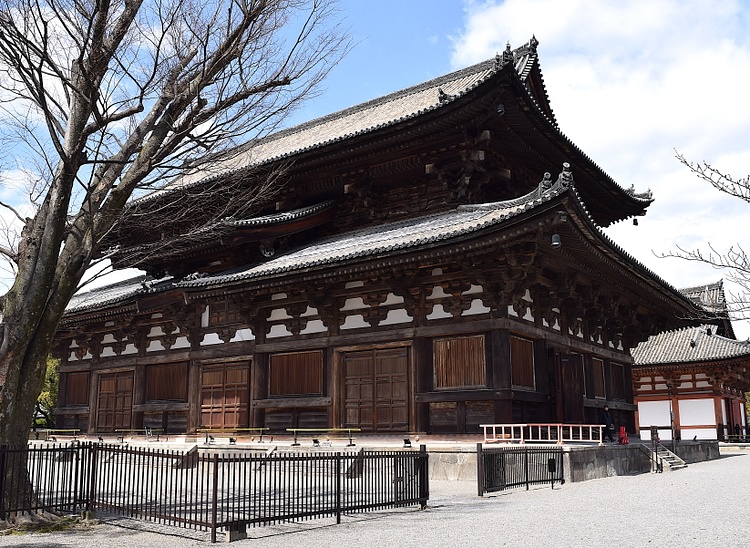 Main Hall (Kondo), To-ji James Blake Wiener (CC BY-NC-SA) ](https://www.worldhistory.org/image/6718/main-hall-kondo-to-ji/ "Main Hall (Kondo), To-ji")### Kodo (Lecture Hall)
The Kodo or Lecture Hall, an Important Cultural Property of Japan, is located at the centre of the temple complex. The building was first constructed c. 835 CE and storms and earthquakes over the centuries necessitated structural repairs. The current building dates to 1491 CE but is true to the original design. Today it contains 21 statues of important religious figures which are arranged in the form of a three-dimensional [mandala](https://www.worldhistory.org/mandala/) and used for teaching aspects of Buddhism. At the centre is the Buddha Dainichi Nyorai (Vairocana) represented by a 2.8 metre high gilded wooden statue. Carved during the [Muromachi Period](https://www.worldhistory.org/Muromachi_Period/) (1336-1573 CE), the Buddha wears a crown and jewelled necklace and is seated in front of a huge halo or aureole itself richly decorated with miniature Buddhist figures. Surrounding the Dainichi Nyorai statue are four groups of figures: Nyorai Buddhas (who have reached enlightenment), bodhisattvas (Buddhas who postpone their progress to enlightenment in order to remain on earth and guide believers), Myoo (wise kings who offer an example of austerity), and Tenbu (guardians who protect the other three groups). All 21 figures are listed as either National Treasures or Important Cultural Properties of Japan. Finally, the Kodo has two fine 9th-century CE mandala scrolls but, as so often with Japanese ancient artefacts, they are not on public display. [ 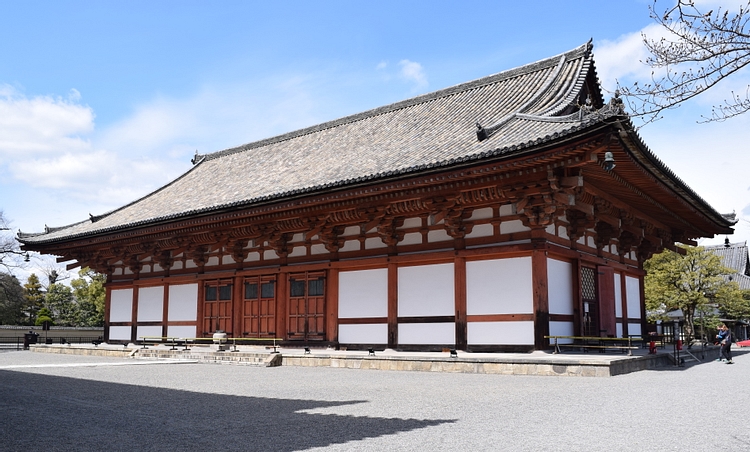 Kodo, To-ji James Blake Wiener (CC BY-NC-SA) ](https://www.worldhistory.org/image/6719/kodo-to-ji/ "Kodo, To-ji")
### Pagoda
To-ji's famous five-storey pagoda, another National Treasure of Japan, was built from 826 to 883 CE but it has been destroyed by fire no fewer than four times, a couple of times due to lightning strikes. The last rebuilding took place in 1644 CE under the auspices of the Edo [shogun](https://www.worldhistory.org/Shogun/) Tokugwa Iemitsu. The pagoda, with its internal interlocking structure, has since proved admirably resistant to [earthquake](https://www.worldhistory.org/disambiguation/earthquake/) damage. It stands around 55 metres (179 ft) tall, making it Japan's tallest wooden pagoda, and, like many other pagodas, it was not simply designed as an architectural highlight of the temple complex but as a repository for important Buddhist relics. The ground floor of the pagoda contains statues of four Buddhas arranged around the central square [column](https://www.worldhistory.org/column/) and each facing a different direction. The interior walls and column carry paintings of the most important bodhisattvas and the founders of Shingon Buddhism while the foundations are said to contain a relic of the Buddha Shakyamuni that Kukai brought back from his visit to Tang China between 804 and 806 CE.
[ 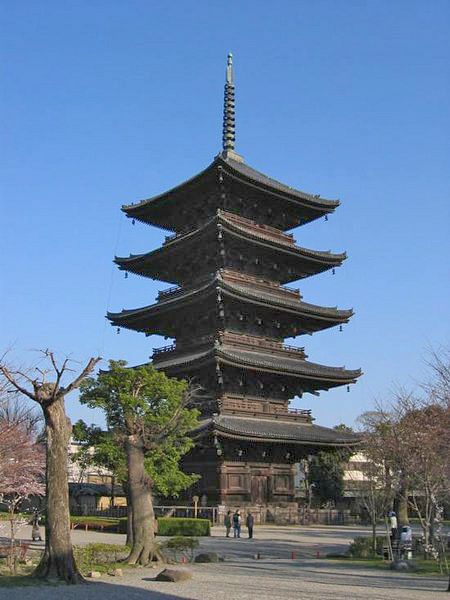 To-ji Pagoda, Kyoto Michael Reeve (CC BY-SA) ](https://www.worldhistory.org/image/6673/to-ji-pagoda-kyoto/ "To-ji Pagoda, Kyoto")### Other Buildings
Other structures at the complex include the Great South Gate (Nandaimon), next to which is a shrine to [Hachiman](https://www.worldhistory.org/Hachiman/), the [Shinto](https://www.worldhistory.org/Shinto/) [god](https://www.worldhistory.org/God/) of [war](https://www.worldhistory.org/disambiguation/War/) and [culture](https://www.worldhistory.org/disambiguation/culture/), and the east Higashidaimon Gate which leads to the Hyotan Pond and gardens. The Miedo (aka Taishido) memorial hall, which contains a 1223 CE statue of Kukai, was once the residence of the famous monk. The wood statue is 83 cm tall and was made by the artist Kosho; it is the oldest surviving portrait of Kukai. The building, like the statue within, is a National Treasure of Japan but was yet another victim of fire in 1379 CE, and so rebuilding began the following year to be completed in 1390 CE. The roof of the Miedo is covered with cypress-bark shingles. The Homotsukan museum at the site houses many important figure sculptures and has examples of calligraphy attributed to Kukai himself in the form of letters he wrote to his fellow monk [Saicho](https://www.worldhistory.org/Saicho/), founder of the rival Tendai sect. The whole To-ji complex is enclosed in a [wall](https://www.worldhistory.org/wall/) with moats at the northern and southern sides.
### Later History
To-ji was used as a base by Ashikaga Takauji (1305-1358 CE), the Muromachi shogun, during the violent rivalry between Japan's northern and southern courts of the 14th century CE. Unfortunately, worse was to come when the temple site was largely destroyed during the 15th-century CE Onin War (1467-1477 CE), but it was rebuilt early in the following century following the same ground plan as previously. In this endeavour, the scholar Goho's *Tobo-ki*, an eight-volume history of the site written in 1352 CE, came in useful. Nevertheless, the current grounds of 10 hectares (24 acres) are only a quarter of what they once were. To-ji is still a working monastery and is the headquarters of the Shingon sect of Buddhism. A popular visitor attraction, To-ji also hosts antiques and [crafts](https://www.worldhistory.org/crafts/) stalls on the 21st of each month, continuing the tradition of holding a market at the site, which goes back 700 years.
This content was made possible with generous support from the [Great Britain Sasakawa Foundation](http://www.gbsf.org.uk/?utm_source=ancient.eu&utm_medium=link&utm_campaign=ancient.eu).
#### Editorial Review
This human-authored definition has been reviewed by our editorial team before publication to ensure accuracy, reliability and adherence to academic standards in accordance with our [editorial policy](https://www.worldhistory.org/static/editorial-policy/).
## Bibliography
- Anonymous. *To-ji.* Shogakukan, 2016
- [Dougill, J. *Japan's World Heritage Sites.* Tuttle Publishing, 2014.](https://www.worldhistory.org/books/4805312858/)
- [Whitney Hall, J. *The Cambridge History of Japan, Vol. 2.* Cambridge University Press, 1999.](https://www.worldhistory.org/books/0521223539/)
## About the Author
Mark is WHE’s Publishing Director and has an MA in Political Philosophy (University of York). He is a full-time researcher, writer, historian and editor. Special interests include art, architecture and discovering the ideas that all civilizations share.
## Timeline
- **796 CE**: The [Buddhist](https://www.worldhistory.org/buddhism/) [To-ji](https://www.worldhistory.org/To-ji/) [temple](https://www.worldhistory.org/temple/) near [Heiankyo](https://www.worldhistory.org/Heiankyo/) (Kyoto), [Japan](https://www.worldhistory.org/disambiguation/Japan/) is founded.
- **826 CE**: A five-storey pagoda is added to the [To-ji](https://www.worldhistory.org/To-ji/) [temple](https://www.worldhistory.org/temple/) complex in [Heiankyo](https://www.worldhistory.org/Heiankyo/) (Kyoto).
## Cite This Work
### APA
Cartwright, M. (2017, May 29). To-ji. *World History Encyclopedia*.
### Chicago
Cartwright, Mark. "To-ji." *World History Encyclopedia*, May 29, 2017. .
### MLA
Cartwright, Mark. "To-ji." *World History Encyclopedia*, 29 May 2017, .
## License & Copyright
Submitted by [Mark Cartwright](https://www.worldhistory.org/user/markzcartwright/ "User Page: Mark Cartwright"), published on 29 May 2017. The copyright holder has published this content under the following license: [Creative Commons Attribution-NonCommercial-ShareAlike](https://creativecommons.org/licenses/by-nc-sa/4.0/deed.en). This license lets others remix, tweak, and build upon this content non-commercially, as long as they credit the author and license their new creations under the identical terms. When republishing on the web a hyperlink back to the original content source URL must be included. Please note that content linked from this page may have different licensing terms.