---
title: Tlaltecuhtli
author: Mark Cartwright
source: https://www.worldhistory.org/Tlaltecuhtli/
format: machine-readable-alternate
license: Creative Commons Attribution-NonCommercial-ShareAlike (https://creativecommons.org/licenses/by-nc-sa/4.0/)
updated: 1970-01-01
---
# Tlaltecuhtli
_Authored by [Mark Cartwright](https://www.worldhistory.org/user/markzcartwright/)_
Tlaltecuhtli, 'Earth Lord/Lady,' was a Mesoamerican earth goddess associated with fertility. Envisioned as a terrible toad monster, her dismembered body gave rise to the world in the [Aztec](https://www.worldhistory.org/Aztec_Civilization/) creation myth of the 5th and final cosmos. As a source of life, it was thought necessary to constantly appease her with blood sacrifices, especially human hearts.
### Name & Attributes
Envisioned as a goddess but perhaps possessing dual gender like one or two other Mesoamerican primordial deities, Tlaltecuhtli, with its male suffix, may be literally translated as 'Earth Lord' or, more typically 'Earth Lady.' The goddess was imagined as a fat toad-like monster with a big mouth, fangs, and clawed feet. Considered the source of all living things she had to be kept benevolent by blood sacrifices which would ensure the continued order of the world.
### The Creation Myth
The idea of a creation myth involving a savage aquatic monster with crocodile features goes back to the Classic [Maya](https://www.worldhistory.org/disambiguation/Maya/) and the 5th century BCE, a figure which was perhaps based on a similar shark-like monster in even earlier [Olmec](https://www.worldhistory.org/Olmec_Civilization/) [mythology](https://www.worldhistory.org/mythology/). In the creation mythology of the Aztecs and other Mesoamerican cultures of the Late Postclassic period (13th-16th century CE), the gods [Quetzalcoatl](https://www.worldhistory.org/Quetzalcoatl/) and [Tezcatlipoca](https://www.worldhistory.org/Tezcatlipoca/), taking the form of gigantic snakes, descended from the heavens one day and found Tlaltecuhtli sitting astride the ocean. In some versions, this creature is known as Cipactl or 'spiny one.' The hideous monster, with large fangs, crocodile skin, and gnashing mouths at her elbows and knees, called menacingly for flesh to feast on. The two gods realised that the 5th and final cosmos could not possibly prosper with such a fiendish creature roaming the world and so they took it upon themselves to destroy her. A mighty tussle ensued in which Tezcatlipoca lost his left foot. Finally, one [god](https://www.worldhistory.org/God/) took the right hand and left foot while the other took the left hand and the right foot, and with a mighty heave, they managed to rip Tlaltecuhtli in two. From the upper half came the sky and the other lower half became the earth.
The other gods were not best pleased to hear of Tlatecuhtli's treatment and so decreed that the various parts of her dismembered body should give rise to features of the new world. Thus, her skin became grasses and small flowers; her hair became the trees, flowers, and herbs; her eyes became springs and wells; her nose became the smaller mountains and valleys; her shoulders the larger mountains; and her mouth became the caves and rivers.
Despite being ripped to pieces and transformed into geographical features, the Mesoamericans still continued to think of Tlaltecuhtli as an earth goddess, and they attributed any strange sounds coming from such features as either the screams of Tlaltecuhtli in her dismembered agony or her calls for human blood to feed her. Indeed, the goddess gained a reputation for having an insatiable appetite for the hearts of sacrificial victims. This appetite had to be satisfied or the goddess would cease her nourishment of the earth and crops would fail.
Another aspect of the goddess was that Tlaltecuhtli was thought to swallow the sun every evening and regurgitate it the next morning at dawn. This solar connection ensured she was part of the prayers offered to Tezcatlipoca before an Aztec military campaign. Finally, midwives called on her aid during difficult births, and she appears in the [Aztec calendar](https://www.worldhistory.org/article/896/the-aztec-calendar/) as the 2nd of the 13 Lords of the Day, with her date glyph being 1 Rabbit.
### Representation in Art
Tlaltecuhtli, in various forms, is an ancient Mesoamerican deity but the earliest representations in [sculpture](https://www.worldhistory.org/disambiguation/Sculpture/) are found at the Maya [city](https://www.worldhistory.org/city/) of Mayapan in Yucatan. These date to the Late Postclassic period. More common in [Aztec art](https://www.worldhistory.org/Aztec_Art/), the goddess is often represented as a spread-eagled figure representing the *hocker* or squat adopted when giving birth. Her mouth usually gapes with fangs or teeth of flint blades, and she may have the skin of a crocodile which represents the surface of the earth.
[ 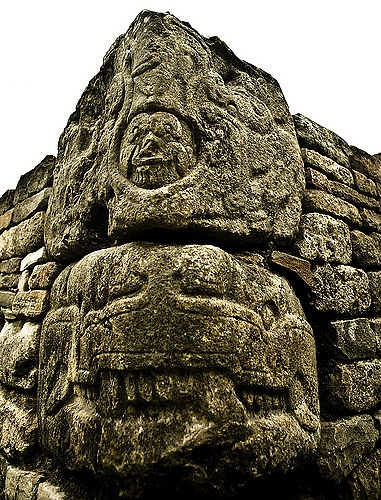 Tlaltecuhtli, El Tajin Philo Nordlund (CC BY) ](https://www.worldhistory.org/image/6432/tlaltecuhtli-el-tajin/ "Tlaltecuhtli, El Tajin")The most famous representation of Tlaltecuhtli is on the colossal stone slab found near the base of the [Templo Mayor](https://www.worldhistory.org/Templo_Mayor/) of the Aztec capital [Tenochtitlan](https://www.worldhistory.org/Tenochtitlan/) (now central Mexico City). The pink andesite stone was broken into four pieces by the weight of a colonial building once above it. Put back together, it measures 4 x 3.5 metres and weighs around 12 tons. Carved in high relief on the stone is the familiar squatting figure of Tlaltecuhtli wearing a skull and bones dress and with a river of blood flowing into her gaping mouth. The stone may have been used to [mark](https://www.worldhistory.org/disambiguation/Mark/) a royal [burial](https://www.worldhistory.org/burial/), perhaps that of [Ahuitzotl](https://www.worldhistory.org/Ahuitzotl/), as indicated by a year glyph (10 Rabbit or 1502 CE) and the nature of the goods buried under it, which are still being studied by archaeologists.
Another representation of the goddess is found on all four sides of the 1503 CE Coronation Stone of the Aztec ruler [Montezuma](https://www.worldhistory.org/Montezuma/) II (aka [Motecuhzoma II](https://www.worldhistory.org/Montezuma/)), and with her, the glyphs for water and fire, traditional symbols of [war](https://www.worldhistory.org/disambiguation/War/). The historian M. E. Miller is of the opinion that the face in the centre of the celebrated Aztec [Sun Stone](https://www.worldhistory.org/Sun_Stone/) (aka [Calendar Stone](https://www.worldhistory.org/Sun_Stone/)) is, in fact, Tlaltecuhtli and she there symbolises the demise of the 5th and final sun of the Aztec cosmos.
The goddess was often carved onto the bottom of sculptures where the base touched the earth and on the undersides of the special stone boxes known as *cuauhxicalli ('eagle box') which were used to keep the sacrificed hearts she was so partial to. Finally, Tlaltecuhtli appears as a fanged toad monster in the form of a cornerstone of a [pyramid](https://www.worldhistory.org/pyramid/) platform at [El Tajin](https://www.worldhistory.org/El_Tajin/). This links the architectural function of the stone as supporting the pyramid to her mythological function of supporting the earth.
#### Editorial Review
This human-authored definition has been reviewed by our editorial team before publication to ensure accuracy, reliability and adherence to academic standards in accordance with our [editorial policy](https://www.worldhistory.org/static/editorial-policy/).
## Bibliography
- [Coe, M.D. *Mexico.* Thames & Hudson, 2013.](https://www.worldhistory.org/books/0500290768/)
- [Jones, D. *Mythology of Aztec & Maya.* Southwater, 2007.](https://www.worldhistory.org/books/1844763978/)
- McEwan, C. *Moctezuma Aztec Ruler.* British Museum
- [Miller, M.E. *An Illustrated Dictionary of the Gods and Symbols of Ancient Mexico and the Maya.* Thames & Hudson, 1997.](https://www.worldhistory.org/books/0500279284/)
- [Miller, M.E. *The Art of Mesoamerica.* Thames & Hudson, 2012.](https://www.worldhistory.org/books/0500204144/)
- [Nichols, D.L. *The Oxford Handbook of Mesoamerican Archaeology.* Oxford University Press, 2016.](https://www.worldhistory.org/books/0190230800/)
- [Townsend, R.F. *The Aztecs.* Thames & Hudson, 2009.](https://www.worldhistory.org/books/0500287910/)
## About the Author
Mark is WHE’s Publishing Director and has an MA in Political Philosophy (University of York). He is a full-time researcher, writer, historian and editor. Special interests include art, architecture and discovering the ideas that all civilizations share.
## Timeline
- **c. 1427 CE**: The [Sun Stone](https://www.worldhistory.org/Sun_Stone/) depicting the ages of the five suns of [Aztec](https://www.worldhistory.org/Aztec_Civilization/) [mythology](https://www.worldhistory.org/mythology/) is carved and set up at [Tenochtitlan](https://www.worldhistory.org/Tenochtitlan/).
- **1502 CE**: The large stone marker depicting the [Aztec](https://www.worldhistory.org/Aztec_Civilization/) goddess [Tlaltecuhtli](https://www.worldhistory.org/Tlaltecuhtli/) is carved at [Tenochtitlan](https://www.worldhistory.org/Tenochtitlan/).
## Cite This Work
### APA
Cartwright, M. (2017, March 23). Tlaltecuhtli. *World History Encyclopedia*.
### Chicago
Cartwright, Mark. "Tlaltecuhtli." *World History Encyclopedia*, March 23, 2017. .
### MLA
Cartwright, Mark. "Tlaltecuhtli." *World History Encyclopedia*, 23 Mar 2017, .
## License & Copyright
Submitted by [Mark Cartwright](https://www.worldhistory.org/user/markzcartwright/ "User Page: Mark Cartwright"), published on 23 March 2017. The copyright holder has published this content under the following license: [Creative Commons Attribution-NonCommercial-ShareAlike](https://creativecommons.org/licenses/by-nc-sa/4.0/deed.en). This license lets others remix, tweak, and build upon this content non-commercially, as long as they credit the author and license their new creations under the identical terms. When republishing on the web a hyperlink back to the original content source URL must be included. Please note that content linked from this page may have different licensing terms.