---
title: Tikal
author: Mark Cartwright
source: https://www.worldhistory.org/Tikal/
format: machine-readable-alternate
license: Creative Commons Attribution-NonCommercial-ShareAlike (https://creativecommons.org/licenses/by-nc-sa/4.0/)
updated: 1970-01-01
---
# Tikal
_Authored by [Mark Cartwright](https://www.worldhistory.org/user/markzcartwright/)_
Tikal, located in the north of the Petén region of Guatemala, was a major [Maya](https://www.worldhistory.org/disambiguation/Maya/) [city](https://www.worldhistory.org/city/) which flourished between 300 and 850 CE. The city, known to the Maya themselves as Mutul, is one of the grandest in Mesoamerica. Amongst the first Maya [cities](https://www.worldhistory.org/city/) to gain prominence in the Early Classic period (250-600 CE), Tikal built its wealth by exploiting its natural resources and geographical location to become a Maya superpower, a status it also enjoyed in the 7th century CE when some of the site's most impressive later monuments were constructed. Tikal is listed by UNESCO as a World Heritage Site.
### Historical Overview
Settlement at Tikal began from around 300 BCE and, first clearing away areas in the jungle, monumental [architecture](https://www.worldhistory.org/disambiguation/architecture/) was built in the period up to 100 CE. The city's prosperity was based on exploitation of natural resources such as cedar wood, dye from brazil wood, copal resin, flint, and cultivating maize in cleared areas of rainforest and fertile swamp areas. In 378 CE Tikal was invaded by forces from distant [Teotihuacan](https://www.worldhistory.org/Teotihuacan/) (or at the very least [trade](https://www.worldhistory.org/disambiguation/trade/) contacts were established) with a consequent influence on the cultural practices at Tikal, from clothes to art and architecture. From the late 4th century CE, Tikal was able to further expand its sphere of influence and [conquer](https://www.worldhistory.org/warfare/) long-time local rivals Uaxactún and Rio Azul, and the city formed useful alliances with such centres as Kaminaljuyú. At its height the population of Tikal, including the scattered urban settlements around the city, was over 50,000, and it utilized some 200 square kilometres of surrounding territory.
In the 6th century CE the power of Teotihuacan declined, and other Maya cities, notably Caracol, sought military expansion, defeating Tikal in 562 CE. However, by the 7th century CE Tikal regained its place as an important Maya city, contemporary with such centres as [Palenque](https://www.worldhistory.org/Palenque/), [Copan](https://www.worldhistory.org/Copan/), and Tikal's greatest rival Calakmul. The most important ruler in this resurgence was Jasaw Chan K'awiil (r. 682-734 CE) who defeated Calakmul in 695 CE and oversaw a significant rebuilding programme in the city. The most impressive new buildings were the massive [pyramids](https://www.worldhistory.org/pyramid/) known simply as [Temple](https://www.worldhistory.org/temple/) I and II. Jasaw Chan K'awiil was buried in Temple I on its completion in c. 727 CE. Other pairings of pyramids were built later but most of these remain unexcavated. Along with other Maya cities, Tikal went into gradual decline during the 8th century CE, and by around 900 CE the site had been abandoned. The city, including its towering temples, was eventually reclaimed by the jungle and would only be rediscovered in the mid-19th century CE.
[ 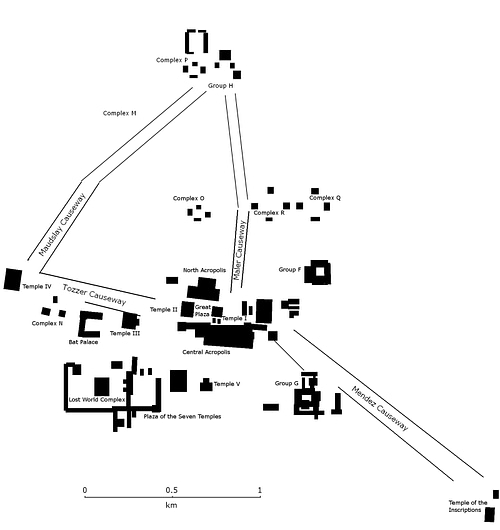 Tikal Map Simon Burchell (CC BY-SA) ](https://www.worldhistory.org/image/3101/tikal-map/ "Tikal Map")### Layout & Architecture
Tikal consists of nine different plazas and courts connected by causeways and ramps and has, in all, over 3,000 structures. The buildings are spread over some 15 square kilometres, and so the city was relatively low in density. Sometime before 250 CE the Great Plaza and North [Acropolis](https://www.worldhistory.org/Acropolis/) were constructed to follow a north-south axis. This plan was adhered to by later constructions until the 8th century CE Temples I and II were built on an east-west axis. Buildings used limestone blocks around rubble cores with lintels and crossbeams in wood (sapodilla was the preferred choice), often elaborately carved to depict scenes. Besides its imposing temples, the city also had palaces, a market complex, ten reservoirs, two sacred causeways, and a unique triple ballcourt. Another typical Maya feature is the [sculpture](https://www.worldhistory.org/disambiguation/Sculpture/) of stone slabs to depict rulers and record their greatest accomplishments. Such stelae were set up in rows along the sides of the plazas. The oldest example of these stelae in Mesoamerica was discovered at Tikal and dates to 292 CE. It shows a ruler holding in his left hand the Jaguar [God](https://www.worldhistory.org/God/) of the Underworld, probably a patron god of Tikal.
The earliest structures, such as the North Acropolis, are typically squat with corner apron moldings. These and later architecture at the site all display the usual Maya features of multi-level pyramids, raised platforms, corbel-vaulted chambers, large stucco masks of gods which flank staircases, and a deliberate orientation with the heavens, cardinal directions and, often time itself, as indicated by the 8th century CE pairs of pyramids built every 20-year *katun* cycle. The large pyramids also had roof-combs which made them even taller, and these may have represented the sacred caves which Mesoamerican people had used as places of worship for millennia. Many tombs within buildings have murals, the earliest dating to c. 50 BCE, typically depicting rulers and gods, no doubt, to emphasise the divine ancestry of the [tomb](https://www.worldhistory.org/tomb/)'s occupant.
[ 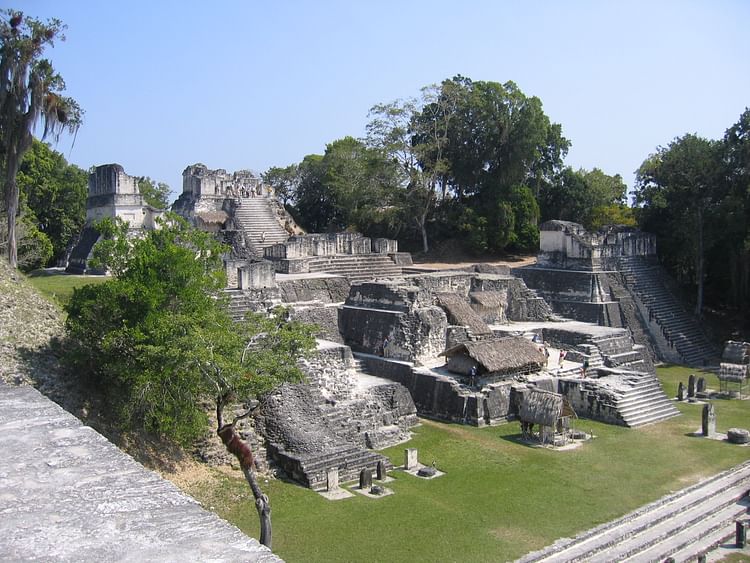 North Acropolis, Tikal Peter Andersen (CC BY-SA) ](https://www.worldhistory.org/image/3103/north-acropolis-tikal/ "North Acropolis, Tikal")### Architectural Highlights
**North Acropolis**
The North Acropolis, first built c. 250 BCE and modified many times over the centuries, includes the oldest structures at Tikal. These temples were built on two rectangular platforms, the oldest and largest measures 100 x 80 metres, and used as mausoleums for the early Tikal kings. The most opulent tomb was of Yax Nuun Ayiin, also known as 'Curl Nose', who died in 420 CE and who was buried in all his finery along with nine sacrificial victims and several fine pots of [chocolate](https://www.worldhistory.org/disambiguation/Chocolate/) and maize gruel. Other colourfully named rulers buried in the twelve temples include Moon Zero Bird (accession c. 320 CE), Great Jaguar Paw, Stormy Sky, and Smoking Frog.
**Central Acropolis**
Facing the Great Plaza, this is the location of Tikal's five-storey royal [palace](https://www.worldhistory.org/disambiguation/palace/). Similar to the better preserved palace at Palenque, the structure had extensive galleries, benches set along walls, enclosed courtyards, and stucco depictions of captives. The presence of four huge hearths suggests meals were prepared for a large number of resident scribes and administrators. The courtyards would have been used for important ceremonies, including blood-letting and sacrifices.
**Mundo Perdido Complex**
The Mundo Perdido or 'Lost World' complex is dominated by a huge [pyramid](https://www.worldhistory.org/pyramid/), and along one side of the complex is a row of small temples, their exact purpose unknown. The complex has three platforms on its eastern side and a single platform on the western side. Those to the east are aligned with the sunrise at the equinoxes.
[  Temple I, Tikal Dave Jimison (CC BY-SA) ](https://www.worldhistory.org/image/3102/temple-i-tikal/ "Temple I, Tikal")**Temples I, II, & IV**
Built in the 8th century CE on a west-east axis and facing each other across the Great Plaza, the Temple I pyramid has the typical nine levels to imitate those of the Maya underworld [Xibalba](https://www.worldhistory.org/Xibalba/). Temple I is 50 m (164 ft) high and is climbed by a steep 70-degree staircase with steps so narrow they can only be climbed side-footed. Deep within Temple I the Tikal king Jasaw Chan K'awiil was buried, while his wife is a prime candidate for the now missing occupant of the 42-metre high Temple II. The king's tomb, besides the usual precious jade and shell jewelry also contained a large number of incised bones which relate tales from Tikal history. Finally, mention should be made of Temple IV as, at 70 metres high, it is the tallest structure at Tikal and was used as the tomb of King Yax Kin (734-746 CE).
#### Editorial Review
This human-authored definition has been reviewed by our editorial team before publication to ensure accuracy, reliability and adherence to academic standards in accordance with our [editorial policy](https://www.worldhistory.org/static/editorial-policy/).
## Bibliography
- [Coe, M.D. *The Maya.* Thames & Hudson, 2014.](https://www.worldhistory.org/books/B0043QJF08/)
- [Kubler, G. *The Art and Architecture of Ancient America, Third Edition.* Yale University Press, 1984.](https://www.worldhistory.org/books/0300053258/)
- [Miller, M.E. *The Art of Mesoamerica.* Thames & Hudson, 2012.](https://www.worldhistory.org/books/0500204144/)
- [Nichols, D.L. *The Oxford Handbook of Mesoamerican Archaeology.* Oxford University Press, USA, 2014.](https://www.worldhistory.org/books/B00E6TJW6Y/)
- [Phillips, C. *The Complete Illustrated History of the Aztec & Maya.* Hermes House, 2014.](https://www.worldhistory.org/books/0681352388/)
## About the Author
Mark is WHE’s Publishing Director and has an MA in Political Philosophy (University of York). He is a full-time researcher, writer, historian and editor. Special interests include art, architecture and discovering the ideas that all civilizations share.
## Timeline
- **c. 300 BCE**: First recorded settlement at [Tikal](https://www.worldhistory.org/Tikal/).
- **c. 250 BCE**: The first structures are built on the North [Acropolis](https://www.worldhistory.org/Acropolis/), [Tikal](https://www.worldhistory.org/Tikal/).
- **c. 100 BCE - 50 BCE**: The earliest known [Maya](https://www.worldhistory.org/disambiguation/Maya/) murals are painted at San Bartolo, Guatemala.
- **250 CE - 950 CE**: The Classic [Maya](https://www.worldhistory.org/disambiguation/Maya/) Period which saw the height of the [Maya Civilization](https://www.worldhistory.org/Maya_Civilization/) in [cities](https://www.worldhistory.org/city/) such as [Chichen Itza](https://www.worldhistory.org/Chichen_Itza/), [Palenque](https://www.worldhistory.org/Palenque/), [Tikal](https://www.worldhistory.org/Tikal/), [Copan](https://www.worldhistory.org/Copan/) and [Uxmal](https://www.worldhistory.org/Uxmal/).
- **c. 292 CE**: The oldest known [Maya](https://www.worldhistory.org/disambiguation/Maya/) stela is produced at [Tikal](https://www.worldhistory.org/Tikal/).
- **378 CE**: First contact between [Teotihuacan](https://www.worldhistory.org/Teotihuacan/) and [Tikal](https://www.worldhistory.org/Tikal/).
- **420 CE**: [Death](https://www.worldhistory.org/disambiguation/Death/) of [Maya](https://www.worldhistory.org/disambiguation/Maya/) ruler Yax Nuun Ayiin 'Curl Nose' at [Tikal](https://www.worldhistory.org/Tikal/).
- **562 CE**: Caracol embarks on a period of expansion and defeats [Tikal](https://www.worldhistory.org/Tikal/) .
- **682 CE - 734 CE**: Reign of Jasaw Chan K'awiil at [Tikal](https://www.worldhistory.org/Tikal/).
- **695 CE**: [Tikal](https://www.worldhistory.org/Tikal/) defeats rival [Maya](https://www.worldhistory.org/disambiguation/Maya/) [city](https://www.worldhistory.org/city/) Calakmul.
- **c. 727 CE**: [Temple](https://www.worldhistory.org/temple/) I at [Tikal](https://www.worldhistory.org/Tikal/) is completed and will be used as the [tomb](https://www.worldhistory.org/tomb/) of ruler Jasaw Chan K'awiil.
- **734 CE - 746 CE**: Reign of [Maya](https://www.worldhistory.org/disambiguation/Maya/) ruler Yax Kin at [Tikal](https://www.worldhistory.org/Tikal/) who would be buried inside [Temple](https://www.worldhistory.org/temple/) IV.
- **c. 900 CE**: [Maya](https://www.worldhistory.org/disambiguation/Maya/) [Tikal](https://www.worldhistory.org/Tikal/) is definitively abandoned.
## External Links
- [Tikal | Essay | The Metropolitan Museum of Art | Heilbrunn Timeline of Art History](https://www.metmuseum.org/toah/hd/maya/hd_maya.htm)
- [Tikal: Sacred Architecture | Essay | The Metropolitan Museum of Art | Heilbrunn Timeline of Art History](https://www.metmuseum.org/toah/hd/maya2/hd_maya2.htm)
- [Tikal: Stone Sculpture | Essay | The Metropolitan Museum of Art | Heilbrunn Timeline of Art History](https://www.metmuseum.org/toah/hd/maya3/hd_maya3.htm)
## Cite This Work
### APA
Cartwright, M. (2014, October 08). Tikal. *World History Encyclopedia*.
### Chicago
Cartwright, Mark. "Tikal." *World History Encyclopedia*, October 08, 2014. .
### MLA
Cartwright, Mark. "Tikal." *World History Encyclopedia*, 08 Oct 2014, .
## License & Copyright
Submitted by [Mark Cartwright](https://www.worldhistory.org/user/markzcartwright/ "User Page: Mark Cartwright"), published on 08 October 2014. The copyright holder has published this content under the following license: [Creative Commons Attribution-NonCommercial-ShareAlike](https://creativecommons.org/licenses/by-nc-sa/4.0/deed.en). This license lets others remix, tweak, and build upon this content non-commercially, as long as they credit the author and license their new creations under the identical terms. When republishing on the web a hyperlink back to the original content source URL must be included. Please note that content linked from this page may have different licensing terms.