---
title: Thor
author: Joshua J. Mark
source: https://www.worldhistory.org/Thor/
format: machine-readable-alternate
license: Creative Commons Attribution-NonCommercial-ShareAlike (https://creativecommons.org/licenses/by-nc-sa/4.0/)
updated: 2025-02-04
---
# Thor
_Authored by [Joshua J. Mark](https://www.worldhistory.org/user/JPryst/)_
Thor (Old Norse: Þórr) is the Norse [god](https://www.worldhistory.org/God/) of thunder, the sky, and [agriculture](https://www.worldhistory.org/disambiguation/Agriculture/). He is the son of [Odin](https://www.worldhistory.org/odin/), chief of the gods, and Odin's consort Jord (Earth) and husband of the fertility goddess [Sif](https://www.worldhistory.org/Sif/), who is the mother of his son Modi and daughter Thrud; his other son, Magni, may be from a union with the giantess Jarnsaxa.
Thor was the defender of Asgard, realm of the gods, and [Midgard](https://www.worldhistory.org/Midgard/), the human realm, and is primarily associated with protection through great feats of arms in slaying [giants](https://www.worldhistory.org/Giants/). The majority of the tales featuring Thor, in fact, put him in conflict with a [giant](https://www.worldhistory.org/Giants/) or with his nemesis the Midgard Serpent ([Jörmungandr](https://www.worldhistory.org/Jormungandr/), the “huge monster”), a monstrous snake who coils and twists itself around the world. Like almost all of the Norse gods, Thor is doomed to die at [Ragnarök](https://www.worldhistory.org/Ragnarok/), the end of the world and twilight of the gods, but falls only after killing the great serpent with his powerful hammer Mjollnir, dying to its poison; his sons Magni and Modi survive Ragnarök along with a small number of other gods and inherit his hammer which they use to restore order.
He developed from the earlier Germanic god Donar and became the most popular deity of the Norse [pantheon](https://www.worldhistory.org/Pantheon/). Thor continues as a popular god in the present day, too, and the modern English and German words for the fifth day of the week – Thursday and *Donnerstag* – both allude to Thor/Donar (“Thor's Day”/“Donar's Day”). He was thought to have ruled the sky from his land of Þrúðvangr (“Power-Field” or “Plains of Strength”) where he built his [great hall](https://www.worldhistory.org/Great_Hall/) of Bilskírnir, a [palace](https://www.worldhistory.org/disambiguation/palace/) of 540 rooms.
Thor's popularity reached its height during the [Viking Age](https://www.worldhistory.org/collection/29/the-viking-age/) (c. 790-1100) at which time he was considered the greatest rival to Christ when, roughly from the 10th century onwards, [Christianity](https://www.worldhistory.org/christianity/) was introduced to Scandinavia. More amulets and charms of Thor's hammer date from the period when Christianity and the Norse [religion](https://www.worldhistory.org/religion/) were in contention than from any other. Christianity finally prevailed and the cult of Thor was gradually replaced by the new religion by the 12th century.
### Functions
Thor functioned primarily as a protector-god, although stories concerning him also explained natural phenomena, thus linking him with the etiological type of myth (one which explains how some aspect of life came to be). He was said to burst forth from his great hall in his chariot, drawn by two male goats – Tanngnjóstr (Tooth Gnasher) and Tanngrísnir (Snarl Tooth) – who could be killed and eaten by the god and then brought back to life the next day as long as their bones remained unbroken. The roar of thunder was the rumble of Thor's chariot's wheels across the vault of the heavens and, in another story, he is credited with creating tides.
For the most part, however, he was invoked for protection and problem-solving. Scholar Preben Meulengracht Sørensen comments that Thor “was master of thunder and lightning, storm and rain, fair weather and crops, and the pagans sacrificed to him when threatened by hunger or disease” (Sawyer, 203). He had three magical items which helped him defend Asgard and Midgard: his hammer Mjollnir, his belt of strength Megingjörð (which doubled his strength when he wore it), and his great iron gloves which he needed to wield his hammer.
[ 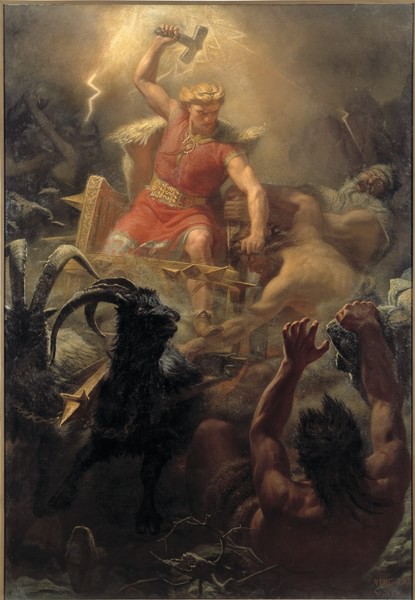 Thor Battling Giants Mårten Eskil Winge (Public Domain) ](https://www.worldhistory.org/image/5166/thor-battling-giants/ "Thor Battling Giants")Thor was invoked to seal business contracts and consecrate marriages, for agricultural abundance, for protection during voyages (especially at sea) and for victory in [battle](https://www.worldhistory.org/disambiguation/battle/), but he seems to have been called upon whenever any need arose. Sørensen notes:
> The relationship with the pagan gods had been a sort of friendship, a contract by which man sacrificed to the gods and was entitled to their support in return…The Icelandic Landnamabok (The Book of Settlements) relates that Helgi inn Magri, who settled Iceland in about 900, believed in Christ but invoked Thor when in distress at sea. He also asked Thor to show him where to build his new farm, but he named it after Christ. (Sawyer, 223)
The introduction of Christianity to Scandinavia, at first, did nothing to diminish the importance of Thor in people's lives. The god continued to be invoked throughout the greater part of the [Viking](https://www.worldhistory.org/Vikings/) Age as evidenced not only by the amulets and charms mentioned above but by engravings, images, statuary and the stories which continued to be told about him.
### Attributes & Character
In all of these stories, Thor's attributes are his previously mentioned three magical items – the hammer Mjollnir, the belt Megingjörð, and his iron gloves, out of which Mjollnir is the most characteristic one – as well as this goat-drawn chariot. These items embellish Thor's great strength, which is his main feature, and Thor also has a quick temper and shows impatience for following others' rules.
He is never depicted as a subtle or careful deity and prefers direct action over discussion or planning in solving any problem. Thor is completely without guile or the capacity to deceive and so cannot recognize these qualities in others; as a result, he is often tricked by magical spells or shape-shifting entities which cause things to appear other than they are.
Contrary to the popular image of Thor in the present day from Marvel comic books and films, he was not the brother of [Loki](https://www.worldhistory.org/Loki/) and is never depicted as clean-shaven or blonde-haired except in chapter 3 of the *Prose [Edda](https://www.worldhistory.org/Edda/)* (composed c. 1220), a mythography of earlier Norse myths reworked by the Icelander Snorri Sturluson into one structured account, written from a Christian context. Elsewhere, and in almost every image, Thor is always shown with long red hair and a great beard, often as not leaping into battle against giants or killing dwarves without pausing to consider alternatives to violence. He is closely associated with water in many of the myths and is depicted rowing out further into the sea than others have gone and also crossing dangerous rivers – both aspects of his role as a protector god who removes boundaries or goes before a believer as a guide.
Viking Age Scandinavians especially revered Thor not only as a guide across the seas and protector from storms, but as a champion in battle. Scholar H. R. Ellis Davidson writes:
> Of all the gods, it is Thor who seems the characteristic hero of the stormy world of the [Vikings](https://www.worldhistory.org/Vikings/). Bearded, outspoken, indomitable, filled with vigor and gusto, he puts his reliance in his strong right arm and simple weapons. He strides through the northern realm of the gods, a fitting symbol for the man of action. (74)
Thor was not just the preferred god of the Viking warrior, however, as his strength and direct response to any given problem were equally appealing across the spectrum of Viking Age social classes. A housewife could call upon Thor for help with domestic challenges just as a farmer, a weaver, or a brewer would with their own difficulties and, as evidenced by his popularity, Thor would help them. Thor therefore became the Norse god of the everyman; the common-sense, no-nonsense deity anyone could relate to and everyone could depend on.
[  Thor's Hammer Amulet Gunnar Creutz (CC BY-SA) ](https://www.worldhistory.org/image/9701/thors-hammer-amulet/ "Thor's Hammer Amulet")### Myths Involving Thor
The stories which feature the god, besides noting his strength and impatience with delays, all emphasize his reliability. Even when Thor is tricked our outsmarted, his past victories and assurance of future triumphs excuse him; he may not win a battle but will eventually win the [war](https://www.worldhistory.org/disambiguation/War/). This concept is clearly explained in Chapter 44 of the *Prose Edda* when the story-teller High responds to a question about Thor's victories:
> Although some things, because of their power or strength, have prevented Thor from being victorious, there is no need to tell about them, not least because everybody ought to keep in mind that there are so many examples where Thor is mightiest. (53)
Even though High claims that the stories where Thor does not win are not worth being told, a number of these are among the most famous. One of these has to do with the Castle of the giant Utgarda-Loki and the three tricks played on Thor. Thor frequently traveled with his human servant Thjalfi or with Loki but, on this journey, he was accompanied by both. They encounter a giant named Skrýmir in the forest who offers to carry the food bag but ties it so tightly that Thor cannot open it. Three separate times Thor attacks Skrýmir with his hammer while the giant is sleeping but with no effect; each time Skrýmir wakes up and asks if perhaps a leaf or acorn has fallen on his head.
After Skrýmir leaves them, the three arrive at the stronghold of the giant Utgarda-Loki who mocks them for being so small and tells them that, if they want to stay, they must compete in contests which show their worth. Loki offers to compete in eating the fastest and is pitted against Logi of Utgarda-Loki's court. Loki eats all the meat in the trough but Logi eats the meat, bones, and trough itself; so Logi is declared the winner. Next, Thjalfi offers to run a race and, three times, loses to his opponent Hugi.
When it is Thor's turn, he chooses a drinking contest and Utgarda-Loki offers him a large horn. Thor drinks three times but cannot empty the horn. Utgarda-Loki mocks him and offers him the challenge of lifting a large gray cat off the floor; Thor can only manage to lift it high enough so that one paw is in the air. Once again, Utgarda-Loki mocks Thor and says that perhaps he can win at wrestling an old woman – his nurse Elli. Thor and Elli grapple through the hall until Thor is finally forced down onto one knee. At this point, Utgarda-Loki calls a halt to the contests and allows the three to spend the night.
The next morning, Utgarda-Loki rides out from the castle with Thor and his companions and reveals the truth of the past few days. He first tells them that he was Skrýmir in the forest and that he deceived Thor each time Thor struck him; Thor was actually striking at mountains whose tops were now leveled from each blow. Once they were in the castle, the deceit continued as Loki's opponent in the eating contest was actually wildfire which burned up meat, bones, and the wooden trough while Thjalfi's opponent in the race had been thought which flies faster than anyone's feet.
[  Thor Disguised as Freyja Haukurth (Public Domain) ](https://www.worldhistory.org/image/8092/thor-disguised-as-freyja/ "Thor Disguised as Freyja")In the case of Thor's contest, Utgarda-Loki explains, the bottom of the drinking horn was in the sea so that, no matter how much Thor drank, he would never have been able to empty it. He did manage to drink so much, however, that the sea level had dropped and Thor had now created tides. The gray cat had actually been the Midgard serpent who encircles the world and the fact Thor had managed to raise it as high as he had was incredible. Finally, the old woman he had wrestled was old age itself, which no one can defeat, and Utgarda-Loki says how everyone was impressed and in awe when Thor was only forced down on one knee.
Thor responds to this speech by drawing out his hammer to smash Utgarda-Loki's skull but the giant has vanished and so has his stronghold. Thor and his companions leave the giant's land but Thor swears vengeance on the Midgard Serpent for being able to resist him. Shortly afterwards, he goes fishing with the giant Hymir and catches the serpent but Hymir, fearful of drowning since Thor's fight with the beast is threatening their boat, cuts the line. The Midgard Serpent escapes and Thor, after hurling Hymir overboard, wades into shore.
Neither of these tales show Thor at his best because he is deceived in the first and betrayed, just as he was about to haul the serpent into the ship, in the second. He remains a heroic figure, however, because his failings are not of his own doing. No one could have done better against the magic of Utgarda-Loki and no one can predict what a companion might do in a moment of crisis. In another popular tale, Thor's hammer is stolen by the giants and he must disguise himself as the goddess [Freyja](https://www.worldhistory.org/Freyja/) and pretend to be the giant's bride in order to get it back. A Norse audience would have been entertained by these stories but would also have derived a comforting message: even Thor could have bad days.
[  Viking Rune Stone (Sanda, Sweden) Emma Groeneveld (Copyright) ](https://www.worldhistory.org/image/7514/viking-rune-stone-sanda-sweden/ "Viking Rune Stone (Sanda, Sweden)")### Cult of Thor
This kind of reassurance that Thor provided gave rise to his popular cult. Very little is known of the specifics of Thor's worship owing to the nature of Norse religion which had no written scripture or formal liturgy but, as noted, his popularity is evidenced by the number of amulets, engravings, and other allusions to him. Sørensen comments on Thor's cult, and Norse religious practices generally, [writing](https://www.worldhistory.org/writing/):
> The most important difference between pagan and Christian worship was that pagan cults did not have the regular organization of the Christian church. Religion was not a separate institution with special temples and priests. It was part of ordinary life and maintained by individual members of society, that is, by yeomen and housewives, and the rituals were performed in the homes of farmers and chieftains. (Sawyer, 213)
There do seem to be exceptions to this general rule, however, as temples to Thor are mentioned by later writers. The most famous of these was the [Temple](https://www.worldhistory.org/temple/) of Uppsala in Sweden dedicated to the worship of [Freyr](https://www.worldhistory.org/Freyr/), Odin, and Thor. According to the account by Adam of Bremen (c.1050-1085), in the *Gesta Hammaburgensis ecclesiae pontificum*, sacrifices were made at this temple every nine years in which the males of every species were killed and hung from trees in a sacred grove. Although Adam's account has been challenged as hearsay and as being unreliable, it seems likely that some sort of ritual sacrifice took place at Uppsala as well as elsewhere. Davidson comments:
> The figure of the god with his hammer is said to have stood in many temples at the close of the heathen period. We hear more of the images of Thor than of those of the other gods, and when he shared a temple with other deities, he is usually said to have occupied the place of honor. Rich robes are mentioned, and sacrifices of meat and bread are said to have been made to him in his temples in Norway. His worshippers would look for guidance from the image of Thor when the time came to make some difficult decision (75)
These temples were all destroyed once Christianity triumphed over the pagan Norse beliefs. Davidson relates the story of the infamous Norwegian king Olaf Tryggvason (r. 995-1000), who forcibly converted his kingdom to Christianity through violence and torture, destroying a temple after he was shown how a statue of Thor operated (it moved). Davidson quotes a description of the statue from the Icelandic manuscript *Flateyjarbók* (c. 1394), a compilation of earlier writings on Norse leaders, which emphasizes the grandeur of Thor's statue:
> Thor sat in the middle. He was the most highly honored. He was huge and all adorned with [gold](https://www.worldhistory.org/gold/) and [silver](https://www.worldhistory.org/Silver/). Thor was arranged to sit in a chariot; he was very splendid. There were goats, two of them, harnessed in front of him, very well wrought. Both car and goats ran on wheels. The rope round the horns of the goats was of twisted silver and the whole was worked with extremely fine craftsmanship. (76)
This statue seems to have moved when one pulled on the rope around the horns and, when it did, would make a sound like thunder. Davidson continues:
> Skeggi, the man who took Olaf Tryggvason to the temple to see Thor, persuaded him to pull the cord round the horns of the goats and, when he did so, the goats moved easily along. Thereupon Skeggi declared that the king had done service to the god and Olaf, not surprisingly, became angry and called on his men to destroy the idols while he himself knocked Thor from his chariot. The implication here is that the pulling along of a well-greased chariot formed part of a ritual in Thor's honor. (76)
Amulets depicting Thor's hammer vied with those of Christian crosses as the Norse religion struggled to maintain itself against the encroachment of the new faith which seemed antithetical to every value Thor embodied. The very characteristics which made Thor such a popular god were denigrated by the new religion which, in theory at least, promoted peaceful resolutions to conflicts and deliberation before action.
Even though Christian kings like Olaf Tryggvason converted more people with burning coals and steel than theological argument, the ideals of Christianity offered no room for a god such as Thor and his worshippers either died resisting Christian conversion or accepted the new faith and forgot about him. By the 12th century CE, Thor's cult was a memory and churches stood where his temples had been.
#### Editorial Review
This human-authored definition has been reviewed by our editorial team before publication to ensure accuracy, reliability and adherence to academic standards in accordance with our [editorial policy](https://www.worldhistory.org/static/editorial-policy/).
## Bibliography
- [Dougherty, M. J. *Vikings: A History of the Norse People.* Amber Books Ltd, 2014.](https://www.worldhistory.org/books/B00IK06ZTW/)
- [Ellis Davidson, H.R. *Gods and Myths of the Viking Age.* Bell Publishing Company, New York, 1982.](https://www.worldhistory.org/books/0517336448/)
- [Lindow, J. *Norse Mythology: A Guide to the Gods, Heroes, Rituals, and Beliefs.* Oxford University Press, 2002.](https://www.worldhistory.org/books/0195153820/)
- [Sawyer, P. *The Oxford Illustrated History of the Vikings.* Oxford University Press, 2001.](https://www.worldhistory.org/books/0192854348/)
- [Simek, R. *A Dictionary of Northern Mythology.* BOYE6 Publishers, 2008.](https://www.worldhistory.org/books/0859915131/)
- [Somerville, A. A. & McDonald, R. A. *The Viking Age: A Reader.* University of Toronto Press, Higher Education Division, 2014.](https://www.worldhistory.org/books/1442608676/)
- [Sturluson, S. *The Prose Edda.* Penguin Classics, 2006.](https://www.worldhistory.org/books/0140447555/)
- [Wolf, K. *Viking Age: Everyday Life During the Extraordinary Era of the Norsemen.* Sterling, 2013.](https://www.worldhistory.org/books/1454909064/)
## About the Author
Joshua J. Mark is World History Encyclopedia's co-founder and Content Director. He was previously a professor at Marist College (NY) where he taught history, philosophy, literature, and writing. He has traveled extensively and lived in Greece and Germany.
- [Linkedin Profile](https://www.linkedin.com/pub/joshua-j-mark/38/614/339)
## Timeline
- **c. 790 CE - c. 1100 CE**: Worship of [Thor](https://www.worldhistory.org/Thor/) reaches its height during the [Viking Age](https://www.worldhistory.org/collection/29/the-viking-age/).
- **995 CE - 1000 CE**: Reign of Olaf Tryggvason in Norway; forcible conversion of populace to [Christianity](https://www.worldhistory.org/christianity/) diminishes [Thor](https://www.worldhistory.org/Thor/)'s status.
## External Links
- [The myth of Thor's journey to the land of giants - Scott A. Mellor](https://ed.ted.com/lessons/the-myth-of-thor-s-journey-to-the-land-of-giants-scott-a-mellor)
- [The Norse Gods](https://thenorsegods.com/)
## Cite This Work
### APA
Mark, J. J. (2018, December 17). Thor. *World History Encyclopedia*.
### Chicago
Mark, Joshua J.. "Thor." *World History Encyclopedia*, December 17, 2018. .
### MLA
Mark, Joshua J.. "Thor." *World History Encyclopedia*, 17 Dec 2018, .
## License & Copyright
Submitted by [Joshua J. Mark](https://www.worldhistory.org/user/JPryst/ "User Page: Joshua J. Mark"), published on 17 December 2018. The copyright holder has published this content under the following license: [Creative Commons Attribution-NonCommercial-ShareAlike](https://creativecommons.org/licenses/by-nc-sa/4.0/deed.en). This license lets others remix, tweak, and build upon this content non-commercially, as long as they credit the author and license their new creations under the identical terms. When republishing on the web a hyperlink back to the original content source URL must be included. Please note that content linked from this page may have different licensing terms.