---
title: Thessalonica
author: Mark Cartwright
source: https://www.worldhistory.org/Thessalonica/
format: machine-readable-alternate
license: Creative Commons Attribution-NonCommercial-ShareAlike (https://creativecommons.org/licenses/by-nc-sa/4.0/)
updated: 1970-01-01
---
# Thessalonica
_Authored by [Mark Cartwright](https://www.worldhistory.org/user/markzcartwright/)_
Thessalonica (also Thessalonike) was an ancient [city](https://www.worldhistory.org/city/) of [Macedon](https://www.worldhistory.org/macedon/) in northern [Greece](https://www.worldhistory.org/greece/) which today is the city of Thessaloniki. Made capital of the [Roman](https://www.worldhistory.org/disambiguation/Roman/) province of Macedon, the city flourished due to its location on the major [trade](https://www.worldhistory.org/disambiguation/trade/) route to the east and continued to thrive as one of the most important [cities](https://www.worldhistory.org/city/) in the [Byzantine Empire](https://www.worldhistory.org/Byzantine_Empire/). Its prosperity and cultural reputation attracted such figures as [Paul the Apostle](https://www.worldhistory.org/Paul_the_Apostle/), [Roman emperor](https://www.worldhistory.org/Roman_Emperor/) Galerius, [Cicero](https://www.worldhistory.org/Cicero/), and Lucian over the centuries. Substantial archaeological remains have been excavated and a Roman [triumphal arch](https://www.worldhistory.org/Triumphal_Arch/) still stands as one of the city's most famous landmarks. Thessalonica is listed by UNESCO as a World Heritage Site.
### Historical Overview
Traditionally Thessalonica was founded in c. 316 BCE by the Macedonian general [Cassander](https://www.worldhistory.org/Cassander/) who named it after his wife Thessalonike, daughter of [Philip II of Macedon](https://www.worldhistory.org/Philip_II_of_Macedon/). However, there is archaeological evidence of a settlement dating back to the 5th century BCE and Cassander is known to have abolished previous settlements in order to unify them into the single political unit of Thessalonica. The city was well-positioned on the Thermaic Gulf of the [Aegean](https://www.worldhistory.org/aegean/) at the point where lucrative trade routes from [Byzantium](https://www.worldhistory.org/Byzantium/) and the Danube basin met. It quickly replaced Pella as the most important Macedonian port, and extensive fortifications were built to protect the city. It was used effectively as a military base from which attacks were launched on [Pyrrhus](https://www.worldhistory.org/pyrrhus/), King of Epirus, c. 273 BCE.
Although the city successfully resisted a prolonged Roman siege during the Macedonian Wars, it was taken over following the general Macedonian defeat at the [battle of Pydna](https://www.worldhistory.org/Battle_of_Pydna/) in 168 BCE. There, in the Third Macedonian [War](https://www.worldhistory.org/disambiguation/War/), Lucius Aemilius Paullus defeated an army led by king [Perseus](https://www.worldhistory.org/Perseus/) which gave the Romans control of Macedon and ended its monarchy. Thessalonica was made the capital of the new Roman province of Macedon in 148 BCE and benefitted from the construction of the via Egnatia in c. 130 BCE which was the Romans' primary route to the east, linking the city to Byzantium. Exiled from [Rome](https://www.worldhistory.org/Rome/), the great orator Cicero stayed in Thessalonica during 58 BCE. Made a free city (*civitas liberas*) with certain tax exemptions, the prosperity of Thessalonica in this period is attested by a prolific production of [coinage](https://www.worldhistory.org/coinage/).
The Roman general [Pompey the Great](https://www.worldhistory.org/pompey/) used Thessalonica as a base during his civil war with [Julius Caesar](https://www.worldhistory.org/Julius_Caesar/), but the city continued to thrive despite the former's defeat. It had a cosmopolitan population with a large Jewish community which was visited by St. [Paul](https://www.worldhistory.org/disambiguation/Paul/) in the 1st century CE. Attesting to the importance of the city in the early spread of [Christianity](https://www.worldhistory.org/christianity/), Aristarchus, a disciple of the apostle, became the first bishop of Thessalonica. The city's reputation as a thriving cultural centre attracted such figures as the Roman writer and sophist Lucian in the 2nd century CE.
In c. 250 CE, during the reign of [Decius](https://www.worldhistory.org/Decius/), Thessalonica was made a Roman colony. Future emperor Galerius commemorated his victory over Narses, the Persian king, by building a triumphal arch in the city in 298 CE. When he became emperor in 305 CE, he chose Thessalonica as his residence and the city benefitted from a re-building project which included a hippodrome and new forum. The city continued to flourish in the [Byzantine](https://www.worldhistory.org/disambiguation/Byzantine/) [Empire](https://www.worldhistory.org/empire/), with only [Constantinople](https://www.worldhistory.org/Constantinople/) being more important. Several churches were constructed, and the city's fortifications were rebuilt and extended, so much so that the city was able to withstand several attacks by the [Slavs](https://www.worldhistory.org/Slavs/) during the 6th and 7th centuries CE.
[  Roman Forum, Thessalonica Dan Diffendale (CC BY-NC-SA) ](https://www.worldhistory.org/image/5001/roman-forum-thessalonica/ "Roman Forum, Thessalonica")### Archaeological Remains
There are substantial archaeological remains from the Roman period of Thessalonica, particularly the buildings erected during the reign of Galerius. His [palace](https://www.worldhistory.org/disambiguation/palace/) complex covered 150,000 square metres in the eastern part of the city. Here were built a hippodrome, the triumphal arch, a large *basilica* (public administrative building), and three buildings known as the Atrium, Octagon (for its form but the function is unknown), and Rotunda (either a mausoleum or [temple](https://www.worldhistory.org/temple/)). Parts of the brick palace buildings survive along with sections of [mosaic](https://www.worldhistory.org/Mosaic/) flooring and a small arch which has a high relief bust of Galerius. Portions of the *stoas* (colonnaded halls) and *basilica* have been restored.
The [Roman forum](https://www.worldhistory.org/Roman_Forum/), the administrative and commercial heart of the ancient city, has been excavated. Rectangular in form and originally with columned wings on three sides there are surviving elements such as an *odeion* with seats for 400 people, the city mint and archives, and the arched semi-underground *cryptoporticus* which was probably used as store rooms for merchants. Large portions of the marble paving have survived and some slabs carry geometric patterns.
[ 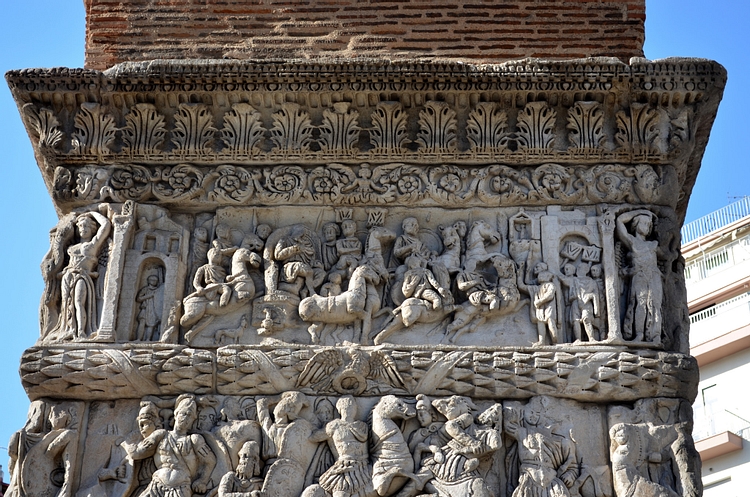 Relief Scenes, Arch of Galerius, Thessalonica Dan Diffendale (CC BY-NC-SA) ](https://www.worldhistory.org/image/5000/relief-scenes-arch-of-galerius-thessalonica/ "Relief Scenes, Arch of Galerius, Thessalonica")The triumphal arch, known today as the Kamara, was built c. 305 CE and still stands as an important city landmark. Originally with eight gates and topped by a dome, today only the large central gate (9.7 metres wide) and one secondary gate (4.85 metres wide) survive. There are relief carvings on its marble pillars which depict scenes from Galerius' military escapades against the Persians. The pillars are joined by a slender brick archway and would have originally had niches with statues above them.
#### Editorial Review
This human-authored definition has been reviewed by our editorial team before publication to ensure accuracy, reliability and adherence to academic standards in accordance with our [editorial policy](https://www.worldhistory.org/static/editorial-policy/).
## Bibliography
- Bagnall, R. et al. *The Encyclopedia of Ancient History.* Wiley-Blackwell, 2012
- [Dimitris, A. *Ancient Greece - Temples & Sanctuaries.* Toubis Editions, 2016.](https://www.worldhistory.org/books/9605409291/)
- [Hornblower, S. *The Oxford Classical Dictionary.* Oxford University Press, 2012.](https://www.worldhistory.org/books/0199545561/)
## About the Author
Mark is WHE’s Publishing Director and has an MA in Political Philosophy (University of York). He is a full-time researcher, writer, historian and editor. Special interests include art, architecture and discovering the ideas that all civilizations share.
## Timeline
- **c. 316 BCE**: [Thessalonica](https://www.worldhistory.org/Thessalonica/) is founded by [Cassander](https://www.worldhistory.org/Cassander/).
- **168 BCE**: [Thessalonica](https://www.worldhistory.org/Thessalonica/) comes under [Roman](https://www.worldhistory.org/disambiguation/Roman/) control.
- **146 BCE**: [Thessalonica](https://www.worldhistory.org/Thessalonica/) is made the captial of the [Roman](https://www.worldhistory.org/disambiguation/Roman/) province of [Macedon](https://www.worldhistory.org/macedon/).
- **250 CE**: [Thessalonica](https://www.worldhistory.org/Thessalonica/) is made a [Roman](https://www.worldhistory.org/disambiguation/Roman/) colony.
- **c. 298 CE**: Galerius builds a [triumphal arch](https://www.worldhistory.org/Triumphal_Arch/) at [Thessalonica](https://www.worldhistory.org/Thessalonica/).
- **305 CE**: [Roman emperor](https://www.worldhistory.org/Roman_Emperor/) Galerius makes [Thessalonica](https://www.worldhistory.org/Thessalonica/) his official residence.
## Cite This Work
### APA
Cartwright, M. (2016, May 01). Thessalonica. *World History Encyclopedia*.
### Chicago
Cartwright, Mark. "Thessalonica." *World History Encyclopedia*, May 01, 2016. .
### MLA
Cartwright, Mark. "Thessalonica." *World History Encyclopedia*, 01 May 2016, .
## License & Copyright
Submitted by [Mark Cartwright](https://www.worldhistory.org/user/markzcartwright/ "User Page: Mark Cartwright"), published on 01 May 2016. The copyright holder has published this content under the following license: [Creative Commons Attribution-NonCommercial-ShareAlike](https://creativecommons.org/licenses/by-nc-sa/4.0/deed.en). This license lets others remix, tweak, and build upon this content non-commercially, as long as they credit the author and license their new creations under the identical terms. When republishing on the web a hyperlink back to the original content source URL must be included. Please note that content linked from this page may have different licensing terms.